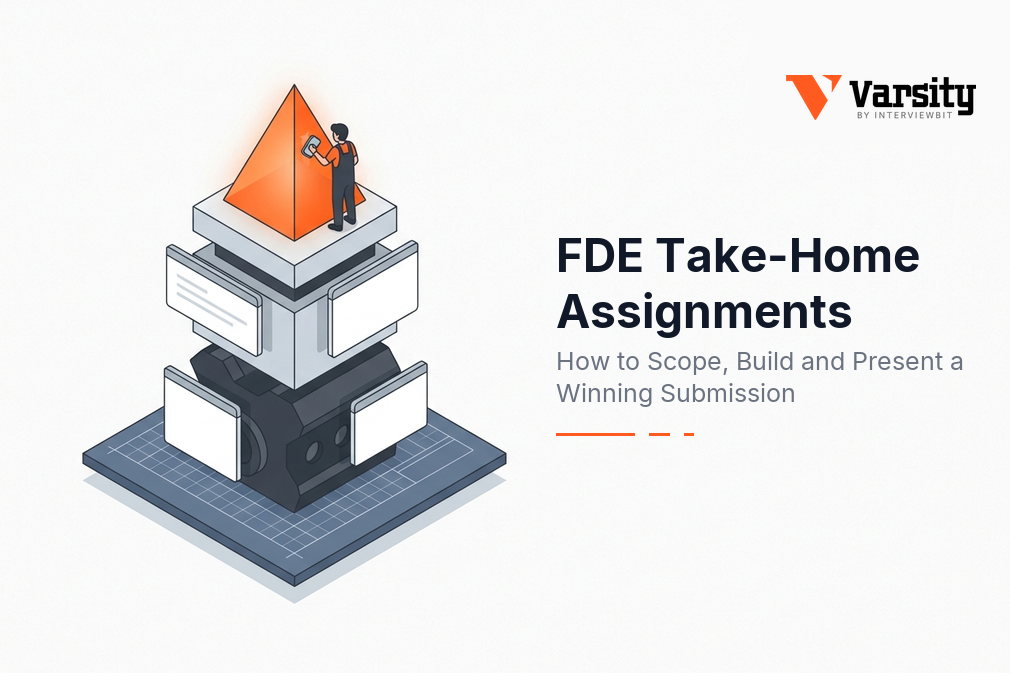
FDE Take-Home Assignments: How to Scope, Build and Present a Winning Submission

Key Insights
- An FDE take-home assignment is less about solving a predefined coding problem and more about turning an ambiguous customer problem into a practical technical solution.
- Start by understanding the user, problem, desired outcome, and constraints before deciding what to build or which technology to use.
- Scope a focused MVP with clear must-haves, assumptions, and success criteria, rather than trying to implement every possible feature.
- Build the core workflow end-to-end first, then use the remaining time for AI enhancements, optimisation, integrations, and other improvements.
- Strong submissions clearly document technical decisions, trade-offs, evaluation, limitations, and how the solution could evolve toward production.
- The final presentation should demonstrate the core workflow and connect technical choices back to customer value, while showing that you can defend your decisions.
FDE Take-Home Assignments: How to Scope, Build and Present a Winning Submission
To ace an Forward Deployed Engineer take-home assignment, treat it as an under-specified customer problem rather than a conventional coding exercise. Instead of simply solving a defined programming task, you need to understand the problem, decide what is worth building within the available time, and turn that scope into a working technical solution.
A strong approach is to think of the assignment as a small customer deployment: define the problem, scope the MVP, build the core workflow, document your decisions, and present and defend the final solution.
This guide walks through that process, from the initial problem statement to the final demo.
What does an FDE Take-Home Assignment Look Like?
An FDE assignment typically combines implementation with problem discovery, prioritisation and communication. The format varies, but the goal is usually to turn a practical customer or business problem into a working solution.
A Customer or Business Problem
The prompt may involve a workflow, customer pain point, AI use case, data problem or automation requirement. Focus first on understanding the underlying problem and desired outcome rather than trying to implement every requirement.
A Working Technical Solution
You may be asked to build a prototype, AI application, RAG system, data pipeline, API or workflow automation. The specific format varies, but the solution should work end-to-end and address the core problem.
A Short Explanation of Your Decisions
Your submission should explain what you built, why you chose the approach, the key trade-offs, what remains incomplete and how you would take the solution toward production. This shows that you can connect technical decisions to customer needs.
How to Scope an FDE Take-Home Assignment?
Scoping is one of the most important parts of FDE interview preparation. A good submission does not try to demonstrate every technology you know. It focuses on solving the most important part of the customer’s problem within the available time.
Start With the User and the Problem
Before writing code, identify who the user is, what problem they are facing, what success looks like and what information or workflow the solution needs. A useful framework is:
User → Problem → Desired outcome → Technical solution
Starting with the user prevents the technology from becoming the objective. The implementation should follow from the problem rather than the other way around.
Separate Must-Haves From Nice-to-Haves
Before building, separate the core requirements from optional features. Must-haves should cover the main user workflow, required data handling and basic evaluation, while nice-to-haves can include extra features, integrations or optimisation.
Define the MVP Before You Build
Define the smallest working version that the interviewer can test and that proves your core technical approach. Build this first, then use any remaining time for improvements.
State Your Assumptions
For ambiguous prompts, document assumptions around data, users, APIs, model capabilities, infrastructure, security and evaluation. This makes your reasoning clear and gives you a basis for explaining how the solution would change if those assumptions changed.
How to Build the Take-Home: MVP First?
Once you have defined the scope, build the core workflow before adding optional features. This ensures you have a working solution even if time runs short.
Build the Core User Flow First
Start with the input, process it, produce the core output and test the complete flow. Avoid spending early time on complex UI, extensive infrastructure or optional integrations. A working end-to-end flow gives you a solid foundation for the final demo.
Add AI Where it Solves a Real Problem
An AI take-home assignment may use AI for classification, extraction, search, summarisation, retrieval or generation. Choose the approach based on the problem, not simply to make the project more AI-heavy. Be ready to explain why the model is needed and how you would handle incorrect outputs.
Add Evaluation and Error Handling
Test how the solution behaves with unexpected inputs, failures and model errors. Where relevant, include basic quality or performance metrics. You do not need production-level monitoring, but you should show that you have considered what happens beyond the ideal workflow.
Make the Architecture Easy to Explain
Keep the architecture simple and focused on the assignment:
User → Application → Backend/API → AI/Data layer → Output
Explain the components that matter and the decisions behind them. Avoid adding complexity that you cannot justify.
How to Document Your FDE Take-Home?
Good documentation makes the problem, solution and key engineering decisions easy to understand without requiring the interviewer to read the entire codebase.
Create a One-Page Executive Summary
A simple structure is:
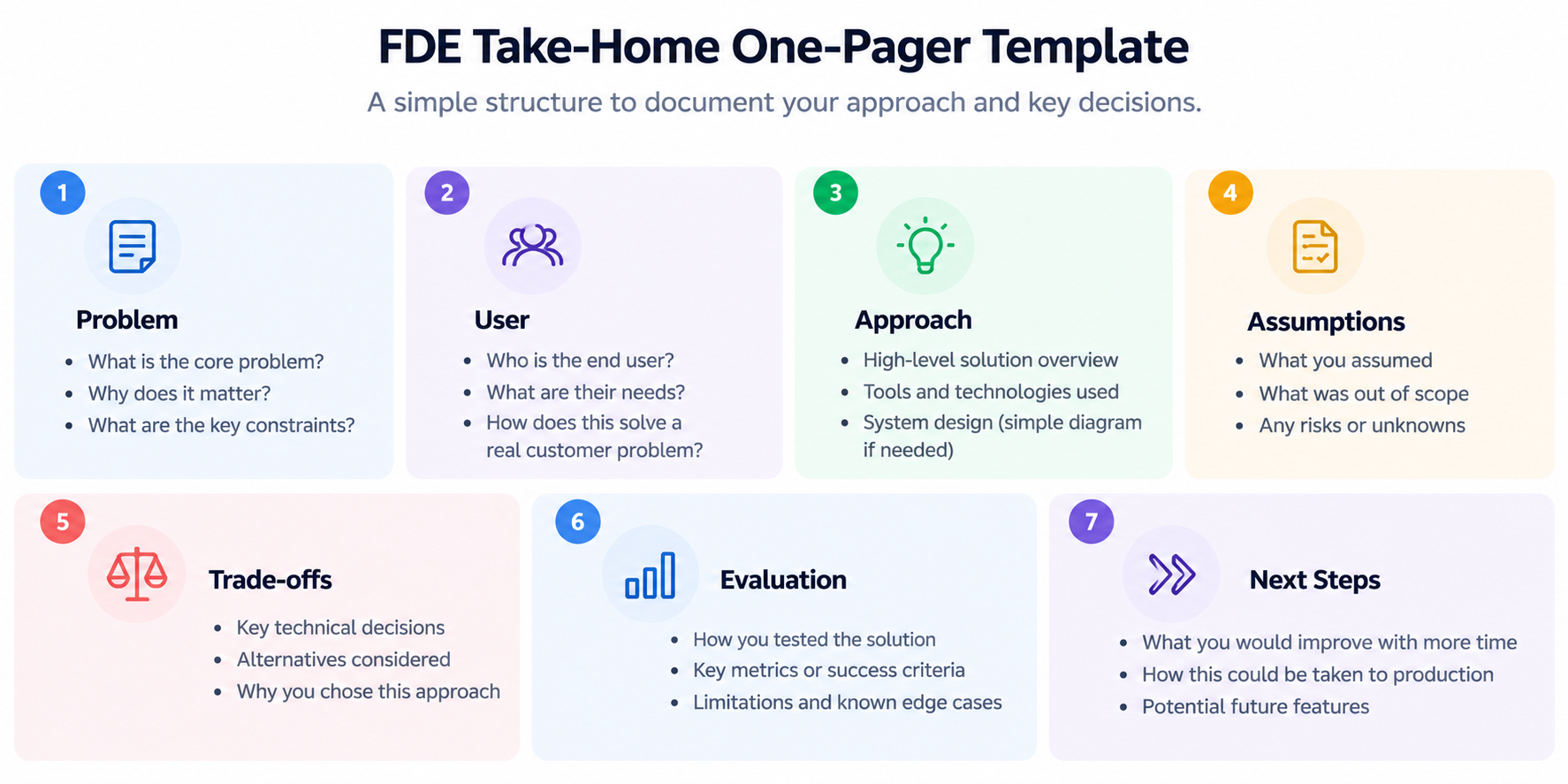
Use it to briefly explain who the solution is for, what you built, how it works, the key assumptions and trade-offs, and what you would build next.
Document Technical Decisions, Not Every Coding Step
Focus on the decisions that demonstrate engineering judgement, such as your choice of architecture, model, data approach, scope and evaluation method. The README should explain how and why the solution works, rather than document your entire development process.
Be Explicit About Trade-Offs
Briefly explain important trade-offs, such as simplicity vs. complexity, accuracy vs. latency, prototype vs. production readiness, or cost vs. model performance. This helps the interviewer understand the reasoning behind your technical choices.
How to Present and Demo Your FDE Take-Home?
A strong FDE take-home presentation should tell a clear story rather than walk through every feature. A simple flow is: Start with the problem and user, demonstrate the core workflow, then briefly explain the architecture, results and limitations before discussing what you would build next.
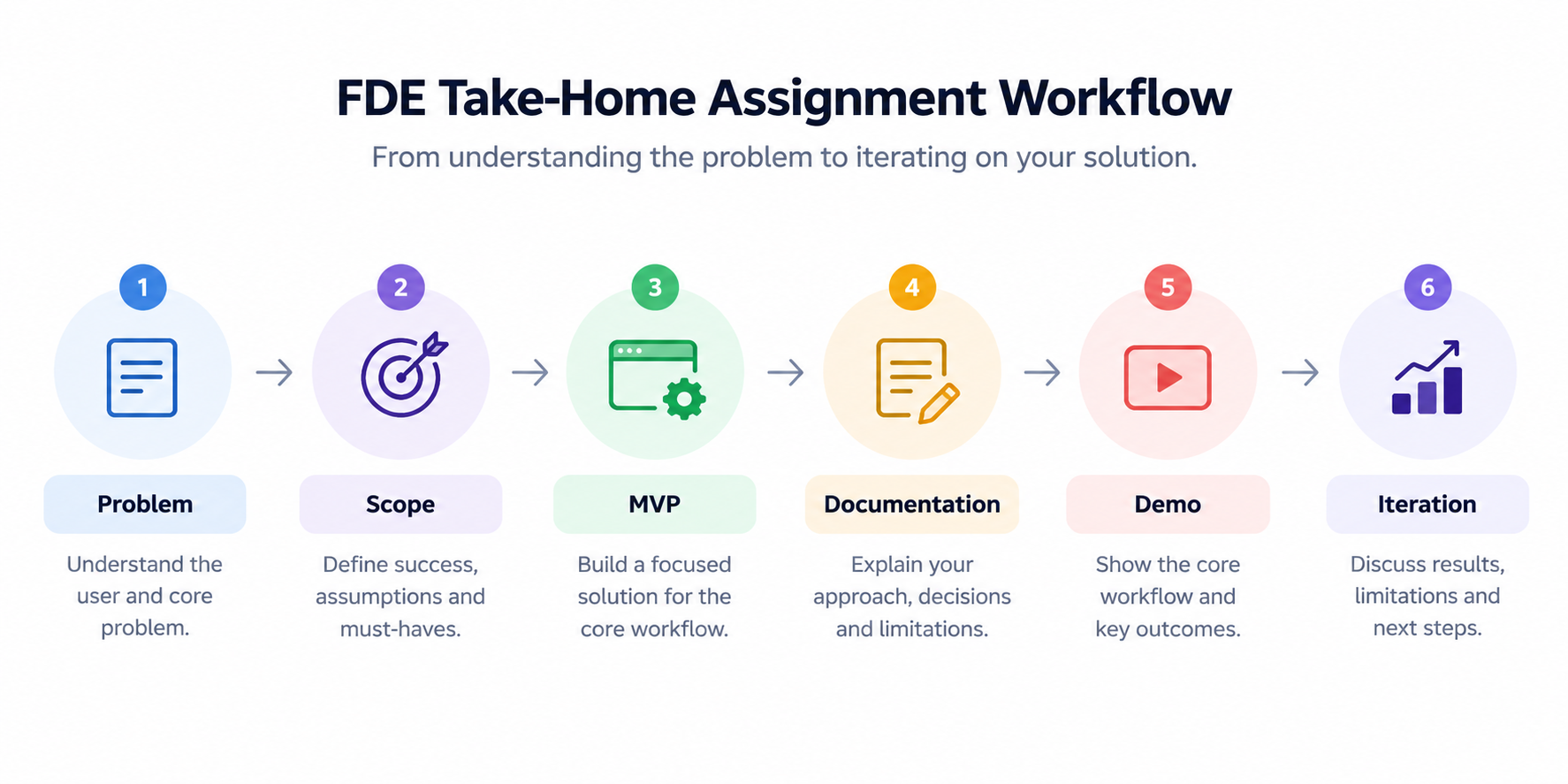
Demo the Core Workflow, Not Every Feature
Focus on the workflow that best shows how your solution addresses the problem. Avoid spending most of the presentation on code, minor UI features or functionality that does not affect the customer’s outcome. The goal is to demonstrate the solution’s value, not the volume of work behind it.
Be Ready to Defend Your Decisions
One should be prepared to explain why they chose the approach, how the solution would behave at 10× the scale, what happens when the model fails, how you would deploy it and how you would evaluate it with real customers. You should also be able to explain what you would change with more time and which assumptions could affect the solution.
How are FDE Take-Home Assignments Evaluated?
The following is a practical FDE interview assessment and take-home assignment rubric, not an official universal hiring rubric. It can be used as a self-review framework before submitting your project.
| Evaluation area | What the candidate should demonstrate |
| Problem understanding | Identifies the core user or business problem |
| Scope | Prioritises an achievable MVP |
| Technical execution | Builds a functional and coherent solution |
| Engineering judgement | Explains sensible technical trade-offs |
| AI/data reasoning | Uses AI or data techniques appropriately |
| Reliability | Considers errors, edge cases and limitations |
| Documentation | Clearly communicates architecture and decisions |
| Presentation | Demonstrates the solution clearly |
| Customer thinking | Connects technical decisions to user outcomes |
| Extensibility | Explains realistic next steps toward production |
FDE Take-Home Assignment Examples and Prompts
The best way to prepare for an FDE take-home is to practise problems that require you to move from an ambiguous requirement to a working solution. The following examples reflect the kinds of AI, data and customer-focused problems you may encounter.
Disclaimer : They are practice prompts, not actual employer interview questions.
Prompt 1 — Build an AI Tool for a Customer Workflow
You may be asked to build a customer-request processing tool using an Express API within three to five hours. The tool should turn an unstructured request into a structured action, while leaving you to decide how to handle edge cases, failures and retries.
Example Prompt: Build a working customer-request processing tool using an Express API within three to five hours. Define how the system handles edge cases and failures, and explain how you would evaluate the quality of its output.
A strong submission should demonstrate problem scoping, AI integration, workflow design, error handling and basic evaluation.
Prompt 2 — Build a RAG System from Messy Documents
Another of the FDE project examples could involve building a RAG system from inconsistent customer documents. The challenge is not only retrieving information but ensuring that the final response remains grounded in the available data.
Example Prompt: Build a RAG application that allows users to ask questions about a collection of inconsistent customer documents and returns answers grounded in the retrieved information.
A strong submission should demonstrate document ingestion, retrieval, grounded responses, handling of messy inputs and basic evaluation.
Prompt 3 — Rebuild an AI Workflow for a Regulated Customer
You may also be asked to adapt an AI workflow for a regulated customer such as a bank or hospital, where data handling, reliability and auditability become important constraints.
Example Prompt: Rebuild an AI-assisted workflow for a regulated customer and explain the controls and design choices required before the workflow can be deployed.
A strong submission should demonstrate data handling, access controls, failure modes, auditability and responsible AI considerations.
Prompt 4 — Audit an LLM Application for Security Risks
An AI engineering take-home could also focus on evaluating an existing LLM application rather than building one from scratch. The task would require you to identify security risks, test them and recommend practical mitigations.
Example Prompt: Audit an existing LLM application for prompt injection, data leakage and unsafe outputs. Create tests to identify key risks and recommend mitigations before deployment.
A strong submission should demonstrate threat identification, testing, mitigation, documentation and risk prioritisation.
FDE Take-Home Assignment Checklist
Before You Build
Define the user, core problem, success criteria, assumptions and MVP. Separate must-haves from optional features.
Before You Submit
Make sure the core workflow works end-to-end, key edge cases are tested, and the architecture, decisions, limitations and next steps are documented clearly.
Before You Present
Be ready to explain the problem, architecture and key decisions simply, along with what you would change with more time and how the system handles failures.
Conclusion
An FDE technical assignment is ultimately about turning an ambiguous customer problem into a focused, working technical solution. Practice moving from problem definition to scope, MVP, implementation, documentation and presentation. Then focus on explaining why each decision was made rather than simply demonstrating how much you built.
A strong FDE submission combines technical execution with problem-solving, scoping and customer-focused thinking. AI Forward Deployed Engineering by IIT Delhi is designed to build these skills through hands-on AI projects and industry-focused capstones.
Frequently Asked Questions
How long should I spend on an FDE take-home assignment?
Follow the employer’s time limit and prioritise a complete, working MVP over unnecessary features or extensive optimisation.
Should I build everything mentioned in the prompt?
No. Prioritise the requirements that directly address the core problem and clearly explain which features you left out and why.
Should I use AI or an LLM in an FDE take-home?
Use AI when it solves a meaningful part of the problem. Avoid adding an LLM simply to make the project appear more advanced.
What should I include in an FDE take-home README?
Include the problem, approach, architecture, key decisions, evaluation, limitations, setup instructions and next steps.
What questions can I expect after presenting an FDE take-home?
Expect questions about architecture, scaling, reliability, security, model choice, evaluation, trade-offs and what you would change with more time.
What if the FDE take-home assignment has unclear requirements?
Start by defining the problem, success criteria and assumptions yourself. Document any important ambiguity rather than waiting for every requirement to be clarified.
Do I need to deploy my FDE take-home project?
Not always. If deployment is expected, provide a working deployed version; otherwise, make the project easy to run locally and clearly explain what would be required for production deployment.
What should I do if I cannot finish the entire FDE take-home?
Prioritise a working core solution and clearly document unfinished features, limitations and what you would build next. A focused submission is more useful than leaving the main workflow incomplete.
Should I include tests in my FDE take-home assignment?
Yes. Include tests for the core workflow and important edge cases. For AI applications, also consider testing incorrect, unexpected or unsupported inputs and explaining how you evaluate the output quality.
What happens after submitting an FDE take-home assignment?
In FDE interview questions, you may be asked to walk through the solution and defend your technical decisions in a follow-up discussion. Be prepared to explain your scope, architecture, trade-offs, failures and how you would adapt the solution to changing customer requirements.