Supply Chain Management: The Bullwhip Effect, Risk, and the AI Fix

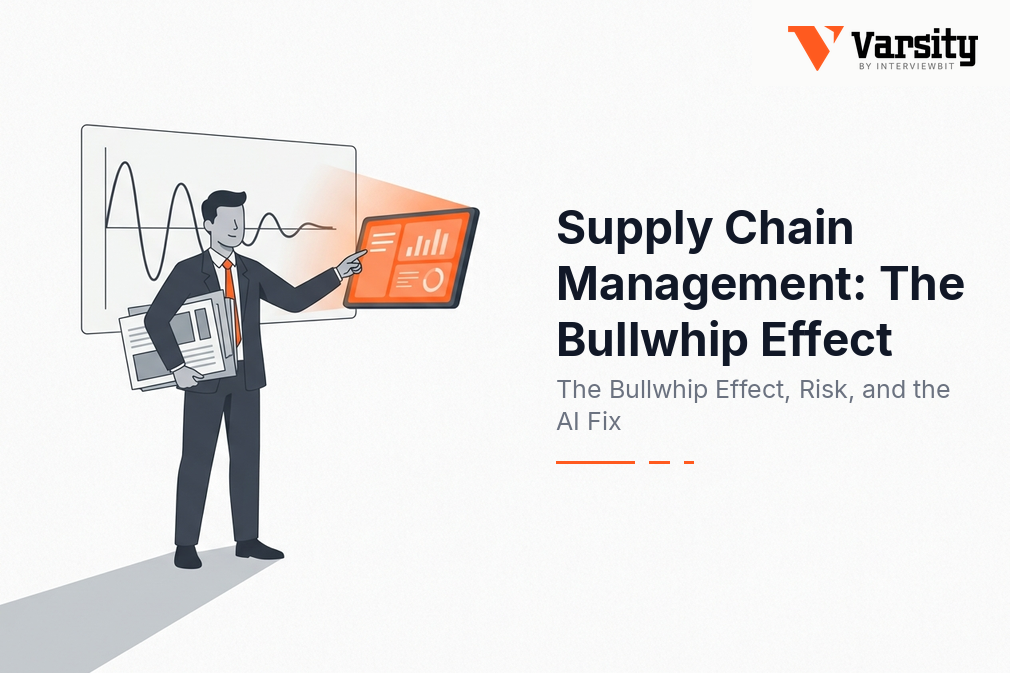
Remember the toilet paper panic of 2020? People weren’t actually using more toilet paper, stuck at home, most households used roughly the same amount they always had. But retailers saw a spike in buying, over-ordered from distributors to be safe, distributors over-ordered from manufacturers to be safe, and manufacturers ramped up production based on orders that were already wildly inflated by everyone else’s caution. By the time the dust settled, factories were producing more toilet paper than the actual, unchanged demand ever called for.
That’s a textbook case of the bullwhip effect, one of supply chain management’s oldest, best-documented problems, and it’s a genuinely useful way into this entire topic, because it shows exactly why supply chains are hard: not because any single company makes a bad decision, but because good, locally rational decisions at every stage compound into a genuinely irrational result for the whole system.
This is the complete guide to supply chain management in the AI era, what the discipline covers, the classic problems that have plagued it for decades, bullwhip effects, disruption risk, sustainability pressure, and what’s actually changing now that AI systems are starting to sense, predict and in some cases act on supply chain decisions with less and less human hand-holding in between.
What Is Supply Chain Management?
Supply chain management is the coordination of every activity involved in turning raw materials into a finished product and getting it to a customer, sourcing, production, inventory, transportation, and the relationships connecting every company involved along the way. If you want the full breakdown, the standard SCOR framework and how the discipline is structured, that’s covered in depth in a separate guide. This one goes deeper into three problems every supply chain professional eventually runs into, and how AI is changing the answer to each.
The Bullwhip Effect: Why Small Demand Changes Cause Big Supply Chain Swings
The term itself comes from Procter & Gamble in the early 1990s. P&G’s logistics executives noticed something strange while reviewing order data for Pampers: retail sales of diapers were fluctuating only mildly, which made sense, babies don’t suddenly need more diapers because of a sale. But distributor orders swung far more wildly, and P&G’s own orders to raw-material suppliers like 3M swung more wildly still. MIT Sloan’s original writeup of the phenomenon, based on research by Hau Lee and colleagues at Stanford, documented exactly how demand variability amplifies at every step moving upstream, away from the end customer.
Four causes show up again and again in the research on this: demand forecasting errors that compound as each link guesses at what the next link will order, order batching (ordering in large, infrequent batches rather than small, frequent ones, to save on ordering costs), price fluctuations and promotions that pull future demand forward artificially, and rationing or shortage gaming, where buyers inflate orders during a shortage because they expect to only get a fraction of what they ask for.
The 2020 toilet paper story fits the pattern almost exactly, and it’s worth noting the original phenomenon Jay Forrester documented at MIT in the 1960s wasn’t really about diapers or toilet paper at all, it’s a structural property of any multi-step supply chain running on imperfect information, which is precisely why it keeps recurring across totally unrelated industries and decades.
AI’s biggest lever against the bullwhip effect is remarkably unglamorous: shared, real-time demand data. When every link in the chain sees actual point-of-sale data instead of inferring demand from the next link’s orders, most of the distortion simply has nowhere to compound from. Machine learning forecasting models trained on that shared signal, rather than each company’s own siloed guess, are a direct, practical attack on a problem that’s been costing companies money since long before anyone called it “AI.”
Supply Chain Risk Management in the AI Era
Supply chain risk management is the discipline of identifying, assessing and mitigating anything that could disrupt the flow of goods, a supplier going bankrupt, a geopolitical event closing a border, a factory fire, a cyberattack on a logistics partner. It’s not a niche specialty anymore. Swiss Re estimates that global supply chain disruptions cost businesses roughly $184 billion a year, and McKinsey’s research found that a single major disruption can wipe out up to 42% of a company’s annual EBITDA for companies without diversified sourcing.
| Risk category | What it covers | Example |
| Supply risk | A supplier’s ability to deliver on time, at quality, at all | A key component supplier goes bankrupt or loses a factory |
| Demand risk | Sudden, unpredictable shifts in customer demand | A product goes unexpectedly viral, or demand collapses in a downturn |
| Operational risk | Internal process failures | A warehouse system outage, a quality control breakdown |
| Geopolitical / environmental risk | External shocks outside any company’s control | Tariffs, port closures, extreme weather, war |
| Cyber risk | Digital attacks on supply chain systems | Ransomware hitting a logistics provider’s tracking system |
AI is changing risk management from a periodic audit exercise into something closer to continuous monitoring. Supplier risk scores can now update automatically based on financial signals, news mentions, and delivery-performance data, rather than a spreadsheet reviewed once a year. Predictive disruption alerts pull in weather forecasts, shipping data and even news sentiment to flag a brewing problem, a storm building near a key port, before it becomes a missed shipment. And scenario simulation, running a digital model of the network against a hypothetical disruption, lets a company stress-test its supply chain before reality does it for them.
Sustainable Supply Chain Management
Sustainable supply chain management integrates environmental, social and governance considerations directly into sourcing, production and logistics decisions, not as a side initiative, but as a factor weighed alongside cost and speed. It matters more than most people assume: EcoVadis’s research (based on an IBM-commissioned survey) found that Scope 3 supply chain emissions, everything a company’s suppliers and value chain produce, run on average 26 times higher than a company’s own direct operational emissions. And yet only 38% of businesses currently measure that footprint at all. Most companies’ biggest environmental impact is sitting almost entirely outside their own walls, and largely unmeasured.
• AI-powered carbon tracking estimates emissions per shipment, per route or per supplier, replacing rough, spend-based estimates with something closer to an actual measurement.
• Route and load optimisation, the same techniques covered in dedicated logistics coverage, cuts fuel use and emissions as a direct side effect of cutting cost, a rare case where the sustainability goal and the cost goal point the same direction.
• Supplier ESG scoring using AI to scan news, regulatory filings and compliance reports at scale, flagging red flags, forced labour risk, environmental violations, far faster than a manual annual audit ever could.
• Waste and overproduction prediction, since less waste is both a cost win and an emissions win simultaneously, one of the few places sustainability and margin genuinely align rather than trade off.
Putting It Together: What an Autonomous Supply Chain Actually Looks Like
Layer these three threads, bullwhip-reducing shared demand data, continuous risk monitoring, and real-time sustainability scoring, on top of the demand forecasting and inventory systems already covered elsewhere, and a genuinely different kind of supply chain starts to take shape. Not one where AI makes every decision unsupervised, but one where the sensing and analysis happen continuously and automatically, freeing human judgement for the calls that genuinely need it, which supplier relationship to prioritise, which risk to accept, which trade-off between cost and emissions actually fits the company’s values.
That’s the realistic version of “autonomous supply chain,” not a system nobody’s watching, but one where a lot less of the watching has to be done manually, by a person, on a schedule.
Building Toward This: A Practical Starting Point
1. Run a supplier risk audit first. You can’t monitor continuously what you haven’t mapped at least once, manually, to start.
2. Establish an emissions baseline, even a rough, spend-based one. You can’t reduce what you’ve never measured, and right now most companies genuinely haven’t.
3. Push for real-time data sharing with your closest supply chain partners. This single step does more to dampen the bullwhip effect than almost any forecasting model applied after the fact.
4. Pilot one predictive-risk use case on a narrow, well-understood category before rolling anything out network-wide.
5. Keep a human explicitly accountable for every category of automated decision, cost thresholds, supplier flags, emissions trade-offs, so nothing genuinely important runs entirely unsupervised.
FAQs
What is supply chain management?
Supply chain management is the coordination of sourcing, production, inventory, transportation and delivery activities involved in getting a product from raw material to a customer, spanning every company involved in that journey.
What is the bullwhip effect?
The bullwhip effect is a phenomenon where small fluctuations in end-customer demand become progressively larger swings in orders as they move upstream through a supply chain, from retailer to distributor to manufacturer to raw material supplier, driven by forecasting errors, order batching, promotions and shortage gaming.
What is supply chain risk management?
Supply chain risk management is the process of identifying, assessing and mitigating threats that could disrupt the flow of goods, including supplier failure, demand shocks, operational breakdowns, geopolitical events and cyberattacks.
What is sustainable supply chain management?
Sustainable supply chain management integrates environmental and social considerations, emissions, ethical sourcing, waste reduction, into sourcing, production and logistics decisions, rather than treating cost and speed as the only factors that matter.
How does AI reduce the bullwhip effect?
AI reduces the bullwhip effect primarily by enabling real-time, shared demand data across supply chain partners, so each link forecasts from actual customer demand rather than inferring it from the next link’s already-distorted orders, cutting off the amplification at its source.
What is an autonomous supply chain?
An autonomous supply chain is one where AI systems continuously sense conditions, forecast demand, monitor risk and optimise decisions, acting automatically within limits set by the organisation, rather than relying on periodic, manual review at every step.
Wrapping Up
The bullwhip effect, supply chain risk, and sustainability pressure aren’t new problems AI happened to show up for. They’re the same structural challenges supply chain professionals have wrestled with for decades, information distortion, disruption exposure, and impact that’s hard to see, let alone measure. What’s changed is the ability to actually see all three continuously instead of catching them in a quarterly review, which is a meaningfully different kind of supply chain to run, even before you get to the question of what to automate.