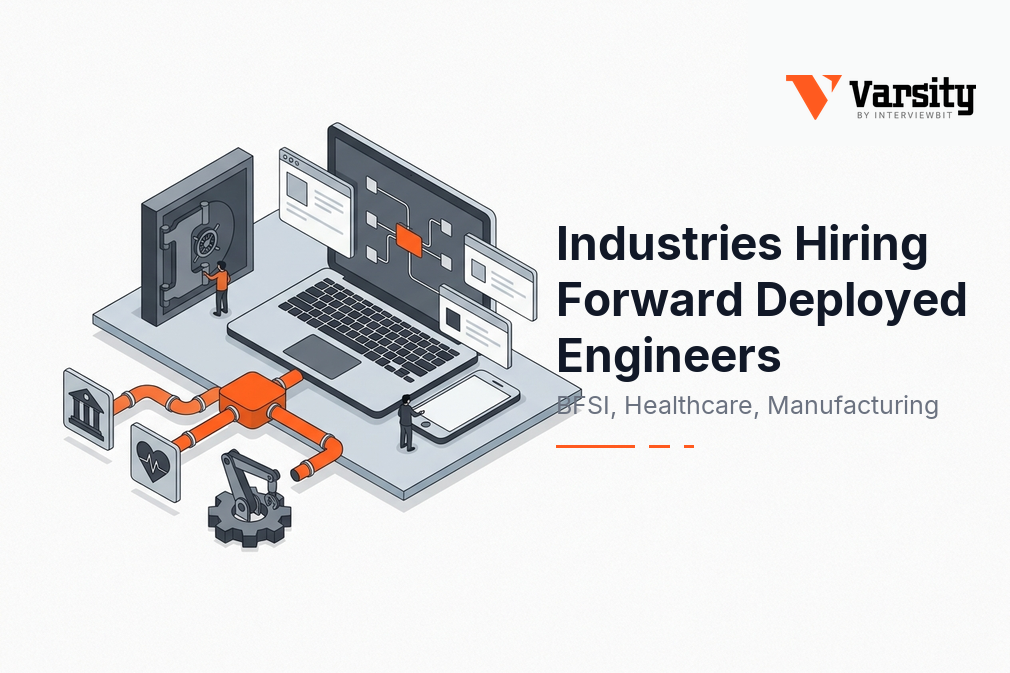
Which Industries Hire the Most Forward Deployed Engineers? BFSI, Healthcare, Manufacturing

Key Insights
- Growing demand: FDE skills help businesses move AI applications from prototypes into production.
- Top industries: BFSI, healthcare, manufacturing, retail, telecommunications, GCCs, cybersecurity, enterprise SaaS, consulting, and logistics.
- Core responsibilities: Building AI solutions, integrating systems, automating workflows, and deploying applications in real business environments.
- Essential skills: Python, APIs, RAG, databases, cloud deployment, system integration, testing, and monitoring.
- Industry-specific challenges: Data privacy in BFSI and healthcare, legacy systems in manufacturing, and data consistency in retail and logistics.
- Career preparation: Build an industry-specific project that demonstrates working integrations, production readiness, and measurable business outcomes.
The industries where Forward Deployed Engineering (FDE) skills are relevant include banking and financial services (BFSI), healthcare, manufacturing, retail, telecommunications, cybersecurity, enterprise software, and logistics. Global Capability Centres (GCCs) and consulting firms also offer opportunities to build and deploy AI solutions for business use.
Forward Deployed Engineers work with customers to solve practical problems through software development, AI integration, and system deployment. Their work can include automating workflows, connecting existing systems, and adapting AI applications to real business requirements.
Job availability and requirements vary by employer. Relevant opportunities may also appear under titles such as Applied AI Engineer, AI Implementation Engineer, and Forward Deployed Software Engineer.
In this guide, we explore 10 industries where FDE skills are applied, their key AI use cases, the technical skills required, and the challenges engineers may face during deployment.
FDE salary & ROI calculator
Is FDE training worth it for you?
See what Forward Deployed Engineers with a profile like yours typically earn in India, and how quickly a programme fee is covered.
Indicative ranges based on public, self-reported salary data. Not a prediction or guarantee of your pay.
How this is calculated
- Typical Forward Deployed Engineer pay in India is about ₹10–30 LPA, blended from salaries people report on Glassdoor and Levels.fyi. The middle of the market sits around ₹15–18 LPA; the top quarter reaches about ₹42 LPA.
- Your experience places you in the lower (0–2 years), middle (3–6 years) or upper (7+ years) part of that range.
- Your current role and company type refine where you sit. Roles closer to FDE work rank higher: software engineering, then data/ML, solutions or customer engineering, DevOps/cloud, implementation or IT consulting, QA, and non-engineering roles last. By company type: product or MNC highest, GCC about 5% below that, startups about 7% below GCC, IT services about 10% below startups. That puts GCC about 20% above IT services, in line with reports that GCCs pay up to 20% more.
- Likely first move: moving into a new, AI-heavy role usually brings a bigger raise than a like-for-like job switch, and one move closes part of the gap to the middle of your range. Small gaps close almost fully; large gaps close up to a limit set by your background: up to +55% from product or MNC companies (employers in India expect AI-skilled workers' pay to rise 54%+), +50% from GCCs, +45% from startups and +40% from IT services. Roles further from FDE work reach a smaller share of that limit, from 100% for software engineering down to 72% for non-engineering roles. Everyone below the top of the all-India range gets at least 40% of their limit (it tapers off above your own range), and no estimate goes past the all-India top of ₹30 LPA.
- Fee covered in: the programme fee divided by the extra monthly pay (before tax) from that first move.
Sources
- Glassdoor India: Forward Deployed Engineer salariesAverage total pay ≈ ₹14.6 LPA (base ₹9–18 LPA + about ₹2 LPA variable); highest reported ≈ ₹22 LPA
- Levels.fyi: Forward Deployed Engineer, IndiaMedian ≈ ₹17.6 LPA; 25th percentile ≈ ₹16 LPA; 75th percentile ≈ ₹42 LPA; 90th percentile ≈ ₹46 LPA
- Michael Page India Salary Guide 2026 (reported by Outlook Business)Job-switch raises up to 30% in AI and other high-demand fields; 9.1% market average
- foundit Appraisal Survey 2026 (reported by Business Today)20% expect a 40%+ hike when switching jobs
- AWS, Accelerating AI Skills: Preparing the Asia-Pacific Workforce (reported by Outlook Business)Employers expect AI-skilled workers' salaries to rise 54% or more
- TeamLease Digital, Digital Skills & Salary Primer FY2025 (reported by People Matters)GCCs pay up to 20% more than IT services companies
- IIT Delhi AI Forward Deployed Engineering programme page₹1,65,000 + 18% GST = ₹1,94,700
Keep in mind
- Forward Deployed Engineer is a new title in India, so salary samples are still small.
- Figures are total compensation before tax, not in-hand pay.
- Figures are based on market benchmarks for Forward Deployed Engineer roles across India.
Why are More Industries Hiring Forward Deployed Engineers?
Businesses are moving beyond AI experiments and looking for applications that work reliably in real operating environments. These projects often involve existing databases, legacy software, sensitive information, and complex business processes.
FDEs help bridge the gap between AI capabilities and practical business requirements. They work with customers to understand problems, build tailored solutions, connect systems, test results, and improve applications after deployment.
According to Indeed data reported by The Indian Express, Forward Deployed Engineer job postings in India increased by 1,807% between June 2025 and June 2026. Postings later moderated but remained well above the previous year’s levels. This reflects growth in advertised positions, not the number of people hired or the total number of vacancies.
Which Industries Hire Forward Deployed Engineers?
FDE skills apply wherever businesses need engineers to build and deploy solutions around specific operational problems. The following ten industries offer relevant use cases, although actual demand varies by employer and role.
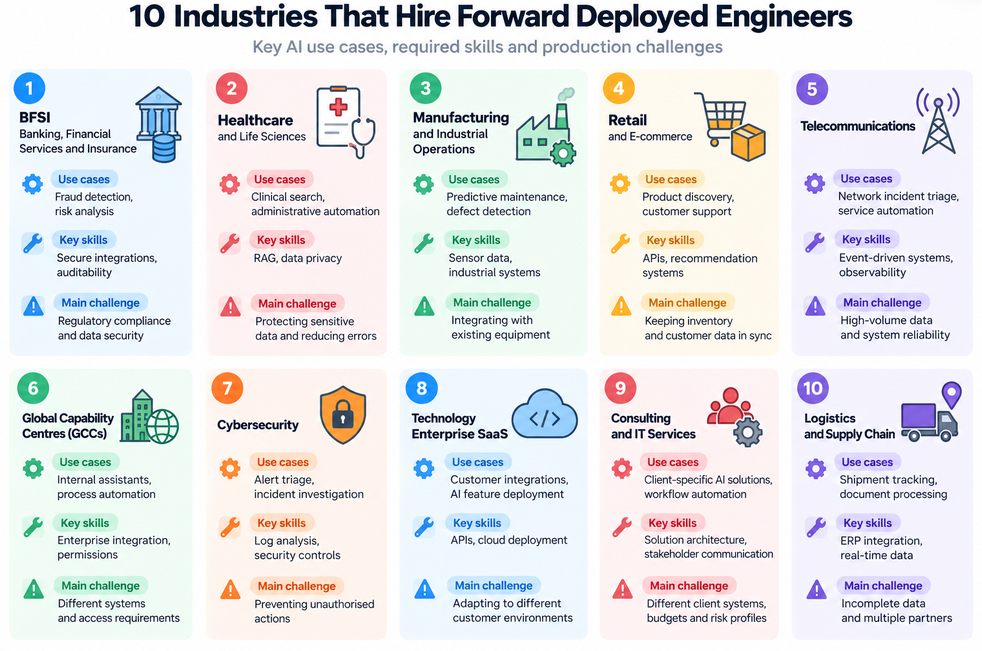
1. Banking, Financial Services and Insurance (BFSI)
Banks, insurers, and financial technology companies manage large volumes of financial data, documents, transactions, and regulatory requirements. FDEs can build AI applications that improve these workflows while maintaining appropriate controls.
Key use cases
- Fraud detection and risk analysis
- Financial document processing
- Customer support automation
- Compliance and reporting assistance
Skills required: Python, APIs, secure data integration, retrieval-augmented generation (RAG), auditability, and access controls.
Main challenge: Protecting sensitive financial data while ensuring that outputs are accurate, traceable, and compliant with applicable requirements.
2. Healthcare and Life Sciences
Healthcare organisations work with clinical documents, patient records, research data, and administrative workflows. FDEs can develop applications that help professionals retrieve information and reduce repetitive work.
Key use cases
- Clinical document search
- Medical knowledge assistants
- Administrative workflow automation
- Research information retrieval
Skills required: Data integration, RAG, evaluation, privacy controls, and secure application development.
Main challenge: Preventing unsupported AI outputs and protecting sensitive information. Clinical applications also require appropriate human oversight and validation.
3. Manufacturing and Industrial Operations
Manufacturers use connected equipment, production systems, maintenance records, and sensor data. FDEs can integrate these systems with AI applications to help teams identify problems and make operational decisions.
Key use cases
- Predictive maintenance
- Defect detection
- Production monitoring
- Maintenance knowledge assistants
Skills required: Python, time-series data, industrial system integration, APIs, and machine learning.
Main challenge: Connecting modern AI applications to existing industrial equipment without disrupting operations.
4. Retail and E-commerce
Retailers handle product catalogues, inventory, customer interactions, and order data. FDEs can develop applications that improve customer service and help teams make faster operational decisions.
Key use cases
- Product discovery and recommendations
- Inventory forecasting support
- Customer service agents
- Returns and order management automation
Skills required: APIs, databases, recommendation systems, data pipelines, and workflow orchestration.
Main challenge: Keeping product, inventory, customer, and order information consistent across multiple systems.
5. Telecommunications
Telecommunications companies manage network infrastructure, service requests, customer data, and technical incidents. FDEs can build tools that help teams investigate issues and automate routine processes.
Key use cases
- Network incident triage
- Customer support automation
- Service ticket resolution
- Operational monitoring
Skills required: API integration, event-driven systems, log analysis, observability, and workflow automation.
Main challenge: Processing large volumes of operational data while maintaining reliability and responding to issues quickly.
6. Global Capability Centres (GCCs)
Global Capability Centres (GCCs) manage technology, analytics, operations, and business functions for multinational companies. Their projects may involve building internal AI tools and connecting applications across global teams.
Key use cases
- Internal knowledge assistants
- Finance and HR automation
- Enterprise AI applications
- Document and process automation
Skills required: Enterprise integration, identity management, data governance, cloud platforms, and application development.
Main challenge: Deploying solutions across teams with different permissions, workflows, systems, and compliance requirements.
7. Cybersecurity
Security teams investigate alerts, examine logs, and respond to potential threats. FDEs can build applications that help analysts retrieve evidence, organise investigations, and automate selected security workflows.
Key use cases
- Security alert triage
- Threat intelligence summarisation
- Incident investigation support
- Security operations automation
Skills required: Python, log analysis, security APIs, access controls, evaluation, and monitoring.
Main challenge: Preventing unauthorised actions and ensuring that AI-generated findings can be checked before consequential decisions are made.
8. Technology and Enterprise SaaS
Software companies often need to adapt their products to different customer environments. FDEs can help integrate product features, deploy AI applications, and resolve technical problems that arise during implementation.
Key use cases
- Customer-specific integrations
- Enterprise onboarding
- AI feature deployment
- Data migration and workflow automation
Skills required: Software engineering, APIs, SDKs, cloud deployment, debugging, and multi-tenant architecture.
Main challenge: Meeting customer requirements without creating fragile customisations that become difficult to maintain.
9. Consulting and IT Services
Consulting firms and IT services companies help clients modernise systems and implement new technology. FDE-style engineers can contribute by building and deploying applications rather than stopping at recommendations.
Key use cases
- Client-specific AI applications
- Legacy system integration
- Workflow redesign
- Business process automation
Skills required: System design, software development, requirements discovery, cloud platforms, and stakeholder communication.
Main challenge: Delivering solutions across client environments with different budgets, infrastructure, priorities, and risk requirements.
10. Logistics and Supply Chain
Logistics businesses coordinate shipments, warehouses, suppliers, inventory, and delivery schedules. FDEs can integrate operational data to help teams identify delays and automate repetitive processes.
Key use cases
- Shipment exception handling
- Document processing
- Inventory insights
- Operations support
Skills required: ERP integration, APIs, data pipelines, optimisation, and workflow automation.
Main challenge: Handling incomplete or delayed information across multiple partners, systems, and operational locations.
Which Companies should you Check for Forward Deployed Engineer Jobs?
Candidates can explore AI companies, enterprise software providers, data platforms, and consulting firms for Forward Deployed Engineer (FDE) and related roles.
- AI companies: OpenAI Careers, Anthropic Careers, Google Careers.
- Data and enterprise software: Databricks Careers, Salesforce Careers, ServiceNow Careers.
- Consulting and technology services: Accenture Careers, Deloitte Careers, EY Careers, PwC Careers.
These are potential employers to investigate, not confirmation that every company currently has an FDE vacancy in India. Search each careers page using terms such as Forward Deployed Engineer, Applied AI Engineer, Forward Deployed Software Engineer, and AI Implementation Engineer. Check the location, responsibilities, and experience requirements listed for each opening.
What Skills do Forward Deployed Engineers Need?
FDEs need to combine engineering fundamentals with the ability to understand customer problems and deliver working solutions.
| Skill area | What to learn |
|---|---|
| Programming | Python, data structures, debugging, testing |
| AI engineering | LLM APIs, RAG, tool calling, evaluation |
| System integration | REST APIs, databases, authentication, data pipelines |
| Deployment | Cloud platforms, containers, CI/CD, monitoring |
| Reliability and security | Logging, access controls, error handling, testing |
| Customer collaboration | Requirements gathering, technical communication, problem-solving |
Not every role requires every skill. Requirements depend on the employer, industry, and type of application being deployed.
How much do Forward Deployed Engineers Earn in India?
Forward Deployed Engineer salaries in India vary by experience, employer, location, and technical responsibilities. A July 2026 report by Moneycontrol, citing TeamLease Digital, reported these indicative annual salary ranges:
| Experience level | Reported annual salary |
|---|---|
| Entry-level | INR 18-25 lakh |
| Mid-level | INR 30-45 lakh |
| Senior-level | INR 50-85 lakh or more |
Note: These are reported salary estimates, not guaranteed offers or market-wide averages. Actual compensation may vary, and total compensation can include bonuses or equity. Compare figures with current job postings and check whether they refer to base salary or total compensation.
How can you Prepare for an Industry-Specific FDE Career?
A strong portfolio should demonstrate that you can solve a practical problem, integrate systems, and account for production constraints.
- Choose an industry: Start with BFSI, healthcare, manufacturing, or another sector you understand.
- Identify a specific problem: For example, searching technical documents or processing shipment exceptions.
- Build a working application: Use Python, APIs, databases, and relevant AI techniques such as RAG or tool calling.
- Integrate real data sources: Demonstrate how the application handles missing information, failed requests, and inconsistent data.
- Add production controls: Include testing, logging, access permissions, monitoring, and human review where necessary.
- Measure performance: Document accuracy, latency, cost, limitations, and the business outcome you intend to improve.
- Explain your decisions: Describe the architecture, trade-offs, risks, and improvements you would make next.
The IIT Delhi AI Forward Deployed Engineering programme includes vertical-focused learning and capstone tracks. Review the programme curriculum to see whether its learning structure fits your goals.
Conclusion
Forward Deployed Engineering brings together software development, applied AI, system integration, and customer collaboration. Banking, healthcare, manufacturing, retail, cybersecurity, enterprise software, and logistics all offer potential applications for these skills.
To prepare, build strong engineering fundamentals, learn the workflows and constraints of one industry, and develop a project that demonstrates reliable implementation. Focus on the problems you can solve rather than relying on a job title alone.
Want to develop practical AI engineering skills? Explore the IIT Delhi AI Forward Deployed Engineering programme and review its curriculum, projects, and eligibility requirements.
Frequently Asked Questions
1. Can software engineers transition into Forward Deployed Engineering without an AI degree?
Yes. Software engineering experience can provide a useful foundation. Candidates should also demonstrate applied AI knowledge, system integration, deployment skills, and the ability to work directly with customers.
2. How can I tell whether an FDE role involves coding or consulting?
Look for responsibilities such as writing production code, building integrations, debugging applications, and deploying systems. Roles focused mainly on recommendations and project coordination may be closer to traditional consulting.
3. Do Forward Deployed Engineers need to travel to customer sites?
Some roles require customer-site visits, while others are remote or hybrid. Check the vacancy for travel expectations, location requirements, and customer engagement responsibilities.
4. How does an FDE role differ from a solutions architect role?
Solutions architects generally focus on technical design and architecture recommendations, although some roles include implementation. FDE positions typically emphasise hands-on development and delivering working solutions in customer environments.
5. What should an FDE portfolio project demonstrate?
It should show the business problem, architecture, data integrations, evaluation method, security controls, deployment process, and known limitations. A working demonstration alone provides limited evidence of production readiness.
6. Can an FDE build AI agents without training a model from scratch?
Yes. Many applications use existing foundation models through APIs. The engineering work may involve tool integration, retrieval, workflow orchestration, evaluation, security, and deployment rather than model training.
7. How should I measure the business impact of an FDE project?
Choose a measurable outcome related to the original problem, such as reduced processing time, fewer unresolved tickets, improved retrieval quality, or lower manual effort. Establish a baseline and explain how the result was measured.
8. Are FDE salaries comparable across employers?
Not necessarily. Compare role seniority, location, experience requirements, base salary, variable pay, equity, and travel expectations. Small samples and inconsistent job titles can make salary estimates difficult to compare.
9. How can I find FDE jobs when companies use different job titles?
Search for Forward Deployed Engineer, Applied AI Engineer, Forward Deployed Software Engineer, AI Implementation Engineer, and relevant Solutions Engineer roles. Review responsibilities instead of relying only on the title.
10. What makes an enterprise AI application production-ready?
It needs appropriate access controls, testing, monitoring, error handling, evaluation, cost management, and a process for handling failures. Useful outputs alone do not establish that an application is safe or reliable enough for production.
11. Which industries require the strongest data privacy controls?
Healthcare, financial services, and cybersecurity often handle sensitive information. The exact requirements depend on the data, jurisdiction, application, and intended use.
12. What should I learn before building an industry-specific AI application?
Start with programming, APIs, databases, testing, and basic cloud deployment. Then learn the relevant AI techniques alongside the target industry’s workflows, data requirements, security controls, and operational constraints.