How Standard Operating Procedures Power AI Workflows in Modern Organizations

How Standard Operating Procedures Power AI Workflows in Modern Organizations
SOP is one of those acronyms everyone nods along to in meetings without necessarily being sure what it expands to. So let’s just get it out of the way in the first line, since that’s mostly why you’re here.
SOP stands for Standard Operating Procedure, a documented, step-by-step set of instructions for carrying out a routine task the same way, every time, regardless of who’s doing it.
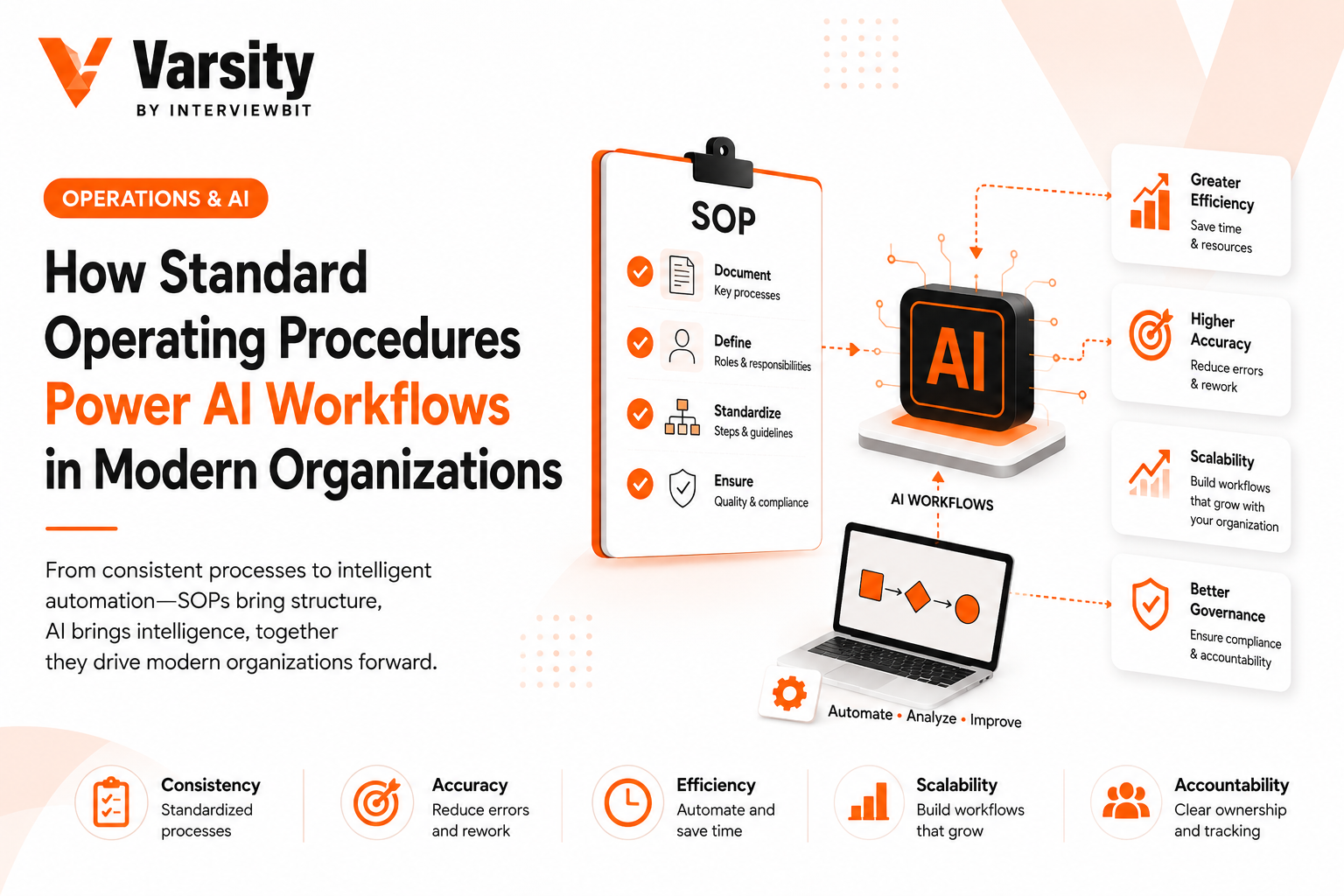
That’s the boring part. The interesting part, and the reason this document is suddenly getting a lot more attention than it used to, is that SOPs have quietly become the raw material AI systems run on inside a company. Every AI agent that books a refund, triages a support ticket, or drafts a compliance report is really just executing somebody’s SOP, except now the somebody is a language model instead of a new hire on their third week.
This piece covers what SOP actually means (including the mix-up with the other SOP, more on that shortly), how it’s different from a policy or a process, and the real reason it’s become the backbone of AI-powered operations rather than a dusty PDF nobody opens.
What Does SOP Stand For?
Quick disambiguation before we go further, because “sop full form” actually pulls two very different crowds. If you landed here from a college application context, you probably want Statement of Purpose, the essay you write for a university admission. Different animal entirely, and not what this article is about.
If you landed here from a workplace, a job description, or an ISO audit checklist, the answer is Standard Operating Procedure, and that’s the one we’re sticking with for the rest of this.
An SOP is a written, repeatable set of instructions an organisation uses so that a task gets done the same way no matter who’s doing it, a new hire, a night-shift employee, or, increasingly, an AI agent that doesn’t take tea breaks.
SOP Full Form in a Company: What It Actually Means at Work
Inside a company, an SOP usually shows up as a document (or these days, a wiki page) covering things like refund processing, employee onboarding, incident response, or how to close the books at month-end. ISO 9001 essentially requires documented procedures like these for any organisation chasing quality certification, which is a big part of why SOPs exist in the first place, not because someone loves paperwork.
The point of an SOP was never to make work feel bureaucratic, even though it often achieves exactly that. The actual point is consistency. If your refund policy depends on which support agent happens to pick up the ticket, you don’t have a policy, you have a mood. SOPs remove the mood.
Three things a decent SOP typically nails down: who owns the task, the exact sequence of steps to follow, and what to do when something doesn’t go according to plan. That last one, the exception-handling bit, is the part most companies skip and the part AI systems need the most. We’ll get to why.
SOP vs Policy vs Process vs Work Instruction
| Term | What it actually is | Example |
| Policy | The rule, the why. Sets boundaries, doesn’t tell you how | “Refunds are allowed within 30 days” |
| Process | The high-level flow of how work moves end to end | Customer requests refund → verified → approved → paid out |
| SOP | The exact, step-by-step how, written so anyone can follow it | “Open ticket, verify order ID, check date, click Approve, log reason code” |
| Work instruction | An even more granular, often single-task version of an SOP | “How to fill the refund reason-code field in this specific tool” |
People use these four words interchangeably all the time, and honestly, in casual conversation it barely matters. It starts mattering a lot once you’re trying to hand a process off to an AI agent, because the agent needs the SOP layer specifically. Feed it a policy and it knows the rule but not the steps. Feed it a vague process diagram and it’ll happily improvise the missing details, confidently and often wrongly.
Why SOPs Are Suddenly the Backbone of AI-Powered Operations
Here’s the part that made this a genuinely interesting topic to write about instead of a dry compliance explainer. McKinsey’s State of AI 2025 survey found that 88% of organisations now use AI in at least one business function. Adoption isn’t the bottleneck anymore. The bottleneck, according to the same body of research, is that companies keep bolting AI onto workflows that were never actually written down properly, and then wondering why the agent keeps doing something slightly, infuriatingly wrong.
An AI agent, unlike a new employee, cannot sit next to a senior colleague for two weeks and absorb the unwritten rules by osmosis. It has no tenure, no gut feeling, no memory of that one time a refund request seemed sketchy for reasons nobody could quite articulate. All it has is what’s written down. If the SOP is vague, the agent doesn’t ask a clarifying question in the hallway. It just picks something and does it, with total confidence, which is precisely the problem.
This is why SOPs have effectively become the input spec for AI-powered operations. Every serious agentic AI rollout eventually runs into the same wall: the model is smart enough, the tooling works, but the underlying procedure it’s meant to follow was always a bit fuzzy, tribal knowledge sitting in someone’s head or scattered across old Slack threads. Turning that fuzziness into a clean SOP is, more often than not, the actual unlock, not a bigger model.
How SOPs Actually Power AI Workflows
Breaking this down into the three jobs an SOP does once AI enters the picture, because it’s doing more than one thing at once:
| Role | What it means in practice |
| The instruction set | The SOP text becomes the agent’s context or system prompt, the literal words it’s told to follow |
| The guardrail | Explicit “never do this” and “always escalate when this happens” clauses stop the agent from improvising in risky territory |
| The audit trail | When an agent acts, someone eventually asks why. “It followed SOP v4.2, step 6” is a real answer. “The model thought it seemed right” is not |
Notice that none of these three jobs are new. SOPs did all of this for human employees long before anyone was talking about AI agents. What’s changed is the tolerance for ambiguity. A human employee who hits a gap in the SOP usually pauses and asks someone. An AI agent, unless you’ve specifically built in that pause, just keeps going. So the ambiguity that a company could quietly live with for years suddenly becomes very visible, very fast, the moment you hand the same document to a machine.
A Worked Example: Turning a Refund SOP Into an AI Workflow
Nothing clarifies this like actually watching it happen, so here’s a simplified before-and-after.
The old, human-only SOP, roughly paraphrased from what a hundred companies have written at some point:
- Check if the order is within the 30-day window.
- Check if the item was used or damaged.
- If both checks pass, approve the refund.
- If unsure, ask a manager.
Perfectly usable by a human. A trained support agent reads “if unsure, ask a manager” and knows exactly what that means in practice, based on months of context nobody wrote down. An AI agent reads the same line and has no idea what “unsure” is supposed to mean, because unsure isn’t a variable it can check.
The AI-ready version of the same SOP, rewritten with the agent in mind:
| Step | AI-ready instruction |
| 1 | Pull order date. If more than 30 days from today, deny automatically and send the standard denial template. |
| 2 | Check item condition field. If marked ‘damaged’ or ‘used’ by the customer’s own description, flag for human review, don’t auto-approve. |
| 3 | If order is within 30 days AND item condition is ‘unopened’ or ‘unused’, approve automatically up to ₹5,000. Above that, route to a human. |
| 4 | Log the decision, the reason code, and the SOP version number against the ticket, every single time, no exceptions. |
Same underlying policy. Completely different level of precision. That gap, between “ask a manager if unsure” and an actual, checkable threshold, is basically the entire difference between an SOP that works for AI-powered operations and one that just sits there generating confused support tickets.
What Happens When You Skip This Step
Skip the rewrite and hand an AI agent a vague SOP anyway, and here’s roughly what happens, based on how this plays out in practice more often than vendors like to admit.
The agent fills gaps with its own judgement, which is sometimes fine and sometimes spectacularly not, and you won’t know which until a customer complains or an auditor asks.
- Every wrong decision looks confident, because the model doesn’t flag its own uncertainty unless you’ve explicitly built that in. It just answers.
- In regulated spaces like finance, healthcare or insurance, an undocumented decision path isn’t just messy, it’s a compliance finding waiting to happen. Regulators tend to ask “why did this happen” and “the AI decided” is not an answer anyone accepts.
- Fixing it after the fact costs more than writing it properly the first time would have, which is the case for basically every corner ever cut in the history of corners.
Writing an SOP That’s Actually AI-Ready
A handful of principles that separate an SOP an agent can actually follow from one that just looks tidy in a shared drive:
- Replace judgement calls with checkable conditions. “If unsure” becomes “if the flagged field equals X.” Vague words are where agents quietly go off-script.
- Write the exception path, not just the happy path. What happens when the input is missing, malformed, or contradicts itself? If the SOP doesn’t say, the agent will decide for you, and not always well.
- Name a human escalation point explicitly, with a real threshold. “Above ₹5,000, route to a human” works. “Use discretion for large amounts” does not.
- Version and date every SOP. Agents don’t know a document is outdated unless you tell the system which version is current. Silent drift between the written SOP and the actual policy is how audits go badly.
- Keep it in plain, literal language. SOPs written for AI consumption benefit from being almost boringly explicit, the kind of writing a very literal-minded intern would appreciate. Because that’s roughly what you’re writing for.
Who’s Actually in Charge: The SOP Author or the Agent?
Worth saying plainly, since it’s easy to lose track of in all the automation talk: the SOP author is still the one accountable. The agent executes; it doesn’t own the decision. If an AI-driven refund process goes wrong, “the model did it” has never once held up as an explanation to a customer, a regulator, or a board.
This is exactly the kind of judgement call product managers and operations leads end up owning once AI enters a workflow, deciding where the human checkpoint sits, not just whether one exists. Human-in-the-loop isn’t a compliance checkbox, it’s the actual design decision that determines whether your AI-powered operation is trustworthy or just fast.
This also isn’t a one-off documentation exercise. It’s closer to a structured analytical discipline, define the procedure, test it against edge cases, watch how the agent actually behaves, then revise. SOPs written for AI get outdated faster than SOPs written for humans, mostly because AI exposes gaps in the document that humans were quietly patching over with common sense for years.
What is the full form of SOP?
SOP stands for Standard Operating Procedure, a documented set of step-by-step instructions for carrying out a task consistently. In a college-admissions context, the same acronym also means Statement of Purpose, a different document entirely.
What does SOP full form mean in a company?
In a workplace, SOP always means Standard Operating Procedure. It refers to the written instructions employees (and increasingly AI systems) follow to complete a recurring task the same way every time.
What is the difference between an SOP and a process?
A process is the high-level flow of how work moves from start to finish. An SOP is the detailed, step-by-step instruction for actually doing it, precise enough that someone with no prior context could follow it correctly.
Can AI write SOPs?
AI can draft a first version quickly from a description of the task, which is genuinely useful. But someone who actually knows the process needs to review it, since AI-written SOPs tend to sound polished while quietly missing the messy exception cases that matter most.
Do AI agents replace the need for SOPs?
The opposite, if anything. AI agents make bad SOPs painfully obvious, because a human can quietly fill gaps with judgement and an agent usually can’t. Deploying AI in a workflow tends to force companies to finally write down what was always tribal knowledge.
How often should SOPs be updated in an AI-driven organisation?
More often than the old annual-review habit suggests. Since agents follow the document literally, any drift between the written SOP and actual policy shows up as real errors fast, not as a slowly ageing PDF nobody notices.
Conclusion
SOPs used to be filed away and reopened twice a year, usually right before an audit. That era is over. The moment a company hands a process to an AI agent, the SOP stops being a formality and becomes the literal thing the agent is running on, word for word.
Write it clearly, with real thresholds instead of vague judgement calls, and the AI workflow built on top of it behaves. Write it loosely, the way most SOPs have quietly been written for decades, and you’ll find out exactly how loose it was, usually from a customer complaint or an auditor’s question, not from a comfortable internal review.
If you’re the one being asked to design these AI-powered workflows rather than just read about them, Scaler’s online PGP in Business & AI is built around exactly this kind of work, translating messy real-world operations into decisions, processes and systems that actually hold up, with mentors who’ve done it for a living.