AI Agents for Marketing: How Agentic AI Runs Campaigns, Bidding and Lifecycle

Your win-back campaign has a problem it was never designed to solve: the customer who does not behave as expected.
They have not purchased in months, so the automation sends the usual win-back email. But what if they’ve opened every email without buying? What if they were a high-value customer who suddenly turned unresponsive? Or what if the usual discount is the wrong move this time?
Your automation can only follow the paths someone has built for it. AI agents for marketing take a different approach. Give an agent a goal and the right permissions, and it can figure out what needs to happen next, use the tools available to it, and adapt to what it finds along the way.
What Are AI Agents for Marketing?
An AI agent for marketing is software that can work toward a marketing goal without being told exactly what to do at every step, using the data and tools available to it. Unlike a fixed workflow, it can respond to what it finds along the way, while staying within the set goals, and permissions.
How an AI Agent Differs From the Marketing Automation You Already Have
Traditional marketing automation follows predefined rules, while an AI agent can decide what to do next based on the situation. The key difference is that an agent can adapt within the goals and limits set by a marketer.
The Limits of Traditional Rule-Based Automation
The marketing tools most teams already use are good at repeating the same steps whenever a trigger occurs: send an email, move a customer to the next stage, or adjust a campaign based on a predefined rule. The problem starts when something falls outside those rules, whether a customer behaves unexpectedly or the timing changes.
The workflow can only follow its existing logic, so it may take the wrong path or stop until someone steps in.
What the Same Journey Looks Like With an AI Agent
[Alt text: Marketing team reviewing campaign performance data on a laptop during a discussion.]
Take a win-back email sent to a customer who has not been responsive. Today: something notices the customer has stopped buying, a rule sorts them into a group, a fixed email goes out at a fixed time, and anything unusual gets set aside for a human to deal with later.
Now picture an agent doing the same job. It notices the customer has gone quiet, looks at whatever information it’s permitted to access, such as past purchases and lifetime spend.
It can then work out which message and channel fits the situation within limits a marketer has agreed to. It writes the message in the brand’s tone and can send it if that action is within its permissions.
If something falls outside what it’s allowed to decide alone, such as spending above a threshold, an uncertain tone or a flagged customer, it stops and passes the decision to a person instead of guessing.
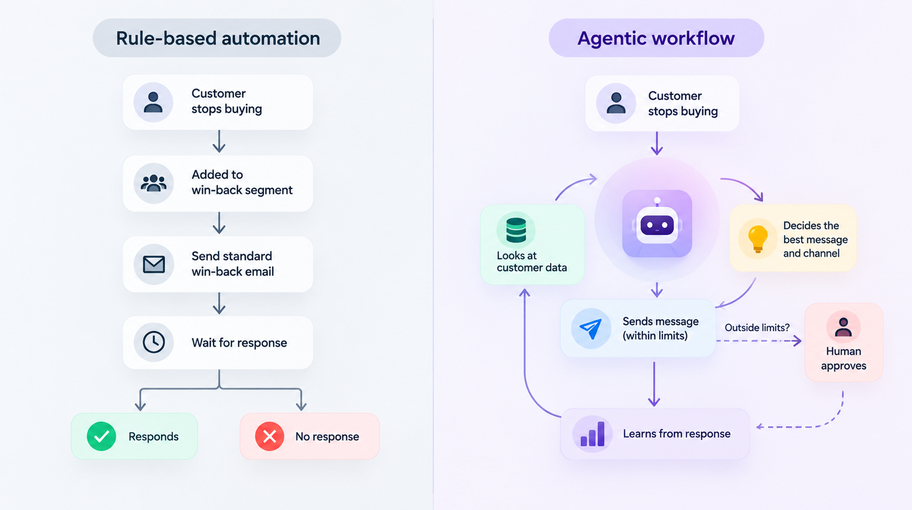
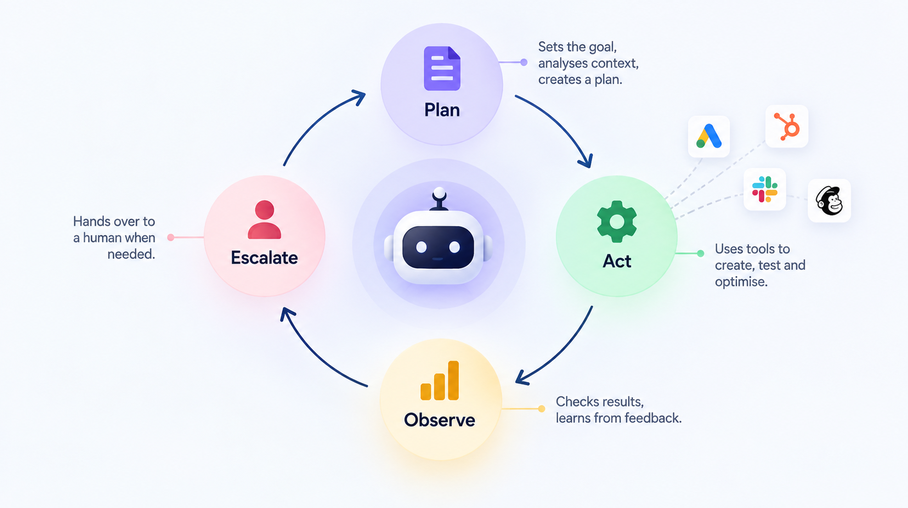
The basic idea is a loop: set the goal, make a plan, act, see what happened, and either continue or hand the decision to a person.
| Aspect | Traditional Automation | An Agent |
| What sets it off | A fixed event, like a signup or abandoned cart | A signal the agent interprets |
| Who decides what happens next | The marketer, ahead of time | The agent, within set limits |
| When something unusual happens | Follows a predefined branch or waits for human review | Assesses the situation and escalates when it exceeds its limits |
| A situation nobody planned for | Breaks the flow or follows a fallback rule | Checks the situation against its limits, then acts or hands off |
| Where the person’s effort goes | Building the rules beforehand | Setting goals, approving consequential actions and handling edge cases |
Where AI Agents Can Make a Difference in Marketing
AI agents are most useful where marketing involves repeated decisions, multiple tools and changing signals. Today, the clearest opportunities are campaign orchestration, paid-media optimisation, lifecycle journeys, and marketing operations.
Campaign Planning and Orchestration
An agent can take a campaign goal and help turn it into a sequence of marketing tasks. It can draft a brief, pull in permitted information and coordinate actions across channels and tools.
IBM’s overview of AI agents in marketing describes similar uses. A marketer still approves the strategy, audience, budget and message before consequential actions go live.
Paid-Media Bidding and Creative Testing
Paid advertising involves repeated decisions around budgets, bids, audiences and creative performance. That makes it a potential area for agentic workflows. These systems can monitor those signals and recommend or make permitted changes within limits a marketer has set. Because a wrong decision can cost money quickly, budget authority and escalation thresholds should remain explicit.
Lifecycle and CRM Journeys
As in the win-back example above, agents can adapt customer journeys based on available signals rather than following a fixed decision tree. They can choose the next step within set limits, while sensitive customer information, significant discounts and other high-consequence actions stay subject to human approval.
Content and Reporting Ops
An agent can draft different versions of copy using brand guidelines, pull together a performance report, organise information from connected systems, or flag something unusual for a marketer to look into. A person still sets the quality bar, approves brand-sensitive content and decides what the data actually means.
Which Marketing Workflows Are Ready for an AI Agent?
The best workflows for an AI agent are frequent, measurable and well documented, with clear limits on what the system can change. Work involving irreversible or high-cost decisions should keep a human in the approval loop.
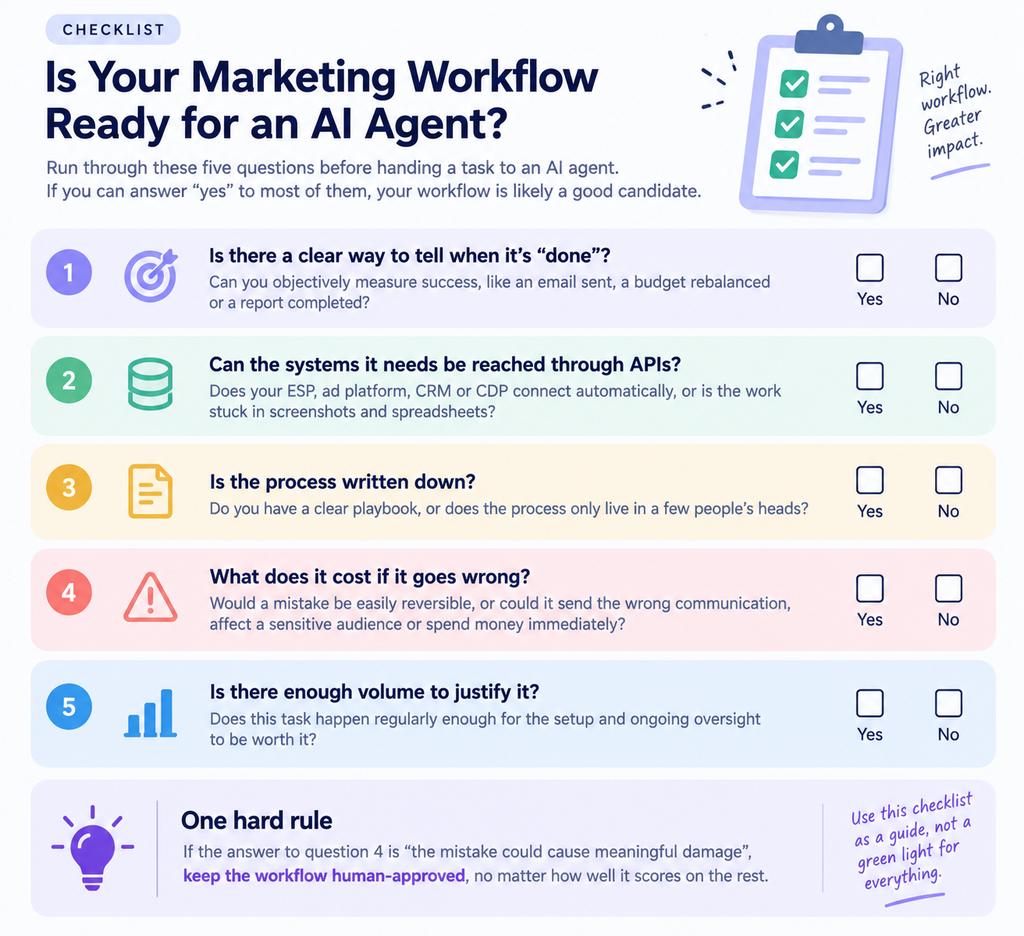
- Is there a clear way to tell when it’s done? For example, an email sent, a report completed or a budget rebalanced.
- Can the agent access the systems it needs? Does your ESP, ad platform or CDP connect through an API, or is someone still copying information between spreadsheets and screens?
- Is the process documented? Or does it depend on things only one or two people know?
- What happens if it goes wrong? Can you fix the mistake, or has money already been spent?
- Does this happen often enough to justify an agent? If the task is rare, setting one up and overseeing it may not be worth the effort.
Don’t forget the hard rule: if a workflow fails the fourth question, keep a person in the approval loop, regardless of how well it performs on the others. A wrong email can be corrected. Money that has already been spent cannot.
The Risks of Letting an Agent Work
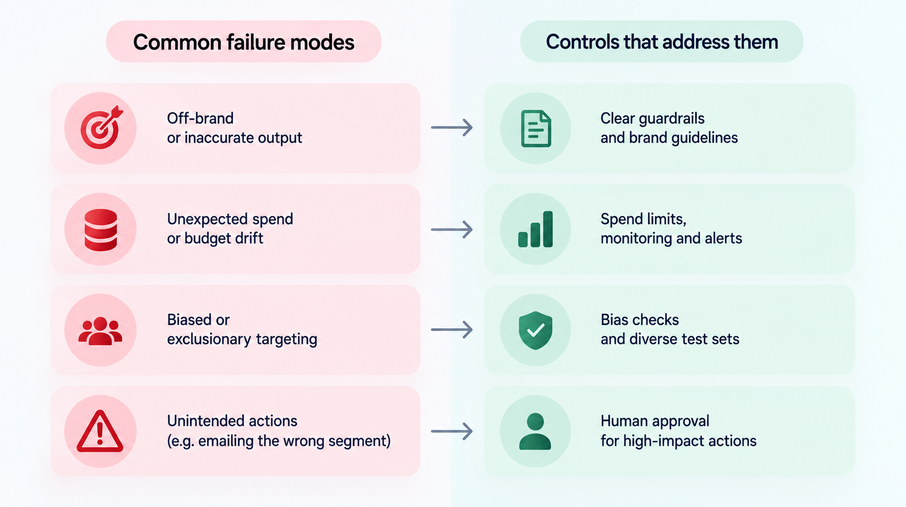
The biggest risks come from giving an agent too much freedom without enough oversight. Marketing teams need controls around content, audiences, spending, data and connected tools.
The NIST AI Risk Management Framework is a useful, vendor-neutral starting point for thinking about how these systems should be managed.
- Small mistakes piling up: Build a rollback path so one wrong move doesn’t trigger several more.
- Off-brand copy going out: Require human approval for content that affects brand voice.
- The audience growing beyond the intended group: Set clear audience limits and check them regularly.
- Money being spent without a clear explanation: Keep a record of the agent’s decisions and actions.
- A connected tool changes and the workflow breaks: Assign someone to monitor the workflow and handle issues.
How AI Agents Could Change the Marketing Role
The role changes from doing campaign work by hand to deciding what needs to be done, overseeing the work and checking the results.
Planning a campaign or customer journey still needs human judgment. So does knowing what fits the brand, understanding customer data and deciding what good work looks like.
Marketers will also need to set clear goals, decide what should and shouldn’t be left to the system, check its work and make changes when needed.
Getting Started With AI Agents in Marketing (No Coding Required)
You don’t need to build an AI agent from scratch to start using one. Begin with a repeatable workflow, map where decisions happen, and identify what the agent can access or change.
- Understand how an agent works.
Start by learning how it differs from a fixed workflow and what it can do on its own. - Pick one process you already run.
Map it from start to finish and identify where it could handle the work and where you’d still need to step in. - Try a small task yourself.
Build a simple automation to understand how the tools, data and actions fit together. - Know what to ask about the tools you use.
Find out what data the system can access, what it can change, how permissions work, what gets recorded and when a person needs to approve something.
AI agents won’t replace the need for marketers to make decisions. But they will change how some of that work gets done. Knowing where an agent can help, where it needs limits and when a person needs to step in will become an important part of using these tools well.
Ready to put AI and Agentic AI into your marketing workflows? Learn how to apply agentic AI to real-world marketing use cases, from campaign planning and bidding to lifecycle journeys, with the IIM Tiruchirappalli Certificate in AI-Powered Marketing & Growth Strategy on Varsity by InterviewBit.
Frequently Asked Questions
Can AI agents do marketing?
Yes. AI agents can handle tasks such as campaign planning, content creation, performance analysis and customer journeys.
What are some examples of AI agents for marketing?
Examples include campaign, audience segmentation, content, personalisation and performance optimisation agents.
What are the main types of AI agents in marketing?
Marketing agents can be designed for different functions, including campaign planning, content creation, personalisation, optimisation and reporting.
Can AI agents manage paid advertising campaigns?
Yes. They can monitor performance, analyse bids and budgets, and make permitted campaign adjustments within set limits.
Are AI agents the same as chatbots?
No. Chatbots mainly respond to conversations, while AI agents can pursue goals, use tools and take actions within defined permissions.
Do AI agents need human approval?
Not for every action. Marketers can allow low-risk decisions while requiring approval for high-impact actions such as major spending or sensitive content.