AI Marketing Automation: Workflows, Tools and Real Use Cases

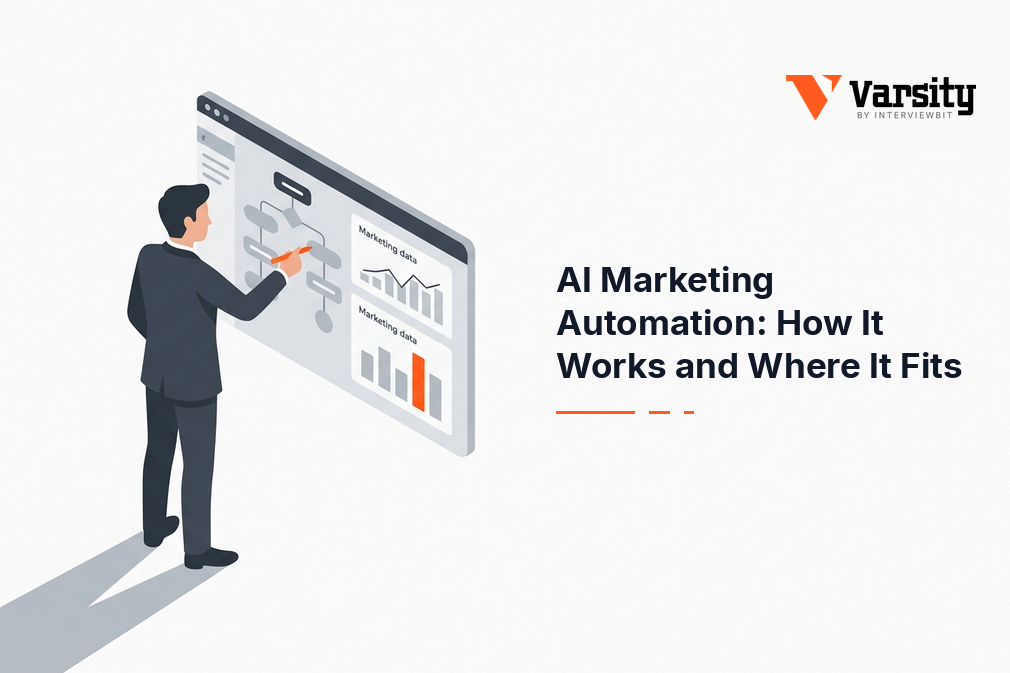
Marketers have been running automation for years without any AI in it at all. A welcome email fires when someone signs up, a reminder goes out when a cart sits abandoned, a lead enters a nurture sequence after filling out a form.
What’s changed is how much AI now sits inside those same tools: the email platform, the CRM, the ad manager. So what does “AI marketing automation” actually mean, and where does it stop?
It isn’t handing an entire campaign over to a system that runs on its own.
Mostly, it’s about making the automation you already have pay closer attention to what’s actually happening.
Here’s the practical difference: instead of treating every customer who hits a trigger the same way, the system can look at their behaviour and make smaller calls, what they see, when they see it, which segment they belong in, whether they even look like they’re going to convert.
That’s also roughly where AI agents come in, which we’ll get to, because they go a step further than this.
What Is AI Marketing Automation?
AI marketing automation uses AI for prediction, personalisation and generative content within automated marketing workflows, making them more responsive than fixed rules alone. A marketer still has to design and supervise the flow. It upgrades existing email, lifecycle, advertising and lead-scoring automation rather than giving an autonomous agent control of the entire journey.
IBM’s overview of AI marketing automation covers similar applications, including customer analysis, segmentation and campaign optimisation. The technology is therefore less about replacing automation and more about adding another layer of decision-making to it.
How It Differs From the Marketing Automation You Already Have
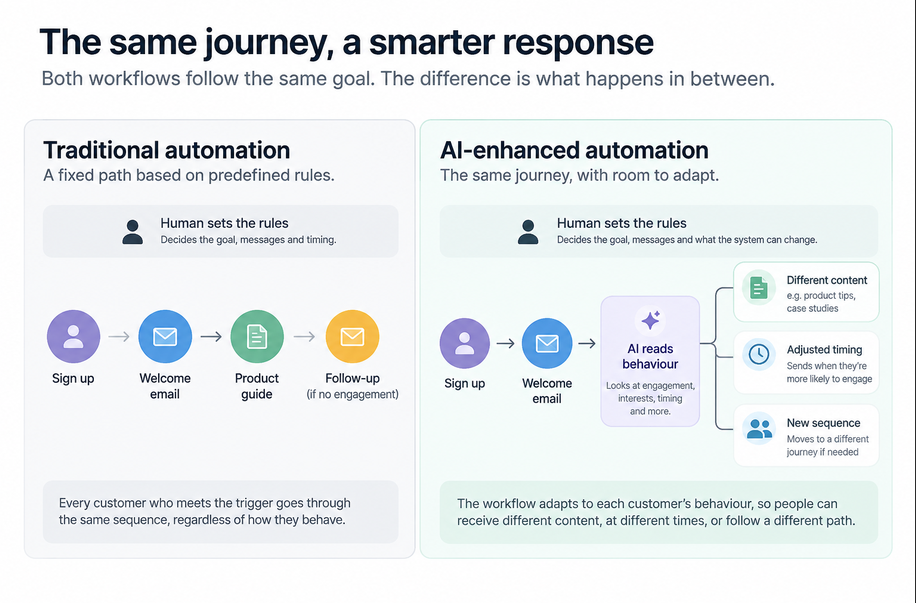
AI marketing automation differs from traditional automation by allowing workflows to respond to customer behaviour instead of following the same fixed path every time.
Picture an onboarding journey: welcome email, a product guide a few days later, follow-ups after that. Most of it is already decided ahead of time, if they do X, send Y, if they don’t, wait and try Z.
That works fine, until two people on the exact same journey start behaving completely differently. One keeps opening every email and poking around the product. The other opens one message and vanishes.
A fixed workflow can see both of those things happening. It just can’t really do anything with what it sees.
AI gives the workflow a little more room to react. It might change the message, move someone into another sequence, or decide that Tuesday morning is probably a better time to reach them than Friday evening.
The marketer still has to set up the journey and decide what can and cannot change. What AI brings in is a bit more flexibility. The same workflow doesn’t have to treat every customer who enters it in exactly the same way.
What AI Actually Adds to Automation
[Alt text: Four ways AI upgrades marketing automation: predictive segmentation, personalisation, send-time optimisation and automated testing.]
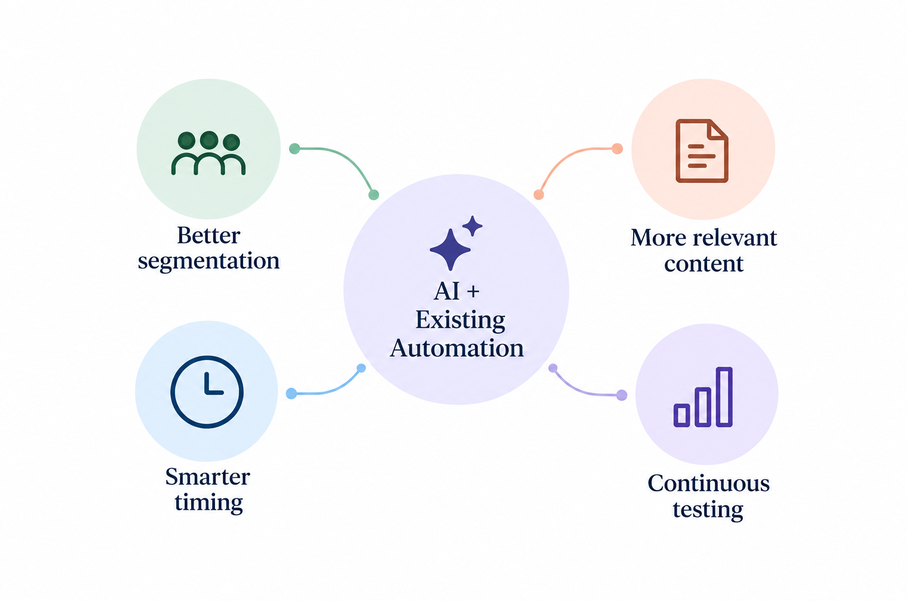
AI adds prediction, personalisation, optimisation and faster testing to the marketing workflows you already use.
- Smarter segmentation and predictive scoring:
Instead of putting customers into broad buckets, AI looks for signs of what they might do next. It can spot who’s ready to buy, who’s losing interest, or which offer might work. - Personalisation and generated content at scale:
AI can turn one campaign into several versions, changing the message for different audiences without making the team write each one from scratch. The trade-off is that someone still needs to make sure it sounds like the brand, not a machine trying very hard to sound like it. - Send-time and channel optimisation:
Ten in the morning might work for one customer and completely miss another. AI can use past behaviour to work out when and where each person is more likely to engage. - Testing that runs on its own:
AI can keep comparing different versions of a campaign and move more traffic toward the ones performing better. Marketers still need to decide what counts as a win and when to stop the test.
Where AI Marketing Automation Is Used
AI marketing automation is most useful where marketing teams already rely on repeatable decisions, such as email timing, lead scoring, paid-media bidding and retention.
- Email and lifecycle journeys:
AI fits naturally into welcome emails, abandoned-cart flows, post-purchase messages, and win-back campaigns. It can change the message, timing, or next step based on how someone behaves. - Lead scoring and nurture:
Instead of judging leads on a few fixed criteria, AI can look at what they actually do across emails, websites, and other touchpoints. That helps sales teams focus on leads showing stronger buying signals. - Paid media and budget automation:
AI can adjust bids and budgets as campaign performance changes, within limits set by the marketer. It optimises the campaign’s execution, rather than deciding what the campaign should be. - Customer retention and churn prevention:
Models flag customers who are likely to leave early enough that an offer or a message can actually change their mind.
AI Marketing Automation vs AI Agents: Where’s the Line?
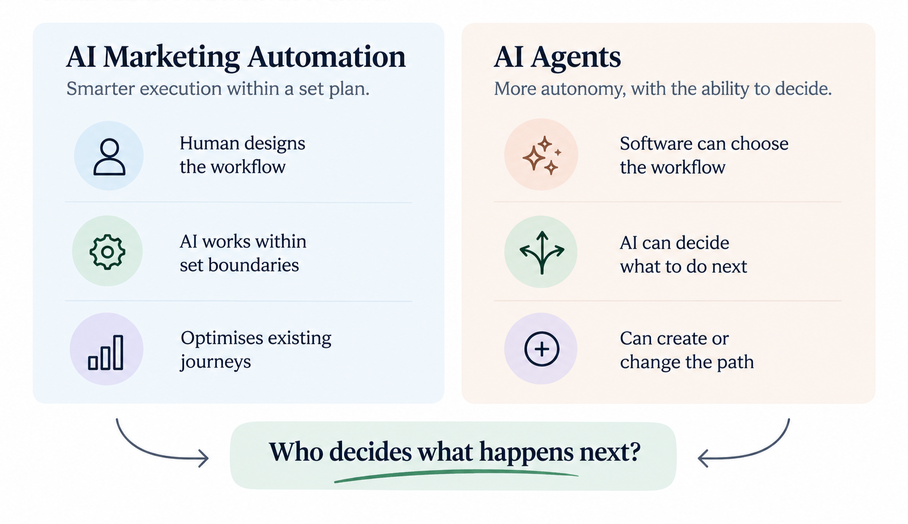
AI marketing automation still lives inside a workflow someone else designed. It can decide which segment a customer lands in, which message they get, when it goes out, but always inside a shape a person already drew.
An agent gets more room to move. Given a goal, it works out what needs to happen, picks its own tools, and changes course as things shift, which is a genuinely different kind of decision-making.
If a human designed the path and AI optimises within it, it’s automation. If the software chooses the path, it’s an agent.
Consider the onboarding example from earlier. AI choosing between two welcome emails based on behaviour, still automation. A system simply told to increase product adoption, and left to decide whom to contact, which channel, what message, what to do next, that’s moving toward agentic territory.
The line can become blurred as marketing platforms become more autonomous. The easiest question to ask is therefore not “Does this use AI?” but “Who is deciding the next steps?”
| Aspect | AI Marketing Automation | AI Agents |
| Who designs the workflow? | Human | AI can determine the path |
| What does AI decide? | Optimises within predefined rules | Chooses actions and next steps |
| Example | Selects the best email for a segment | Decides whom to contact, through which channel, and what to do next |
What Goes Wrong (and What to Put in Place)
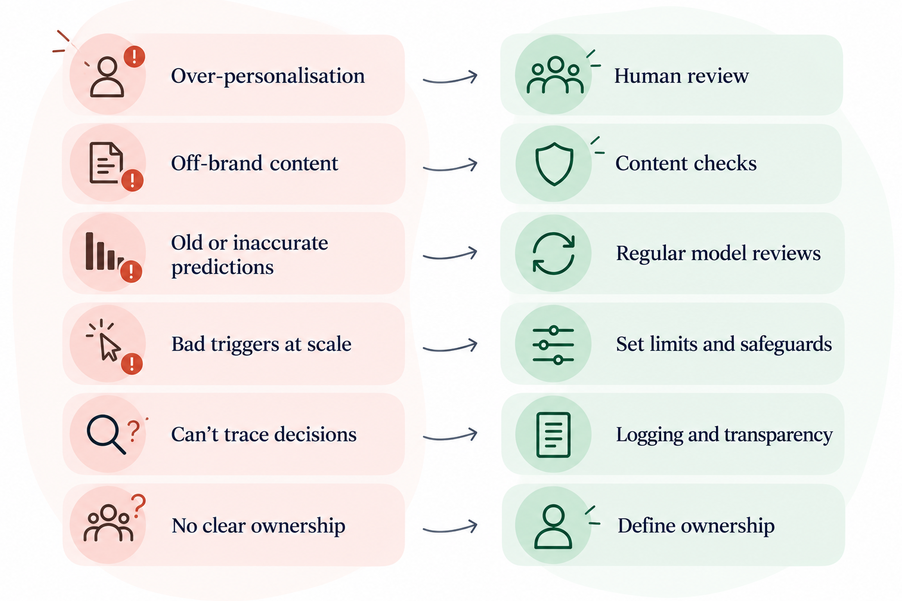
AI does not make the ordinary problems of marketing automation disappear. If anything, it can make them happen faster.
Personalisation can tip into uncomfortable territory when a brand clearly knows something about a customer it had no business knowing.
Generated content can slowly lose the brand’s voice.
Predictive models drift when the data behind them gets stale.
And a bad trigger touching twenty customers becomes a real problem the moment it fires automatically across thousands.
There’s a more subtle problem underneath all of this: knowing why something happened after it happened. If nobody can say why a customer landed in a particular segment, or why they got that exact message, fixing it later is a lot harder than it should be.
The NIST AI Risk Management Framework is a decent, vendor-neutral place to start. Short version for a marketer: an automated decision still needs someone who owns it.
A few safeguards go a long way:
- Check generated content and new audience segments before they go live.
- Refresh predictive models on a set schedule.
- Cap advertising spend and message volume so a misfire can’t scale unchecked.
- Keep a record of what the system decided, and why.
- Keep one person accountable for the whole workflow.
A Short, Even-Handed Tools Landscape
The right tool depends on which part of the marketing workflow you want AI to improve, from lifecycle messaging to customer data or paid media.
- ESP and lifecycle platforms, such as HubSpot and Braze, add AI to email and customer journeys.
- CDPs (customer data platforms), such as Segment, pull together customer data from different sources and feed the scoring that other tools act on.
- Ad automation platforms manage bidding and budget across paid channels using AI.
- All-in-one marketing suites combine several of these in one place, trading some depth for convenience.
There is no universal “best” option here, nor do they replace human judgement. It really comes down to what works well with what your team already has.
How to Start With AI Marketing Automation (No Coding Needed)
Start with one repetitive marketing decision where better data could improve the outcome, then test it before expanding AI across the workflow.
- Look for journeys that rely on triggers, rules, and scheduled messages, and find where targeting, timing, content, or scoring could genuinely improve.
- Send-time optimisation or subject-line testing are sensible places to begin, since neither requires redesigning the whole journey. Give the experiment a clear metric and see what changes.
- Move to predictive segmentation once your data is reliable. This changes who receives the message rather than just how or when it is delivered.
- Decide who checks generated content, how often models get refreshed, and what the spend or volume limits are, before rolling this out more widely.
There’s no real prize for turning the biggest possible chunk of a marketing operation “AI-powered.” A smaller starting point works better, find one repetitive decision that more information could genuinely improve, try it, and see if it earns the right to grow.
What Skills Are Needed for AI in Digital Marketing?
Marketers need skills in data analysis, digital marketing strategy, AI tools, and prompt writing. Understanding how to evaluate AI outputs is also important.
If you want to move beyond experimenting with individual tools and learn how to build AI into the bigger picture, explore the IIM Tiruchirappalli Certificate in AI-Powered Marketing & Growth Strategy, delivered on Varsity by InterviewBit. The programme covers lifecycle automation, AI-driven paid media and the emerging world of AI agents.
Explore the programme on Varsity here.
Frequently Asked Questions
What Is an Example of AI in Marketing?
AI can personalise emails based on customer behaviour. It can also predict purchase intent and optimize campaign timing.
What Are the Types of AI Used in Digital Marketing?
Common types include predictive AI, generative AI, conversational AI, and recommendation systems. They support tasks such as targeting, content creation, and optimisation.
What Is the Role of AI in Digital Marketing?
AI helps marketers analyse data, personalise campaigns, and automate repetitive decisions. This gives teams more time for strategy.
Is AI Going to Replace Digital Marketing?
AI is changing how digital marketing work is done, but marketers still need to set strategy and make decisions. AI mainly automates repetitive tasks and supports faster decisions.
What Are the Benefits of AI in Digital Marketing?
AI can improve personalisation, targeting, and campaign optimisation. It can also reduce repetitive manual work.