AI in Digital Marketing: Applications Across SEO, Paid, Social and Content

AI in digital marketing is beginning to change more than the speed at which marketers produce things. It is getting involved in decisions: what to target, what to show, when to send it, where money should go, and which changes in the data deserve attention.
But AI does not enter every channel in the same way. Search is dealing with AI generated answers. Paid media is handing more decisions to algorithms. Social media has an abundance problem. Email is becoming more responsive to behaviour. Analytics is trying to move beyond reporting what already happened.
That makes a better starting point than the usual “AI is transforming marketing” conversation: what has actually changed in the channel you work in?
What does AI in digital marketing actually mean?
AI in digital marketing means using AI across search, paid media, social, email and analytics to speed up research, execution and optimisation. The marketer still sets the objective and strategy, while AI handles parts of the work.
The focus here is on how AI is being applied across digital channels. The interesting question is what happens when AI gets inserted into the work marketers already do.
How AI changes each digital-marketing channel
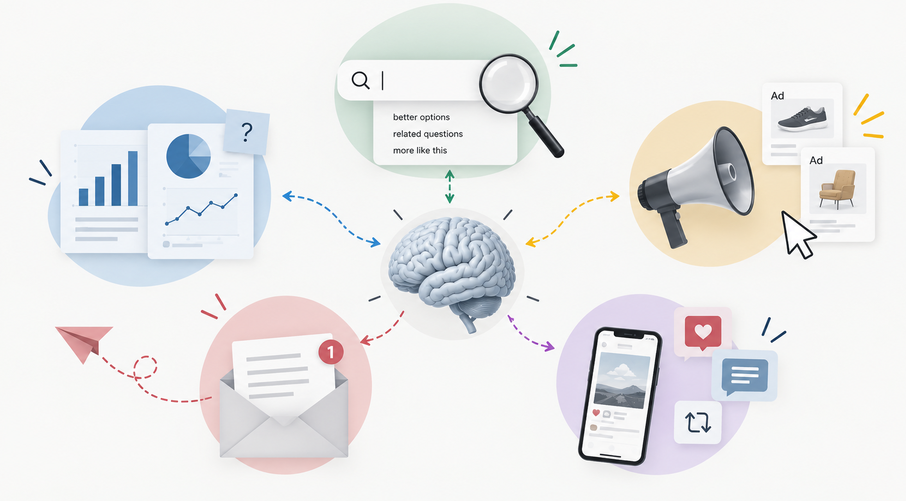
There is no single “AI marketing workflow” waiting to replace everything a marketer does.
AI changes digital marketing differently across each channel. It can help automate decisions, analyse behaviour and optimise activity across SEO, paid media, social, email and analytics.
Search: SEO and GEO
AI helps SEO teams research search behaviour, identify content gaps and optimise content for both traditional search and AI-generated answers.
SEO began with a fairly direct question: What are people searching for?
Now there is another one: What does the search engine need to understand about my content before it can use it in an answer?
AI can speed up keyword research, cluster related queries and uncover content gaps. It can also help marketers look beyond individual keywords to related questions, entities and the broader topic a page needs to cover.
Then comes GEO, or generative engine optimisation.
Here, visibility is no longer only about earning a position among traditional search results. AI-generated search experiences can pull information from several sources and present an answer directly.
That creates a different editorial challenge for content teams. Pages need to be clear, useful and well-supported so their information can be understood and used accurately.
So instead of endlessly asking, “Where can I add this keyword?”, an SEO marketer can ask something more revealing:
If an answer engine had to explain this topic, would this page give it something worth using?
Try this: Start with one page that already receives search traffic. Identify the questions it leaves unanswered and improve those gaps before researching another batch of keywords.
Paid media
AI helps paid-media teams automate bidding, budget allocation, audience targeting and creative testing. Instead of making every adjustment manually, marketers set the objective and let the platform handle many of the smaller decisions.
Paid advertising has always been full of small decisions.
How much should you bid? Where should the budget move? Which audience should receive more spend? Which creative is beginning to outperform the others?
Increasingly, marketers are not making every one of those decisions themselves.
Advertising platforms can now adjust bids, distribute budgets and test creative variations using AI and machine learning. Marketers set the objective and boundaries, while the platform handles many of the adjustments.
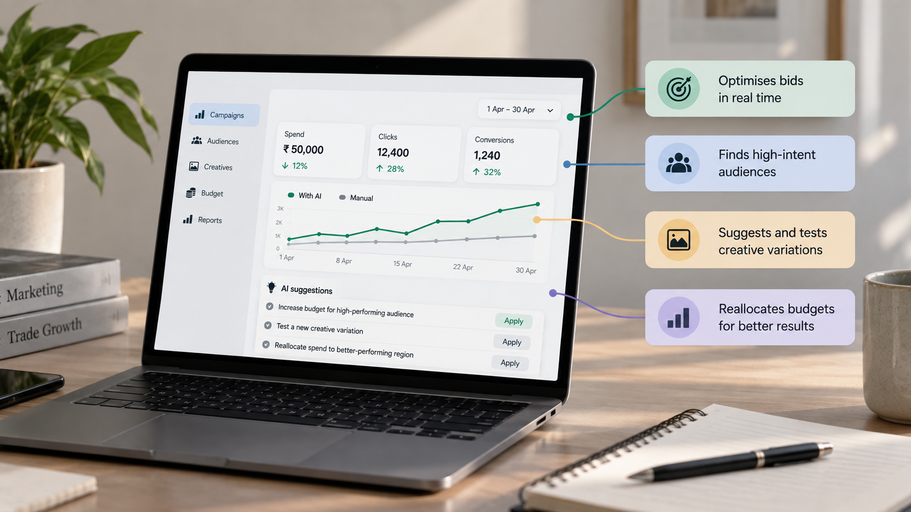
That sounds efficient. Simultaneously, it changes the meaning of control.
If a platform is deciding thousands of times a day where money should move, knowing what it is optimising becomes more important than knowing how to manually change every setting.
Try this: Take one live paid campaign and list the decisions involved in running it. Mark which decisions you make and which the platform makes. The second list shows where AI or automation is already part of your workflow.
Social media
AI helps social-media teams scale content production, create variations, analyse audience responses and manage large volumes of interactions. The challenge is deciding which of that output is actually worth publishing.
A marketer can generate post ideas, turn one piece of content into several formats, create variations, schedule posts and sift through large volumes of comments or mentions. The production queue can suddenly become very full.
But a cramped schedule is not the same thing as a good social strategy.
When anyone can produce twenty plausible captions before lunch, the scarce thing becomes judgement. Which idea is actually interesting? Which customer reaction is worth responding to? What sounds like the brand, rather than a machine that has studied several thousand brands?
This is where human skills can make all the difference.
Try this: Take one post from the past month that genuinely worked. Give AI the central idea and ask it to create three formats from it. Then edit the outputs yourself. The real test is whether AI can multiply a good idea without losing what made it work.
Email and lifecycle
AI makes email marketing more responsive by using customer behaviour to personalise content, segment audiences and optimise when messages are sent.
Email marketing has always had access to a lot of behavioural information.
Yet, two people can join the same mailing list, receive the same sequence and get the same follow-up despite behaving completely differently.
One person opens almost every message. Another has not opened anything in a month. One tends to buy after reading product education, while another responds to offers. Treating them identically is easy to manage, but it can leave useful signals ignored.
AI can help in several areas:
- Personalisation: Move beyond simply adding a first name.
- Segmentation: Group subscribers based on behaviour.
- Subject lines: Generate and test variations at scale.
- Send-time optimisation: Identify when subscribers are more likely to engage.
Try this: Find one decision in an existing lifecycle journey that is identical for everyone. Ask whether past behaviour could change that decision, then test one variation.
Analytics and measurement
AI helps marketing analytics detect anomalies, identify patterns and highlight changes that deserve investigation. This can reduce the time marketers spend scanning dashboards for something unusual.
A dashboard can tell you that traffic fell, conversions changed or one campaign spent more than expected. But it cannot always tell you which of those things need to be prioritized.
AI can detect anomalies, summarise reports, identify patterns and generate predictions from historical data. This lets marketers spend less time scanning every metric and more time investigating the changes that matter.
There is a catch, though. Finding a pattern and explaining it are two different things.
A conversion drop could come from a campaign, but it could also come from broken tracking, seasonality, a pricing change or something outside marketing. AI can flag the anomaly. It cannot supply the missing business context.
Try this: Give AI last month’s campaign data and ask it to flag three changes worth investigating. First check whether those patterns are real. Then work out why they happened.
Will AI replace digital marketing jobs?
AI is likely to automate parts of digital marketing, but it does not eliminate the need for marketers. The role is shifting towards strategy, judgement, context and evaluation.
Writing first drafts, producing variations, preparing reports, sorting large datasets and making certain routine optimization decisions are all areas where AI can reduce manual effort.
A marketer still needs to understand the customer, choose the positioning and decide whether an idea fits the brand. They also need to recognise when a number looks impressive but means very little.
A good prompt cannot rescue weak marketing knowledge.
- Without channel knowledge, you may not recognise a bad recommendation.
- Without data literacy, you may accept an explanation the numbers do not support.
- With a vague brief, AI can produce a beautifully formatted version of the vagueness.
The marketer’s role increasingly involves directing, questioning and evaluating machine-assisted work. India’s broader AI ecosystem is also placing attention on skills and workforce development through initiatives such as the IndiaAI Mission.
As AI takes over more of the repetitive work, knowing what still needs a marketer’s judgement becomes part of the job itself.
How to start using AI powered digital marketing
The easiest way to start using AI-powered digital marketing is to choose one channel, test one task and measure the result before expanding.
- Pick one channel you already understand.
Choose SEO, paid media, social, email or analytics. Existing channel knowledge gives you a basis for judging the output. - Add one AI capability and measure it.
Pick one task, such as research, reporting, creative variations, audience analysis or testing. Decide what improvement you want before you begin. - Turn the useful experiment into a repeatable brief.
When something works, document what the AI needs to know: audience, objective, context, constraints, examples and format. The goal is not a secret prompt. It is a repeatable way to give the system the right information. - Expand only after you trust the result.
Move the workflow into another task once the first one is reliable. If it fails, investigate the failure before scaling it. Sometimes the tool is the problem. Sometimes the data is poor. Sometimes the task simply needs a human decision.
That is a more sensible version of AI powered digital marketing: not handing the wheel to a machine, and where human judgement still matters.
The next marketing advantage may not be another tool. It may be knowing how to direct the tools you already have.
To build that across SEO, paid, content and analytics, the IIM Tiruchirappalli Certificate in AI-Powered Marketing & Growth Strategy (Varsity by InterviewBit) covers all of it.
Frequently asked questions
What are the best AI tools for digital marketing?
The best AI tools for digital marketing depend on the task, such as SEO, content creation, advertising, email automation or analytics. Choose tools that fit your existing workflow and allow marketers to review and control the output.
Is AI-generated content good for SEO?
AI-generated content can support SEO when it is original, accurate, useful and created for people rather than to manipulate search rankings. Google says AI-generated content is not automatically penalised, but content designed primarily to manipulate rankings can violate its spam policies.
How can small businesses use AI in digital marketing?
Small businesses can use AI marketing tools to handle tasks such as content creation, customer research, campaign analysis and marketing automation. Starting with one repetitive task can help a small team test its value before expanding.
How much does AI digital marketing cost?
The cost of AI digital marketing depends on the tools, features and level of automation a business needs. Some AI marketing tools have free plans, while paid platforms charge subscriptions or usage-based fees.
What are the disadvantages of AI in digital marketing?
AI in digital marketing can produce inaccurate outputs, overlook business context and introduce privacy or data-quality concerns. Human review is still important when AI influences customer-facing content, budgets or campaign decisions.