20 Best AI Marketing Tools in 2026: Free & Paid Tools Across the Funnel

The best AI marketing tools in 2026 include ChatGPT and Claude for content and research, Semrush and Ahrefs for SEO, Canva for marketing design, Buffer for social media, HubSpot and Klaviyo for CRM and email, and Google Analytics 4 and Microsoft Clarity for analytics. Other tools, such as Jasper, Copy.ai, Surfer, Frase, AdCreative.ai and OpusClip, focus on specific marketing workflows.
Instead of ranking 20 tools from 1 to 20, this guide groups them by marketing funnel stage and use case. You’ll see what each tool does, who it is best suited for, whether it has a free option, and where its limitations start to matter.
Free plans and features change frequently, so check each tool’s current pricing and plan details before making a purchase.
How we chose these AI marketing tools
These tools were selected for practical marketing use, not simply because they have an AI feature.
We looked at four things:
- Usefulness: Does it solve a real marketing task?
- Marketing fit: Is it useful to marketers without technical expertise?
- Free access: Is there something meaningful to test before paying?
- Differentiation: Does it do something specific enough to justify a place in the stack?
AI marketing tools by funnel stage
The right tool changes with the job. Here are 20 AI tools organised around the work marketers actually do, from content creation to analytics and automation.
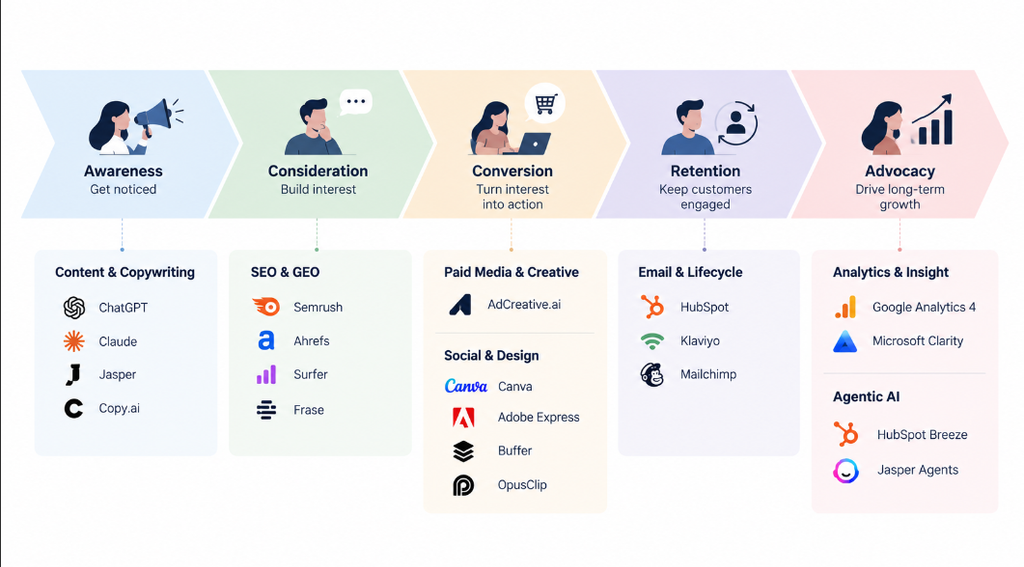
When the blank page is the problem: Content & copywriting
Content tools are most useful when they remove repetitive work without removing editorial judgement.
1. ChatGPT
Best for: Research, ideation, briefs, first drafts and content repurposing.
ChatGPT can turn research into outlines, campaign angles, drafts or repurposed social content.
Free: Yes, with usage and feature limits.
Watch out for: It is a general-purpose AI tool. It still needs good context, fact-checking and human editing.
2. Claude
Best for: Long-form writing, editing and working with large amounts of context.
Claude is useful for long briefs, detailed research and editing existing writing without losing its essence.
Free: Yes.
Watch out for: It is not a complete marketing platform. You’ll need other tools for SEO, publishing and campaign management.
3. Jasper
Best for: Brand-focused marketing content.
Jasper is designed around marketing teams, with features for brand voice, content creation and repeatable marketing workflows.
Free: Trial rather than a permanent full-featured free plan.
Watch out for: It makes more sense for regular marketing teams than occasional users.
4. Copy.ai
Best for: Marketing and go-to-market workflows.
Copy.ai is useful for repetitive marketing tasks such as campaign copy, sales messaging and other GTM content.
Free: Limited access is available.
Watch out for: Its value becomes clearer when you have recurring workflows. For one-off copy, a general AI assistant may be enough.
When Google isn’t the only place people search: SEO & GEO
SEO tools show you what people search for. GEO adds another question: how does your brand appear in AI-generated answers?
5. Semrush
Best for: SEO research, competitor analysis and AI visibility.
Semrush brings keyword research, site audits, competitive research and AI-related visibility features into one platform.
Free: Limited access.
Watch out for: It is a large platform. Smaller teams may not need every feature.
6. Ahrefs
Best for: Search research and content strategy.
Ahrefs helps you understand search demand, competitors, backlinks and top-performing pages.
Free: Limited tools are available.
Watch out for: It is primarily an SEO research platform, not a full content-production system.
7. Surfer
Best for: On-page content optimisation.
Surfer analyses search results and gives writers guidance on topics, terms and content structure that may improve a page’s search relevance.
Free: No full free plan.
Watch out for: Don’t write for a score. Search optimization still needs useful information, original thinking and good readability.
8. Frase
Best for: SEO content briefs and optimisation.
Frase combines search research, content briefs and optimisation so SEO teams and writers can work from the same understanding of search intent.
Free: Limited/trial access depending on the plan.
Watch out for: It works best as an optimisation layer, not as a substitute for knowing your audience.
When one ad isn’t enough: Paid media & creative
AI is particularly useful in paid media when marketers need many creative variations quickly.
9. AdCreative.ai
Best for: Producing variations of advertising creatives.
The platform helps marketers generate multiple ad concepts and creative variations for paid campaigns.
Free: Trial available.
Watch out for: More creative variations don’t automatically produce better campaigns. The offer, audience and landing page still matter.
When your social calendar starts fighting back: Social & design
10. Canva
Best for: Social graphics, campaign visuals and quick creative production.
Canva combines templates, design tools and AI features in one interface. Its free plan currently includes basic design access and a limited amount of AI usage.
Free: Yes.
Watch out for: Easy design can also create sameness. Customise templates rather than publishing them untouched.
11. Adobe Express
Best for: Fast branded visual content.
Adobe Express combines templates, image and video editing, generative AI and social content tools.
Free: Yes, with premium features behind paid plans.
Watch out for: Teams producing content at scale will likely need premium assets or higher AI allowances.
12. Buffer
Best for: Social scheduling and lightweight AI-assisted content creation.
Buffer is useful when the main problem is keeping multiple social channels organised. Its free plan currently supports up to three channels, 10 scheduled posts per channel and an AI Assistant.
Free: Yes.
Watch out for: It is primarily a scheduling and publishing tool. Deeper creative or enterprise workflows may require additional software.
13. OpusClip
Best for: Turning long-form video into short-form content.
OpusClip can identify potential highlights from longer videos and adapt them for short-form platforms.
Free: Limited access.
Watch out for: Automated clipping still needs human selection. Context matters more than simply finding a short section with high-energy visuals.
When the customer journey needs more than another email: Email & lifecycle
AI becomes more useful in email when it works with customer data, segmentation and behaviour rather than simply writing another subject line.
14. HubSpot
Best for: CRM-connected marketing and lifecycle workflows.
HubSpot combines CRM data, marketing automation, content and AI features. Its Breeze tools can generate and refine marketing content directly inside HubSpot.
Free: Yes, although advanced features vary by plan.
Watch out for: Costs and complexity can increase as your contact database and automation needs grow.
15. Klaviyo
Best for: Ecommerce email and lifecycle marketing.
Klaviyo is built around customer data, segmentation and automated messaging. That makes it particularly useful for abandoned-cart, post-purchase and retention campaigns.
Free: Yes, with limits.
Watch out for: Sophisticated personalisation depends on having enough clean customer data to work with.
16. Mailchimp
Best for: Email campaigns for small teams.
Mailchimp combines email creation, audience management and automation with AI-assisted features.
Free: Yes, with limits.
Watch out for: Contact and send limits can become important as an email list grows.
When your dashboard gives you numbers but not answers: Analytics
Analytics answers a question content generators can’t: what happened after the campaign went live?
17. Google Analytics 4
Best for: Website and campaign measurement.
GA4 helps marketers track acquisition, engagement, conversions and other website behaviour.
Free: Yes.
Watch out for: AI cannot rescue poor tracking. Your events and measurement setup need to be correct first.
18. Microsoft Clarity
Best for: Understanding how visitors behave on a website.
Clarity adds heatmaps and session recordings to conventional analytics, helping marketers spot friction that traffic numbers alone may hide.
Free: Yes.
Watch out for: It shows behaviour, not intent. You still need to interpret what the behaviour means.
The tools that don’t just answer prompts anymore: Agentic AI
The next turn is from AI that generates something to AI that can carry out a sequence of tasks.
19. HubSpot Breeze
Best for: AI-assisted CRM and marketing workflows.
Breeze can generate content, summarise records, find information and complete tasks within HubSpot. HubSpot also offers specialised Breeze agents for workflows such as customer support and prospecting.
Free: Some Breeze capabilities are available across HubSpot plans; advanced agent features can require additional subscriptions or credits.
Watch out for: An agent is only as useful as the data, permissions and workflow it receives.
20. Jasper Agents
Best for: Repeatable, multi-step marketing workflows.
Jasper’s agent-based approach is aimed at moving beyond individual content prompts toward repeatable marketing processes.
Free: Paid/trial access.
Watch out for: Agents are most useful when the same workflow happens frequently enough to justify setting it up.
Free vs paid: Is “free” actually free?
Free AI marketing tools are useful for testing workflows, but “free” does not always mean unlimited.
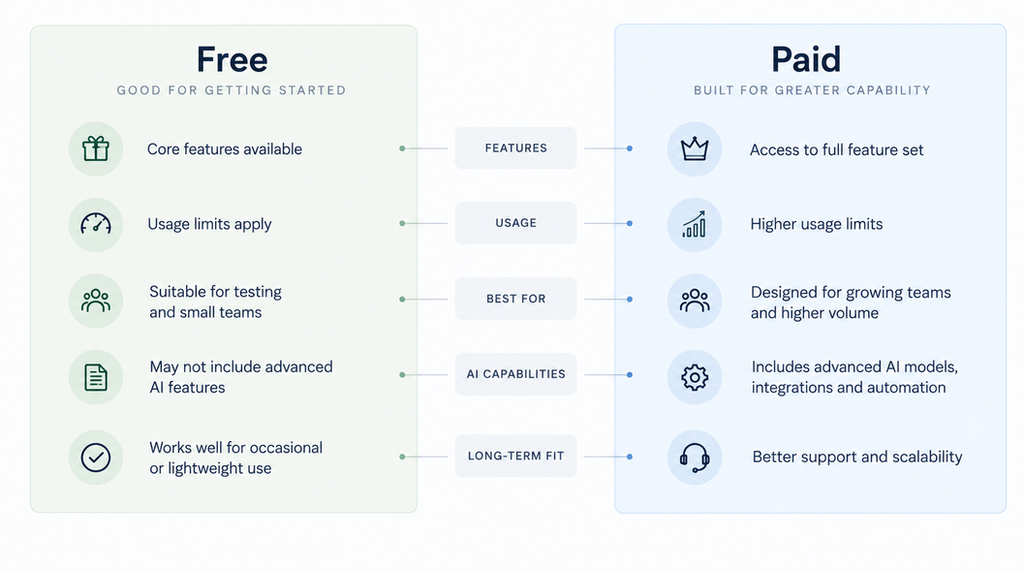
There are three common models:
| Type | What it really means | Good for |
| Free plan | Core features remain available | Regular lightweight use |
| Freemium | Basic features are free, useful extras are paid | Testing the product |
| Free trial | Temporary access to paid features | Evaluating a full platform |
The useful test is simple: take one real marketing task and run it through the free tier.
If it saves meaningful time without creating another problem, consider upgrading. If it doesn’t, move on.
How to choose an AI marketing tool
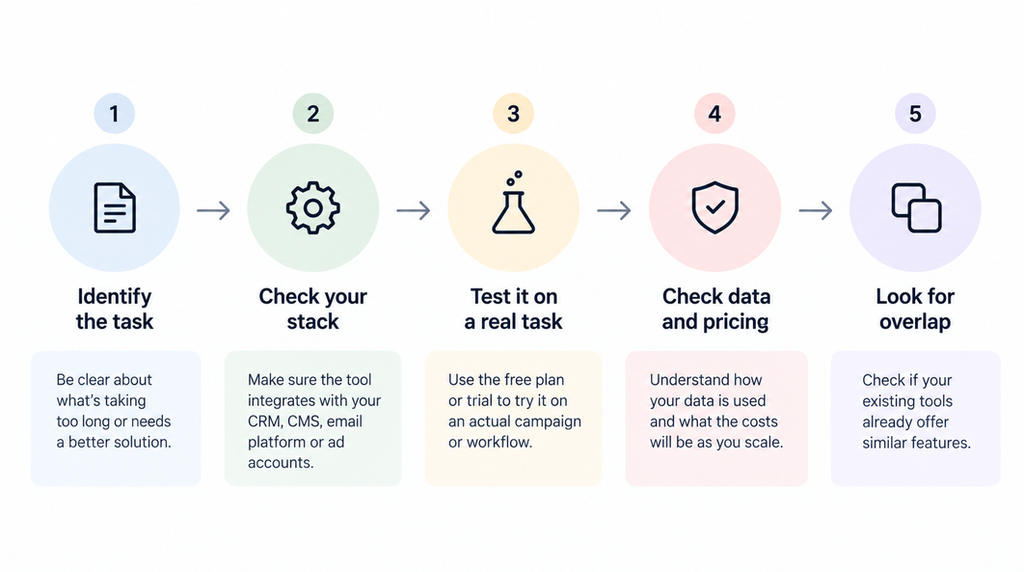
Choose the workflow first, then the software.
Before adding another subscription, check five things:
- The job: What specific task are you trying to improve?
- Your stack: Can the tool connect with your CRM, ESP, analytics or ad platforms?
- The free tier: Can you test it with a real campaign?
- Data: What customer or business information will you put into it?
- The overlap: Are you already paying for something that does the same job?
The last one is easy to overlook. A larger AI stack is not automatically a better one.
How these AI marketing tools fit together in a real workflow
AI tools work best when they form a workflow rather than a pile of subscriptions. Here’s what a product launch could look like:
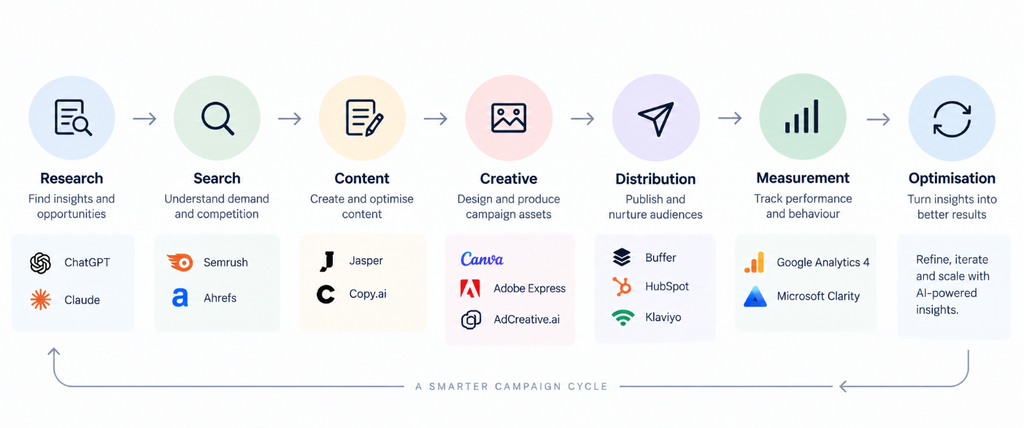
| Campaign stage | What happens | Example tools |
| Research | Find insights and campaign angles | ChatGPT, Claude |
| Search | Understand demand and competitors | Semrush, Ahrefs |
| Content | Turn the strategy into copy | Jasper, Copy.ai |
| Creative | Build visual and ad variations | Canva, Adobe Express, AdCreative.ai |
| Distribution | Publish and nurture audiences | Buffer, HubSpot, Klaviyo |
| Measurement | Track traffic and conversions | GA4 |
| Behaviour | Find friction on the site | Microsoft Clarity |
The important part is the handoff.
Research should inform the content. Content should inform the creative. Campaign data should inform what happens next.
That is where an AI marketing stack becomes useful instead of becoming 20 browser tabs you forgot to close.
Are AI marketing tools worth paying for?
They can be when they remove a recurring task or connect several parts of a workflow. Before paying, measure the time saved, output produced and whether the tool replaces or merely duplicates something you already use.
Tools change every quarter; the judgement to choose and orchestrate them is what lasts. If you want to build that judgement formally, the IIM Tiruchirappalli Certificate in AI-Powered Marketing & Growth Strategy (delivered on Varsity by InterviewBit) covers content engineering, AI-driven paid media and the agentic layer end to end.
Frequently asked questions
What are the best AI marketing tools for small businesses?
Small businesses can start with a general AI assistant for content, Canva for design, Buffer for social scheduling and GA4 for measurement.
What are the best free AI tools for marketing?
Useful free options include ChatGPT, Claude, Canva, Buffer, GA4 and Microsoft Clarity. Check each free tier for the features and usage limits you actually need.
Can AI tools create a complete marketing campaign?
They can support most parts of a campaign, including research, copy, creative, distribution and analysis. They do not remove the need for a marketer to set the strategy, approve outputs and interpret results.
What AI marketing tools are useful for social media marketing?
Canva and Adobe Express are useful for creating visual content, while Buffer handles scheduling and publishing. OpusClip is useful when your social strategy depends heavily on repurposing long-form video.
Which AI tools should a beginner learn first?
Start with one general AI assistant and one tool connected to your main marketing responsibility. A content marketer might begin with ChatGPT or Claude, while a social marketer may get more immediate value from Canva or Buffer.