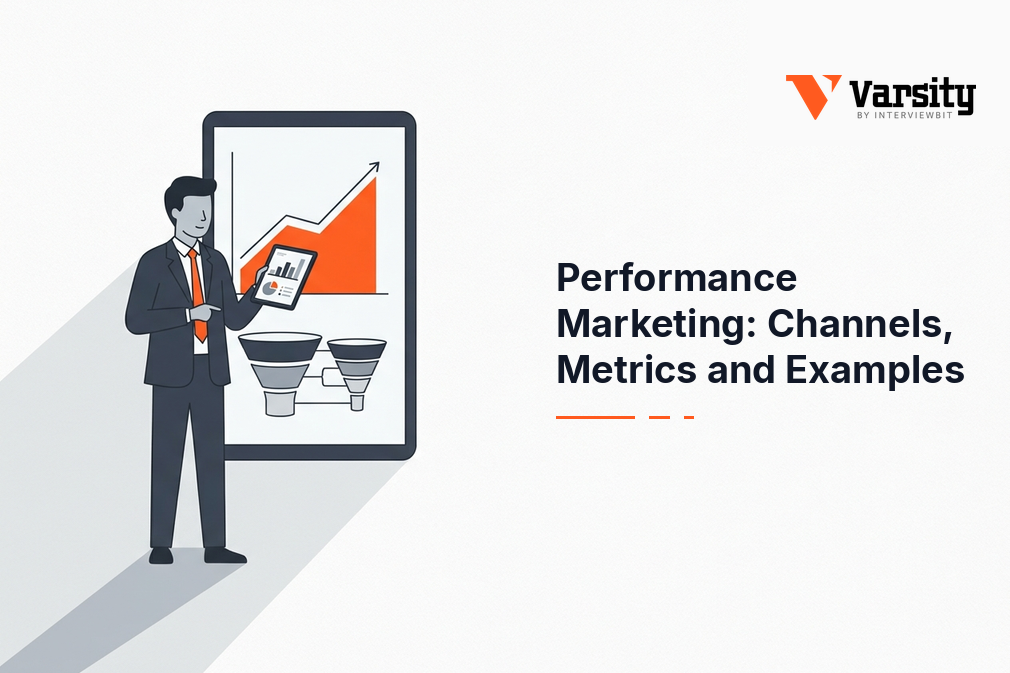
Performance Marketing: Channels, Metrics and Examples (2026 Guide)

Meta title: Performance Marketing: Channels, Metrics & Examples
Meta description: Learn performance marketing channels, metrics, strategy and examples, plus how it differs from digital marketing and how AI is changing campaign optimization.
A click is easy to buy. A customer is not.
Performance marketing tracks what advertising produces, from clicks and leads to sales, installs and revenue.
In short:
- It has a defined goal. Every campaign is built around an action such as a lead, sale, install or booking.
- It is calculable. CPA, CPL, ROAS and LTV show what the spend produced.
- It is increasingly automated. AI now handles more of the bidding, budgeting and ad testing, while marketers decide what the campaign should work towards.
This guide walks through the channels, the metrics, a few examples, and where AI helps versus where it just moves faster in the wrong direction.
What is performance marketing?
Performance marketing is advertising built around something you can measure, such as a click, lead or sale. Every rupee is tied to something that actually triggered the result.
Here is the basic setup:
- You spend on a campaign.
- Someone takes an action.
- You monitor that action and use what you learn to decide what to change next.
Two campaigns that cost the same don’t deserve the same budget next month if one brought real customers and the other brought cheap clicks that went nowhere.
That is the whole discipline: following up after the click.
A dashboard alone does not make something “performance marketing”. What you are monitoring and what you do with the result afterwards are also important parts of the process.
Performance marketing vs brand and digital marketing
Performance marketing lives within the idea of digital marketing, but it is not a synonym for it, and it is not the opposite of brand marketing either.
It is just that they can often overlap with each other.
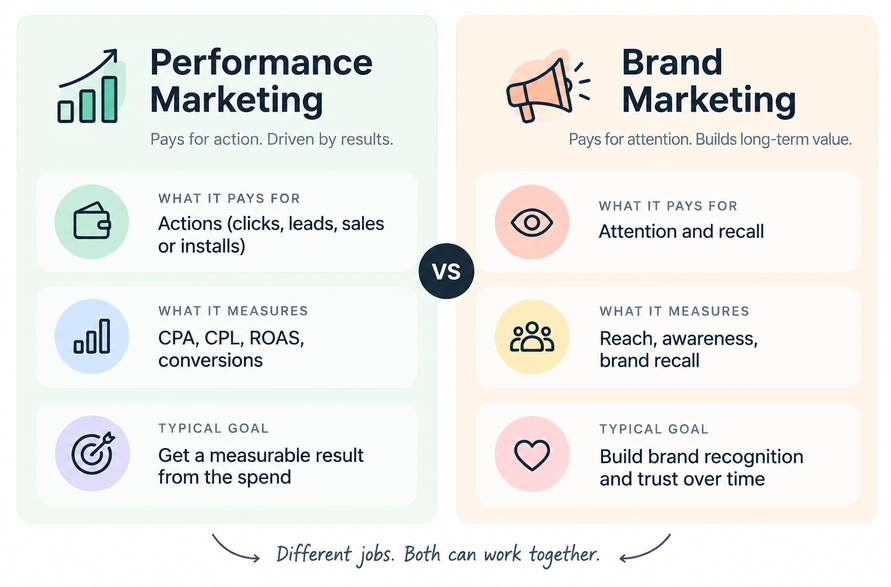
[Alt text: Performance marketing compared with brand marketing: what each pays for and measures.]
A few quick examples:
- SEO is digital marketing.
- An Instagram brand film is digital marketing.
- A Google Search campaign enhanced for qualified leads is both digital marketing and performance marketing.
Is performance marketing only about immediate sales?
No. You can improve toward leads, app installs, demo bookings, or qualified opportunities. A B2B company with a six-month sales cycle can’t judge a campaign on same-day purchases, so it follows the fuller chain instead:
Ad → lead → qualified lead → opportunity → revenue
Pick the outcome that is tied to the business.
The channels of performance marketing
The main performance marketing channels are paid search, paid social, programmatic/display, affiliate marketing, retargeting and performance-based influencer marketing. Each one works differently, so the right choice depends on what you’re trying to achieve.
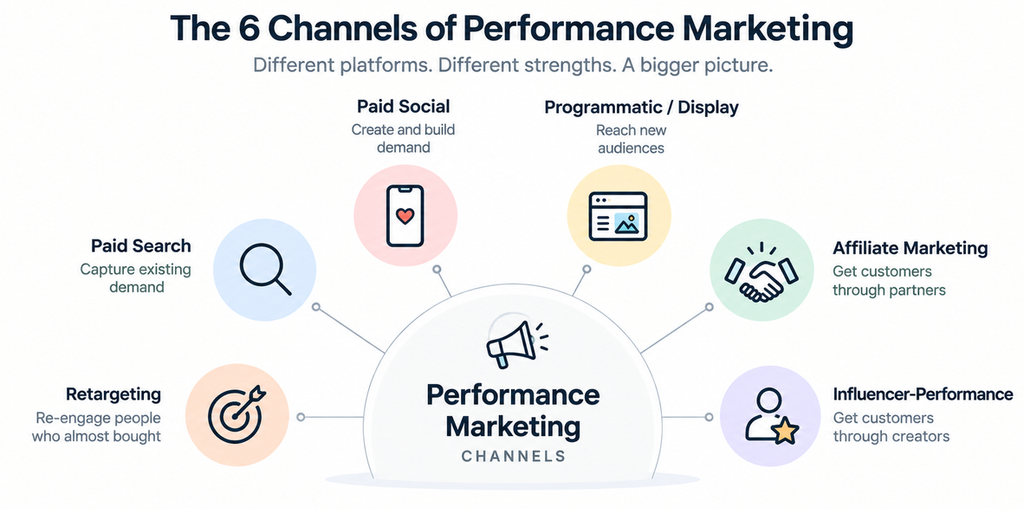
The channel depends on what you need the advertising to do.
| Channel | Best for | Core metrics |
| Paid search | Capturing existing demand | CPC, CPA, ROAS |
| Paid social | Getting people interested | CPM, CPL, CPA |
| Programmatic/display | Reaching new audiences | CPM, viewability |
| Affiliate | Getting customers through partners | Commission, revenue per sale |
| Retargeting | Re-engaging people who almost bought | CPA, frequency |
| Influencer-performance | Getting customers through creators | Tracked commission, CPA |
Paid search works because the person is already looking. Someone searching “best accounting software for small business” has intent baked in. The risk is the cost. High-intent keywords get expensive fast, and a cheap click that never converts is not a win.
Paid social works differently. Nobody was searching for you. You have to introduce the idea, which is why creativity carries most of the weight. A product demo, a customer story, a founder talking straight to camera — these can pull very different numbers from the same audience.
Programmatic and display ads help brands reach people across websites and apps. Useful, but worth a warning: an impression only proves an ad was served. It doesn’t prove anyone noticed. So look at whether people could see the ad and where it appeared, not just what you paid for the impressions.
Affiliate marketing pays partners for outcomes, usually a tracked sale. It connects spend to revenue cleanly, but returns and cancellations can quietly wreck the economics if you’re not watching them.
Retargeting goes after people who already showed interest. Someone who added a ₹5,000 item to their cart and left is worth treating differently from a stranger. Just don’t show them the same ad twenty times and call it “strategy”.
Performance-based influencer marketing ties creator-pay to results, not just a posting fee. A creator earning commission on monitored sales is a lot closer to this model than one paid flat for a single post.
The metrics that matter
Different metrics answer different questions. CPC and CPM tell you what media costs. CPA, ROAS and LTV tell you more about whether that spend produced something valuable for the business.
| Metric | What it tells you | Where it can mislead |
| CPC / CPM | Cost of a click or 1,000 impressions | Cheap traffic can still be valueless traffic |
| CPL / CPA | Cost per lead or acquisition | A cheap lead can be a bad lead |
| ROAS / LTV | Revenue efficiency and customer value | Revenue is not profit |
This is where variation becomes obvious: Campaign A brings leads at ₹300 each. Campaign B brings them at ₹700. If A’s leads are mostly unqualified and B’s are sales-ready, the cheaper campaign is not the better one. Cost only means something with context.
On ROAS specifically: spend ₹1 lakh, report ₹4 lakh in attributed revenue, and your ROAS is 4. That number says nothing about product cost, fulfillment, discounts or returns. It is not profit, and treating it like profit is one of the more common ways teams fool themselves.
On LTV: two campaigns can land the same CPA and still not be equal. One brings a customer who buys once. The other brings someone who comes back for two years. Same acquisition cost, very different value to the business. An Indian D2C brand might find a ₹300 lead is futile if that customer never buys again, while a ₹700 acquisition can be a bargain if the customer returns several times over a year.
A word on attribution and incrementality
Attribution decides which touchpoint gets credit for a sale. Incrementality asks a tougher question: would that sale have happened anyway, without the ad?
A customer might see a social ad, search the brand later, click a retargeting ad, then buy. Several channels can claim a piece of that.
Common ways to split the credit:
- Last-click: credit to the final touchpoint
- First-click: credit to the first
- Data-driven: a system estimates how much each interaction contributed
- Incrementality: looks at what extra result the marketing produced
Attribution and ROAS tell you what the campaign is being credited with. Incrementality asks what would not have happened without the campaign. A platform showing 500 conversions doesn’t mean it caused all 500. Treat the conversion report as evidence, not proof.
How AI drives performance marketing
AI now handles many of the repetitive decisions in performance campaigns, from bidding and budgeting to testing different ads and finding likely customers.
| Area | What AI does | What marketers still do |
| Bidding | Balances bids based on what is likely to work | Choose what counts as a useful result |
| Budget | Moves money towards better-performing campaigns | Decide when more money is profitable |
| Ad testing | Creates and tests more variations | Judge the idea, offer and message |
| Audiences | Finds patterns in past behaviour | Decide whether those patterns are useful |
Google Smart Bidding, for example, can regulate bids towards goals such as Target CPA or Target ROAS. Now, the marketer’s job changes accordingly. Instead of regulating bid manually, they have to decide whether the campaign is being trained towards something that might be useful.
Budget allocation works the same way.
AI can move money to whatever is converting right now. What it cannot do is make diminishing returns disappear. A campaign that performs beautifully at ₹10,000 a day can behave completely differently at ₹1 lakh a day. Audiences saturate. Auctions vary.
Creative testing is where AI earns its keep fastest, generating dozens of headline and hook variations in the time it used to take to write three. But fifty versions of a weak idea are still a weak idea. The offer and the positioning are still a human call.
And predictive audiences carry one catch: AI is only as good as the information it has been given. Maximize for cheap leads, and the system gets very good at finding cheap leads. That’s not the same as finding good customers.
What AI genuinely can’t fix: broken follow-ups, missing revenue data, or a lead-quality judgment that was never fed into the system in the first place. The system can make the campaign more efficient. Someone still has to decide what “good” means.
How to build a performance marketing strategy
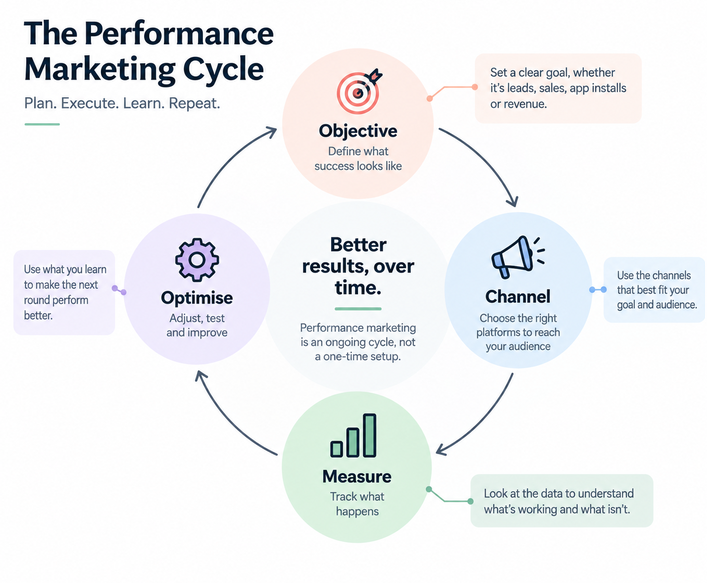
Don’t start with Meta, Google or LinkedIn. Start with what you want the money to bring back.
[Alt text: A performance-marketing strategy loop from objective to optimization.]
- Pick one clear objective. More qualified leads, lower CAC, higher app activation — not “let’s run Meta ads,” which is a channel choice dressed up as a strategy.
- Define the conversion before you spend. A completed purchase for ecommerce. An activated account for SaaS. A SaaS company selling to Indian businesses might hone beyond demo requests and connect ad data to CRM stages like qualified opportunities and closed revenue, since a form fill alone is often too shallow.
- Match the channel to the job.
| Situation | Channel | Job |
| People are actively searching | Paid search | Capture demand |
| Product needs discovery | Paid social | Create demand |
| Visitors need another nudge | Retargeting | Re-engage |
| Partners can drive sales | Affiliate | Extend reach |
- Build assessment before you scale. Conversion events, observing, attribution rules, lead-quality signals — set these up before launch, not after the budget is already converting.
- Test one variable at a time. “Does a testimonial outperform a product-led ad” is a good question. Changing the creative, audience, and landing page together is not a test, it is a guess.
- Push past the first conversion. Click → lead → qualified lead → opportunity → customer. The more you know about what happens after someone fills out the form, the better your decisions become.
- Scale carefully. A winning campaign at ₹10,000 a day is not automatically a winner at ten times that. Watch CPA, conversion quality, and frequency as you push spend up, not just the topline number.
Performance marketing examples
Ecommerce: A fashion brand runs three creatives for one collection, a product video, a customer testimonial, and a styling tutorial. The video wins on clicks. The testimonial wins on purchases. The tutorial wins on repeat buyers. Upgrade for CTR alone, and you’d have picked the wrong winner.
B2B: A SaaS company runs Search ads for demo requests, optimizing for form fills. Once they connect campaign data to the CRM, they find one keyword brings fewer leads but far more sales opportunities. The campaign can now chase something closer to revenue.
App marketing: An app’s install numbers look strong. Then the team checks onboarding completion and finds a large drop-off. Instead of quantifying installs, the team starts observing whether people really activate the app.
Common mistakes
- Chasing the cheapest number. Cheap clicks and cheap leads feel good on a dashboard. They mean nothing if they don’t become customers.
- Treating ROAS as profit. It is not. Revenue and profit are different conversations.
- Trusting platform attribution blindly. Platform-reported conversions reflect the platform’s own assessment system. Understand what the number includes before using it to make budget decisions.
- Feeding AI a bad goal. Automation does exactly what it is told. A weak objective just gets executed faster and at a greater scale.
- Changing everything in one test. You might get a better result. You won’t know why.
- Scaling before the economics are proven. Working at a small budget doesn’t guarantee it works at ten times the budget. Scale is its own test.
Performance marketing now runs on AI-driven optimization, and the marketers who lead are the ones who can direct it well. Performance Marketing & AI-Driven Paid Media is Module 6 of the IIM Tiruchirappalli Certificate in AI-Powered Marketing & Growth Strategy (Varsity by InterviewBit). → [insert Varsity course URL before publish — brief didn’t supply one]
Frequently asked questions
How is performance marketing different from growth marketing?
Performance marketing focuses on paid acquisition channels and short-term, trackable results. Growth marketing owns the whole funnel, including onboarding, retention and referrals, and leans more on experimentation than repeatable execution.
What is the difference between performance marketing and PPC?
PPC is one channel within performance marketing, specifically the pay-per-click model used in paid search. Performance marketing is the broader approach and also covers pay-per-lead, pay-per-sale, and affiliate commission models.
Do you need a big budget to start performance marketing?
No. You can start small on one channel and scale as the data proves out. What matters more than budget size is having enough spend to generate a learnable amount of data before drawing conclusions.
What tools do performance marketers use?
Google Ads and Meta Ads Manager for buying media, GA4 or a similar analytics setup for monitoring, and a CRM connection for anything B2B where the actual conversion stays past the form filling.
Is performance marketing still relevant now that third-party cookies are going away?
Yes, though tracking is changing. Server-side tracking, first-party data and platform-level signals (like Google’s auction-time bidding data) are taking over from browser cookies as the main quantification layer.
Which industries get the most value from performance marketing?
Ecommerce, SaaS, edtech and app-based businesses tend to see the clearest returns, since each has a well-defined, trackable conversion event. Businesses with long, offline-heavy sales cycles see slower, harder-to-attribute results.
Can performance marketing work for a brand nobody has heard of?
Yes, but expect a higher CPA at first. Paid social in particular has to do double duty, introducing the brand and asking for the click, which usually costs more until some retargeting and repeat-exposure data builds up.
What counts as a “good” ROAS?
There is no universal number, it depends entirely on margin. A 3x ROAS can be excellent for a high-margin SaaS product and a loss-maker for thin-margin retail. Judge ROAS against your own cost structure, not an industry average.
What is performance media?
It is paid media activity managed around quantifiable actions rather than exposure. Paid search, paid social, affiliate and programmatic campaigns all count as performance media when they’re bought and improved this way.
Does performance marketing replace SEO?
No. They solve different problems on different timelines. Performance marketing buys speed; SEO builds a channel that keeps working after you stop paying for it. Most serious strategies run both.