Forward Deployed Engineer vs DevOps Engineer: The Real Differences, and What Transfers

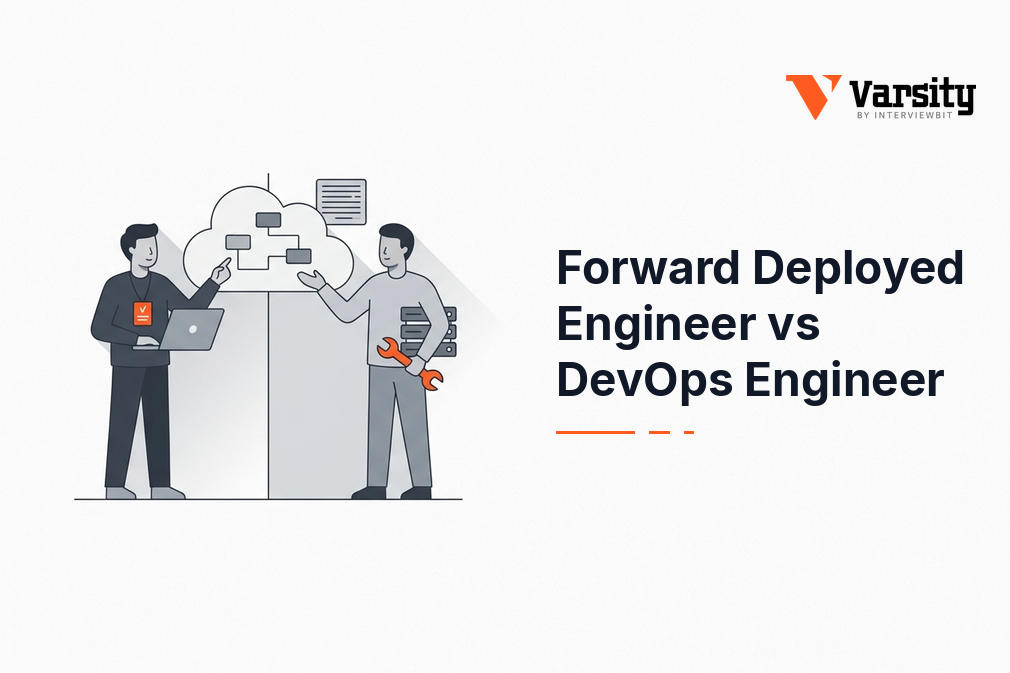
A DevOps engineer owns how software gets built, shipped and kept running inside their own organisation. A forward deployed engineer owns how a customer’s version of a product gets designed, built and made to work inside the customer’s environment. Both are production roles. Both get called when something live breaks. The difference is whose production, and whether the job includes sitting in the room where the requirements are still being argued about.
This page compares the two roles honestly across the dimensions that actually matter, then maps exactly which DevOps skills carry into a forward deployed engineering role, which have no equivalent, and what you would have to add. If you are a DevOps, SRE or platform engineer in India evaluating this move, this is written for you.
What Both Roles Genuinely Have in Common
Before we compare, the overlap. This section is why the rest of the page gets believed.
Both own something that is live. Neither role’s work is finished at merge. A DevOps engineer is accountable for uptime, reliability and deployment velocity. A forward deployed engineer is accountable for whether the system they shipped into a customer’s environment is actually working, being used and delivering value. In both cases, the real job starts after the code is written.
Both are accountable when it breaks. A DevOps engineer gets paged at 3 AM when a production incident hits. A forward deployed engineer gets a call from the customer’s Head of Operations when the system they deployed stalls during a live business process. This shared accountability shapes how each role thinks about risk, rollback, blast radius and the cost of being wrong. Both have learned, the hard way, that “it works on my machine” is not a deliverable.
Both work inside constraints they did not choose. A DevOps engineer operates inside their organisation’s compliance requirements, cost envelope, legacy infrastructure and security policies. A forward deployed engineer operates inside the client’s network policy, data reality, security review process and organisational politics. Neither gets to start from a clean slate.
The production instincts are the same instincts. That is exactly why the crossover happens. AWS announced a $1 billion investment in June 2026 to build a dedicated Forward Deployed Engineering organisation, embedding engineers directly inside customer teams. Companies are not replacing DevOps with FDEs; they are recognising that production-ownership skills are the foundation the FDE role is built on.
Forward Deployed Engineer vs DevOps Engineer: The Differences That Matter
| Forward Deployed Engineer | DevOps Engineer | |
| Who you serve | An external customer, named | Your own engineering organisation |
| Whose environment you work in | The customer’s stack, network and policy | Infrastructure you own and shaped |
| What “done” looks like | A customer outcome accepted and handed over | A system that keeps running and keeps getting faster |
| Primary output | A working solution inside a client system | Pipelines, platform, reliability, developer velocity |
| Requirements come from | A conversation, often unresolved, with a stakeholder | A backlog, an SLO, an incident |
| Client-facing load | High and non-optional | Low to moderate, mostly internal |
| Travel / on-site | Frequently stated in postings, often 25-50% | Rarely a factor |
| Commercial pressure | Direct: scope, timelines and renewals are visible to you | Indirect |
| Core technical centre | Application and integration work; increasingly LLM systems | Infrastructure, automation, observability, security |
| How success is measured | Did the customer adopt it | Uptime, lead time, change failure rate, cost |
| Typical experience asked for | 1+ years (Palantir) to 5+ (OpenAI) | Varies, commonly 3-8 years |
Boundaries vary by company. Some organisations now advertise a single hybrid role combining DevOps infrastructure skills with FDE client-embedded delivery, which proves the two are not in competition but increasingly converging at the edges.
If the comparison table has you thinking about the move, the Advanced Certificate in AI Forward Deployed Engineering with IIT Delhi is built around exactly the gap most DevOps engineers face: production LLM systems, RAG architecture, agentic workflows, evaluation and deployment inside real client environments.
What a DevOps Engineer Already Brings to a Forward Deployed Role
This is the section the competitors skip entirely. Four things that transfer, each with the reason it transfers.
Production instinct and blast-radius judgement. An FDE ships into a live customer system where a bad change is a client incident, not a rollback in staging. Knowing what a change can take down before you make it is the single most valuable thing DevOps hands over. Every DevOps engineer who has carefully scoped a deployment to limit blast radius has already done the core mental work of FDE delivery.
Observability and incident response. FDE work is heavily about whether the deployed thing is actually behaving, which is a monitoring problem before it is an AI problem. DevOps engineers who set up alerting, tracing and dashboards for their own systems already think in the right terms. The difference is that an FDE adds LLM-specific observability: evaluation scores, hallucination rates, retrieval accuracy and cost per query.
Infrastructure as code and deployment mechanics. Enterprise deployment targets are the same platforms: cloud accounts, containers, CI/CD, secrets management, network boundaries. A DevOps engineer who has deployed to a customer’s VPC, managed secrets across environments, or configured infrastructure inside a regulated network has already done FDE-adjacent work.
Explaining a failure to people who are upset about it. Every DevOps engineer who has run a post-incident review has already done the hardest part of client communication: taking ownership of a problem, explaining what went wrong in terms a non-engineer can understand, and presenting a fix under pressure. Most DevOps engineers have never been told this counts. It does.
Practical CV tip: a DevOps engineer moving across should lead with deployments into environments they did not control: client VPCs, air-gapped installs, customer-managed clusters, regulated environments. That is the closest existing evidence to FDE work, and most DevOps CVs bury it under tooling lists.
What Does Not Transfer, and How to Close Each Gap
Client-facing solution design under commercial pressure. Scoping a problem with a stakeholder who has not decided what they want, while a contract is in the room, has no DevOps equivalent. DevOps requirements come from backlogs and SLOs; FDE requirements come from conversations that are still messy. Route: volunteer for the customer-facing edges you can already reach: support escalations, onboarding a partner team, running the enterprise-customer side of an integration.
Application-level and LLM-specific engineering. FDE postings at Anthropic ask for “production experience with LLMs including advanced prompt engineering, agent development, evaluation frameworks, and deployment at scale.” OpenAI asks for having “built or deployed systems powered by LLMs or generative models.” DevOps work does not produce this evidence. Route: the evidence needed is a shipped, running application with retrieval, agents or evaluation in it. Not a certificate.
Evaluating a system whose output is not deterministic. DevOps correctness is a green check or a red X. LLM correctness is a measured distribution: evaluation sets, regression baselines, human review, faithfulness scores. This is a fundamentally different way of reasoning about whether something works. Route: name it as the specific new discipline to learn. You have never had to reason this way before, and knowing that up front is more useful than discovering it mid-deployment.
None of these three requires starting over. They are additions to a production engineer, not a replacement for one.
What the Job Postings Actually Ask For
Three verified reference points from September 2026:
Palantir (Forward Deployed Software Engineer, New York, hybrid): 1+ years post-college experience. Strong coding in Python, Java, C++ or TypeScript. Travel up to 25%. $135,000-$200,000 USD plus RSUs. Source: Palantir careers page.
Anthropic (Forward Deployed Engineer, NYC/SF/Seattle): 4+ years in a technical customer-facing role, “or as a Software Engineer with consulting experience.” ~25% travel. $280,000-$320,000 USD. Source: Anthropic Greenhouse.
OpenAI (Forward Deployed Engineer, San Francisco, hybrid): 5+ years of engineering or technical deployment experience “that includes customer-facing work.” Travel up to 50%. $185,000-$300,000 USD plus equity. Source: OpenAI careers.
The observation that matters: every one of the three names customer-facing work as a hard requirement. None of them lists infrastructure automation as one. That is the real difference between the two roles, stated by the employers rather than by us.
For context on the role’s history and growth, Wikipedia’s entry on the Forward Deployed Engineer notes the term was popularised by Palantir and that companies including AWS, OpenAI and Anthropic have hired for it, with listings growing significantly between 2024 and 2025.
Should You Move from DevOps to Forward Deployed Engineering?
Five questions. No scoring, no personality quiz. Just answer honestly.
- Do you want to be in the room when the requirement is still an argument, or do you want it settled before it reaches you?
- Does an unfamiliar stack energise you or exhaust you?
- Is 25-50% travel workable for your life right now?
- Do you want to keep going deeper on infrastructure, or go broader across a customer’s whole problem?
- Would you still want it if the title were “solutions engineer” instead?
A “no” here is a real answer. Platform engineering and SRE work is a deep, well-paid, durable career. India’s DevOps job market has far more open roles than the FDE market, and the infrastructure skills you have built are not going to be less valuable. Choosing to stay is a decision, not a failure to move.
Which role is better for a career in India?
DevOps has far more open roles and a more established career path. FDE is smaller, newer and concentrated in AI-first companies, global capability centres and the India offices of companies like Palantir, Databricks and Salesforce. If you want volume and stability, DevOps. If you want a smaller, faster-growing niche with higher customer exposure, FDE.
If you have read the gaps section and recognised your own: production engineering already solid, the LLM and client-facing half still to build. That is a specific gap, not a career restart. The Advanced Certificate in AI Forward Deployed Engineering with IIT Delhi is built around exactly that gap: RAG architecture, agentic systems, LLM evaluation and observability, deployment on Bedrock, Azure OpenAI or Vertex, and enterprise integration, across six months of live online sessions with recordings and five projects.
Frequently Asked Questions
What is the difference between a forward deployed engineer and a DevOps engineer?
Whose production you own. A forward deployed engineer builds and ships inside a customer’s environment. A DevOps engineer builds, ships and maintains infrastructure inside their own organisation’s environment. Both are production roles; the difference is who the customer is and whether the job includes sitting in the room where requirements are still being argued.
Can a DevOps engineer become a forward deployed engineer?
Yes, and the production and incident-response skills transfer directly. The additions are client-facing solution design, application-level LLM engineering, and evaluating non-deterministic systems. None of these requires starting over; they are additions to what you already know.
Which pays more, an FDE or a DevOps engineer?
It depends on employer tier and country. At frontier AI labs in the US, FDE postings range from $135,000 (Palantir, entry-level) to $320,000 (Anthropic, senior). Indian FDE salary data is thinner; Glassdoor India reports ~Rs 13.5 lakh average from limited submissions. DevOps salaries vary widely by seniority and employer. Compare specific postings, not averages.
Is forward deployed engineering replacing DevOps?
No. They solve different problems. DevOps owns how software is built and kept running internally. FDE owns how a product is deployed inside a customer’s environment. Some employers now advertise both skills in a single role, which proves the two are converging, not competing.
Do forward deployed engineers do DevOps work?
Often some of it: deployment, environment setup, monitoring inside the client’s stack. But it is a means to the delivery, not the job itself. The core FDE work is client discovery, solution design and shipping a system that gets adopted.