The Marketing Funnel: Stages, AIDA and the Customer Journey

A marketing funnel maps the stages a customer moves through, from first hearing about a brand to buying from it and staying loyal afterward. These marketing funnel stages typically include awareness, consideration, conversion and retention.
Here’s how those stages work, how AIDA maps onto them, why real customer journeys rarely move in a straight line, and where AI fits in.
The Stages of the Marketing Funnel
AIDA (Attention, Interest, Desire, Action) is an older four-stage model that broadly maps onto the journey from awareness to conversion.
| Funnel stage | What’s happening (AIDA) | What marketing fits here |
| Awareness (TOFU) | Discovers your brand exists (Attention) | Blog content, social posts, ads, SEO, PR |
| Consideration (MOFU) | Compares you against alternatives (Interest, Desire) | Case studies, comparison pages, webinars, email nurture |
| Conversion (BOFU) | Decides to buy (Action) | Demos, free trials, pricing pages, sales calls |
| Retention and advocacy | Stays, buys again, tells others (not in AIDA) | Onboarding, loyalty programs, referral incentives |
A few things worth noting:
- TOFU and MOFU content should teach, not sell. Pitching too early is one of the most common reasons a funnel leaks at the top.
- AIDA stops at the sale. Most modern funnels add retention and advocacy, since repeat customers and referrals are usually cheaper to win than new ones.
- The stages aren’t rigid boxes. A single blog post can serve someone in awareness and someone in consideration at once, depending on what they search.
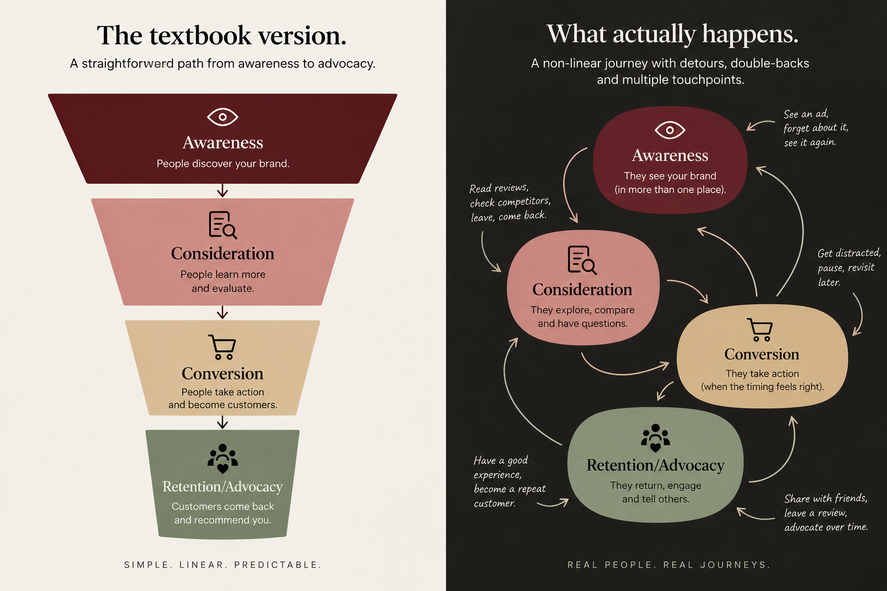
Is the Marketing Funnel Dead? The Modern, Non-Linear Reality
No, but it’s a map, not a literal path. Real buyers loop back, skip stages, and self-educate long before they ever talk to a brand.
A B2B buyer might read a comparison article, forget the brand for three months, see a retargeting ad, check reviews, and only then request a demo. That doesn’t move down a funnel in order. It moves in circles.
A few reasons the straight-line version breaks down:
- Self-education. Buyers research on their own through search, forums, and peer recommendations, often before a brand’s own funnel content ever reaches them.
- Non-linear paths. People re-enter earlier stages. Someone can be in consideration for one product line and awareness for another, from the same company, at the same time.
- Multiple discovery paths. Younger buyers can discover brands through short-form video, creators, social platforms, search and recommendations. Some journeys move from discovery to purchase quickly, while others involve repeated research and comparison.
Keep the stages as a planning tool for what content to create. Drop the assumption that people move through them one at a time.
How AI Works at Each Stage of the Funnel
AI doesn’t replace the funnel. It changes how efficiently marketers work at each stage.
| Funnel stage | Where AI helps | Example |
| Awareness | Targeting and content generation | AI can help identify high-propensity audiences and optimize ad targeting based on behavioral and conversion data. |
| Consideration | Personalization and lead scoring | Website content and email sequences adapt to what a visitor has already viewed; AI scores leads by likelihood to buy |
| Conversion | Optimization | AI can analyse experiment results, identify patterns and help marketers optimize landing pages, offers and conversion paths. |
| Retention | Churn prediction | Models flag accounts likely to cancel or lapse, so teams can step in before it happens |
AI is particularly useful for analysing large volumes of behaviural data, identifying patterns and automating repetitive decisions.
Of course, human judgment still matters for decisions involving brand voice, context, ethics or sensitive customer situations.
How to Map Your Own Marketing Funnel
Mapping your funnel is a short exercise, not a project.
- List your touchpoints. Every place a prospect interacts with you: blog, ads, social, email, sales calls, product pages, support tickets.
- Assign each one to a stage. Some touchpoints will belong to more than one.
- Find the leaks. A high bounce rate on a comparison page usually means a consideration leak. A high cart-abandonment rate is a conversion leak.
- Decide the next action for each leak:
- Awareness leak: the content doesn’t match what people are actually searching for
- Consideration leak: not enough proof (case studies, reviews, comparisons)
- Conversion leak: friction in the buying process itself, not the offer
- Retention leak: weak or missing onboarding
Running this once a quarter is usually enough to figure out where a funnel is losing people before it becomes a bigger problem.
Conclusion
Customers don’t move through a funnel because a marketer drew one. They move according to their own questions, habits, timing and circumstances. The funnel is useful precisely because reality is messier than the diagram.
The goal isn’t to force every customer into the same sequence. It’s to understand where people are, what is keeping them from moving forward, and what your marketing can do next. The journey may be non-linear, but the funnel can still give you a way to make sense of it.
The funnel doesn’t predict the customer. It helps you respond to them.
Take this further with Module 8 of the IIM Tiruchirappalli Certificate in AI-Powered Marketing & Growth Strategy (Varsity by InterviewBit): growth marketing, and experimentation.
Frequently Asked Questions
1. What is the difference between a marketing funnel and a sales funnel?
A marketing funnel covers how marketing attracts and develops potential customers, while a sales funnel focuses more closely on qualified prospects and the process of converting them into customers. In businesses where marketing and sales teams work separately, the two funnels may overlap at the point where leads are handed to sales.
2. How do you measure conversion between marketing funnel stages?
Calculate the percentage of people who move from one defined stage to the next. For example, if 1,000 visitors become 100 leads, the visitor-to-lead conversion rate is 10%. Tracking these stage-to-stage rates helps identify where performance changes rather than relying only on the final conversion rate.
3. What is funnel analysis in marketing?
Funnel analysis uses behavioral and conversion data to examine how prospects progress through different stages. It can reveal bottlenecks, unusual drop-offs and differences in conversion between audiences, channels or campaigns.
4. What causes a marketing funnel to leak?
A funnel can leak because of mismatched messaging, weak proof, poor targeting, friction in the buying process, an unclear offer or a gap between what a prospect expects and what the brand provides. The cause usually depends on the stage where the drop-off occurs.
5. Should every marketing channel have its own funnel?
Not necessarily. Channels can contribute to different stages of the same funnel, and customers often interact with several channels before converting. Separate funnel views can be useful when channel behaviour or conversion paths differ enough to require independent analysis.
6. How does attribution work across the marketing funnel?
Attribution connects customer actions or conversions to the marketing interactions that influenced them. This becomes more complicated when a customer encounters multiple channels, returns several times or converts after a long consideration period. The attribution model chosen can therefore change how credit is distributed across the funnel.
7. What is a funnel bottleneck?
A funnel bottleneck is a stage where progression slows significantly compared with the stages around it. Instead of optimising every part of the funnel at once, marketers can use stage-to-stage data to identify the constraint that is having the greatest effect on overall performance.
8. How does a marketing funnel differ for high-consideration purchases?
High-consideration purchases usually involve more research, comparison, multiple interactions and sometimes several decision-makers. As a result, the journey between awareness and conversion can be longer and may involve more content, proof points and sales interactions than a low-consideration purchase.
9. What is the difference between a marketing funnel and a marketing flywheel?
A funnel traditionally represents progression toward conversion, with retention and advocacy added as later stages. A flywheel treats existing customers as an ongoing source of momentum through retention, repeat purchases and advocacy rather than treating conversion as the endpoint. The two are alternative ways of organising marketing activity rather than identical models.
10. Can AI optimize the entire marketing funnel?
AI can support activities across the funnel, including audience analysis, personalisation, experimentation, forecasting and retention modelling. However, optimising the entire funnel still requires marketers to define objectives, interpret results, set constraints and make decisions where context matters.