Conversion Rate Optimization: Tactics That Turn Traffic into Customers

More traffic does not automatically mean more conversions. If visitors are arriving but dropping off before they buy, enquire or sign up, the problem may be what happens after they land.
The right CRO tactic depends on where visitors drop off and what is stopping them from converting. Landing pages need relevance and clarity. Product pages need to reduce purchase uncertainty. Checkout needs to remove friction. Forms need to balance completion with lead quality.
This guide covers practical CRO tactics by page type, then shows how to prioritise, test and measure them.
Conversion Rate Optimization Tactics by Page Type
The best conversion rate optimization tactics are tied to a specific page and conversion problem. A tactic that works for a checkout may have little relevance to a landing page, so start with the job each page needs to perform.
| Page type | Primary CRO goal | Tactics to consider |
| Landing page | Move visitors to the next action | Message match, value proposition, CTA, proof |
| Product page | Reduce purchase uncertainty | Product information, reviews, imagery, delivery details |
| Checkout | Complete the purchase | Fewer steps, cost transparency, payment options |
| Form | Increase qualified submissions | Fewer fields, field order, error handling, CTA |
Landing Page CRO Tactics
Landing page optimization is largely about making the offer clear, relevant and easy to act on. Start with the visitor’s intent, then remove anything that creates unnecessary uncertainty or distraction.
Make the value proposition obvious
Visitors should quickly understand:
- What you offer
- Who it is for
- What problem it solves
- What they should do next
Avoid headlines that sound impressive but leave the actual offer unclear.
Match the page to visitor intent
The promise that brings someone to the page should connect with what they see next.
For example:
Search query → ad or search result → landing-page headline → offer → CTA
A mismatch can create friction even when the page itself is well designed.
Strengthen the primary CTA
Make the desired action specific.
Instead of a generic “Submit”, use language that reflects the actual next step, such as:
- Book a consultation
- Start your free trial
- Get a quote
- Download the guide
Test the CTA rather than assuming one wording will work for every audience.
Put proof near the decision point
Use evidence that addresses the visitor’s likely concerns:
- Customer reviews
- Testimonials
- Case studies
- Ratings
- Certifications
- Client logos
- Relevant results
The goal is not to add as many trust signals as possible. It is to answer the hesitation that is preventing action.
Remove competing actions
If the page has one primary conversion goal, make it visually and strategically clear.
Review:
- Multiple competing CTAs
- Excessive navigation
- Unnecessary pop-ups
- Repetitive sections
- Distracting elements
Do not remove useful information simply to make the page shorter. Remove what interferes with the decision.
Product Page CRO Tactics
Product-page CRO focuses on reducing the uncertainty that prevents someone from buying. The page should provide the information a visitor needs without making them hunt for it.
Improve product information
Depending on the product, make these easy to find:
- Specifications
- Dimensions
- Materials
- Compatibility
- Availability
- Usage information
- Delivery details
- Returns
The right information depends on the questions customers ask before purchasing.
Strengthen product imagery
Use visuals to answer questions that text cannot.
Consider testing:
- Multiple product angles
- Product-in-use images
- Demonstration videos
- Size references
- Zoom functionality
- Comparison visuals
Surface relevant reviews
Reviews can reduce uncertainty by showing how existing customers experienced the product.
Useful elements include:
- Overall rating
- Review count
- Written reviews
- Customer images
- Product-specific feedback
Place relevant proof close to the information or action it supports.
Make price and delivery information clear
Do not force visitors deep into the buying process to discover important costs.
Where possible, clarify:
- Product price
- Shipping charges
- Delivery timelines
- Taxes
- Availability
- Return conditions
Unexpected costs can introduce friction at a point where purchase intent is already high.
Make the purchase action easy to find
The primary action should be obvious.
Depending on the product, this could be:
- Add to cart
- Buy now
- Choose options
- Subscribe
- Request a quote
The CTA should reflect the actual buying journey rather than use generic wording.
Checkout CRO Tactics
Checkout optimization is about removing unnecessary effort and uncertainty when the visitor is already close to purchasing.
Reduce unnecessary steps
Review every checkout field and screen.
Ask:
- Is this information necessary?
- Can two steps be combined?
- Can returning customers use saved information?
- Is account creation required?
- Are there fields that do not affect the transaction?
Shorter is not automatically better. The aim is to remove unnecessary effort.
Make costs visible
Unexpected shipping charges, taxes or fees can disrupt the purchase decision.
Show important costs as early as practical so customers understand what they are paying for.
Offer relevant payment methods
Make commonly used payment options easy to find.
For Indian e-commerce, this may include options such as:
- UPI
- Cards
- Net banking
- Wallets
- Other supported payment methods
Use actual customer behaviour to decide which options deserve priority.
Test guest checkout
Requiring account creation can add friction for first-time buyers.
If accounts are valuable to the business, test how registration is presented rather than assuming that compulsory registration is necessary.
Improve checkout error messages
An error should tell the customer:
- What went wrong
- Which field or step needs attention
- What they should do next
A vague message such as “Something went wrong” gives the customer nowhere to go.
Form CRO Tactics
Form optimization is a balance between reducing effort and collecting enough information to make the conversion valuable.
Remove unnecessary fields
Review every field.
Ask whether you genuinely need information such as:
- Phone number
- Company size
- Job title
- Full address
- Multiple qualification questions
Do not remove fields solely to increase submissions. If the business needs those fields to qualify leads, lead quality matters too.
Test field order
Put straightforward questions before questions that require more thought.
For longer forms, test whether grouping questions or using a multi-step format makes the process easier to complete.
Improve error handling
Good validation helps visitors recover quickly.
Use:
- Specific error messages
- Clear field-level guidance
- Preserved information
- Immediate feedback
Avoid making users complete the form again because of one incorrect field.
Make the CTA specific
The CTA should communicate the outcome.
“Get a quote” tells the visitor more than “Submit.”
The supporting copy can also set expectations:
Get a quote and hear from our team within one business day.
Test form placement
Test where the form appears in relation to:
- The value proposition
- Supporting information
- Social proof
- Product or service details
- The primary CTA
The best placement depends on how much information visitors need before they are ready to convert.
AI-Assisted CRO Tactics
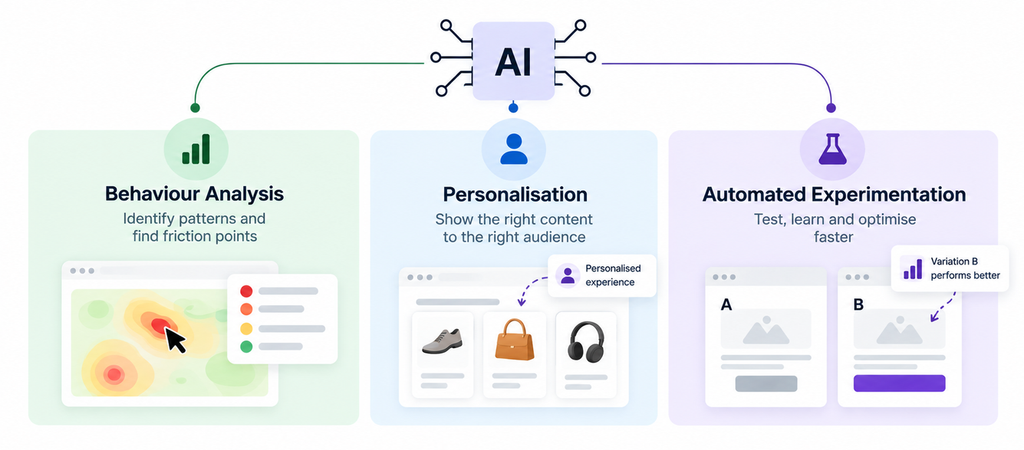
AI can help marketers analyse behaviour, personalise experiences and automate parts of experimentation. It is most useful when it supports a well-defined CRO problem rather than replacing the optimisation process.
Use AI to analyse behavioural patterns
AI can help process large volumes of behavioural data and identify patterns that deserve investigation.
For example:
Observed pattern: Mobile visitors abandon a particular step more often.
CRO question: Is the mobile experience creating unnecessary friction?
Next step: Investigate the page and test a specific improvement.
The analysis generates a direction. It does not automatically prove the cause.
Use AI for personalisation
AI-assisted personalisation can adapt content, recommendations or experiences based on visitor behaviour or audience characteristics.
Potential applications include:
- Product recommendations
- Personalised content
- Audience-specific offers
- Behaviour-based messaging
Measure personalised experiences against an appropriate baseline rather than assuming that more personalisation means more conversions.
Use automated experimentation
Some optimisation systems can dynamically allocate traffic between variations based on observed performance.
This can be useful when the objective and experimentation conditions are well defined.
However, automation does not answer the most important CRO question:
Are you testing the right problem?
Human judgement remains important for experiment design, customer context, brand decisions and interpreting ambiguous results.
How to Prioritise CRO Tactics
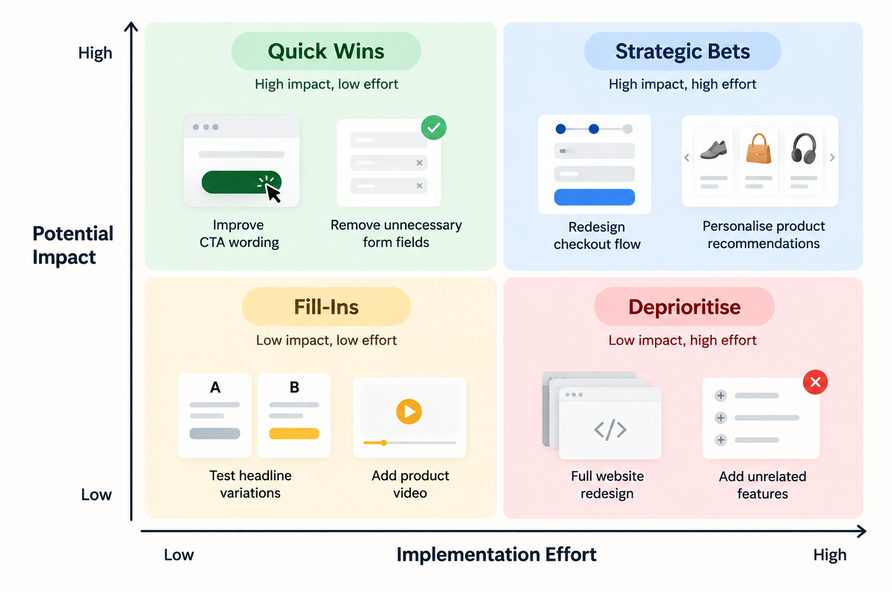
Do not start with the tactic. Start with the conversion problem. Prioritisation prevents teams from spending weeks testing low-impact changes while larger leaks remain unresolved.
Find the biggest conversion leak
Start with your existing data.
Look for:
- High-traffic pages with weak conversion
- Large drop-offs between funnel stages
- Device-level conversion gaps
- High form abandonment
- Checkout abandonment
- Differences between traffic sources
- Changes in conversion over time
Analytics can tell you where the problem occurs.
Use qualitative evidence to investigate why.
Heatmaps, session recordings, customer feedback, usability research and support queries can add that context.
Turn the problem into a hypothesis
A useful hypothesis connects the observed problem with a proposed change.
Weak:
“The form needs improvement.”
Stronger:
“Reducing the form from eight fields to five will increase completion because three fields are not needed to qualify the lead.”
The second version gives you something specific to test and measure.
Rank opportunities by impact and effort
A simple prioritisation framework can help teams decide what to test first.
| Factor | Question |
| Impact | How much could this affect conversions if it works? |
| Evidence | What data indicates there is a problem? |
| Confidence | How strong is the reasoning behind the proposed change? |
| Effort | How difficult is implementation? |
A high-impact problem supported by strong evidence is generally more useful to investigate than a cosmetic change with little evidence behind it.
How to Test CRO Tactics (H2)
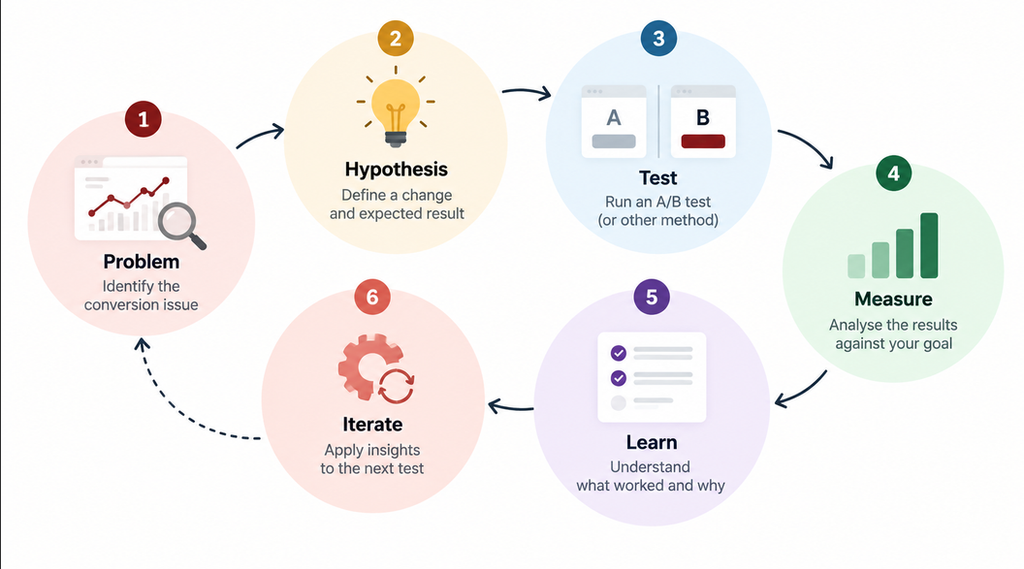
Testing tells you whether a proposed change actually affects the conversion goal. A/B testing is one of the methods used in CRO, but the test needs a clear hypothesis and measurable outcome.
For example:
| Problem | Hypothesis | Test | Primary metric |
| Low form completion | Fewer fields will reduce friction | Shorter form vs current form | Form completion |
| Low product engagement | More product information will reduce uncertainty | Revised product section | Add-to-cart rate |
| Low demo requests | More specific CTA will clarify next step | New CTA vs current CTA | Demo conversion |
| Checkout abandonment | Guest checkout will reduce friction | Guest vs forced account creation | Purchase completion |
Avoid changing unrelated elements simultaneously if you want to understand what caused the result.
Also avoid declaring a winner based on an early difference alone. Sample size, test duration and statistical significance matter when interpreting experiment results.
How to Know Whether a CRO Tactic Worked
Measure the outcome that represents the actual business objective, not simply the metric that moved the most.
Conversion rate
Conversion rate measures the proportion of a defined audience or interaction that completes the chosen conversion.
The exact denominator depends on what you are measuring, so define it consistently before comparing results.
CTR vs CVR
CTR measures whether people click.
CVR measures whether people complete the desired conversion.
A campaign can have a strong CTR but weak CVR.
That may indicate that the ad successfully generates interest while the landing page, offer or subsequent experience fails to convert it.
Micro-conversions
Not every useful action is the final conversion.
Track signals such as:
- Product views
- Add-to-cart actions
- Pricing-page visits
- Form starts
- Checkout starts
- Newsletter sign-ups
- Demo-page interactions
These can help identify where the user journey is breaking down.
Measure downstream quality
A tactic that generates more form submissions is not automatically successful if those submissions are poorly qualified.
Likewise, more clicks do not necessarily mean more revenue.
Where possible, connect CRO experiments to the metric that actually matters:
Click → lead → qualified lead → customer → revenue
Common CRO Mistakes to Avoid
Most CRO mistakes come from optimising without enough evidence or focusing on a metric that does not represent the real business outcome.
Changing what looks wrong
A page can look outdated without being the source of a conversion problem.
Use data and user evidence to decide what deserves attention.
Copying competitors
A competitor’s tactic reflects its own audience, offer, pricing and customer journey.
Use competitor research to generate hypotheses, not as proof that the same change will work for you.
Testing too many things at once
If the headline, CTA, layout, offer and pricing all change simultaneously, the result becomes harder to interpret.
Prioritise the strongest hypothesis.
Stopping tests too early
Early results can fluctuate.
Give the experiment enough data to support a meaningful conclusion rather than stopping because one variation happens to be ahead.
Optimising clicks instead of outcomes
More clicks can look impressive while producing fewer qualified leads or purchases.
Always connect the experiment to the next meaningful business outcome.
Treating a failed experiment as wasted effort
A result that does not improve conversion can still eliminate an assumption.
That learning should inform the next hypothesis.
Conclusion
Conversion rate optimization is often treated as a search for the change that makes the number go up.
But a higher conversion rate is not the end goal if the people converting are not the right people, the experience becomes harder to use, or the tactic cannot be repeated elsewhere.
The real value of CRO is making better decisions about why people do or do not convert.
Once that becomes the focus, every experiment has a purpose beyond winning a test. A failed hypothesis removes one assumption. A successful change reveals something about customer behaviour. Over time, those insights become more valuable than any individual button, headline or landing-page variation.
The best CRO programme therefore does not ask, “What should we change?”
It asks, “What have we learned about the customer, and what should we test next?”
Frequently Asked Questions
What is a good conversion rate for a website?
There is no single conversion rate that is considered good for every website. It depends on the industry, business model, traffic source, audience and type of conversion being measured. The more useful benchmark is your own baseline and how conversion changes over time.
What is a CRO audit?
A CRO audit is a structured review of a website or conversion journey to identify potential barriers to conversion. It can combine analytics, funnel data, heatmaps, session recordings, user feedback and usability research to identify areas worth investigating.
Can CRO work for websites with low traffic?
Yes. Lower-traffic websites can still use CRO, although they may have less data for controlled experiments. In these cases, qualitative research, usability testing, customer feedback and behavioural analysis can provide useful evidence.
Is CRO useful for small businesses?
Yes. Small businesses can use CRO to improve the value generated from their existing website traffic. The focus should be on identifying meaningful conversion problems rather than making large numbers of changes at once.
How often should you run CRO tests?
CRO should be treated as an ongoing process rather than a one-time project. How frequently you can test depends on traffic, conversion volume, available resources and the type of experiment being conducted.
Does CRO affect SEO?
CRO and SEO have different objectives, but they influence the same website experience. CRO changes should therefore be evaluated alongside search visibility, usability, accessibility and organic traffic.
What tools are commonly used for CRO?
Common CRO tools include analytics platforms, heatmaps, session recordings, experimentation platforms, surveys and user-research tools. The right combination depends on the conversion problem being investigated.
What is the difference between CRO and UX?
UX focuses on the broader experience users have with a website or product, while CRO focuses specifically on measurable conversion outcomes. UX research can therefore inform CRO, but the two disciplines are not identical.
Can CRO increase revenue without increasing traffic?
It can. If more existing visitors become customers or qualified leads, a business can generate more value from the same traffic. The actual revenue impact depends on factors such as lead quality, average order value and retention.
How long does CRO take to show results?
There is no fixed timeline. Results depend on factors such as traffic volume, conversion frequency, expected effect size and the type of change being tested. Experiments should be evaluated using enough evidence to support a meaningful conclusion.