MBA in Operations Management: Is It Worth It in 2026?

An MBA in operations management combines general management with the systems behind how businesses produce, move and deliver things.
In short:
- It builds breadth. You study management alongside operations, analytics, supply chain, finance and strategy.
- It can enable a career switch. For fresh graduates and early-career professionals, the degree can provide access to campus placements, new functions and management-track roles.
- It is a significant investment. Time, fees and the opportunity cost of leaving work matter, particularly for professionals already working in operations.
- It is not the same as supply chain management. Operations covers how a business runs and improves its processes; supply chain focuses more specifically on the flow of goods, suppliers and inventory.
This guide breaks down what the degree actually teaches, who it makes sense for, what AI is changing in operations, what the different formats offer, and when a shorter route may make more sense.
Is an MBA in operations management worth it?
It is worth considering when the value you need comes from the degree itself: campus recruiting, a function switch, a strong management-school network or a postgraduate qualification required for a particular career path. If you already work in operations and need current analytical or AI skills rather than a new credential, a shorter applied route may address the gap more directly.
The real question is what is blocking your next move.
Two readers can look at exactly the same programme and make different decisions:
- A final-year graduate trying to enter operations may value structured recruiting and campus access.
- A supply chain professional with five years of experience may already have the domain experience and need stronger analytics, automation or AI capabilities instead.
That distinction runs through the rest of this guide.
What an MBA in operations management teaches
The general management core
An MBA combines operations with broader management subjects such as:
- Accounting and finance
- Economics
- Marketing
- Organisational behaviour
- Strategy
- People management
- Managerial communication
The operations specialisation subjects
Core subjects typically cover:
| Subject area | Focus | Application |
| Operations research | Decision-making and optimisation | Capacity, scheduling |
| Supply chain | Flow of goods and information | Sourcing, planning |
| Inventory management | Stock and availability | Warehousing, retail |
| Quality management | Process improvement | Manufacturing, services |
| Procurement | Supplier decisions | Vendor management |
| Logistics | Movement and distribution | Transport, fulfilment |
| Project management | Planning and execution | Process implementation |
| Operations strategy | Operations and business goals | Leadership |
Source: IIM Mumbai’s current curriculum includes operations research, purchasing and supply management, warehouse and logistics management, manufacturing systems and operations strategy.
What most syllabi don’t cover
A syllabus may not reflect the latest tools used on the job.
Before enrolling, check:
- How recently the curriculum was updated
- Practical projects and real datasets
- Analytics and AI coverage
- Industry-based assignments
Curriculum currency matters particularly as technology changes the skills expected from operations professionals.
Who should choose an operations MBA?
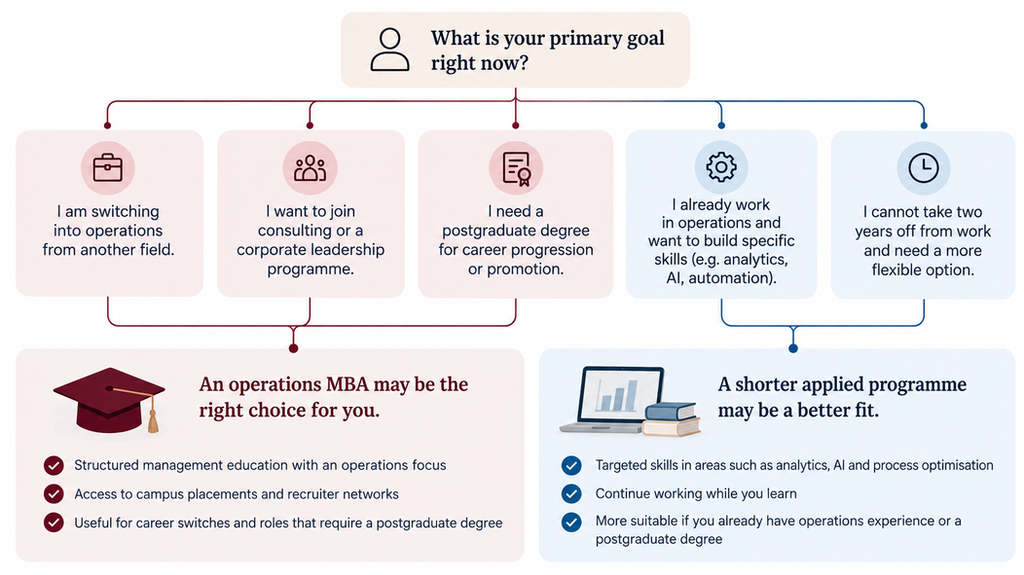
The degree has its clearest value when you need something a shorter skills programme cannot provide: a structured career switch, campus recruiting, a management-school network or a postgraduate qualification tied to your career path.
You are switching function and need campus placement access
If you are entering operations from another field, the challenge may be access to the first role.
A full-time management programme can combine formal training with internships, peer networks, placement processes and recruiter access. Those mechanisms are fundamentally different from completing a short course while remaining in your current role.
For a career switcher, that difference can matter more than the number of certificates on a CV.
You are targeting consulting or a corporate leadership programme
Some career paths use structured management recruitment and postgraduate qualifications as part of their screening process.
It is crucial to verify the actual requirement for the programme or employer you are targeting. Do not assume that every consulting or leadership role requires an MBA, and do not assume that a certificate will be treated as equivalent.
Check the employer’s current careers information and the eligibility criteria for the specific role.
You want the network and the brand
Beyond the syllabus, a strong management programme can provide:
- Alumni relationships
- Peer learning
- Industry exposure
- Recruiter access
- Faculty relationships
Institute reputation also varies considerably. NIRF’s 2025 Management rankings, for example, provide an official government ranking framework rather than requiring you to rely on an unofficial “top MBA colleges” list.
IIM Mumbai is a particularly relevant example for operations. The institute, formerly NITIE, has a long history in industrial engineering and management and currently identifies Operations Management among its functional areas.
Your pay grade or promotion track requires a postgraduate degree
In some organisations, progression rules can explicitly specify educational qualifications.
If that is your situation, do not rely on assumptions.
Ask HR for the written eligibility or promotion criteria for the target grade and check:
- Whether a postgraduate qualification is required.
- Which qualifications are accepted.
- Whether online or distance qualifications are included.
- Whether the requirement applies to the specific grade you are targeting.
If the degree is a formal requirement, a short skills programme solves a different problem.
How AI has changed what operations teams actually do
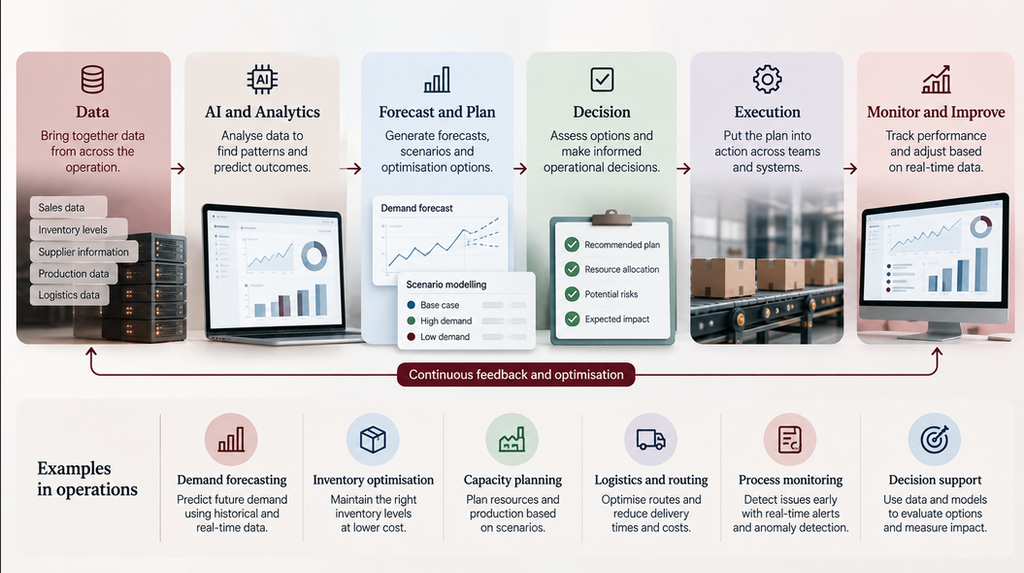
AI is shifting operations work towards forecasting, optimisation, exception management and data-supported decisions, while increasing the value of people who can interpret outputs and apply them to real operating environments.
The World Economic Forum’s Future of Jobs Report 2025, based on employer survey data across 55 economies, identifies AI and information processing as one of the major technologies expected to transform businesses through 2030. It also identifies AI and big data among the fastest-growing skills and highlights resource management and operations among important skill gaps between growing and declining roles.
Where AI is changing operations workflows
Consider the difference between the old workflow and the emerging one.
| Operations task | Traditional approach | AI/data-enabled approach |
| Demand forecasting | Historical spreadsheets | Model-assisted forecasts |
| Inventory planning | Manual calculations | Data-driven optimisation |
| Fulfilment exceptions | Manual monitoring | Automated alerts and prioritisation |
| Supplier risk | Periodic review | Continuous data analysis |
| Routing | Rule-based planning | Algorithmic optimisation |
| Capacity planning | Static assumptions | Scenario modelling |
The technology does not eliminate the need for operational judgement.
Someone still needs to ask whether the data is reliable, whether the assumptions make sense and whether the recommendation works in the real operating environment.
What AI changes for operations professionals
The skill is not simply using AI. It is knowing:
- What problem to give the tool
- Which data matters
- Whether the output is credible
- What operational constraints apply
- When human intervention is required
- How to turn an output into an operational decision
What hiring managers now need to see
A modern operations profile can therefore combine:
Operations knowledge + analytical thinking + technology literacy + business judgement
That combination is different from simply adding “AI” to a résumé.
Who is better served by a shorter, AI-focused route?
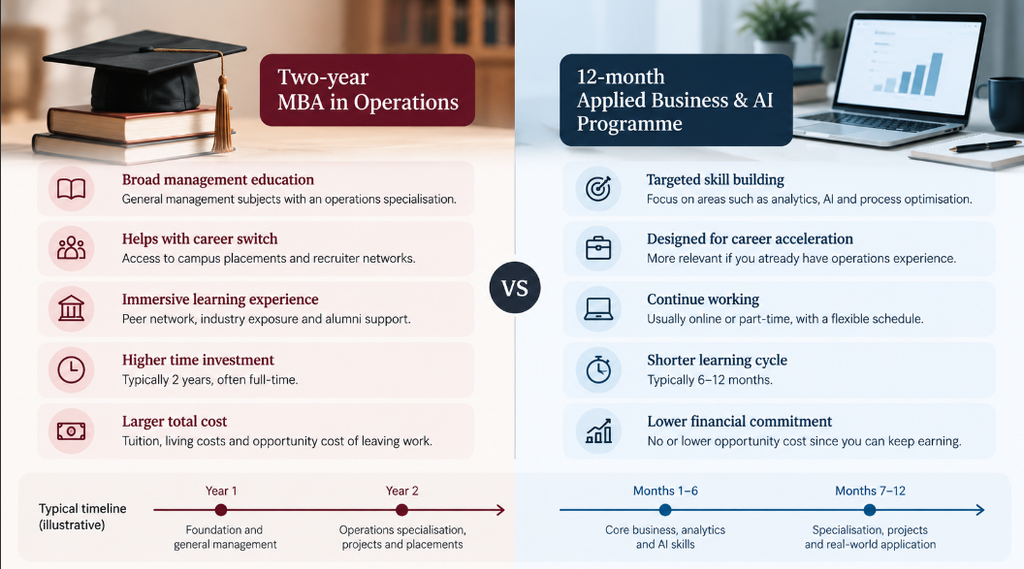
A shorter applied programme can make more sense when you already have operations experience, cannot leave work for two years, or already hold a postgraduate degree and need current skills rather than another general management credential.
You are already in operations and want to move up, not in
You already have the part a career switcher needs to acquire: domain experience.
Your next gap may instead be:
- Data analysis
- Forecasting
- AI applications
- Automation
- Decision modelling
- Business intelligence
- Process optimisation
Match the programme to the actual skill gap before enrolling.
You cannot stop earning for two years
The headline fee is not the full cost of a full-time MBA.
Use this calculation:
Total MBA cost = tuition + living costs + other programme costs + foregone salary
For example, if you currently earn ₹X per year, the opportunity cost of leaving work is approximately:
₹X × years away from work
Then add the actual programme costs.
This gives you a more realistic comparison with an online or part-time route that lets you continue earning.
You already hold a postgraduate degree
A second general-management qualification should have a clear purpose.
Ask:
- What signal is the second degree adding?
- What specific role does it unlock?
- Does the employer require it?
- Would a specialised skill programme address the actual gap?
- Would a portfolio of applied projects be more useful?
If the answer is primarily “I need current operations and AI skills,” a targeted route may be more directly aligned with the problem.
Formats, and how to check a programme is actually recognised
The right format depends on whether you need campus recruiting, flexibility, executive-level learning or the ability to continue working. Recognition should be checked against the exact programme and award, not just the institution’s name.
Full-time, part-time, executive, online and distance
| Format | Main advantage | Main trade-off | Typically suits |
| Full-time | Campus, immersion, recruiting | Time away from work | Career switchers |
| Part-time | Continue working | Longer or less immersive | Working professionals |
| Executive | Designed around experience | Eligibility can be narrower | Experienced professionals |
| Online | Flexibility | Less campus immersion | Professionals who cannot relocate |
| Distance/ODL | Flexible study structure | Requires careful recognition check | Specific working/study situations |
There is no universally correct format.
The question is what you need the programme to do for your career.
MBA or PGDM: the difference that matters
An MBA and a PGDM are not simply two names for the same qualification.
An MBA is a university degree. A PGDM is a postgraduate diploma awarded by an autonomous institution, with its regulatory status and implications depending on the institution and programme.
That distinction can matter for:
- Further academic study
- Eligibility for specific roles
- Government requirements
- How the qualification is formally classified
Check the exact award name rather than assuming that every two-year management programme awards an MBA.
How to verify an online or distance MBA before you pay
For an online or ODL programme, check the specific programme and academic session on the UGC Distance Education Bureau portal.
The UGC DEB maintains lists of recognised and entitled institutions and programmes. Its current portal includes programme-level information for online and ODL offerings.
Use this checklist:
- Find the institution on the UGC DEB portal.
- Confirm the relevant academic session.
- Check that the exact programme is listed.
- Confirm the mode, such as Online or ODL.
- Ask the institute for its current entitlement or recognition documentation.
- Check the exact award name that will appear on the final certificate.
- If it is a PGDM, separately verify the relevant AICTE status.
- Keep the documentation you checked before paying.
UGC’s current 2026-27 instructions also distinguish online and ODL eligibility and require institutions to meet specified conditions for recognition.
Getting in, and what it costs
Admission requirements and fees vary substantially by institute, so compare programmes using the exact intake year’s official admissions and fee information rather than relying on generic cut-offs or fee ranges.
Entrance exams
Depending on the institute, management programmes may consider exams such as:
- CAT
- XAT
- CMAT
- MAT
- SNAP
- NMAT
But acceptance, weightage and eligibility differ by programme.
Check the institute’s official admissions page for the intake you are applying to. Do not use an old cut-off from a blog as a proxy for current eligibility.
Eligibility
Eligibility can differ by programme and may consider:
- Bachelor’s degree
- Minimum academic performance
- Entrance score
- Work experience
- Interview or selection stages
For executive programmes, work experience may be an explicit requirement.
Calculate the real cost
Do not compare programmes using tuition alone.
Calculate:
Total cost = tuition + accommodation + travel + study expenses + exam/application costs + foregone income
For a working professional, the final component can be substantial.
For an online programme, compare the tuition and time commitment against the income you can continue earning while studying.
Roles, the career ladder and what to expect from pay
An operations MBA can lead to roles across supply chain, procurement, logistics, manufacturing, quality, fulfilment and broader operations, but the outcome depends on prior experience, institute, role, sector and location.
A typical progression can look like:
Executive / Analyst → Assistant Manager → Operations Manager → Plant or Regional Head → COO
The actual path is not linear. Someone in e-commerce fulfillment may follow a very different route from someone in manufacturing or healthcare operations.
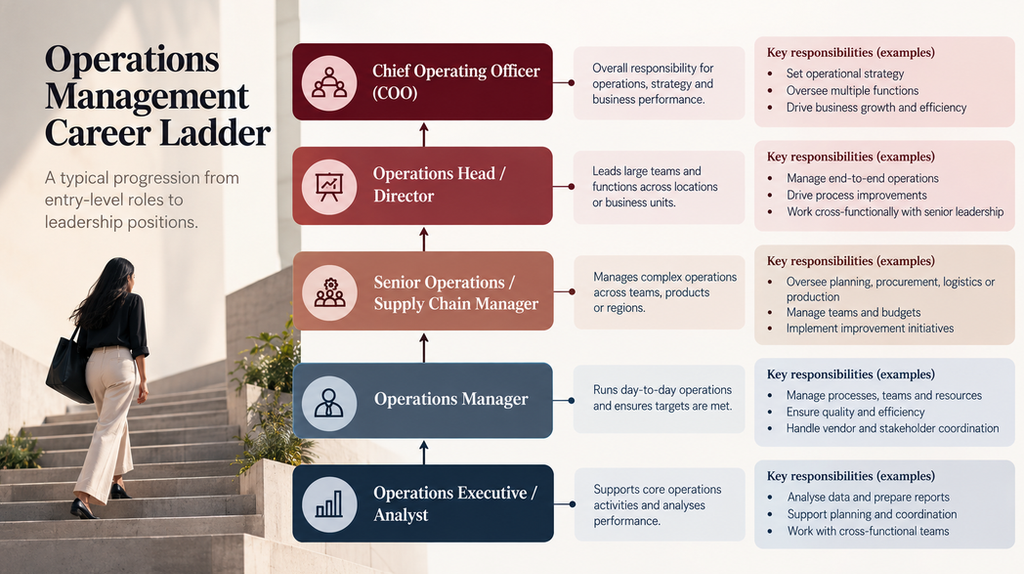
Roles after an operations MBA
Potential roles include:
- Operations analyst
- Operations manager
- Supply chain analyst
- Procurement manager
- Logistics manager
- Quality manager
- Warehouse or fulfilment lead
- Project manager
- Plant operations roles
- Operations consulting roles
Where operations professionals work
Operations skills are relevant across sectors including:
- Manufacturing
- E-commerce
- Retail
- Logistics and 3PL
- Healthcare
- Consumer businesses
- Quick commerce
- Industrial businesses
What actually drives progression
The title alone does not determine progression.
Career growth can depend on:
- Scope of responsibility
- Team size
- Cost or revenue impact
- Process improvements delivered
- Analytical capability
- Industry knowledge
- Leadership responsibilities
- Ability to work across functions
For salary research, use programme-specific placement reports for institute outcomes and clearly dated market data for broader salary information. Avoid treating a single salary number as the expected outcome for every graduate.
The five questions that settle it
The right choice becomes clearer when you identify whether your problem is access, credentials, skills, time or career direction.
1. Am I entering operations, or already in it?
If you’re switching in, consider whether you need structured recruiting and formal training. If you’re already in operations, identify the specific barrier to your next move.
2. Do I need a hiring channel, or a skill?
A full-time MBA can provide access to internships, placements and recruiters. A shorter programme focuses on specific skills. Decide which gap you actually need to close.
3. Can I stop earning for one to two years?
Calculate the total opportunity cost, not just tuition:
Total cost = tuition + living costs + other expenses + foregone income
If leaving work is not practical, compare part-time, executive and online options.
4. Is a degree written into my promotion criteria?
Check your employer’s written requirements. Confirm whether a postgraduate degree is required, which qualifications are accepted, and whether online or distance qualifications count.
5. What was my last rejection actually about?
Look at your most recent career setback or stalled progression. Was the gap:
- Postgraduate qualification?
- Operations experience?
- Analytical skills?
- AI or technology exposure?
- Leadership experience?
- Industry knowledge?
- Recruiter access?
The answer tells you what you need next: a degree, a hiring channel, or a specific skill set.
If you are switching into operations, need campus access or need a postgraduate qualification for your career path, a full MBA can address those requirements.
If you are already in operations, need current applied skills and cannot leave work, a shorter applied route may address the problem with a different time commitment.
Conclusion
An MBA in operations management is not valuable simply because it carries the MBA label. Its value comes from what it changes in your career.
If you need access to a new function, campus recruiting, a management-school network or a qualification that your career path explicitly requires, the degree can solve a structural problem. If you already have the experience and only lack newer analytical or AI capabilities, the problem is different.
The real decision is not whether an MBA is worth it. It is whether an MBA solves the problem you actually have.
That is the point worth carrying into any programme brochure, admissions call or fee comparison.
Already working in operations and don’t want to take two years out of your career? Scaler’s Online PGP in Business & AI offers a 12-month online format with an AI-Powered Supply Chain Management specialisation. If you’re switching into operations or need campus placement access, a full-time MBA may be the more relevant route.
Frequently Asked Questions
1. Is work experience required for an operations MBA?
Not always. Requirements vary by programme. Full-time MBAs may admit fresh graduates, while executive programmes commonly have work-experience requirements. Always check the eligibility criteria for the specific programme and intake.
2. Can I switch to operations from another field?
Yes. A background in engineering, IT, finance, marketing or another function does not automatically prevent a move into operations. The more important questions are whether the programme provides relevant training and whether its recruiting opportunities match the career switch you want to make.
3. Can non-engineers study operations management?
Yes, depending on the programme’s eligibility rules. Some operations programmes are designed with technical or engineering backgrounds in mind, while others accept graduates from broader academic backgrounds. Check the specific institute rather than assuming that engineering is mandatory.
4. Is an operations MBA useful for manufacturing careers?
Yes. Operations education can cover areas directly relevant to manufacturing, including quality, capacity planning, inventory, process improvement, production systems and operations strategy. The relevance depends on the role and the depth of these subjects in the programme curriculum.
5. Is Six Sigma useful for an operations career?
Six Sigma can be useful for roles involving quality, process improvement and operational efficiency. However, it is a specific methodology rather than a substitute for broader operations knowledge, analytical ability or practical experience.
6. What projects can I do in operations management?
Useful projects can focus on demand forecasting, inventory optimisation, capacity planning, process improvement, warehouse operations, supplier performance or logistics. Projects using real operational data can also demonstrate analytical and problem-solving ability.
7. Does operations management involve a lot of mathematics?
The quantitative level varies by programme. Operations research, forecasting, statistics, optimisation and analytics can involve mathematical or statistical methods. You do not necessarily need an advanced mathematics background, but comfort with quantitative reasoning is useful.
8. What is the difference between operations and BPO operations?
Operations management covers the planning and improvement of processes that produce or deliver goods and services. BPO operations specifically concerns outsourced business or back-office service processes, such as customer support, transaction processing or other managed workflows.
9. Can an operations MBA lead to consulting?
It can. Operations knowledge can be relevant to consulting work involving process improvement, supply chain, cost optimisation, transformation and operational strategy. Access to consulting roles, however, depends on the institute, recruitment process, candidate profile and specific employer.
10. What should I look for in an operations MBA curriculum?
Look beyond the specialisation title. Check whether the curriculum covers operations research, inventory, procurement, logistics, quality, forecasting, analytics, operations strategy and practical projects. Also check how recently the curriculum was updated.
11. Is an operations MBA suitable for someone with several years of experience?
It depends on what you need next. An experienced professional may benefit from the degree when a credential, career transition, recruiting access or management qualification is the actual requirement. If the gap is mainly technical or analytical, a targeted programme may address it differently.
12. What industries hire operations professionals?
Operations roles exist across manufacturing, e-commerce, retail, logistics, healthcare, consumer businesses, industrial companies and other sectors. The specific roles available depend on the candidate’s experience, skills, sector knowledge and recruitment channel.
13. Can I pursue an operations MBA without leaving my job?
Part-time, executive, online and distance formats can allow professionals to continue working. The trade-offs differ in flexibility, campus exposure, recruiting access, duration and eligibility, so compare the format with your career objective rather than choosing based on flexibility alone.
14. What should I consider besides the MBA fee?
Consider the total cost, including tuition, accommodation, travel, study expenses and foregone income. Also consider the time commitment, recruiting access, curriculum, recognition, alumni network and the specific career outcome you expect from the programme.