Operations Manager Career Path in India: The Levels, the Money, and the AI Skills That Now Decide Who Gets Promoted

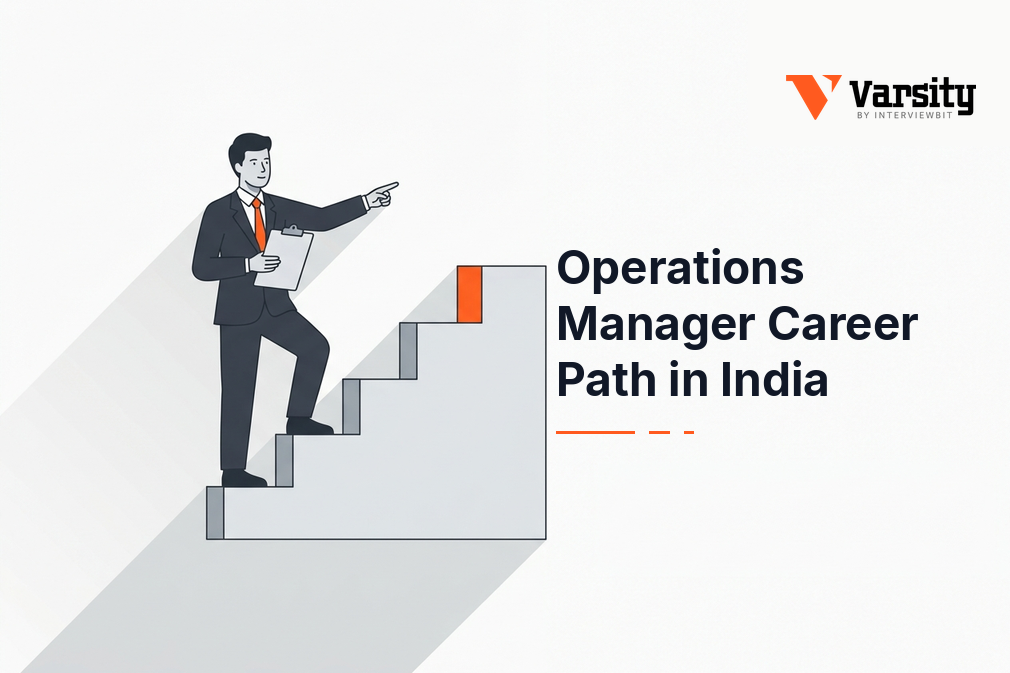
The operations manager career path in India can move from operations analyst or executive to operations manager, senior manager, head of operations and, in larger organisations, COO. Progression depends on the scope you own, including people, budgets, processes and business decisions, rather than years of experience alone.
The word “operations” covers several career tracks. Business operations works across functions, supply chain covers planning and logistics, plant operations manages production, and BPO or back-office operations focuses on service delivery. The skills and progression can differ across each.
What Is the Operations Manager Career Path in India?
The usual path is operations analyst or executive → operations manager → senior or divisional manager → head of operations → COO. However, the route is not fixed. Professionals can also move into supply chain, product operations, consulting, analytics or general management as their scope expands.
Your career path will depend on the type of operations you manage and the size of your responsibility.
How to Become an Operations Manager in India
You can enter operations through analyst, executive, process, management-trainee or supply-chain roles and build towards management by taking responsibility for measurable outcomes.
Which Jobs Can Lead to an Operations Manager Role?
Common entry points include:
- Operations Analyst
- Operations Executive
- Management Trainee
- Process Associate
- Supply Chain Analyst
- Logistics Coordinator
- Workforce Management Analyst
The first step is less about having the perfect title and more about gaining exposure to processes, KPIs, reporting, problem-solving and operational decision-making.
What Should You Learn in Your First Operations Role?
Focus on the metrics and processes behind your function.
You should understand:
- How the process works
- How performance is measured
- Where delays or errors occur
- What drives cost
- How escalations are handled
- How your work affects the wider operation
Once you can improve a process rather than simply follow it, you have stronger evidence for the next role.
What are the five levels in an operations manager career path?
The five broad levels move from executing processes to owning business-wide outcomes. At each step, the focus shifts from completing work to managing people, costs, decisions and increasingly complex operations.
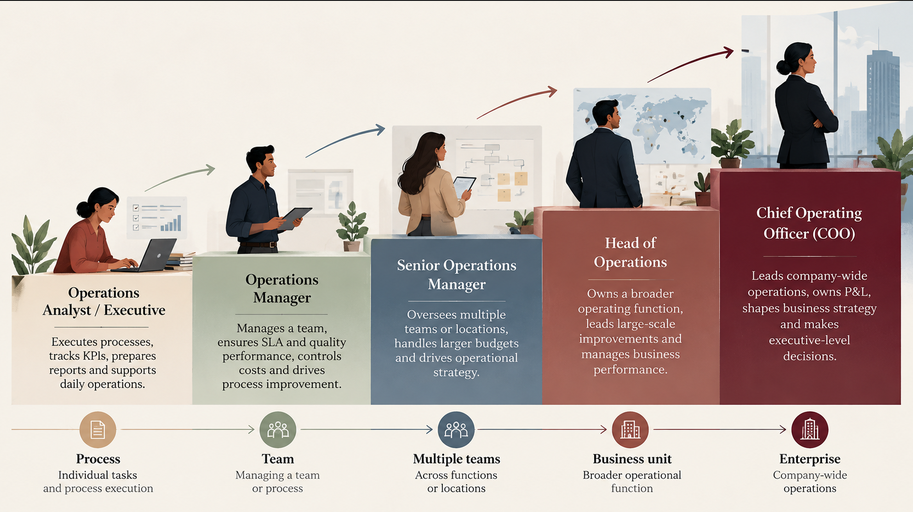
Operations Analyst or Operations Executive
At this stage, the focus is on executing processes and understanding how the operation works.
Typical responsibilities include:
- Tracking operational KPIs
- Preparing reports
- Following SOPs
- Handling process issues
- Supporting daily operations
- Maintaining operational data
The next step comes when you can take ownership of a process or measurable outcome rather than only completing assigned tasks.
Operations Manager
An operations manager is responsible for the performance of a team, process, function or operating unit.
The role can include:
- Team management
- SLA and quality performance
- Capacity planning
- Cost control
- Process improvement
- Escalation management
- Stakeholder coordination
The important shift is from doing the work to being accountable for how the work performs.
Senior Operations Manager or Divisional Manager
At this level, responsibility usually expands across multiple teams, processes, locations or business units.
The focus moves towards:
- Larger teams
- Larger budgets
- Cross-functional decisions
- Operational strategy
- Performance across multiple units
- Process standardisation
You are no longer managing only the output of one team. You are managing how several parts of the operation work together.
Head of Operations
A Head of Operations typically owns a broader operating function or multiple business units.
The role can involve:
- Operating strategy
- Large-scale process improvement
- Budget ownership
- Leadership hiring
- Vendor management
- Business performance
- Cross-functional decision-making
At this level, the question changes from “Is the team performing?” to “Is the operating model working?”
Chief Operating Officer (COO)
A COO operates at an enterprise level and works across functions rather than one operational area.
The scope can include:
- Company-wide operations
- P&L responsibility
- Business strategy
- Organisational design
- Major investments
- Executive-level decisions
Not every operations professional follows this route. Many build specialist careers in supply chain, consulting, product operations or analytics instead.
What Is the Salary of an Operations Manager in India?
There is no reliable five-level salary ladder because salary databases use different job titles, samples and methodologies. Current India data shows substantial variation even for the same Operations Manager title.
Indeed reports an average base salary of ₹32,420 per month for Operations Managers in India, based on 271 reported salaries and updated 5 June 2026.
Glassdoor’s current India data reports an average base pay of about ₹10 lakh per year for Operations Managers, with a base-pay range of ₹6 lakh to ₹17.6 lakh. Its reported Senior Operations Manager trajectory is also higher, but these figures should not be treated as guaranteed promotion bands.
| Role level | Salary reference | What to keep in mind |
| Operations Manager | ₹32,420/month average base salary on Indeed | Based on 271 reported salaries, updated June 2026 |
| Operations Manager | ₹10 lakh/year average base pay on Glassdoor | Different methodology and sample from Indeed |
| Head of Operations | Wide variation in current reported salaries | Scope, industry, location and company size have a major effect |
The difference between sources is itself useful. Do not treat one salary number as the market rate for every operations manager.
What Gets an Operations Manager Promoted?
Promotion usually follows an increase in ownership. The strongest signals are the size of the business number you manage, the people you lead and the decisions you can make without escalation.
Use these three questions to assess your current level:
- What number do you own?
It could be cost, revenue, throughput, productivity, inventory or SLA performance. - How large is your span of control?
Look at both direct reports and the wider team whose work you influence. - What decisions can you make independently?
More decision rights usually mean greater operational responsibility.
A useful test is to write down the largest cost line or operational metric you personally influence.
If you can explain its movement, identify its root causes and make decisions that change the outcome, you are demonstrating more than task-level experience.
How Do Operations Career Paths Differ Across Industries?
Business operations is generally broader and cross-functional. It can lead towards strategy, general management or product operations.
Supply chain operations has more specialised routes through demand planning, procurement, inventory, logistics and fulfilment.
Plant operations focuses on production, quality, maintenance, safety, capacity and cost at a manufacturing site.
BPO and back-office operations often centre on SLAs, workforce management, quality, productivity, client relationships and escalations.
The title “Operations Manager” can therefore describe very different jobs. Always assess the scope of the role rather than the title alone.
What Does an Operations Manager Do Day to Day?
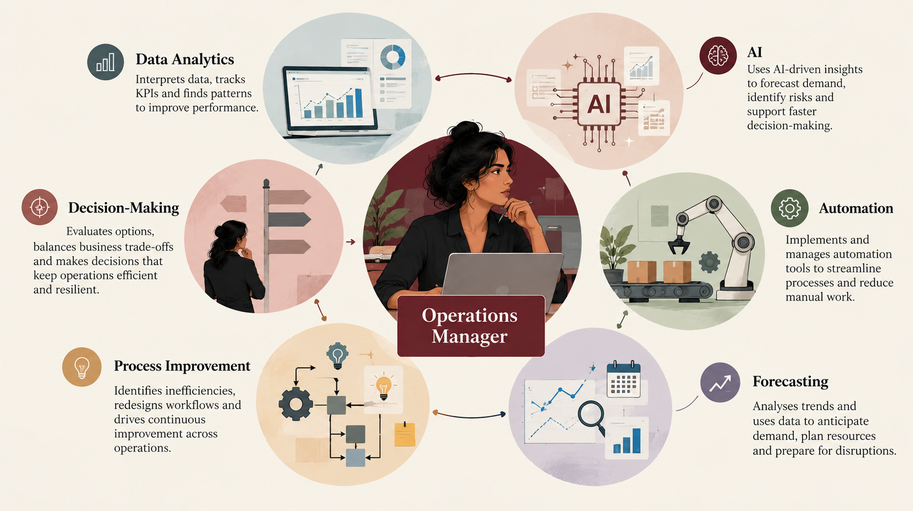
Operations managers are spending less time on manual information handling as systems take over more forecasting, monitoring and workflow tasks. The manager’s role increasingly centres on interpreting information, setting rules and deciding what happens when the system encounters an exception.
Which Operations Tasks Are Moving to Automation?
| Earlier workflow | What systems handle now | What the manager decides |
| Manual demand planning | Forecast generation and scenarios | Whether the forecast is realistic |
| Spreadsheet replenishment | Stock alerts and recommendations | What inventory risk is acceptable |
| Manual scheduling | Automated capacity-based scheduling | Which constraints take priority |
| Manual exception checks | Alerts and exception queues | Which issues need intervention |
| Supplier monitoring | Risk and performance dashboards | Whether to escalate or renegotiate |
Current operations roles reflect this shift. An Amgen Strategic Planning & Operations Manager role in Hyderabad asks for analytics, dashboarding, forecasting, process optimisation, digital enablement and Power BI, alongside automation and AI productivity tools.
A Bank of America Senior Operations Manager role in Gurugram focuses on process redesign and AI-enabled transformation, including identifying suitable business problems, redesigning workflows and measuring outcomes.
Which Operations Skills Are Becoming More Valuable?
Judgement becomes more important when systems produce the first answer.
An operations manager may need to decide whether a forecast reflects actual demand, whether a supplier problem needs escalation or whether an automated workflow is creating the wrong outcome.
Process design also matters.
Someone still needs to decide:
- Which tasks should be automated
- Which exceptions need human review
- What rules the system should follow
- When an issue should be escalated
- How success should be measured
The valuable skill is not simply knowing that automation exists. It is knowing where automation should stop and human judgement should begin.
What Skills Does an Operations Manager Need in 2026?
Current operations postings increasingly combine operations expertise with analytics, automation, forecasting, digital transformation and AI-enabled workflows. The most useful skills are practical: interpreting outputs, defining workflows, working with data teams and using the systems already deployed by the organisation.
Can you evaluate an AI or model output?
An operations manager should be able to question a model output rather than accept it automatically.
Check:
- What data produced the result?
- Which assumptions drive it?
- What changed from the previous forecast?
- Does it match operational reality?
- What happens if an assumption is wrong?
The skill is critical interpretation, not model building.
Can you specify an automation?
A useful automation needs a clear workflow:
Input → rule → action → exception → escalation
For example, a system may flag a possible stockout. The operations manager needs to define when the alert triggers, what action follows and when a human needs to intervene.
Can you work with a data team?
Operations managers increasingly need to turn business problems into measurable questions.
Instead of:
“Can AI reduce delays?”
Ask:
“Which order characteristics are associated with delays beyond the SLA, and which of those factors can we control?”
The second question can be investigated, measured and acted on.
Can you use the tools your organisation runs?
Tool requirements vary by employer.
Current postings mention platforms such as Power BI, ERP systems, Power Platform tools, workflow automation and analytics systems.
The goal is not to collect AI tools.
It is to understand how the tools your organisation uses affect operational decisions.
How data-heavy is operations management now?
Operations managers do not need to become data scientists, but they need enough data fluency to interrogate performance.
Useful measures include:
- Forecast accuracy
- MAPE
- Throughput
- Cost per unit
- OTIF
- Inventory turns
- Shrinkage
- Productivity
- SLA performance
The important step is connecting the metric to the operational cause.
“Performance fell” is an observation.
“Performance fell because order mix changed while staffing stayed flat” is an operational diagnosis.
Do AI Skills Increase Operations Manager Salaries?
AI skills are associated with higher pay in broader labour-market datasets, but there is no reliable published figure for an AI-skills salary premium specifically for operations roles in India. General AI salary figures should therefore not be presented as an operations benchmark.
Lightcast’s Beyond the Buzz analysis found that more than half of job postings requesting AI skills were outside IT and computer science. It also reported that postings mentioning AI skills had salaries 28% higher, representing roughly $18,000 more per year. The analysis covered more than 1.3 billion job postings.
PwC’s 2026 Global AI Jobs Barometer reported a 62% average wage premium for AI skills across its analysis of more than one billion job advertisements in 27 countries and territories. The reported premium varied significantly by industry, so it is not an operations-specific or India-specific figure.
India-specific evidence also shows AI learning spreading beyond traditional engineering. Scaler’s 2026 report, based on 11,444 professionals, says nearly 25% of its AI learners come from non-technical fields and that nearly half of AI-enabled career outcomes are outside traditional engineering roles. This is cohort data, not an operations salary benchmark.
The practical takeaway is narrower: AI skills are becoming relevant beyond technology roles, but the market does not currently support a precise salary premium for operations professionals in India.
What Qualifications Do You Need to Become an Operations Manager?
There is no single qualification that defines an operations manager career. The value of a degree or certification depends on your function, career stage and the role you want next.
Is an MBA Required to Become an Operations Manager?
An MBA can help with a career switch, structured management education or access to certain recruitment channels. It is not a universal requirement for moving into operations management.
For someone already working in operations, measurable results, leadership and functional expertise can matter more directly to the next promotion.
Are CPIM and CSCP Useful for Operations Careers?
ASCM’s CPIM and CSCP are particularly relevant to supply chain professionals.
CPIM focuses on areas such as planning and inventory management. CSCP covers broader end-to-end supply chain topics.
They are less directly relevant if your career is entirely in areas such as BPO, workplace operations or general business operations.
Is Lean Six Sigma Useful for Operations Managers?
Lean Six Sigma can be useful when your work involves process improvement, quality, waste reduction or variation.
ASQ offers Six Sigma certifications at different levels, including Yellow Belt, Green Belt and Black Belt.
The strongest use of the certification is applying it to an actual operational problem.
Are AI and Analytics Courses Useful for Operations Professionals?
They can be useful when they build a skill you can apply immediately.
For operations professionals, useful outcomes include:
- Building a performance dashboard
- Analysing operational data
- Creating a forecasting workflow
- Mapping an automation
- Measuring process performance
A practical project gives you something concrete to demonstrate in an interview or performance review.
What Is the Next Role After Operations Manager?
An operations manager can move upward into operations leadership or laterally into supply chain, product operations, consulting, analytics or general management. The strongest route depends on the type of responsibility you already own.
General management
General management expands your scope beyond one operational function.
The focus moves towards broader business performance, including revenue, costs, customers and multiple functions.
Supply chain leadership
Operations managers with experience in planning, procurement, inventory or logistics can move into supply chain leadership.
The transition is easier when you already understand forecasting, supplier performance, inventory and end-to-end fulfilment.
Product operations
Product operations sits between product, technology and business teams.
The work can involve improving workflows, adoption, reporting, customer processes and cross-functional execution.
Consulting
Operations experience can transfer into consulting when you have evidence of solving measurable business problems.
Useful examples include:
- Process redesign
- Cost reduction
- Service improvement
- Operating-model changes
- Operational transformation
Analytics management
Operations professionals can move towards analytics management when they combine domain knowledge with strong data skills.
The bridge is usually built through dashboards, forecasting, KPI analysis, business questions and data-driven decision-making.
COO or enterprise leadership
The COO route requires a much wider operating view.
The role can involve financial ownership, organisational design, strategy, systems, hiring and cross-functional leadership.
The key shift is from managing an operation to designing how the organisation operates.
How can you audit your operations skills in 10 minutes?
A quick skills audit can show whether your current capabilities match the next role you want. Focus on ownership, automation, data, systems and decision-making rather than collecting a long list of courses.
| Capability | Question to ask yourself | If the answer is no |
| Ownership | Do you personally own a measurable number? | Take responsibility for a KPI |
| Automation | Can you define an automation from trigger to escalation? | Map one manual workflow |
| Forecasting | Can you explain why a forecast missed? | Learn forecast accuracy and MAPE |
| Data | Can you turn an operational problem into a data question? | Practise writing measurable questions |
| Systems | Do you understand your ERP or WMS beyond your own screen? | Learn the wider process flow |
| Process improvement | Can you identify the root cause of a recurring issue? | Practise RCA, Lean or Six Sigma |
| Decision-making | Can you make operational calls without escalating everything? | Clarify which decisions you can own |
If most answers are “yes”, your next step may be about expanding scope rather than simply adding another certificate.
If several answers are “no”, use the gaps to build a focused learning plan.
Conclusion
The next step in an operations career is not always another title. It is more ownership.
Look at the role above yours and identify what changes: the size of the team, the financial responsibility, the decisions you can make and the complexity of the problems you handle. Then build the skill that closes that specific gap.
For operations professionals in 2026, that increasingly includes data, automation and AI alongside process and people management. The goal is not to become a technology specialist. It is to become the person who can use technology to make better operational decisions.
FAQs
Who is higher, a general manager or an operations manager?
It depends on the organisation. A general manager usually has broader responsibility for a business unit, while an operations manager focuses more specifically on operational performance. Reporting structures vary by company.
What is the difference between an operations manager and a project manager?
An operations manager oversees ongoing processes and performance, while a project manager is responsible for a defined initiative with a specific scope, timeline and deliverables. Operations management is continuous; project management is usually tied to a specific outcome.
What is the difference between an operations manager and an HR manager?
An operations manager focuses on business processes, delivery and operational performance. An HR manager focuses on people systems such as recruitment, employee relations, compensation and workforce policies.
Which operations roles are closest to analytics?
Operations analytics, business operations, supply chain planning, workforce management and performance management are among the more data-heavy paths. These roles can involve forecasting, dashboards, KPI analysis and operational reporting.
Can an operations manager move into strategy?
Yes. Business operations roles can provide a route into strategy when the role involves cross-functional problem-solving, business performance analysis and decision-making beyond one operational process.
Can an operations manager move into product management?
It is possible, particularly for professionals with experience in product operations, process improvement, customer workflows or cross-functional technology projects. The transition usually requires additional product knowledge.
Can an operations manager work remotely?
Some operations roles can be performed remotely, particularly business operations, technology operations, analytics and service-based roles. Manufacturing, logistics and plant operations generally require more on-site involvement.
What industries hire operations managers?
Operations managers are employed across manufacturing, logistics, retail, healthcare, financial services, technology, pharmaceuticals and business services. The responsibilities and required domain knowledge vary by industry.
What is the difference between business operations and operations management?
Business operations is a broader function that can cover cross-functional processes, planning and business performance. Operations management focuses more directly on managing people, processes and operational outcomes. The exact scope varies by organisation.
How long does it take to become an operations manager?
There is no fixed timeline. Professionals can enter through analyst, executive, process, management-trainee or supply-chain roles and progress as they take ownership of larger teams, processes and measurable outcomes.
Can an operations manager become a COO?
Yes. COO is one possible long-term path, particularly when an operations professional expands from managing a function to owning broader business performance, financial decisions, organisational design and cross-functional strategy.
What should an operations manager focus on when changing companies?
Look beyond the job title. Compare the team size, budget, decision-making authority, operational complexity, business metrics and reporting level. Two Operations Manager roles can represent very different levels of responsibility.