Process Mining Explained: How It Works, What It Costs, and When to Use It

What Is Process Mining?
Process mining reconstructs how a business process actually runs. It reads the timestamped records your existing systems already produce.
Then it shows you the gap between that and how the process is supposed to run.
It has nothing to do with mining coal, minerals, or crypto. Despite the name similarity, it isn’t data mining either. More on that distinction shortly.
Here’s a small, very ordinary example. A company believes its purchase-to-pay process takes five clean steps.
Someone finally pulls the event log and finds forty-plus distinct variants. Half of them involve an invoice getting bounced back to procurement over a mismatch nobody had flagged before.
Nothing dramatic happened. The process was just never as tidy as the flowchart on the wall suggested. That gap, between the flowchart and the log, is the entire point of process mining.
How Process Mining Works, From Event Log to Process Map
The Event Log
This is the one idea everything else in this article rests on, so it gets the most space.
An event log needs exactly three things: a case ID (which instance of the process this row belongs to), an activity (what happened), and a timestamp (when). That’s the floor.
Everything else, cost, region, who touched it, is optional seasoning.
Here’s what one actually looks like, pulled from a single purchase order working its way through the system, rework loop and all:
| Case ID | Activity | Timestamp |
| 4001 | Create Purchase Requisition | 2026-02-03 09:14 |
| 4001 | Approve Purchase Requisition | 2026-02-03 14:02 |
| 4001 | Create Purchase Order | 2026-02-04 08:30 |
| 4001 | Send Invoice for Review | 2026-02-10 11:00 |
| 4001 | Send Back to Procurement (Discrepancy) | 2026-02-10 16:45 |
| 4001 | Correct Purchase Order | 2026-02-11 09:20 |
| 4001 | Match Invoice to PO | 2026-02-12 10:05 |
| 4001 | Post Payment | 2026-02-14 13:40 |
Trace it with a finger. The PO gets created, approved, and turned into an order.
Then the invoice comes back wrong and gets kicked to procurement. It gets fixed, matched, and paid, four days later than it should have been.
That single row, “Send Back to Procurement,” is the whole reason process mining exists. Nobody designs a process with that step in it on purpose.
Where the Event Data Actually Comes From
ERP systems (SAP, Oracle, Dynamics), CRMs, ITSM tools like ServiceNow, ticketing systems, workflow platforms. All of it, in theory.
In practice, this is where most first projects quietly spend the bulk of their time and budget, and nobody warns you about it going in.
The honest part: extraction is the hard bit, not the analysis. Deciding what actually counts as a “case.” Joining tables that were never meant to talk to each other.
Timestamps logged at different granularities across systems, one system logs to the second, another to the day, and now your sequencing is a guess. Clocks that quietly disagree by a few minutes across servers.
None of this is glamorous, and all of it happens before a single process map gets drawn.
What Comes Out: The Discovered Process Map
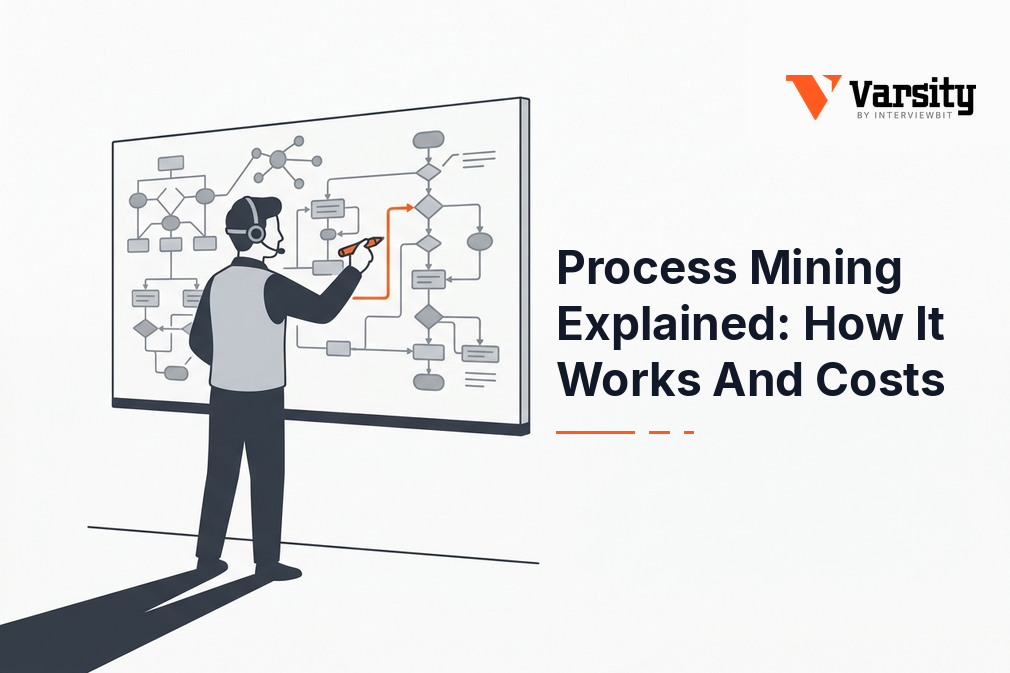
Once the log is clean, the output is usually a directly-follows graph or a Petri net: boxes for activities, arrows for what follows what, thicker lines for the paths more cases actually took.
Somewhere in that tangle is a happy path, the route most cases follow with no drama, and a long tail of variants that drift away from it.
The whole payoff of the exercise is seeing how far the real process wanders from the one on the wall, and exactly where it wanders.
The Three Types of Process Mining
Discovery
Building the map from scratch, with no assumptions about what the process should look like.
This is where almost everyone starts, because most organisations don’t actually have an accurate, current model of how a process runs today. They have a slide from three reorganisations ago.
Conformance Checking
Take the discovered process and hold it up against the documented one. Where does reality break the rules?
This is the version that gets budget approved fastest, because it plugs directly into audit and compliance. “We can now prove where the process deviates” is a sentence that lands well in front of a risk committee.
Enhancement
You already have a model. Now enrich it with real timing, cost, and resource data pulled from the log.
It stops being a diagram and starts being something you can actually make decisions from.
Process Mining vs Data Mining vs Task Mining vs BPM
These four get mashed together constantly, mostly because they all involve the word “process” or “data” and a dashboard.
They’re not interchangeable. Here’s the version that actually holds up, split into two quick comparisons so it’s easy to scan on a phone.
| Process Mining | Data Mining | |
| What it reads | Timestamped system event logs, in sequence | Static records or datasets |
| Question it answers | How does this process actually run, step by step? | What patterns exist in this data? |
| What it produces | A process map, conformance report, bottleneck list | Clusters, rules, predictive models |
| Typical tool | Celonis, UiPath Process Mining, PM4Py | scikit-learn, SAS, R |
| Who owns it | Operations / process excellence | Data science |
| Task Mining | BPM | |
| What it reads | Screen-level clicks and keystrokes | Process definitions and rules |
| Question it answers | What is a person literally doing on screen? | How should this process be designed? |
| What it produces | A map of manual, repetitive desktop steps | Process models and governance docs |
| Typical tool | UiPath Task Mining, Kryon | SAP Signavio, Bizagi, ARIS |
| Who owns it | RPA / automation team | Business architecture / governance |
Short version: data mining finds patterns in records. Process mining finds patterns in sequence and time.
Task mining watches the desktop, below the level any system log reaches, which makes it a complement to process mining rather than competition.
BPM is the design and governance layer. Process mining is what tells BPM whether the design is actually being followed.
What the AI Era Actually Changed
From a Quarterly Project to a Continuous Feed
The old shape of this work was a one-off diagnostic: extract the log, analyse it, present a deck, and maybe act on it six weeks later once budget clears.
Cheaper storage and streaming extraction pushed a lot of this toward something closer to a live dashboard, with alerts firing when a variant spikes or an SLA looks like it’s about to breach.
One honesty check worth keeping: “near real-time” is only as real-time as your extraction schedule. If the pipeline runs nightly, you’re looking at yesterday, dressed up as now. Worth asking directly of any vendor who uses the phrase.
Where Machine Learning and LLMs Actually Help (and Where They Don’t)
Genuinely useful: predicting which running cases are heading toward an SLA breach before it happens, clustering a few thousand messy variants down into a handful a human can actually read.
Also useful: letting someone query the log in plain language instead of learning a query syntax, and drafting a first pass at the root-cause narrative.
Honestly limited: an LLM can’t infer a process from a log it was never given, can’t invent a missing case ID out of thin air, and will happily produce a confident-sounding causal story out of what is really just correlation.
The bottleneck in this field was never the analysis step. It’s still the extraction, same as it’s always been.
Worth a passing mention: object-centric process mining, which treats a process as several interacting objects (an order, an invoice, a delivery, a line item) instead of forcing everything into one clean case ID.
Most real processes never fit the single-case model cleanly anyway, and that’s roughly where the research is heading next.
What Process Mining Costs, and When It’s Not Worth Doing
What You Actually Pay For
No figures here, on purpose. None of the major vendors, Celonis, UiPath, SAP Signavio, publish list pricing. Any number floating around the internet is a third party’s guess dressed up as fact.
What actually shows up on the invoice, structurally:
• Platform licensing, usually usage- or connector-based
• The data extraction and engineering effort
• A connector for every source system you want to include
• Someone to own the thing after go-live
• The change-management cost of actually acting on what the analysis tells you
The line item that catches people off guard: licensing is rarely the biggest cost. Extraction is.
Budgeting for the software and forgetting the plumbing is the single most common way these projects go over.
Five Situations Where It Won’t Pay Back
Every one of these comes with a next step. A “don’t bother” with nowhere to go isn’t useful to anyone.
• Your systems don’t log timestamps per step. Fix the instrumentation first. That’s the actual project here, and it comes before any mining tool.
• The process is genuinely simple and low-volume. A whiteboard and a value-stream map will beat a platform, and cost about a marker’s worth.
• The process runs mostly through email, spreadsheets, and phone calls. There’s no event log to mine. Task mining, or just watching someone do the job, is the right tool here.
• You already know the bottleneck and nobody has the authority to fix it. The constraint is organisational, not analytical. This would buy you a very expensive confirmation of something you already knew.
• You want to automate one specific task, not diagnose a whole process. Go straight to the automation. Come back to this when the question becomes which of forty processes to fix first.
Try Process Mining Yourself, Free
Nobody on the results page for this topic will hand you something to actually run. Here it is, and it costs nothing.
Grab a real dataset from the public BPI Challenge event logs on 4TU.ResearchData: anonymised corporate process data, loan applications, permit approvals, purchase orders, tens of thousands of cases, free to download.
If you want the fuller catalogue of public logs beyond BPI Challenge, the IEEE Task Force on Process Mining’s website is the canonical index.
Then install PM4Py, the open-source Python library for this exact job, and run this. Tested against PM4Py 2.7.23, September 2026, since the API has shifted across major versions and old snippets have a habit of failing silently:
# PM4Py 2.7.23 (Sep 2026)
import pm4py
log = pm4py.read_xes(“BPI_Challenge_2017.xes”)
net, im, fm = pm4py.discover_petri_net_inductive(log)
pm4py.view_petri_net(net, im, fm)
variants = pm4py.get_variants(log)
print(f”{len(variants)} distinct variants in this log”)
Nine lines, and you’ve loaded a real event log, discovered a process model, rendered it, and counted how many distinct ways the process actually gets executed.
From there, the natural next move is scanning the discovered graph for the thickest arrow pointing backward. That’s your rework loop, sitting right there instead of buried in a consultant’s deck six weeks from now.
Official repo for the library is PM4Py on GitHub, and if you want the citeable, peer-reviewed version for a report or a paper, there’s a PM4Py paper in Software Impacts. A few commercial vendors also offer free tiers or academic licences, worth checking their current pages directly since those terms move around.
Process Mining as a Career
This is the section that doesn’t exist anywhere else on the results page, which is a little strange given how many actual job titles now have “process mining” or “process intelligence” somewhere in them.
Titles you’ll see advertised: process mining analyst, process intelligence consultant, business process analyst, and process mining folded into broader transformation or consulting roles at a Big Four firm or a GCC.
India specifically is a real market for this, concentrated in global capability centres, shared-services hubs, and the large consulting practices, where a handful of platforms and a lot of processes to fix tend to sit together in one building.
The skills, in the order they actually matter on the job, not the order a course outline would suggest:
• SQL and data extraction first, because that’s most of the actual work
• Domain process knowledge next, finance, supply chain, ITSM, whichever function you’re pointed at
• A platform third
• Python fourth, for the parts a licensed platform can’t reach
Vendor certifications exist as a category worth knowing about. Treat any specific paid training provider as a separate decision from this one.
Reading a process map is one thing. Knowing which gap is actually worth fixing, and being able to make that case to the person who controls the budget, is a different skill entirely, and it’s the one that actually gets rewarded. If you want to build that judgement properly rather than pick it up in fragments across a dozen vendor blogs, AI-Powered Operations is a module inside Scaler’s PGP in Business & AI, built around exactly this: reading what a process is actually doing, and deciding what to do about it.
Frequently Asked Questions
What is process mining in simple terms?
Reading the timestamps your systems already record to reconstruct how a process really runs, then comparing that with how it’s meant to run.
Is process mining a one-time project, or something you run continuously?
It started as a one-off diagnostic, but most organisations now treat it as ongoing monitoring. Conditions keep changing, so a single snapshot goes stale fast, and continuous or near-real-time feeds are increasingly the default setup.
Which industries actually use process mining?
Banking and finance for compliance and loan approvals, manufacturing for production-line delays, healthcare for treatment workflows and wait times, retail and logistics for supply chain and delivery bottlenecks, and telecom for service and complaint handling.
How long before a process mining project shows results?
A first discovery pass on a clean log can surface real findings within weeks. What takes longer is the extraction and data-cleanup work described above, which is usually the actual bottleneck, not the analysis itself.
Is process mining the same as RPA?
No. Process mining diagnoses what’s actually happening. RPA executes a task. Process mining often ends up telling you what’s actually worth automating in the first place.
Can you do process mining for free?
Yes. PM4Py in Python plus a public BPI Challenge event log costs nothing but time. Both are linked above.
How much does process mining software cost?
Vendors don’t publish list prices. Cost is usage- and connector-based, and the extraction work is normally the larger expense, not the licence. No further figures beyond that, because none are honestly available.
What skills do you need for a process mining role?
SQL and data extraction first, since that’s most of the actual job. Then domain process knowledge, then a platform, then Python for what the platform can’t do.