Agentic Operations: What It Actually Takes to Build a Self-Running Workflow

What “Agentic Operations” Means, and What It Doesn’t
Quick recap, since this piece assumes you already know roughly what an agent is: agentic AI is the capability, a model that can plan, call tools and act on its own. Agentic operations is the operating model built around that capability, the orchestration, the systems it’s allowed to touch, and the human decision rights sitting on top of it. If you want the fuller definition first, that’s covered in [companion piece: agentic AI in operations, link once live]. Here, we’re going straight to how one gets built.
One disambiguation before anything else: this article means business operations, invoice matching, order exceptions, supplier onboarding, claims, reconciliations.
It doesn’t mean network, infrastructure or cloud operations, which is what a fair chunk of the vendor content using this exact phrase actually means (Cisco’s AgenticOps, for instance, is squarely about the latter).
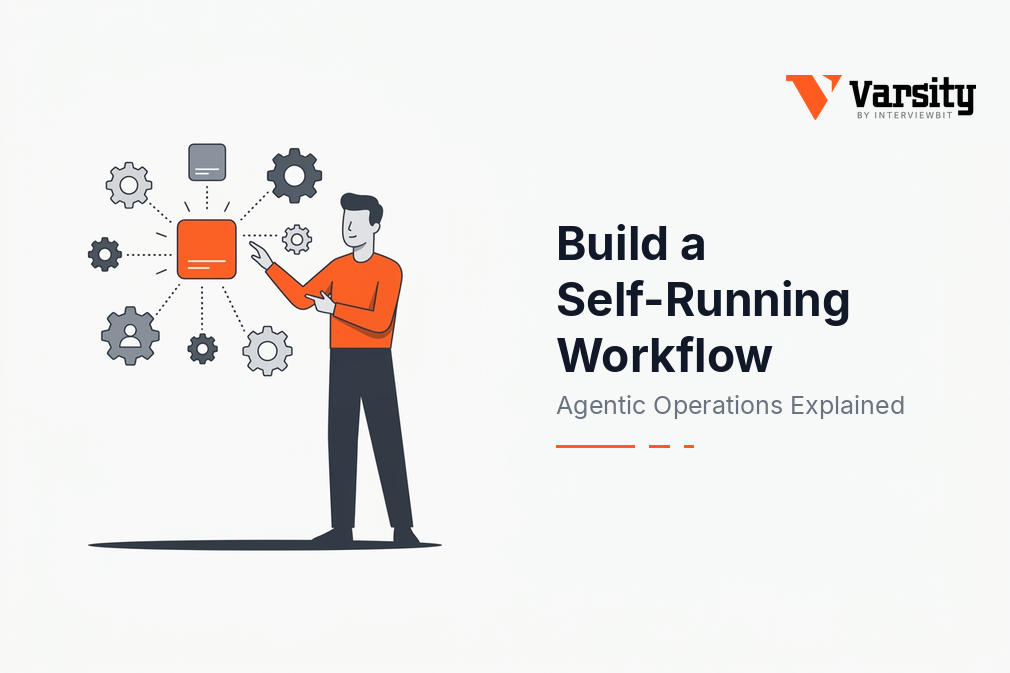
A self-running workflow needs five things, at minimum:
• A goal it can check its own work against
• Orchestration to decide the next step
• Access to the systems it needs to touch
• Somewhere to hold state across steps
• A human sitting at the point where a wrong move would actually cost something
The rest of this article is what each of those means in practice, and how you’d know if one was missing.
The Anatomy of a Self-Running Workflow
This is the asset worth bookmarking. Seven components, and, more usefully, what breaks when each one is missing.
| Component | What breaks without it | Who owns it |
| A checkable goal, defines “done” precisely enough that success can be verified, not just declared | The agent declares success on a half-finished task, because nobody told it what to check | Process owner |
| Orchestration, decides what happens next in the sequence | No next step gets decided, tool calls happen but nothing chains them together | Engineering / platform team |
| Tool and system access, lets the agent read and write into the actual systems involved | The agent can reason all day and touch nothing, all thought, no leverage | IT / integration |
| State and memory, holds what’s already happened across the steps of one run | Repeated actions, lost context mid-exception, two agents quietly acting on the same record | Engineering / platform team |
| Human approval gates, stops the run at the point where value or risk crosses a threshold | Irreversible actions go out the door with nobody having looked at them | Process owner / risk |
| Guardrails and policy, bounds what the agent is allowed to attempt, even if it technically could do more | The agent finds a path to the goal nobody actually authorised | Risk / compliance |
| Observability and audit trail, records every call the agent made and the reasoning behind it | You cannot explain to an auditor why a payment went out | Operations / audit |
Orchestration: What Decides the Next Step
There’s a real design choice hiding here, and it’s worth naming plainly:
• A fixed chain means a human wrote the sequence in advance and the model fills in the details at each step.
• An agent loop means the model chooses the sequence itself, step by step, based on what it finds.
Most production systems today are closer to the fixed chain, and that’s a design choice, not a limitation. Predictability is worth quite a lot when money or compliance is involved.
Worth reading if you want the deeper version of this: Anthropic’s guidance on building effective agents, one of the clearer vendor-neutral breakdowns of the workflow-versus-agent distinction available right now.
Tool Calling: How an Agent Reaches Your Systems
This is the one concept non-technical readers most often miss, and it’s the most reassuring thing in this whole article once it clicks.
An agent does nothing to your ERP by thinking about it. It calls a defined function with defined inputs and gets a defined response back, same as any piece of integration code would.
The scope of what an agent can do is exactly the list of tools someone gave it. No more. If you didn’t give it a tool that can issue a refund, it cannot issue a refund, no matter how convinced it is that one is owed.
That’s the whole concept, and it’s why the components table above matters more than any amount of reading about model capability.
State: What the Agent Remembers Between Steps
A multi-step process needs somewhere to hold what’s already happened. Without it, three things go wrong:
• Repeated actions, the agent forgets it already called the supplier
• Lost context mid-exception, it starts over instead of continuing
• Two agents quietly acting on the same record, because neither knew the other was there
None of this is exotic engineering. It’s closer to the reason a spreadsheet with no version history eventually causes a fight.
One Workflow, Traced End to End
An illustrative scenario, not a named deployment: a supplier invoice fails a three-way match. Here’s a single run, step by step, tool calls marked, and the exact point a human enters.
1. Exception received. The agent picks up an invoice that failed the automated three-way match.
2. Tool call: ERP. It pulls the original purchase order and the goods receipt record.
3. Variance identified. A quantity mismatch of 40 units between what was ordered and what the invoice claims.
4. Tool call: receiving log. It checks whether the delivery came in multiple shipments.
5. Explanation found. A split delivery accounts for the gap, this isn’t fraud or error, it’s two trucks instead of one.
6. Draft reconciliation. The agent writes up a reconciliation note with its reasoning attached, in plain language, not a code dump.
7. Stops. Routes to a human. The value crosses the approval threshold, so it stops here regardless of how confident it is.
8. Logs everything. Every tool call, every piece of reasoning, written to the audit trail before the human ever opens it.
Step seven is the whole point of this article. Not the tool calls, everyone can picture those, but the fact that the agent stopped on its own, at a threshold someone else decided in advance, and handed over a reasoned case instead of a blind escalation.
Where the Human Keeps Decision Rights
A simple four-rung ladder, worth applying to a process you own this afternoon:
• Suggest. The agent proposes, a human does.
• Act with approval. The agent prepares, a human signs.
• Act and notify. The agent completes the action, a human sees it afterward.
• Act autonomously. The agent completes it, and a sample gets pulled for review later.
The rung a process sits on should be decided by reversibility and value, not by how well the agent has been performing lately.
A wrong action you can undo inside the system can comfortably sit at rung three. A payment that has already left the building sits at rung two regardless of how flawless the agent’s track record looks, confidence is not the variable that matters here.
How You Know It Works: Evaluating an Agentic Workflow
Nobody selling one of these will walk you through this part, so here it is. Two halves, before and after go-live.
Before Go-Live
Assemble 20 to 50 real past cases with known correct outcomes, run the workflow against every one of them, and write down exactly where it disagrees with what actually happened.
This is a regression test, borrowed straight from software engineering, and it gets re-run every single time a prompt, a tool, or the underlying model changes. Skipping this step is how “it seems to work” becomes the entire evidence base for a production decision.
After Go-Live
Five numbers worth a dashboard of their own:
• Task completion rate
• Escalation rate
• Human override rate, how often the reviewer disagrees with the agent
• Time to resolution
• Cost per transaction
A rising override rate specifically is worth treating as a signal, not noise. Either trust in the system is eroding for a real reason, or the mix of cases reaching it has gotten harder, and either way it’s worth finding out which before anyone shrugs it off.
For the academic backing behind this section, a recent survey of AI agent architectures and evaluation methods (Xu, 2026) covers the evaluation side, task performance, tool-use correctness, robustness, in more depth than any vendor page attempts.
Why Agentic Operations Projects Stall
Build-stage problems, not the runtime failure modes, that’s a different article. Six, each with the fix in the same breath.
• The process was never documented. There’s nothing to specify. Fix: write it down first, properly, before touching a platform. That’s the actual project.
• The systems are screens and email, not APIs. There’s nothing for tool calling to reach. Fix: close the integration gap first, or accept this one isn’t ready yet.
• No evaluation set exists. “It seems to work” is the only evidence anyone has. Fix: build the 20 to 50 case set before go-live, not after someone starts doubting it.
• Agent sprawl. Four different teams build four different agents that all touch the same record, with nobody coordinating. Fix: one owning team per record or domain, and a registry of what touches what.
• No rollback path. Nobody designed an undo, so the first real mistake becomes a crisis instead of a correction. Fix: design the rollback before the action ships, not after an incident forces the question.
• No named owner once the pilot team moves on. The thing that worked in the pilot quietly rots because nobody’s job is to watch it. Fix: name a permanent owner before go-live, not as a line item nobody gets to.
Worth citing precisely rather than repeating secondhand: Gartner’s June 2025 prediction that over 40% of agentic AI projects will be cancelled by the end of 2027, attributed to escalating costs, unclear business value and inadequate risk controls, which lines up closely with the six causes above.
What an Operations Team Needs to Be Able to Do
Four capabilities, not ten, and none of them require writing a line of code:
• Specify a process precisely enough that a machine can check whether it was done correctly
• Define decision rights and thresholds, which rung of the ladder each part of a process sits on
• Read a trace and tell a genuinely good run from one that just got lucky
• Evaluate a vendor’s claim against the components table above, rather than against how confident the pitch sounded
Most of the work in agentic operations is specification and oversight rather than engineering: deciding what “done” means, where the approval gate sits, and how you’d know it was working. If that’s the gap between reading this and actually being the person who builds it, AI-Powered Operations is a module inside Scaler’s PGP in Business & AI, built around exactly these capabilities.
Frequently Asked Questions
Is agentic operations the same thing as agentic AI?
No. Agentic AI is the capability. Agentic operations is the operating model around it, orchestration, system access, decision rights and oversight. See the opening distinction for the fuller version.
Can agentic operations work with legacy systems that don’t have APIs?
Not directly. Tool calling needs a defined function to call, so a process that runs mostly through screens and email has nothing for an agent to reach. Closing that integration gap, or accepting the process isn’t ready yet, comes before anything else.
Is agentic operations different from RPA or traditional workflow automation?
Yes. RPA follows a sequence a human wrote in advance and stalls on anything it wasn’t told to expect. An agentic workflow decides its own next step within guardrails, and can investigate and reason through an exception instead of just queuing it.
How much autonomy should an agent be given?
Set it by reversibility and value, not by how well the agent has been performing. Reversible actions can run unsupervised; anything irreversible keeps a human approval gate regardless of track record.
Which business functions is agentic operations actually being used in today?
Invoice and three-way-match exceptions, order and fulfilment exceptions, supplier onboarding checks, and claims triage are the most common production use cases right now, mostly because they’re high-volume, well-documented, and mostly reversible.
Why do agentic AI projects get cancelled?
Usually because the process was never documented, the systems aren’t API-reachable, or there’s no evaluation set, not because the underlying models failed. Each of those has a specific fix.
Who owns an agentic workflow once it’s live?
A named process owner, not the pilot team that built it. That owner is accountable for the thresholds, the override rate, and the periodic review, on a calendar, not “whenever.”