Responsible AI in Operations: Governance, Bias and the Human-AI Collaboration Layer

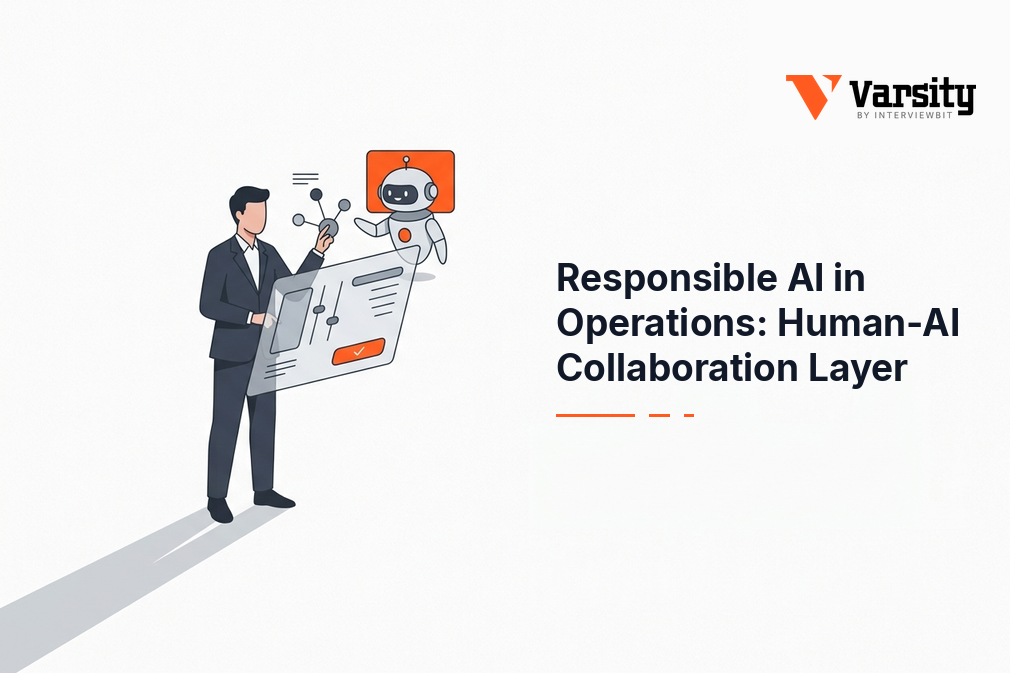
Human in the loop, in an operations context, means a person can inspect an AI-made decision before it takes effect and actually change it, not just watch it happen.
This page is about responsible AI in operations: where AI decisions go wrong function by function, where bias actually enters a process that never touched a protected attribute, how to tell a real human review from a decorative one, and who answers for a decision after it’s already been made.
This is not a guide to which regulation applies to you, that comparison lives in [companion page: NIST AI RMF vs EU AI Act vs ISO/IEC 42001 vs DPDP vs MeitY, compared, link once live].
What Responsible AI Means Once It’s Your Process
You didn’t ask for this. The forecast the planning team now trusts without checking. The supplier score nobody can quite explain. The shift roster a model wrote overnight.
At some point an AI system started making calls inside a process you own, and someone has asked whether it’s safe.
Here’s the distinction the rest of this page runs on. Governance is the paperwork: inventories, sign-offs, frameworks. Responsible operations is what happens at the point the decision is actually made, whether it can be explained, evidenced, and corrected.
You can hold a complete governance file and still run a review step nobody has time to do properly.
Where AI Decisions Go Wrong, Function by Function
Risk in operational AI isn’t generic, it varies by function, a finding from Pang and Szliter’s systematic review of 57 peer-reviewed studies (AI and Ethics, June 2026). This is how it plays out across five common operational functions.
| Function | What the AI decides | How it goes wrong | |
| Demand forecasting | How much to produce, stock, or staff | A prediction error becomes a resourcing decision, an allocative harm, not just an inaccurate number | |
| Workforce scheduling | Who works when, and how much | Reproduces uneven historical allocation and calls it a pattern; workers can’t contest the roster | |
| Supplier / procurement scoring | Which suppliers pass risk or ESG checks | A contestability deficit: a downgraded supplier can’t see why, or challenge it | |
| Dynamic pricing | What a customer is charged, in real time | Optimising for revenue produces discriminatory outcomes for customers with the least ability to switch | |
| Service triage and routing | Which queue or priority a case gets | Fewer cases from one segment get reviewed, so fewer errors surface there, so it looks more accurate there | |
Two real, documented cases behind these rows, cited in the review:
• Amazon’s warehouse systems have automated productivity tracking and disciplinary triggers with no worker-accessible way to contest an assessment.
• Uber’s surge pricing has drawn regulatory scrutiny for offering no transparency into individual price multipliers and no post-event review.
Neither failure was a broken algorithm. Both were a missing contestability mechanism.
Where Bias Actually Enters a Business Process
Bias doesn’t enter because someone wrote a biased rule. It enters through three ordinary, well-intentioned places.
• The history you trained on. The model learns what the organisation actually did, including what it did badly. If overtime was allocated unevenly for five years, a scheduling model reproduces that allocation and calls it a pattern.
• The proxy you didn’t know you had. You removed gender or caste from the training data. Postcode, career-gap length, and shift availability survived and carry much of the same signal. Removing a protected attribute removes your ability to measure its influence, not the influence itself.
• The loop that teaches itself. The model routes fewer cases from one segment to a human reviewer, so fewer errors get found there, so it looks more accurate there, so it routes even fewer. This is the hardest to spot, because it hides inside a metric that’s visibly improving.
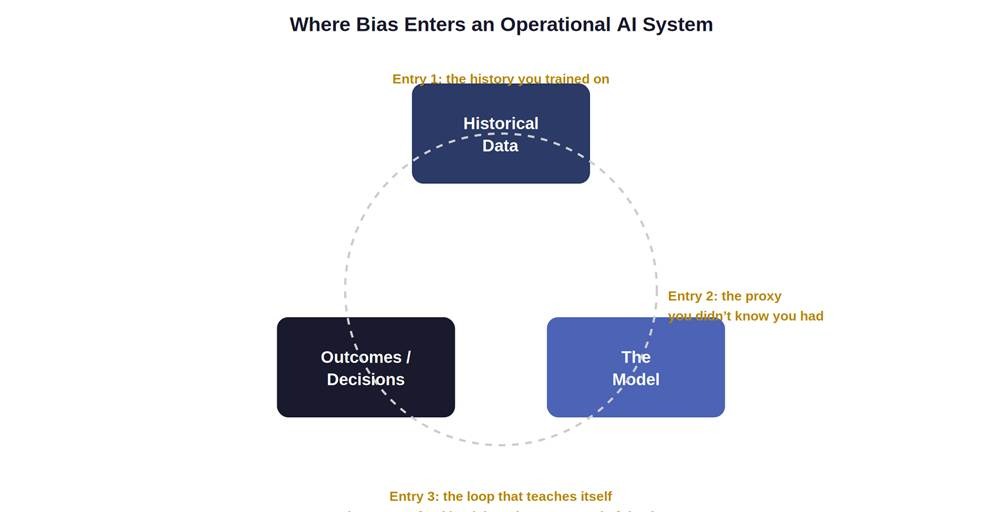
Three entry points, none of them a written rule.
The honest paragraph most pages skip: how do you test for disparate impact when you deliberately never collected the attribute?
Three imperfect options, none fully satisfactory:
• Proxy analysis. Checking correlated variables for the pattern you can’t measure directly.
• A held-out evaluation set. Where the attribute was collected separately, with consent, purely to test for this.
• External audit. A third party with access you don’t have.
Say so plainly rather than pretending this is solved tooling.
Designing a Human Review That’s Actually Real
“A human reviews the output” is not oversight if the reviewer sees 400 cases an hour, can’t see why the system decided what it decided, and has no authority to overrule it.
Automation bias, trusting the machine’s output by default, is a design problem, not a training problem.
Apply this to a review step you already run. Missing any one box, and it’s decorative.
The half everyone forgets is the appeal path. The person the decision was about, the rejected supplier, the employee with the worst roster, the customer routed to slow-track, needs a route to contest it.
Three things that route needs: a stated reason, a named human to appeal to, and a recorded outcome.
This is the review-design question. How much autonomy a system should have is a different question, covered in [companion page: how much autonomy different types of AI agents actually need, Row 5, link once published].
The Governance You Need, in One Page
Four artefacts, no framework comparison:
• A model and use inventory. What AI touches which process, and who owns each.
• A decision record per system. What it decides, what it must never decide, and the threshold.
• An incident log. With a defined response.
• A named accountable owner. Who isn’t the pilot team.
One clause each on where these come from: NIST’s AI Risk Management Framework is a voluntary US framework. ISO/IEC 42001 is a certifiable management-system standard. The EU AI Act is binding law that can reach an Indian company through a customer contract.
India, in three sentences: MeitY’s India AI Governance Guidelines set a voluntary, principles-led direction and state that a separate AI law isn’t needed at present. The DPDP Rules, 2025 and existing law already bind domestic operations. In practice, most Indian firms build these controls because a customer asked, not because a regulator did.
What You Do After Go-Live
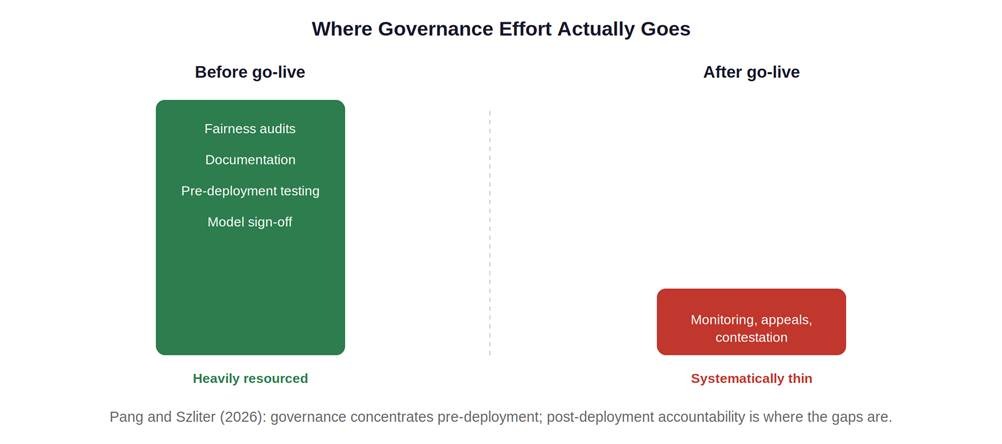
Nobody on this SERP covers this. Pang and Szliter’s review of 57 papers found governance concentrated before deployment, audits, documentation, testing, with significant gaps in post-deployment accountability and contestation.
Where the effort goes, and where the accountability questions actually arise.
Four things worth watching monthly:
• Override rate. How often reviewers disagree; a rise means the model or the world moved.
• Override distribution. If one segment gets overturned far more than others, you’ve found something.
• Appeal volume and outcome. Appeals that always fail aren’t an appeal path.
• Exception ageing. Cases stuck in the human queue are cases the system silently offloaded.
Two events force a review regardless of what the numbers say: an upstream process change, and a model or prompt change. The first surprises people, nobody tells the model the intake form changed.
Who Owns This in an Operations Team
Four capabilities, not ten, and none of them requires writing code or belongs to legal:
• Read a reason code and tell a good decision from a lucky one.
• Specify a threshold and defend it.
• Run a subgroup check on last quarter’s outcomes.
• Say no to a rollout, and make it stick.
This is becoming part of an operations job description, not a separate specialism.
None of this is exotic, but almost none of it happens by default either. Someone has to actually spot the proxy, read the override rate correctly, and be willing to stop a rollout that looks fine on paper. If you want to build that judgement formally rather than learn it the hard way after something goes wrong, AI-Powered Operations is a module inside Scaler’s PGP in Business & AI.
Frequently Asked Questions
What is responsible AI in operations?
Making sure an AI system inside a business process produces decisions you can explain, evidence, and correct. In practice: a named owner, a stated reason for each decision, a review step that can actually overrule it, and a route for the affected person to contest it.
What’s the difference between human-in-the-loop and human-on-the-loop?
In-the-loop means a person reviews and can change a decision before it takes effect, one case at a time. On-the-loop means the system runs on its own and a person monitors it, stepping in only when something looks wrong. Most of this page is about designing the first properly, not assuming the second counts as oversight.
Can you remove bias by deleting the sensitive field?
No. Removing gender or caste from the data doesn’t remove the correlated signals, postcode, career gap, shift availability. It removes your ability to measure the effect. Proxy analysis, a consented held-out evaluation set, or external audit are the imperfect alternatives.
How many cases can one reviewer realistically oversee before review becomes decorative?
There’s no fixed number, it depends on how much reasoning the reviewer actually needs to read per case. What matters more than a headcount ratio is whether the reviewer has a realistic, stated time budget per case; a queue that quietly grows past that budget is the real warning sign, not a specific case-per-hour figure.
Is one human reviewer enough, or do you need more than one?
One reviewer holding all decisions for a system is a single point of failure, not just a bottleneck: leave, illness, or plain fatigue creates a silent gap in oversight that nobody notices until an audit does. Cover and rotation matter as much as the review step itself.
Does India have a law requiring responsible AI?
There’s no standalone AI law, and MeitY’s guidelines state one isn’t needed at present. The DPDP Act, the IT Act, and consumer protection law already apply. Most Indian firms build these controls because a customer asked.
Why do human reviewers stop catching errors over time?
Automation bias creeps in gradually: after weeks of the model being right, a reviewer starts rubber-stamping instead of actually checking. This is why override rate is worth watching as a trend, not a one-time audit, a rate that quietly falls to near zero is often complacency, not a model that got better.
What should you ask a vendor who claims their AI has “human oversight”?
Ask them to name the reviewer’s per-case time budget, show you a real reason code a reviewer sees, and confirm the reviewer can overrule without escalating. “Human oversight” on a slide and a real, working review step are not the same claim, and a vendor who can’t answer specifics is describing the first.