Total Productive Maintenance (TPM): 8 Pillars, Examples & Implementation

Key Insights
- TPM is a company-wide approach, not just a maintenance strategy. Operators, maintenance teams, engineers and managers all contribute to improving equipment performance.
- The 8 TPM pillars address different sources of equipment and operational losses, from routine operator care and planned maintenance to quality, training, safety and administrative processes.
- TPM targets the six big losses that reduce equipment effectiveness, including breakdowns, setup and adjustment losses, minor stops, reduced speed and production defects.
- OEE is the key metric for measuring equipment effectiveness. It combines Availability, Performance and Quality to show where equipment losses are occurring.
- Successful TPM implementation starts with measurable losses, usually by piloting the approach on one production line, establishing a baseline and then standardizing improvements that work.
- TPM can fail even when the maintenance strategy is technically sound if employees are not trained, management support is weak, data is unreliable or improvements are not maintained over time.
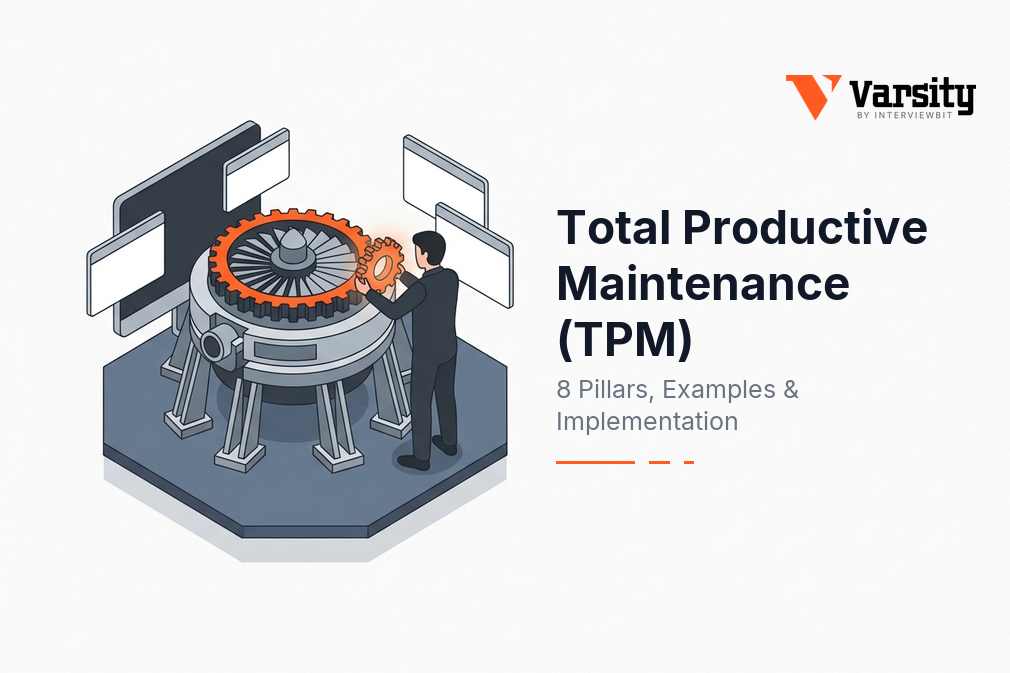
Total Productive Maintenance (TPM) is a company-wide approach to keeping equipment in peak working condition. It makes every employee responsible for equipment, not only the maintenance department, and aims to improve availability, running speed and output quality. Operators, technicians, engineers and managers all take part.
- Goal: Zero breakdowns, zero defects and zero accidents.
- Origin: Developed in Japan around 1970 and formalized by the Japan Institute of Plant Maintenance (JIPM).
- Foundation: 5S workplace organization, which makes equipment problems visible.
- Structure: Eight pillars covering autonomous maintenance, focused improvement, planned maintenance, quality maintenance, early equipment management, training, safety and administration.
- Target: The six big losses: breakdowns, setup and adjustment, minor stops, reduced speed, startup rejects and production rejects.
- Measurement: Overall Equipment Effectiveness (OEE), which shows whether TPM is improving results.
Together, these elements make TPM a management system for equipment performance rather than a maintenance schedule. The sections below cover the pillars, OEE, implementation steps, common challenges and a full plant example.
What are the 8 Pillars of Total Productive Maintenance (TPM)?
The 8 pillars of TPM divide responsibility for equipment performance across the organization. Each pillar removes a different source of loss, and they deliver results only when run together. The table summarizes all eight before the detail.
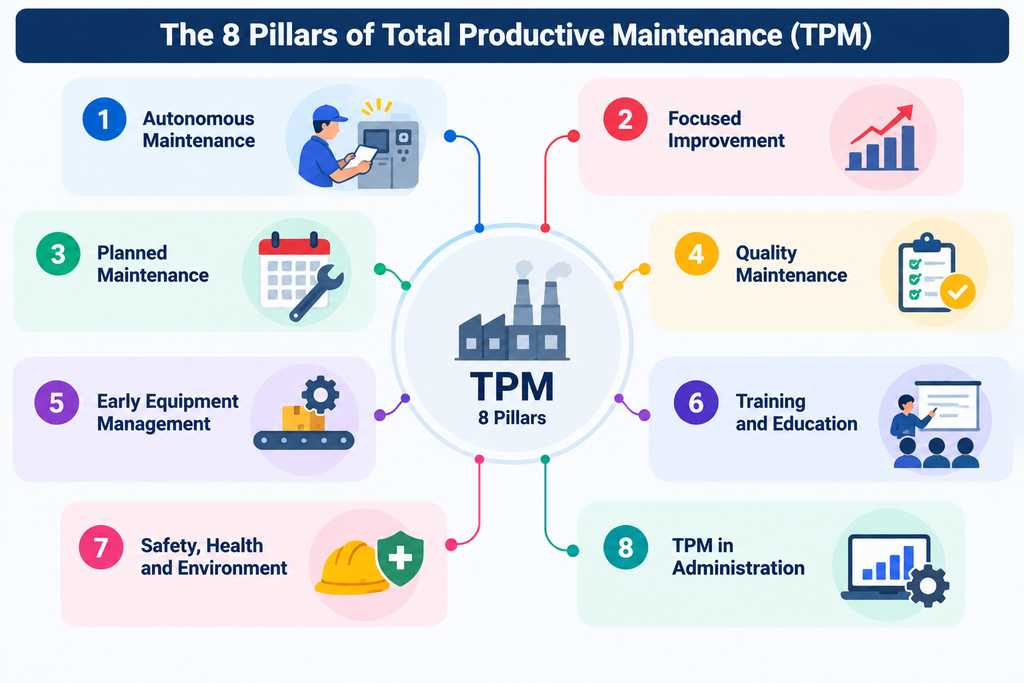
| TPM Pillar | Main Focus |
| Autonomous Maintenance | Operator-led routine care and early problem detection |
| Focused Improvement | Eliminating specific recurring losses |
| Planned Maintenance | Scheduled technical work that prevents failures |
| Quality Maintenance | Equipment conditions that prevent defects |
| Early Equipment Management | Building reliability into new equipment |
| Training and Education | Skills to operate and maintain equipment |
| Safety, Health and Environment | Accident-free, low-impact operation |
| TPM in Administration | Removing losses in support functions |
1. Autonomous Maintenance in TPM: Operator-Led Equipment Care and Inspection
Autonomous Maintenance makes operators responsible for the routine care of their own machines. Abnormalities are caught at the source, and maintenance technicians gain time for complex technical work.
- What it focuses on: Operator ownership of basic equipment condition.
- Key activities: Cleaning, inspection, lubrication, tightening and reporting abnormalities.
- Practical example: A filler operator spots a leaking valve seal during a start-of-shift check.
2. Focused Improvement in TPM: Eliminating Recurring Equipment Losses
Focused Improvement, also called Kobetsu Kaizen, uses small cross-functional teams to eliminate one specific loss at a time. It turns recurring equipment problems into structured projects with a measurable result.
- What it focuses on: The largest recurring losses, ranked by impact.
- Key activities: Loss analysis, root cause tools such as 5 Whys, and verified countermeasures.
- Practical example: A team traces repeated capper jams to a worn guide rail and redesigns it.
3. Planned Maintenance in TPM: Preventing Equipment Failures With Scheduled and Condition-Based Maintenance
Planned Maintenance schedules technical work around equipment condition and failure history. Unlike Autonomous Maintenance, it is carried out by skilled technicians and covers tasks operators cannot perform.
- What it focuses on: Preventing breakdowns through time-based and condition-based tasks.
- Key activities: Maintenance calendars, failure records, spare parts planning and condition monitoring.
- Practical example: Filler pump bearings are replaced at a planned stop, based on vibration trends.
4. Quality Maintenance in TPM: Preventing Product Defects Through Equipment Control
Quality Maintenance sets and holds the equipment conditions under which defects cannot occur. It shifts quality control from inspecting finished product to controlling the machine settings that create defects.
- What it focuses on: The link between machine condition and product defects.
- Key activities: Defining critical settings, monitoring them and correcting drift early.
- Practical example: Capper torque is checked hourly against a fixed range to prevent loose caps.
5. Early Equipment Management in TPM: Designing New Equipment for Reliability and Maintainability
Early Equipment Management applies lessons from existing machines to the design and purchase of new ones. New equipment reaches stable output faster and is easier to operate, clean and maintain.
- What it focuses on: Reliability and maintainability at the design stage.
- Key activities: Design reviews with operators and technicians, and structured startup planning.
- Practical example: A new labeler is specified with tool-free guards and accessible lubrication points.
6. Training and Education in TPM: Building Equipment Operation and Maintenance Skills
Training and Education builds the skills every other pillar depends on. Operators learn equipment basics, technicians deepen diagnostic skills, and managers learn to lead TPM activities.
- What it focuses on: Closing the gap between required and actual skills.
- Key activities: Skill matrices, on-the-job coaching and one-point lessons.
- Practical example: Operators complete a lubrication course before taking over daily greasing.
7. Safety, Health and Environment in TPM: Preventing Equipment, Workplace, and Environmental Risks
Safety, Health and Environment targets zero accidents, zero health damage and zero environmental incidents. It ensures changes under other pillars never introduce new risks.
- What it focuses on: Hazards created by equipment and maintenance work.
- Key activities: Risk assessments, machine guarding, lockout procedures and spill control.
- Practical example: Filler cleaning steps are redesigned so no guard is removed while it runs.
8. TPM in Administration: Reducing Waste in Purchasing, Planning, Stores, and Support Processes
TPM in Administration, or Office TPM, extends loss elimination to support functions such as purchasing, planning and stores. Delays in these departments often appear as downtime on the shop floor.
- What it focuses on: Waste in information flow and support processes.
- Key activities: Process mapping, faster approvals and better spare parts ordering.
- Practical example: Purchasing shortens seal lead times, so repairs no longer wait for parts.
How Total Productive Maintenance (TPM) Improves Overall Equipment Effectiveness (OEE)?
OEE is the main measure used to judge whether TPM is working. It combines three factors into one percentage, and each factor responds to specific TPM pillars.
OEE = Availability × Performance × Quality
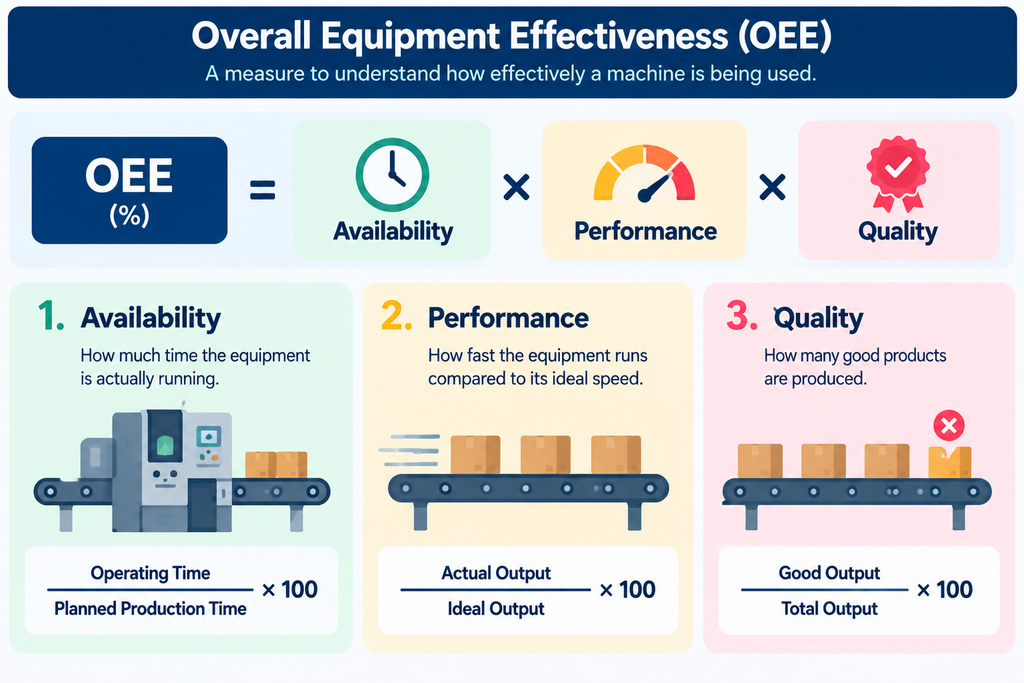
| OEE Factor | What It Asks | Key TPM Pillars |
| Availability | Is the equipment available when required? | Planned Maintenance, Autonomous Maintenance |
| Performance | Is it operating at the expected speed? | Focused Improvement |
| Quality | Is it producing defect-free output? | Quality Maintenance |
TPM and OEE Example: How a Bottling Line Improves Availability, Performance, and Quality
The figures below are an illustrative example, not industry data. They show how modest gains in each factor multiply into a larger OEE gain on one bottling line.
| Metric | Before TPM | After TPM |
| Availability | 80% | 90% |
| Performance | 85% | 92% |
| Quality | 95% | 98% |
| OEE | 64.6% | 81.1% |
Each gain traces to a pillar: fewer breakdowns from Planned and Autonomous Maintenance, fewer jams from Focused Improvement, and fewer rejects from Quality Maintenance.
How to Implement Total Productive Maintenance (TPM): 9 Steps for a Successful TPM Program
TPM implementation usually starts on one pilot line and expands once results are proven. The nine TPM implementation steps below move from measuring current losses to making improvement routine.
- Assess current equipment performance. Record downtime, speed and reject data on the pilot line to set a baseline OEE.
- Identify major losses. Sort the data into the six big losses and rank them by time lost.
- Establish TPM goals. Set numeric targets, such as an OEE figure or breakdown count, with a deadline.
- Begin autonomous maintenance. Run an initial deep clean, then give operators daily check sheets.
- Create planned maintenance schedules. Build a calendar of technical tasks from failure history and manufacturer guidance.
- Train employees. Teach operators and technicians the specific skills their new tasks require.
- Track OEE and other KPIs. Review OEE, breakdown frequency and defect rates at a fixed interval.
- Standardize successful practices. Write proven checks and settings into standard work, then copy them to other lines.
- Continuously improve. Raise the targets and assign a Focused Improvement team to the next largest loss.
Common Total Productive Maintenance (TPM) Implementation Challenges and How They Affect Results
Most TPM programs stall for organizational reasons rather than technical ones. Each challenge below weakens a specific part of the TPM framework.
- Employee resistance: Operators may see equipment care as extra work, so Autonomous Maintenance never takes hold.
- Lack of training: Checks completed without understanding miss the abnormalities they exist to find.
- Poor maintenance data: Without accurate downtime records, teams target the wrong losses.
- Limited management support: TPM needs production time for cleaning and training, which only managers can release.
- Difficulty maintaining standards: Early gains fade when audits stop and checks become optional.
- Focusing only on maintenance: Treating TPM as a maintenance program ignores speed and quality losses, which caps OEE gains.
Total Productive Maintenance Example: How TPM Improves a Bottling Line Step by Step
This TPM in manufacturing example follows the bottling line from the OEE table through one full improvement cycle. It shows the pillars working as one system.
- Problem: The line misses its weekly output target because of frequent stoppages and rejected bottles.
- TPM assessment: Four weeks of downtime logs reveal three main losses: pump breakdowns, capper jams and loose caps.
- Relevant pillars: Planned Maintenance for the pumps, Focused Improvement for the jams, Quality Maintenance for cap torque, plus Autonomous Maintenance and Training.
- Actions: Technicians start condition-based bearing changes. A team redesigns the capper guide rail. Operators are trained in daily checks and hourly torque readings.
- OEE measurement: Over six months, OEE rises from 64.6% to 81.1% (illustrative).
- Continuous improvement: The new checks become standard work, and the team targets changeover time next.
Each pillar removed a different loss that the assessment had exposed.
Take Your Operations Skills Further With AI
Modern operations are increasingly combining process improvement with AI, automation and data-driven decision-making. Understanding how these technologies can support operational transformation can help professionals approach efficiency and process improvement more strategically.
The Certificate Programme in AI-Powered Operations & Process Transformation by IIM Tiruchirappalli is designed for professionals looking to build an understanding of AI-powered operations and process transformation.
FAQs
1. What is the difference between TPM and preventive maintenance?
Preventive maintenance focuses mainly on scheduled maintenance activities designed to prevent equipment failures. TPM is broader: it involves operators, maintenance teams, engineers and managers in improving equipment performance, quality and safety. Preventive maintenance is therefore one part of a wider TPM system.
2. When should a company implement Total Productive Maintenance?
TPM is most useful when equipment-related losses are affecting production, such as frequent breakdowns, slow operation, defects or repeated stoppages. Companies can begin with a pilot line, establish a performance baseline and use the results to decide where TPM activities should be expanded.
3. What data is needed to start a TPM program?
A TPM program needs reliable equipment-performance data to identify the largest losses. Useful starting data includes downtime, production speed, rejects, breakdown frequency and OEE, along with records of recurring equipment problems.
4. How do you choose a pilot area for TPM implementation?
A practical approach is to select a production line or equipment area where measurable losses are affecting performance. Establish a baseline, identify the largest losses and use the pilot to test TPM practices before extending them to other lines.
5. What is the role of operators in Total Productive Maintenance?
Operators are responsible for more than running equipment under TPM. Through Autonomous Maintenance, they perform routine activities such as cleaning, inspection, lubrication and tightening, while reporting abnormalities early so technical teams can address more complex problems.
6. Can TPM be used alongside predictive maintenance?
Yes. TPM provides the broader system for improving equipment effectiveness, while predictive or condition-based maintenance can support the Planned Maintenance pillar by using equipment condition and failure information to determine when technical intervention is needed.
7. How do you know if a TPM program is actually working?
The results should be visible in equipment and production performance rather than only in completed maintenance activities. Teams can track changes in OEE, breakdown frequency, defect rates and the specific losses targeted by improvement projects.
8. How can TPM reduce unplanned equipment downtime?
TPM addresses downtime by combining routine operator inspections, planned technical maintenance and focused improvement activities. Detecting abnormalities early and eliminating recurring causes can reduce the likelihood and impact of equipment failures.
9. What should a TPM checklist include?
A TPM checklist can include routine equipment cleaning, inspection, lubrication, tightening and abnormality reporting. The exact checks should reflect the equipment and the conditions that can affect its reliability, safety or performance.
10. How can companies sustain TPM improvements over time?
TPM improvements need to become part of standard work rather than remaining one-time projects. Successful practices can be documented, incorporated into routine checks, reviewed through KPIs and applied to other production lines after the pilot demonstrates consistent results.
11. What are the most common reasons TPM programs fail?
TPM can lose momentum when employees see equipment care as extra work, training is inadequate, maintenance data is unreliable or management does not provide enough time and support. Another common problem is treating TPM only as a maintenance initiative instead of involving production, quality and other functions.
12. Can TPM be applied outside the maintenance department?
Yes. TPM is designed as a company-wide approach. Its scope extends beyond maintenance to operators, engineering, management, safety, quality and even administrative functions such as purchasing, planning and stores.