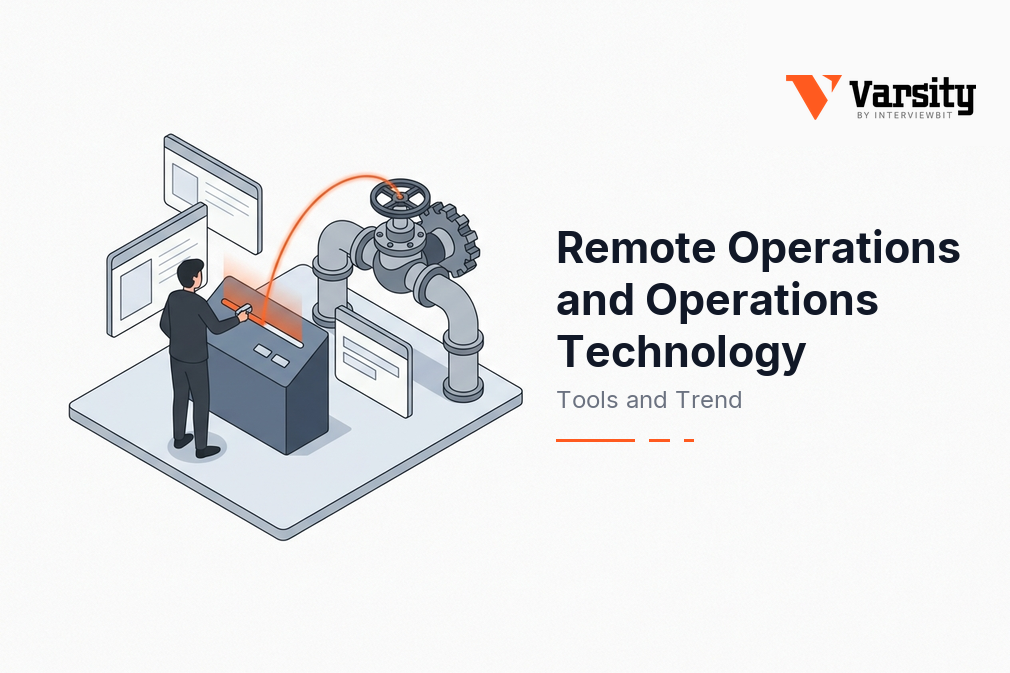
Remote Operations and Operations Technology: Tools and Trends

Key Insights
- Remote operations combines real-time monitoring, remote control, and data-driven decision-making to manage equipment and physical processes without requiring teams to be constantly present on-site.
- OT forms the operational backbone, connecting sensors, PLCs, SCADA systems, and other technologies that monitor or control physical equipment and industrial processes.
- IoT, edge computing, cloud platforms, AI, and digital twins are making remote operations more intelligent, moving organizations from simply monitoring assets to predicting failures and optimizing operations.
- Remote operations is particularly valuable for distributed, hazardous, or difficult-to-access assets across industries such as manufacturing, energy, utilities, mining, logistics, and oil & gas.
- The biggest challenge is not simply connecting equipment remotely but doing it securely and reliably. OT environments must account for cybersecurity, connectivity failures, legacy systems, data quality, and human oversight. Pasted markdown
- The direction of remote operations is shifting from visibility to intelligent action: AI can predict failures and recommend actions, while automation can handle routine decisions under defined human-oversight rules.
Remote operations means managing, monitoring, and controlling operational activities from a location away from the physical site. Operations Technology (OT) is the hardware and software that monitors and controls physical processes, equipment, and industrial operations.
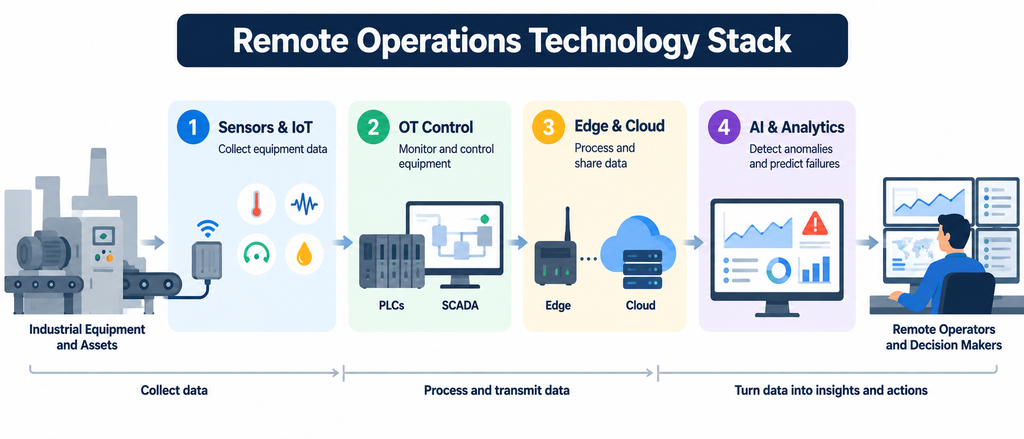
Together, they give teams visibility and control over distributed assets they cannot physically see.
The points below sum up how that works, where it is used, and what enables it.
- How it works: Sensors on equipment collect readings, OT systems process them, and the data travels to a central platform where remote teams watch performance.
- How teams respond: Alerts flag abnormal conditions. Operators, or pre-approved automation, then adjust settings, stop equipment, or send a field crew.
- How it differs from traditional operations: Sensors replace many manual inspections, one central view replaces site-by-site decisions, and predictive alerts replace waiting for a breakdown.
- Where it is used: Manufacturing, energy, utilities, logistics, mining, and other industrial facilities.
- What enables it: IoT sensors, industrial automation, remote monitoring systems, cloud platforms, AI, and digital twins.
The sections that follow cover the main remote operations tools, the trends changing them, the challenges to plan for, and a practical strategy framework.
Remote Operations Technology: Key Tools for Monitoring, Control, Data Processing, and AI
Remote operations tools do four jobs: capture data from equipment, let operators see and control processes, move and store data, and turn it into decisions. No single piece of remote operations software does all four, so they run as a layered stack.
The table below shows how those layers fit together.
| Layer | Tools | Role in remote operations |
| Sensing | IoT sensors and connected devices | Capture conditions at the asset |
| Control | Controllers, SCADA, industrial control platforms | Monitor and operate processes |
| Data | Edge devices and cloud platforms | Process, store, and share data across sites |
| Intelligence | AI and predictive analytics | Predict failures and guide decisions |
IoT Sensors in Remote Operations: How Connected Devices Monitor Equipment and Assets?
Sensors do the observing that a technician once did on a walk-round. They measure conditions at a machine or site in real time and pass the readings to remote teams.
In IoT remote operations, each common reading flags a specific condition:
- Temperature: overheating in motors, bearings, or cold-chain goods
- Pressure: safe limits in pipelines, tanks, and hydraulic systems
- Vibration: early wear in rotating equipment
- Location: position of vehicles, containers, and mobile machinery
- Equipment status: whether an asset is running, idle, or faulted
- Energy consumption: machines drawing more power than expected
Remote Monitoring and Control Systems: How SCADA and PLCs Operate Industrial Equipment?
These systems turn raw sensor signals into something an operator can act on. The best known is SCADA (Supervisory Control and Data Acquisition), which gathers data from many sites and presents it in one control room.
On site, programmable logic controllers (PLCs) run the equipment directly, and SCADA supervises them from above.
A typical remote monitoring and control setup provides five things:
- Real-time dashboards showing process values across sites
- Equipment status at a glance
- Alerts when a value moves outside its limits
- Remote controls for approved actions, such as opening a valve
- Historical operational data for trend analysis and incident review
Control is usually more restricted than monitoring, with commands limited to specific roles and conditions.
Cloud vs Edge Computing in Remote Operations: Where Operational Data is Processed
Cloud and edge computing settle where operational data is processed. Remote operations usually need both, because each handles a different job.
Cloud platforms pull data from many sites into one place. That enables centralized monitoring and gives every team the same information.
Edge computing processes data on or near the equipment. This allows low-latency responses, such as shutting down a pump within milliseconds.
Connectivity decides the balance. Where links are weak, edge devices filter data locally, keep running during outages, and sync to the cloud once the link returns.
AI and Predictive Analytics in Remote Operations: Predictive Maintenance, Anomaly Detection, and Optimization
AI adds interpretation to remote monitoring. A team may be watching thousands of data points, and analytics models help decide which ones deserve attention.
The main uses in remote environments are practical ones:
- Predictive maintenance: Estimating when a component will fail
- Anomaly detection: Spotting behavior that differs from an asset’s normal pattern
- Demand forecasting: Anticipating load on a grid, water network, or production line
- Process optimization: Recommending settings that cut energy use or raise output
- Automated alerts: Ranking warnings so operators see the important ones first
For remote teams, a predicted failure becomes a planned visit rather than an emergency call-out.
Remote Operations Across Industries: Applications in Manufacturing, Energy, Utilities, Mining, Logistics, and Oil & Gas
The same sensors, control systems, and analytics appear in very different settings. What changes is the asset being watched and the problem being solved.
The table below shows what industrial remote operations look like in six sectors.
| Industry | Remote operations use case | What teams watch |
| Manufacturing | Remote equipment monitoring | Machine health, output, and downtime |
| Energy | Monitoring distributed assets | Wind turbines, solar farms, and substations |
| Utilities | Remote infrastructure management | Pumping stations and treatment plants |
| Mining | Remote equipment and site monitoring | Haul trucks, conveyors, and ventilation |
| Logistics | Fleet and asset tracking | Vehicle location and cargo condition |
| Oil & Gas | Monitoring remote facilities | Wellheads, pipelines, and offshore platforms |
In each case, assets are spread out, hard to reach, or hazardous, and sending people to every one is slow and costly.
Remote Operations Trends: AI, Digital Twins, Edge AI, and Increasing Automation
Current remote operations trends point the same way. Systems are moving from showing operators what is happening to helping them decide what to do, and sometimes doing it for them.
AI-Powered Remote Operations: From Predictive Monitoring to Automated Decision Support
AI in remote operations is moving through four stages: monitoring, prediction, decision support, and optimization. Each stage takes more routine analysis off the operator.
Four developments are driving that shift:
- Predictive analytics that forecast failures instead of reporting them afterward
- AI-powered anomaly detection that learns each asset’s normal behavior, replacing fixed alarm thresholds
- Automated recommendations that pair each warning with a specific next action
- Generative AI interfaces that let staff ask questions of operational data in plain language
Digital Twins in Remote Operations: How Virtual Models Enable Monitoring, Simulation, and Optimization
A digital twin is a virtual model of a physical asset or process, kept current with live data from it. For a remote team, it is the closest thing to standing beside the equipment.
Twins support monitoring, simulation, and optimization. Simulation matters most at a distance: an operator can test a new setting on a compressor’s twin before sending the command to a site nobody can reach quickly.
Edge AI in Remote Operations: How Local AI Enables Real-Time Decisions With Low Latency
Edge AI runs analytics models on devices at the site instead of in a central data center. The data is analyzed where it is produced.
Some decisions cannot wait for a round trip to the cloud, such as stopping a machine when vibration spikes. Others arise where connectivity is weak, such as offshore platforms and remote mines.
Automation in Remote Operations: How Autonomous Control Changes the Role of Operators?
Automation is widening what one remote team can manage. Routine tasks such as starting equipment, balancing loads, and adjusting flows are increasingly handled by control logic.
The operator’s role shifts from running each process to supervising many and handling exceptions.
Human oversight stays in place for anything safety-critical or unusual, with clear rules on what automation may do alone.
Remote Operations and OT Challenges: Cybersecurity, Connectivity, Legacy Systems, Data Quality, and Safety
Moving people away from the site changes operational risk instead of removing it. Most remote operations challenges come from relying on networks, older equipment, and judgment exercised at a distance.
The issues below need attention before any rollout:
- OT cybersecurity: Connecting control systems to outside networks exposes equipment built to run in isolation. A breach can disrupt physical processes as well as data.
- Connectivity and network reliability: When the link drops, visibility drops with it. Sites must fail safely and keep running locally.
- Legacy-system integration: Older equipment often uses proprietary protocols that modern platforms cannot read directly.
- Data quality: Faulty or uncalibrated sensors give misleading readings that remote teams cannot easily check in person.
- Workforce training: Operators need both process knowledge and digital skills, with less hands-on time at the site.
- Remote access management: Every employee, contractor, and vendor connection should be limited, time-bound, and logged.
- Safety and human oversight: Some actions should never be triggered remotely without confirming conditions on the ground.
How to Build a Remote Operations Technology Strategy: 8 Steps for Secure and Scalable Deployment
Good remote operations management starts small and builds on proof. The eight steps below help an organization decide what to run remotely, connect it securely, and confirm results before scaling.
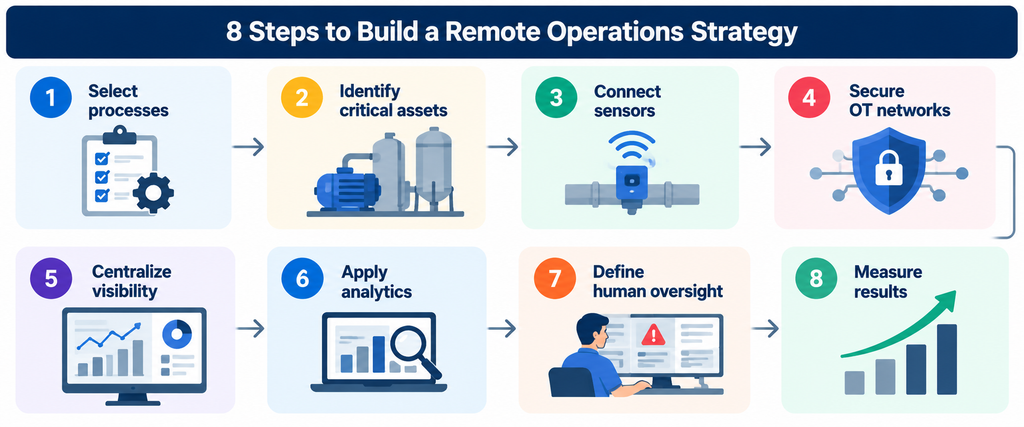
- Identify processes suitable for remote monitoring. Start with stable, well-understood, lower-risk processes.
- Identify critical equipment and data. Decide which assets matter most and which readings show their health.
- Connect relevant assets and sensors. Add instrumentation only where it answers an operational question.
- Establish secure OT connectivity. Segment networks, encrypt links, and control who can reach what.
- Centralize operational visibility. Bring every site into one shared view.
- Introduce analytics and AI where useful. Apply them to specific problems once the data is reliable.
- Define human intervention points. Specify which actions automation may take and which need an operator.
- Measure operational improvements. Track downtime, response times, site visits, and maintenance costs against a baseline.
Build AI-Driven Operations and Transform Business Processes
Remote operations is increasingly moving beyond monitoring equipment to using AI, automation, and data-driven systems to improve how processes are managed. Building these capabilities requires an understanding of both AI applications and operational transformation.
The Certificate Programme in AI-Powered Operations & Process Transformation by IIM Tiruchirappalli
is designed for professionals looking to understand how AI and automation can be applied to operations and process transformation.
- Institute: IIM Tiruchirappalli
- Duration: 6 months
- Mode: Live Online
- Classes: Weekends
Explore the programme to build skills in AI-powered operations and process transformation.
Frequently Asked Questions
1. What is the difference between remote monitoring and remote operations?
Remote monitoring focuses on observing equipment and processes from another location, while remote operations can also include taking approved actions to control those processes. Remote operations therefore combines visibility with the ability to respond or intervene remotely.
2. What equipment is needed for remote operations?
A remote operations setup typically combines sensors for collecting equipment data, control systems such as PLCs and SCADA, connectivity, edge or cloud platforms, and analytics tools. The exact combination depends on the assets being managed and whether the goal is monitoring, control, prediction, or automation.
3. How does remote operations work when internet connectivity is lost?
Remote sites should be designed to continue essential local operations when connectivity fails. Edge computing can process data close to equipment, while local systems can continue operating and synchronize information with the central platform once the connection is restored.
4. Is edge computing better than cloud computing for remote operations?
Neither is universally better. Cloud platforms are useful for centralized visibility, data storage and analysis across multiple sites, while edge computing is better suited to time-sensitive decisions that need to happen close to the equipment. Many remote operations environments use both.
5. What types of processes are suitable for remote operations?
Remote operations work particularly well for processes that are stable, measurable and suitable for remote monitoring or control. Organizations should generally start with lower-risk processes where equipment condition can be reliably observed through sensors and operational data.
6. How does AI improve remote operations?
AI can help remote teams move beyond simply monitoring equipment by identifying abnormal behavior, predicting failures, forecasting demand and recommending operating changes. This can help teams prioritize important alerts and plan interventions before problems become failures.
7. What are the biggest cybersecurity risks of remote OT access?
Remote access creates additional pathways into industrial control environments. Risks include unauthorized access, compromised credentials, insecure connections and exposure of legacy OT systems. Access should therefore be restricted by role, monitored and logged, with networks segmented to limit the impact of a breach.
8. How can companies integrate remote operations with legacy OT systems?
Legacy equipment can be integrated by identifying the data and control interfaces available on existing systems and adding appropriate connectivity or edge layers. The goal is to modernize visibility and analytics without unnecessarily replacing equipment that still performs its core operational function.
9. When should companies use edge AI in remote operations?
Edge AI is most useful when decisions need to be made close to the equipment or when connectivity to a central cloud platform is unreliable. It can analyze operational data locally and support rapid responses without waiting for data to travel to a remote server and back.
10. Can remote operations be fully automated?
Some routine operational tasks can be automated, such as adjusting flows, balancing loads or starting equipment. However, safety-critical or unusual situations generally require defined human intervention points and clear limits on what automation can do independently.
Sources
NIST — Guide to Operational Technology (OT) Security
NIST — Digital Twin Core Conceptual Models and Services