FDE at a Startup vs an Enterprise: Which One Should You Join First?

Key Insights
- Startup FDEs typically have broader ownership and work across high-ambiguity problems, while enterprise FDEs operate with more structure and deeper domain specialization.
- AI lab FDEs offer another path, with greater emphasis on technically demanding AI implementations and cutting-edge systems.
- The environment you choose directly affects your pace of work, learning breadth, customer exposure, technical depth, and level of ownership.
- Compensation and career growth can vary by environment, with startups offering breadth, enterprises offering scale and stability, and AI labs offering deeper AI exposure.
- FDE experience can build transferable skills across software engineering, AI, solution design, customer problem-solving, and technical consulting.
- The right FDE environment ultimately depends on the kind of engineer you want to become—not simply which environment offers the “best” career.
FDE at a Startup vs an Enterprise: Which One Should You Join First?
A Forward Deployed Engineer (FDE) at a startup works without a playbook and handles a broad, high-ambiguity technical scope, whereas an FDE at an enterprise follows structured onboarding, defined processes, and deeper domain specialization. Choosing between the two is not simply a choice between two company sizes. The environment you enter can shape your day-to-day work, technical scope, customer exposure, learning curve and career growth. AI labs add another path, with a stronger focus on AI-first technical implementation.
So, when comparing FDE startup vs enterprise opportunities, the question is not which environment is universally better, but which one matches the kind of engineer you want to become. This guide compares these environments across scope, pace, learning, compensation and stability to help you decide where to start your FDE career.
How does a Forward Deployed Engineer Role Differ at a Startup, Enterprise, and AI Lab?
The FDE role sits between engineering and consulting, but the balance can change significantly depending on the organisation. A startup FDE may work across several parts of a product, while an enterprise FDE may specialise within a larger implementation team. An AI lab FDE may spend more time translating advanced AI capabilities into practical customer solutions.
| Factor | Startup FDE | Enterprise FDE | AI Lab FDE |
| Scope | Broad, often end-to-end | More specialised and structured | Deep technical and AI-focused |
| Pace | Fast iteration | More processes and approvals | Fast technical iteration |
| Learning | Broad exposure | Enterprise systems and processes | Advanced AI and engineering |
| Customer interaction | Often high | High but structured | Often highly technical |
| Stability | Generally more variable | Generally more structured | Varies by team |
| Ownership | Often broad | Defined by team/project | Often technically deep |
FDEs at Startups: Broad Scope and Fast Iteration
A startup FDE often works across multiple parts of the product and may take a problem from customer discovery through implementation. Smaller teams can mean broader ownership, faster feedback loops and fewer layers between identifying a problem and deploying a solution.
This can make a startup FDE role particularly useful for engineers who want exposure to different technologies, customer conversations and product decisions. The trade-off is that priorities and responsibilities may change quickly.
FDEs at Enterprises: Scale, Structure, and Complex Systems
An enterprise forward deployed engineer typically works within more established engineering and implementation processes. The customer environments can be larger and involve complex integrations, multiple stakeholders, security requirements and existing enterprise systems.
The role may therefore have more defined responsibilities and specialised teams. At the same time, it can provide valuable experience with enterprise-scale deployments and structured customer implementations.
FDEs at AI Labs: Deep AI and Technical Deployment
An AI lab FDE typically works in an AI-first environment where the challenge is often to translate emerging AI capabilities into usable customer solutions. The work may involve models, APIs, AI infrastructure, evaluation or deployment workflows.
The exact responsibilities vary by organisation and team, but AI-focused FDE roles can offer deeper exposure to AI implementation and technically demanding customer problems.
Startup vs Enterprise vs AI Lab: What Changes for Your Career?
The best environment for an FDE career depends on the type of experience you want to build. Rather than asking which is better, consider what each environment changes about your work.
Scope and Ownership
A startup FDE may have wider responsibility and more end-to-end ownership because smaller teams require engineers to work across different parts of the solution.
An enterprise FDE is more likely to work within defined responsibilities and larger teams. This can mean less ownership of every component but greater exposure to complex organisational and technical systems.
An AI FDE may have a narrower focus on AI implementation but deeper technical ownership of the AI components connecting customer requirements to deployed solutions.
Pace and Day-to-Day Work
The pace of forward deployed engineering can look very different across environments. Startups often have rapid iteration and shifting priorities, so an FDE may move quickly between customer feedback, implementation and product changes.
Enterprise implementations tend to involve more structured cycles, stakeholder coordination and established processes. AI labs can combine rapid technical iteration with customer deployment, particularly when working with fast-moving AI products.
Learning and Skill Development
Each environment develops a different combination of skills. A startup can provide broad exposure to engineering, product decisions, customer discovery and problem-solving. An enterprise can strengthen your understanding of large systems, implementation processes and stakeholder management. An AI lab can provide deeper exposure to AI/GenAI, technical implementation and emerging AI capabilities.
None of these automatically provides better learning. The more useful question is which skills you want your FDE career to develop first.
Compensation and Career Growth
FDE salary varies by company, experience, location, role scope and compensation structure:
| Experience | Indicative FDE salary in India |
| Entry-level | ₹18–28 LPA |
| Mid-level | ₹30–50 LPA |
| Senior | ₹50–80 LPA |
These are indicative, not universal market benchmarks or company-specific guarantees. Actual compensation can also include base salary, bonus and equity. Startup packages may include meaningful equity, while enterprise compensation may follow more structured bands. AI-focused organisations can have different structures depending on technical expertise and the role.
Stability and Risk
Stability is another factor to consider when comparing a startup FDE with an enterprise FDE. Startups can have more variable priorities and organisational structures, while established enterprises generally have more defined teams and processes.
However, company size alone does not determine stability. The organisation’s business position, team structure, role clarity and changing customer priorities can all affect the experience.
Startup vs Enterprise vs AI Lab: Which FDE Environment Fits You?
There is no universal winner in the startup vs enterprise FDE decision. The right environment depends on what you want from your first or next role.
Choose a Startup If You Want Broad Ownership
A startup may suit you if you want to work across the stack, own problems end-to-end and learn through rapid iteration. It can also be a good fit if you enjoy ambiguous problems and want close interaction with customers and product teams.
Choose an Enterprise If You Want Scale and Structure
An enterprise may suit engineers who want exposure to large-scale systems, structured engineering processes and complex customer environments. It can also provide experience working with multiple stakeholders and established implementation teams.
Choose an AI Lab If You Want AI-First Engineering
An AI lab may be a better fit if you want strong exposure to AI/GenAI, technically demanding implementation work and AI-first products or infrastructure. These environments can be particularly relevant for engineers interested in translating emerging AI capabilities into real-world applications.
What Should You Prioritise in Your First FDE Job?
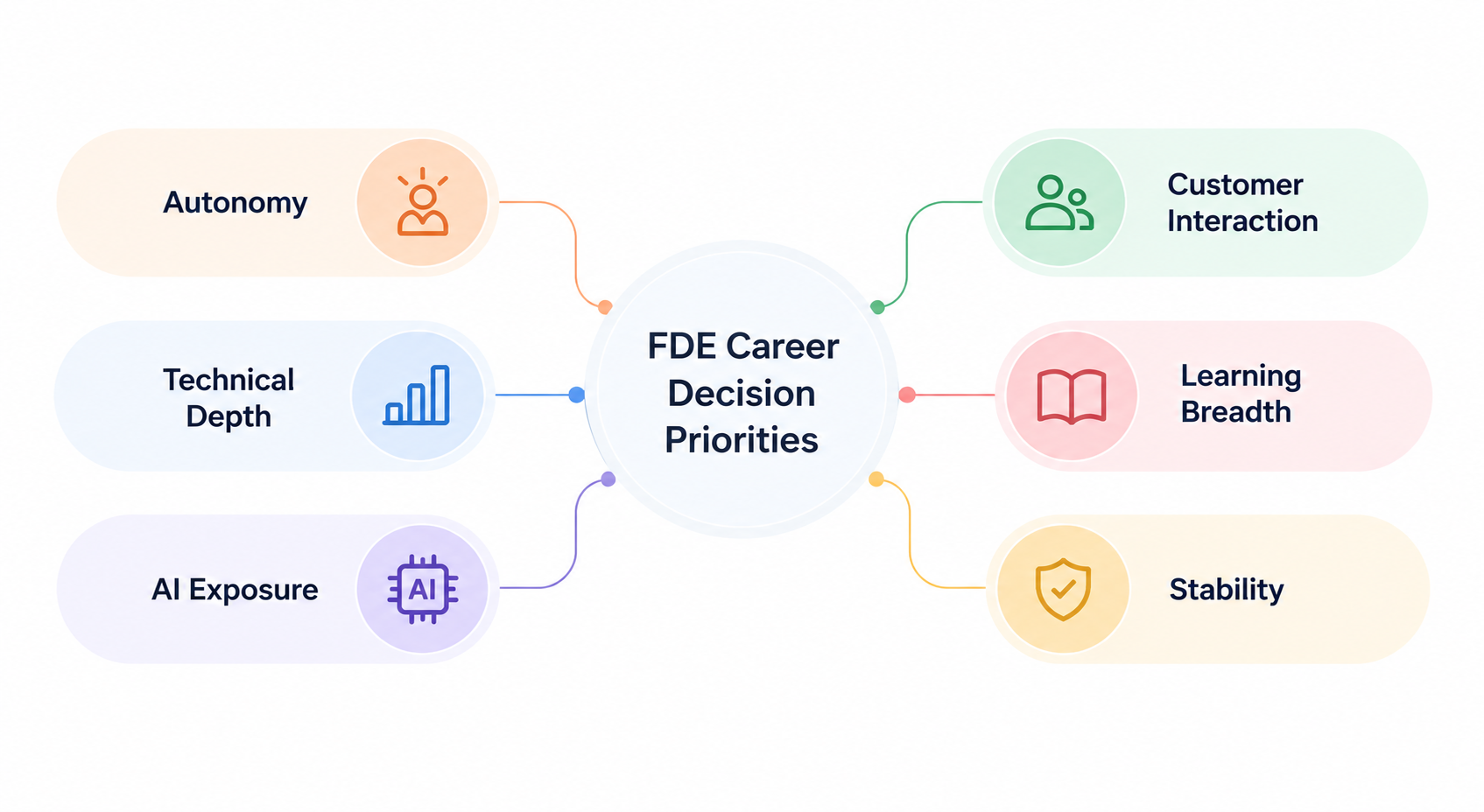
Before accepting an offer, ask:
- How much technical ownership will I get?
- How close will I be to real customer problems?
- Will I build and deploy solutions or mainly coordinate them?
- How much AI/GenAI exposure will I get?
- What engineering skills will I develop?
- How clearly is the role defined?
- What could my career progression look like after one to three years?
These questions can help you evaluate startup FDE jobs, enterprise FDE jobs and AI lab opportunities on the basis of the experience they offer rather than the company label.
What Skills Matter Across All FDE Environments?
While the working environment changes, several FDE engineer skills remain transferable across organisations.
Strong Software Engineering Fundamentals
Programming, APIs, backend systems, debugging and systems thinking form the foundation of forward deployed engineering. FDEs need to turn customer requirements into software that can actually be deployed and maintained.
AI and GenAI Implementation Skills
AI FDE roles increasingly require familiarity with AI/ML fundamentals, LLMs, APIs, AI applications, evaluation and iteration. The important skill is not simply knowing AI concepts but understanding how to apply them to practical customer problems.
Customer and Consulting Skills
FDE responsibilities combine technical implementation with customer problem-solving. That means understanding requirements, communicating technical ideas, managing stakeholders and translating a customer problem into a workable solution.
Adaptability and Problem-Solving
An FDE may move between technical implementation, customer conversations, product constraints, business requirements and real-world deployment issues in the same project. Being able to adapt between these contexts is therefore a core part of forward deployed engineering.
What can an FDE Career Lead To?
A Forward Deployed Engineer career can build a combination of engineering, AI implementation, technical delivery and customer problem-solving skills. These can create pathways into several technical and customer-facing roles.
Common FDE Career Paths
Depending on your interests and experience, possible paths include AI Implementation Engineer, AI/ML Engineer, Solutions Engineer, Forward Deployed Engineer, Technical Consultant, Solutions Architect and other AI implementation or technical delivery roles.
The transition is not automatic, but the skills developed through FDE work can transfer across these roles.
Why Your First FDE Environment Matters?
Your first environment can influence the kind of experience you accumulate. A startup can emphasise breadth and ownership, an enterprise can provide exposure to scale and structured implementation, and an AI lab can offer greater AI depth and technical exposure.
The goal is not to choose the environment with the best reputation. It is to choose the one that gives you the experience most aligned with the FDE career path you want to build.
Conclusion
There is no single best environment for an FDE career. Startups can offer broader ownership, enterprises can provide scale and structure, and AI labs can offer deeper exposure to AI-driven technical work. The right choice depends on the skills, pace, and level of ownership you want to build.
If you want to develop these capabilities through hands-on AI projects and industry-focused experience, the AI Forward Deployed Engineering programme by IIT Delhi can help you build the technical and customer-facing skills needed for the role.
Frequently Asked Questions
Is an FDE role better at a startup or an enterprise?
Neither is universally better. A startup may suit engineers seeking broader ownership and faster iteration, while an enterprise may be better for those seeking scale, structure and complex customer environments.
Is an FDE role at an AI lab more technical?
It can be, particularly when the role involves AI models, infrastructure or advanced AI implementation. However, responsibilities vary by organisation and team.
Can I become an FDE without prior consulting experience?
Yes. Consulting experience can help, but strong software engineering, problem-solving, communication and implementation skills are also important for FDE roles.
What does an FDE’s day actually look like?
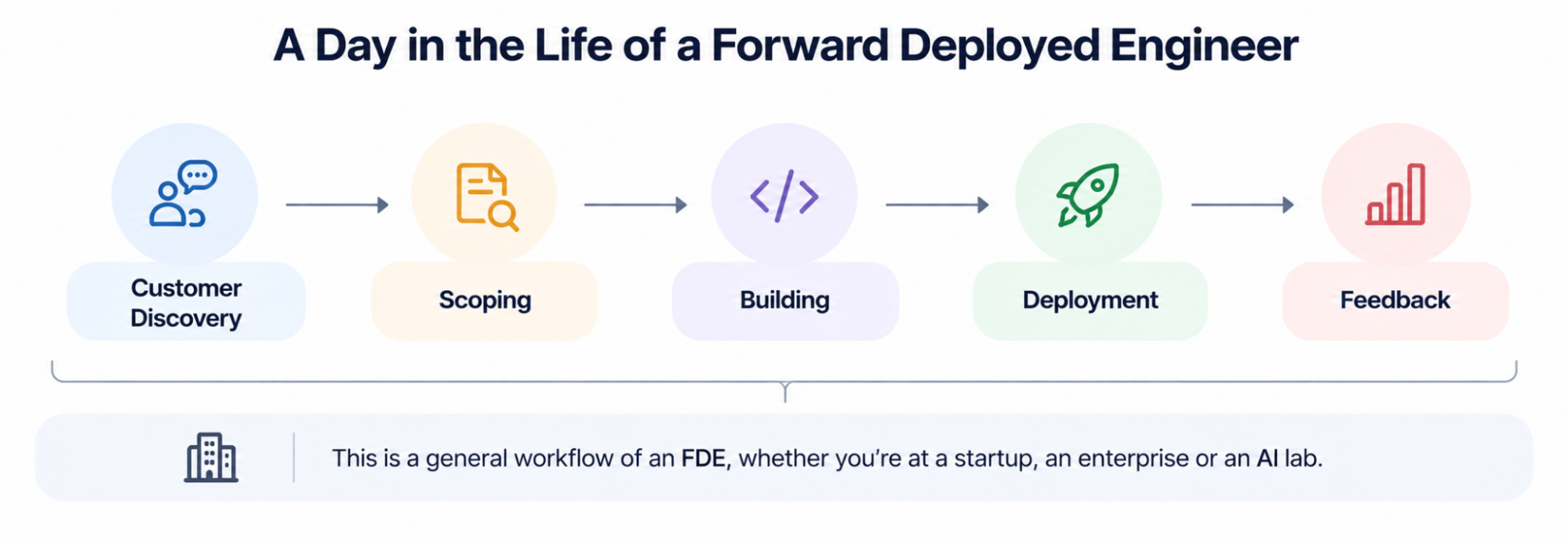
It can range from customer discovery and technical scoping to coding, deployment, debugging, and stakeholder meetings. The balance depends heavily on the company and project.
Do FDEs travel frequently for customer deployments?
Some roles involve regular customer-site work, while others are mostly remote. Check the job description for travel expectations before applying.
Can a software engineer switch to FDE without changing their technical career path?
Yes. FDE engineering still involves software development, APIs, integrations, debugging, and production systems, while adding customer-facing responsibilities.
Should I apply for FDE jobs before I have AI experience?
You can, particularly for roles focused on software engineering and deployment. However, AI/GenAI knowledge is increasingly useful for AI FDE and AI implementation roles.
What should I look for in an FDE job description?
Look for the actual mix of coding, deployment, customer interaction, travel, AI implementation, and ownership. The title alone does not tell you what the role involves.
Can an FDE move back into a pure software engineering role?
Yes. Strong production engineering experience can transfer to software engineering, particularly when the role involves substantial coding and system ownership.
What makes a strong FDE candidate stand out?
The ability to combine engineering depth with problem-solving, customer empathy, and comfort with ambiguity. Strong candidates can move from an unclear problem to a practical, deployable solution.