Customer Segmentation: Types, Examples & AI-Powered Segmentation

Key Insights
- Customer segmentation divides a broad customer base into groups based on shared characteristics, behaviours, needs or customer value, helping marketers create more relevant campaigns and experiences.
- The five core types are demographic, geographic, psychographic, behavioural and value-based segmentation, and marketers can combine multiple approaches when one variable is not enough.
- An effective segmentation process starts with a clear marketing goal, followed by relevant customer data, suitable variables, segment creation, testing and continuous refinement.
- Clustering and RFM analysis can help marketers identify meaningful customer groups from purchase and behavioural data without relying only on manually defined rules.
- AI-powered customer segmentation can analyse larger datasets, identify behavioural patterns, predict customer actions and create dynamic segments, but simpler rule-based methods can still be more practical for clear marketing needs.
- Useful customer segments should be measurable, actionable and distinct enough to justify different marketing actions. Indian D2C brands can use customer data to tailor recommendations, offers, products and customer experiences.
Customer segmentation is the process of dividing a broad customer base into groups with shared characteristics, behaviours, needs or values. It helps marketers move beyond one-size-fits-all campaigns and make more relevant decisions about messaging, offers, products and customer experiences.
The approach can range from simple demographic or geographic groups to behavioural segmentation, RFM analysis, clustering and AI-powered methods. The goal is not simply to create different groups, but to create useful segments that lead to different marketing actions.
In this guide, you’ll learn about the five main types of customer segmentation, how to create and evaluate segments, how clustering and RFM work, how AI can make segmentation more dynamic, and how Indian D2C brands use customer data.
In short:
- Customer segmentation groups customers based on shared characteristics or behaviours.
- The five core types are demographic, geographic, psychographic, behavioural and value-based segmentation.
- Clustering, RFM and AI can uncover patterns that are harder to identify with simple rules.
- Useful segments should be measurable, actionable and relevant to a specific marketing goal.
What are the Types of Customer Segmentation?
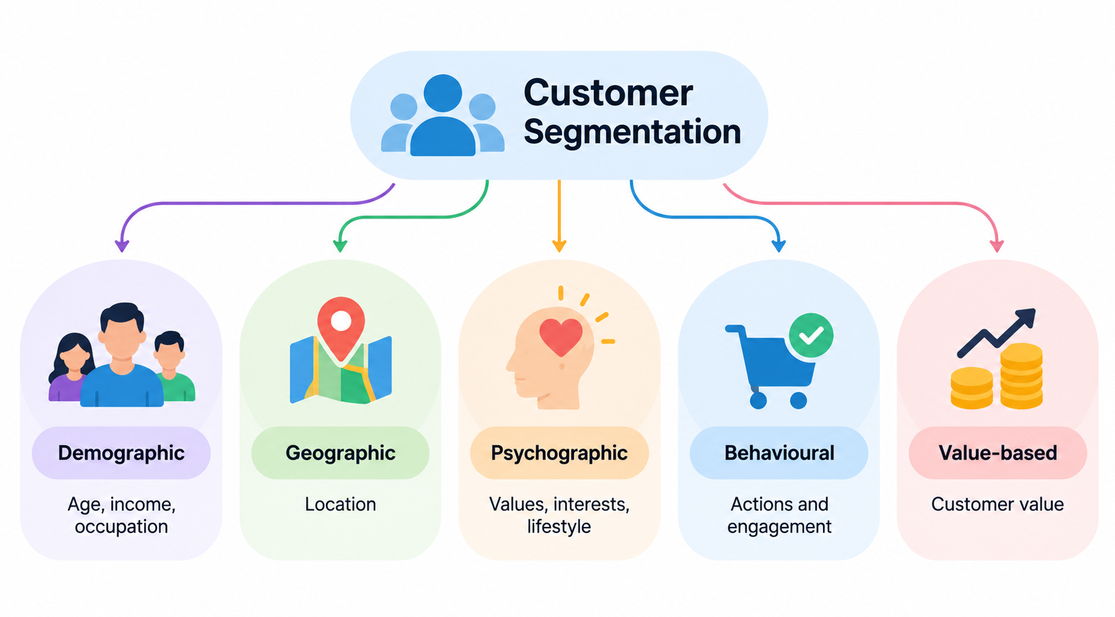
The five core types of customer segmentation are demographic, geographic, psychographic, behavioural and value-based segmentation.
| Type | Based On | Example |
| Demographic | Age, income, occupation | Students vs professionals |
| Geographic | Location | Delhi vs Mumbai |
| Psychographic | Values, interests, lifestyle | Sustainability-focused buyers |
| Behavioural | Actions and engagement | Frequent vs occasional buyers |
| Value-based | Customer value | High-value vs low-value buyers |
Demographic Segmentation
Demographic segmentation groups customers using characteristics such as age, income, occupation, gender or family status.
Example: A financial services company could create different campaigns for young professionals and customers nearing retirement.
Demographic data is easy to use, but customers with similar demographics may still have very different needs.
Geographic Segmentation
Geographic segmentation divides customers by location, such as country, state, city or region.
Example: A food delivery brand could promote different offers in Delhi and Mumbai based on local availability or demand.
Location can also affect delivery, pricing, product availability and seasonal campaigns.
Psychographic Segmentation
Psychographic segmentation groups customers based on interests, values, attitudes and lifestyle.
Example: A beauty brand could target customers interested in simple skincare routines with products suited to minimalist routines.
This approach helps marketers understand what customers care about, not just who they are.
Behavioural Segmentation
Behavioural customer segmentation uses what customers actually do.
Common factors include purchase frequency, browsing activity, product usage, cart activity and campaign engagement.
Example: An ecommerce brand could separate frequent buyers from customers who browse products but rarely purchase.
Behavioural data is useful because it reflects actual customer actions.
Value-Based Customer Segmentation
Value-based segmentation groups customers according to the value they create for a business.
Metrics can include purchase value, frequency, margin or customer lifetime value.
Example: A D2C brand could identify high-value customers who make frequent purchases and create a loyalty campaign specifically for them.
How does Customer Segmentation Work?
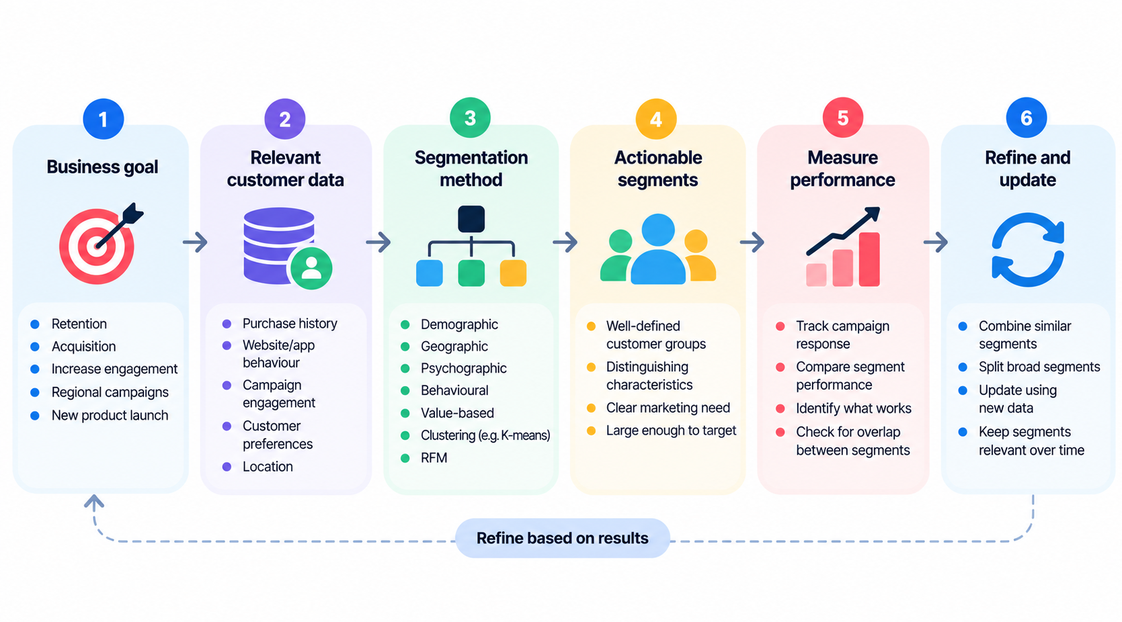
A practical customer segmentation process starts with a marketing goal and ends with groups that can be measured, reached and activated.
1. Define the Marketing Objective
Start with the question: What do you want the segmentation to help you achieve?
The goal could be increasing repeat purchases, improving campaign engagement, reducing churn or promoting a new product.
A clear goal prevents marketers from creating segments that look interesting but have no practical use.
2. Collect Customer Data
Collect the data needed for the marketing objective.
This can include:
- CRM data
- Purchase history
- Website behaviour
- App activity
- Campaign engagement
- Customer preferences
- Location
- Product usage
You do not need every possible data point. Focus on information that can help answer the marketing question.
3. Select Relevant Variables
Choose the characteristics that can meaningfully separate customers.
For a retention campaign, purchase frequency and time since the last purchase may matter more than occupation.
For a location-based campaign, geography may be more useful.
4. Create Customer Segments
Segments can be created using simple business rules or data-driven methods such as clustering.
For example:
Customers who purchased more than three times in the last six months.
More advanced methods can identify groups based on several behaviours at once.
5. Test and Analyse the Segments
A segment is not useful simply because it is statistically different.
Check whether each segment:
- Is large enough to target
- Has a meaningful difference from other groups
- Has a distinct marketing need
- Can be measured
- Can be reached through an available channel
6. Activate and Refine Them
Connect the segments to CRM, CDP or marketing automation systems.
Then monitor performance. If two segments respond in almost the same way, they may not need to remain separate. If one group contains very different behaviours, it may need further segmentation.
What is Customer Segmentation Clustering?
Customer segmentation clustering uses algorithms to find groups of customers with similar characteristics or behaviours.
Clustering becomes useful when manual rules cannot capture enough customer behaviour. Instead of defining every group yourself, you provide relevant data and let an algorithm identify patterns.
How Clustering helps Marketers?
Consider an ecommerce business with data on:
- Purchase frequency
- Average order value
- Product categories
- Website activity
- Discount usage
Creating separate rules for every combination would quickly become difficult. Clustering can identify customers with similar combinations of behaviours.
Marketers then examine those groups and decide whether they represent useful customer segments.
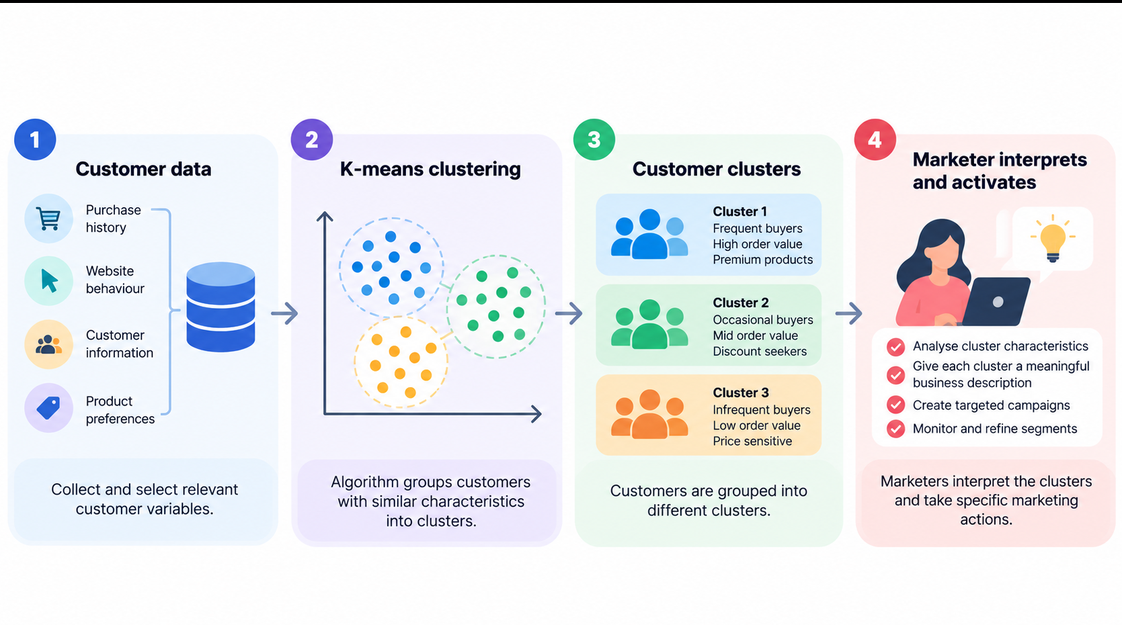
K-Means Clustering for Customer Segmentation
K-means is a commonly used clustering method.
The basic process is:
- Select relevant customer variables.
- Decide how many groups to analyse.
- The algorithm groups similar customers.
- Examine the characteristics of each group.
- Give each group a meaningful business description.
- Test whether the groups lead to different marketing outcomes.
The algorithm creates the groups. The marketer still decides what those groups mean and what action to take.
RFM Customer Segmentation
RFM stands for:
- Recency: How recently did the customer purchase?
- Frequency: How often do they purchase?
- Monetary value: How much do they spend?
Customers who purchase recently, purchase often and spend more could form a high-value segment.
Customers who used to purchase frequently but have not purchased recently could become a reactivation segment.
RFM is useful because it turns transaction data into groups that marketers can understand and act on without requiring complex machine learning.
How does AI-Powered Customer Segmentation Work?
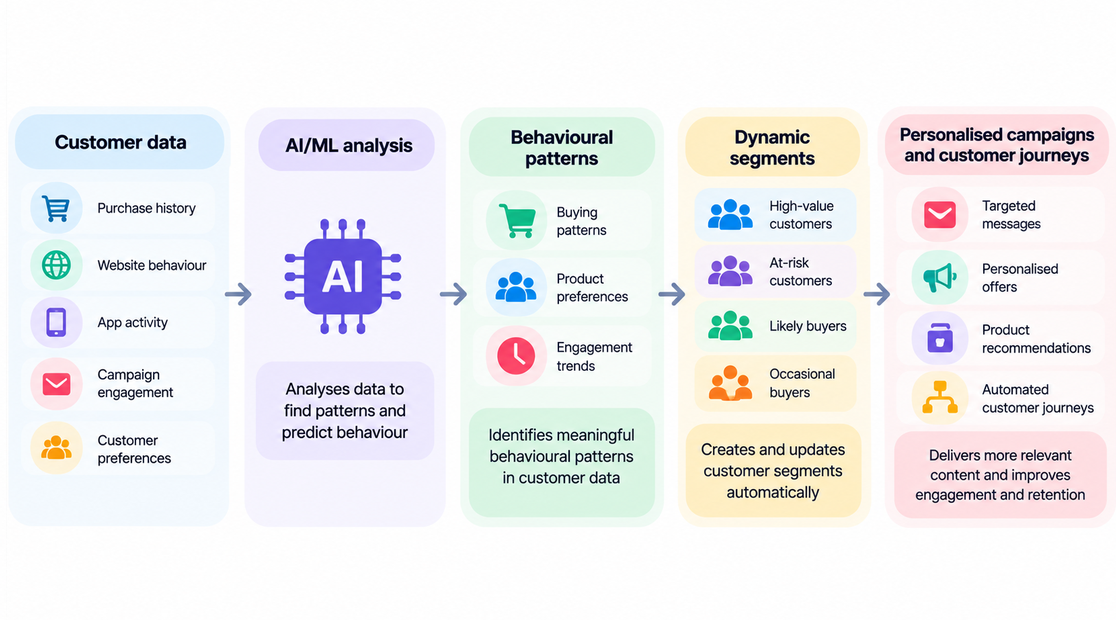
AI-powered customer segmentation extends traditional and clustering-based approaches by using machine learning, predictive signals and continuously updated customer data.
This can help marketers work with larger datasets and respond to changing customer behaviour.
AI vs Traditional Customer Segmentation
| Traditional Segmentation | AI-Powered Segmentation |
| Often uses fixed rules | Can identify patterns in large datasets |
| Uses predefined criteria | Can combine many behavioural signals |
| Segments may remain static | Segments can change as behaviour changes |
| Easier to understand | May require more interpretation |
| Works well for clear rules | Useful for complex customer behaviour |
Traditional segmentation is still useful. A simple rule can be better than a complex model if marketers cannot understand or act on its output.
What can AI-Powered Segmentation help Marketers Do?
AI can help marketers:
- Identify behavioural patterns
- Predict churn or purchase likelihood
- Personalise campaigns
- Create dynamic customer segments
- Trigger customer journeys
For example, an ecommerce business could identify customers whose purchase frequency is declining, combine that signal with product preferences and trigger a relevant re-engagement campaign.
This is where predictive customer segmentation can extend traditional rule-based approaches.
Customer Segmentation Tools
Customer segmentation can involve several parts of the marketing technology stack.
CRM platforms store customer information and interactions.
Customer data platforms (CDPs) combine data from different sources into unified customer profiles.
Analytics and machine-learning tools help identify patterns and create predictive segments.
Marketing automation platforms use those segments to trigger campaigns and customer journeys.
The goal is not to use as many tools as possible. It is to connect reliable customer data with useful marketing actions.
Customer Segmentation Examples in Indian D2C Brands
Indian D2C brands use customer data to personalise products, recommendations and customer experiences. Public information does not always reveal the exact segmentation models used internally, so these examples focus on documented uses of customer data rather than assuming a particular AI or clustering method.
Fashion and Apparel
Lenskart
Customer data: Lenskart states that it collects information such as postcode, preferences and interests to understand customer needs and customise its website.
Segment: Customers can be differentiated by location, preferences and product needs.
Marketing action: These signals can support more relevant product discovery, offers and experiences.
Beauty and Personal Care
Nykaa
Customer data: Nykaa has described personalisation based on customer preferences, browsing history and demographics. It has also introduced AI-based recommendations and tools such as its Virtual Skin Analyzer.
Segment: Customers can be differentiated by beauty preferences, concerns and shopping behaviour.
Marketing action: These signals can support personalised product recommendations and shopping experiences.
Food and Beverage
Country Delight
Customer data: Country Delight allows customers to choose different delivery schedules and operates across multiple Indian cities.
Segment: Customers can be differentiated by location and subscription or purchasing preferences.
Marketing action: The brand can tailor availability and delivery experiences around those preferences.
How to Choose the Right Customer Segmentation Strategy?
The right customer segmentation strategy depends on the business goal and the data available.
Start With the Business Goal
Choose the marketing decision the segment needs to support.
Retention, acquisition and regional campaigns may require different approaches.
Prioritise Actionable Customer Data
Use variables that can change a marketing action.
A data point may be interesting but not useful if it does not affect the campaign, offer, channel or customer experience.
Combine Multiple Segmentation Methods
Customer segments do not have to use only one method.
For example, a D2C brand could combine geography, purchase frequency and customer value to identify high-value customers in a particular city who purchase frequently.
Keep Segments Measurable and Useful
A useful segment should be:
- Large enough to analyse and target
- Different enough from other segments to justify separate treatment
- Easy to measure
- Practical to reach
- Connected to a clear marketing action
Conclusion
Customer segmentation gives marketers a practical way to understand that not all customers need the same message, product or offer. Demographic and geographic data can provide a starting point, while behavioural, value-based and psychographic insights can make segments more useful.
Clustering, RFM and AI can take this further by finding patterns across larger datasets and helping marketers update segments as customer behaviour changes. But the technology is only useful when the resulting segments lead to clear marketing actions.
The best approach is therefore to start with the business goal, use relevant customer data, build meaningful segments and measure how they perform. As customer data becomes richer, marketers can make segmentation more precise without losing sight of the decision it is meant to support.
Frequently Asked Questions
How is customer segmentation different from personalisation?
Customer segmentation groups customers into broader groups, while personalisation uses customer-level information to tailor an experience. Segmentation can be one input used to personalise campaigns at scale.
How many customer segments should a business have?
There is no fixed number. The right number depends on the business goal, customer base and available data. If two segments receive the same marketing action, they may not need to remain separate.
Can a business use more than one type of customer segmentation?
Yes. Combining methods can provide a clearer picture of customers. For example, a brand could combine location, purchase behaviour and customer value to create more useful groups.
What data is needed for customer segmentation?
The data depends on the goal. Common inputs include purchase history, website or app behaviour, campaign engagement, location, customer preferences and transaction value.
How often should customer segments be updated?
It depends on how quickly customer behaviour changes. Fast-moving ecommerce or digital businesses may need more frequent updates, while segments based on relatively stable characteristics can be reviewed less often.
What makes a customer segment useful?
A useful segment has a clear difference from other groups and leads to a different marketing action. It should also be large enough to target, measurable and based on reliable data.
What are common customer segmentation mistakes?
Common mistakes include creating too many segments, using irrelevant data, relying on outdated information and creating groups that do not lead to different marketing actions.
Can small businesses use customer segmentation?
Yes. Small businesses can start with simple data such as purchase frequency, location, product preferences and spending. They do not need complex AI models to create useful customer groups.
Is AI always better than traditional customer segmentation?
No. AI can handle larger and more complex datasets, but simple rule-based segmentation can be more practical when the customer groups are already clear and easy to define.
How can customer segments be measured?
Marketers can compare metrics such as conversion rate, purchase frequency, average order value, engagement or retention across segments. The right metric depends on the original marketing goal.
Can customer segmentation be used for retention?
Yes. Marketers can identify groups showing declining purchase frequency, lower engagement or other signs of reduced activity and create targeted retention campaigns for them.
What is dynamic customer segmentation?
Dynamic segmentation updates customer groups as new customer data becomes available. This allows a customer to move between segments when their behaviour changes.
What is the difference between customer segmentation and customer profiling?
Customer profiling describes the characteristics of a customer or customer group. Segmentation goes a step further by dividing the customer base into groups that can be targeted differently.
Does customer segmentation work for B2B marketing?
Yes. B2B marketers can segment customers based on factors such as industry, company size, location, purchase history, account value and engagement with sales or marketing activity.