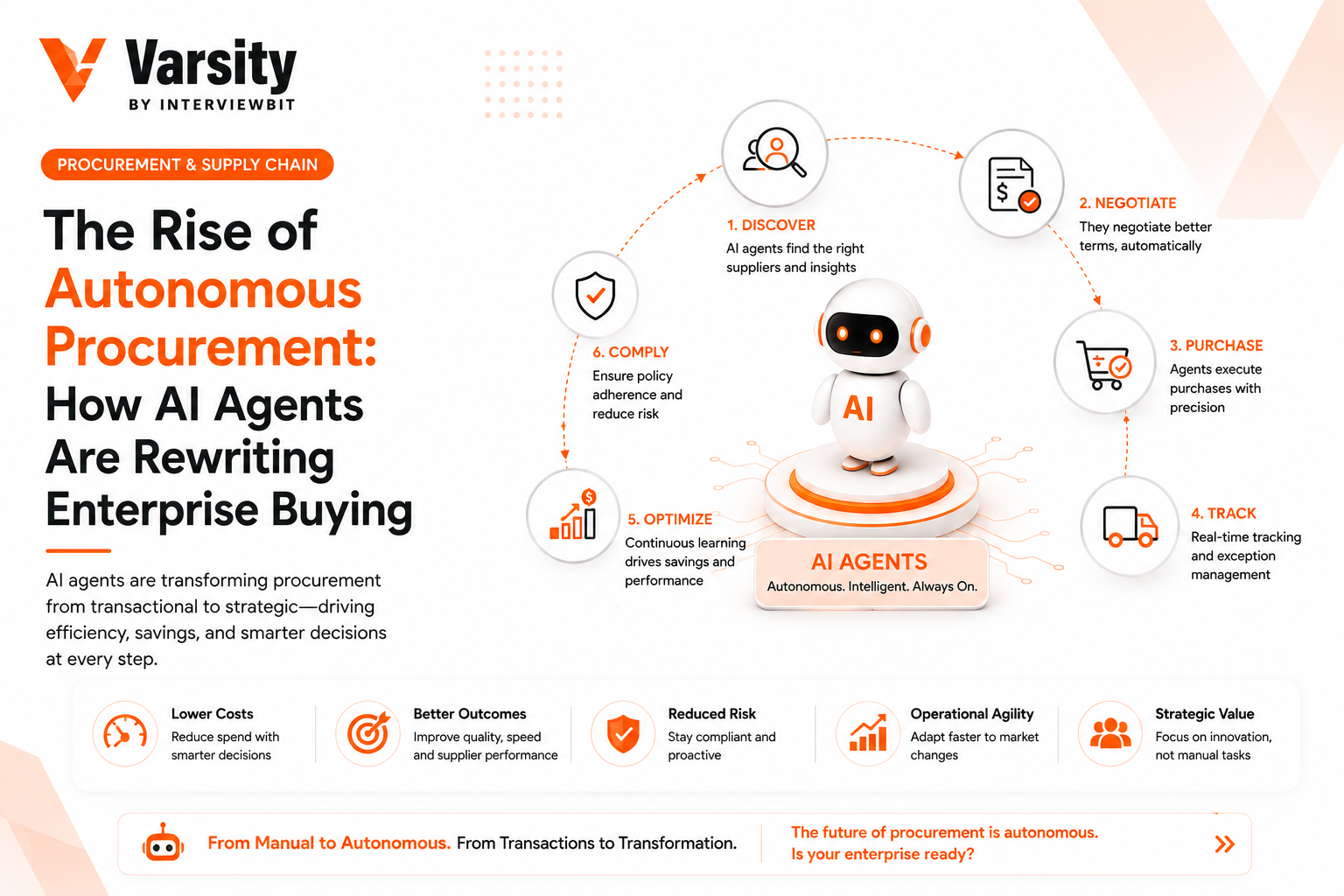
The Rise of Autonomous Procurement: How AI Agents Are Rewriting Enterprise Buying

According to Procurify’s 2026 Procurement Benchmark & KPIs Report, the median time between a requisition landing and a purchase order actually going out is 55 hours. Not the whole buying cycle, just that one handoff. The fastest teams do it in under 40. Sit with that for a second: over two full working days just to turn “we need this” into “okay, go ahead,” before a single supplier conversation has even started.
That gap is exactly where AI agents have started showing up in enterprise procurement, not as a fancier dashboard, but as software that actually does the requesting, comparing and routing itself. This is the part of the AI story in business operations that doesn’t get the same headlines as chatbots and coding assistants, mostly because enterprise buying has never been a glamorous topic. It’s also, quietly, one of the places the technology is moving fastest.
This piece walks through what procurement actually is, how it differs from sourcing and e-procurement (three words people use like they’re the same thing, they’re not), what an RFQ actually is, and how AI agents are changing the mechanics of enterprise buying specifically, which behaves very differently from a person buying a laptop on their own card.
What Is Procurement?
Procurement is the function responsible for acquiring the goods, services and capital assets an organisation needs to operate, covering everything from spotting the need through to paying the final invoice. It’s a cycle, not a single purchase, and it sits somewhere between finance, operations and legal depending on who you ask.
That’s the short version. If you want the fuller breakdown, the step-by-step process and how procurement differs from plain purchasing, we’ve covered that in depth elsewhere. Here, the focus is narrower and more specific: enterprise buying, and what’s actually changing about how it gets done.
Sourcing vs Procurement vs Purchasing
Three words, three different jobs, constantly used as if they’re interchangeable in meetings where nobody wants to be the person who stops to correct anyone.
| Term | What it actually covers | Time horizon |
| Sourcing | Finding, vetting and building relationships with suppliers before a specific need even exists | Strategic, ongoing |
| Procurement | The full cycle: need to requisition to sourcing to contract to payment | Full lifecycle, per purchase |
| Purchasing | The transaction itself, placing the order and paying for it | Tactical, one-off |
Sourcing is upstream of procurement. A good sourcing function has already identified three reliable packaging suppliers before anyone in operations even asks for one. Procurement is what happens once that need is formally raised. Purchasing is the last, smallest step of procurement. All three show up on a resume as “procurement experience,” which is a big part of why the terms blur together in practice.
What Is E-Procurement?
E-procurement is the digital version of the procurement cycle, requisitions, approvals, purchase orders and invoicing handled through software instead of paper forms, spreadsheets and email chains. Think of platforms like SAP Ariba, Coupa or Jaggaer, the systems most large enterprises already run their buying through.
Here’s the distinction that actually matters for this article: e-procurement digitised the paperwork. It made the forms faster to fill and the approvals easier to track. It did not, on its own, make the decisions any smarter. A digitised RFQ is still a form a human has to fill out and a comparison a human has to run. That’s the ceiling e-procurement hit, and it’s exactly the ceiling agentic AI is now pushing past.
What is an RFQ in Procurement?
An RFQ, Request for Quotation, is a formal document a buyer sends to pre-qualified suppliers asking for pricing and commercial terms on a clearly defined product or service. You use an RFQ when you already know exactly what you want and just need to compare prices across vendors, not when you’re still figuring out what solution fits your problem.
That last bit trips people up, because RFQ often gets used as a catch-all for any vendor request. It isn’t. There are two close cousins worth knowing, especially since interviewers and job descriptions love asking about the difference:
| Document | Full form | You use it when |
| RFI | Request for Information | You’re still exploring the market and want to know what’s out there before committing to anything |
| RFP | Request for Proposal | You have a problem but you’re open to different solutions, and want suppliers to propose an approach, not just a price |
| RFQ | Request for Quotation | You know exactly what you need, specs and quantity included, and just want the best price |
A typical RFQ includes the item or service description, exact quantity, required delivery timeline, payment terms, and a deadline for suppliers to respond by. No ambiguity, no room for creative proposals, just a clean, comparable price on a defined spec. That precision is exactly why RFQs were among the first procurement documents AI agents got good at drafting and processing automatically, there’s very little judgement involved once the spec is locked.
Enterprise Buying Is Its Own Beast
Everything above applies to a small business too. What makes enterprise buying specifically painful, and specifically ripe for AI agents, comes down to scale and layers:
- Multiple approval tiers. A single purchase order might need sign-off from a department head, finance, and sometimes legal, each with their own queue and their own definition of urgent.
- Compliance and vendor risk checks. Enterprises can’t just buy from whoever quotes lowest, there’s due diligence, certifications, sanctions screening, and data-security reviews to run first.
- Fragmented systems. Large companies routinely run purchasing through multiple ERPs across regions or business units that don’t talk to each other cleanly.
- Sheer volume. A mid-size enterprise can generate thousands of purchase requisitions a month. At that scale, even a small manual bottleneck compounds into real, measurable delay.
This is the environment where a 55-hour requisition-to-PO cycle stops being an inconvenience and starts being a genuine cost, projects stall, discounts on time-bound quotes expire, and procurement teams spend more time chasing status updates than actually negotiating.
How AI Agents Are Rewriting Each Stage of Enterprise Buying
| Stage | How it traditionally worked | What an AI agent now does |
| Requisition intake | An employee fills a form, procurement manually checks it against budget and policy | Agent validates the request against budget and category rules instantly, flags anything unusual for review |
| RFQ drafting and vendor outreach | A buyer manually writes the RFQ and emails it to a shortlist of suppliers | Agent drafts the RFQ from the requisition details and sends it to pre-approved vendors automatically |
| Quote comparison | Someone builds a spreadsheet, copies numbers in by hand, compares line by line | Agent normalises incoming quotes into one comparable view within minutes of the last response landing |
| First-pass negotiation | A buyer emails back and forth over days on standard terms | Agent negotiates within pre-approved price and term bands, escalates only what falls outside them |
| Contract review | Legal manually reads and redlines every clause | AI flags non-standard clauses and deviations from approved templates, legal focuses only on the flagged parts |
| PO issuance and ERP sync | Someone manually keys the PO into the ERP after approval | Agent generates and pushes the PO straight into the ERP the moment approval clears |
| Invoice reconciliation | Finance manually matches invoice, PO and goods-receipt line items | Agent auto-matches the three-way check and only surfaces genuine mismatches |
Notice the pattern across every row: the agent isn’t replacing judgement, it’s absorbing the repetitive comparison and matching work that used to eat the bulk of a buyer’s week, so the actual negotiation, the actual risk call, still lands on a person, just a person with far less busywork standing between them and the decision that matters.
The Platforms Leading This Shift
Most of the major e-procurement suites, SAP Ariba, Coupa, Jaggaer, Zip, have started layering agentic features on top of their existing requisition-to-pay software rather than building something from scratch. That’s a sensible move, since the hardest part of automating enterprise buying was never the AI, it was getting clean spend and supplier data into one place to begin with, and these platforms already had that.
Worth being clear-eyed about where this actually sits on the hype curve, though. Most of these agentic layers today handle narrowly scoped tasks well, RFQ drafting, invoice matching, basic supplier risk flags, and are nowhere near running an entire enterprise sourcing event unsupervised. The category is moving fast, but “fast” in enterprise software still means years, not months, before this becomes the default rather than the pilot.
What Enterprise Teams Still Need to Get Right
- Fix the data before you automate the decision. An agent negotiating off outdated supplier records or duplicated vendor entries in the ERP will just make the same old mistakes at higher speed.
- Write the buying policy down properly. Vague instructions like “use discretion above a certain amount” mean nothing to an agent. Explicit thresholds, in currency, per category, are what actually make autonomy safe.
- Keep legal and compliance in the loop by design, not as an afterthought. Contract review and vendor risk checks are exactly the areas where a missed edge case turns into a real liability.
- Pilot on a narrow, low-risk spend category first. Office supplies or software renewals are a far safer place to test agentic buying than a strategic raw-material contract with a single-source supplier.
- Treat this as change management, not just a software rollout. Buyers who’ve spent years building supplier relationships need a genuine reason to trust that an agent handling first-pass negotiation isn’t quietly undercutting the relationship they’ve built.
What is procurement?
Procurement is the end-to-end process an organisation follows to acquire the goods and services it needs, from identifying a need through sourcing, negotiating, purchasing and paying the resulting invoice.
What is the difference between sourcing and procurement?
Sourcing is the upstream work of finding and vetting suppliers, often before a specific need exists. Procurement is the full cycle that follows once a need is formally raised, sourcing is one part of it, not a synonym for it.
What is e-procurement?
E-procurement is the digital, software-based version of the procurement process, requisitions, approvals, purchase orders and invoicing managed through a platform instead of paper or email. It speeds up the paperwork but doesn’t automatically make the underlying decisions smarter.
What is an RFQ in procurement?
An RFQ, or Request for Quotation, is a formal document sent to pre-qualified suppliers asking for pricing on a clearly defined product or service. It’s used when the buyer already knows exactly what they need and just wants to compare prices.
What is the difference between RFQ, RFP and RFI?
An RFI gathers general information when you’re still exploring the market. An RFP asks suppliers to propose a solution when you have a problem but are open to different approaches. An RFQ asks purely for pricing on a specification you’ve already locked down.
Are AI agents replacing enterprise procurement teams?
Not the teams, mostly the repetitive middle layer of the job, drafting RFQs, comparing quotes, matching invoices. Negotiation on strategic contracts, supplier relationships and risk judgement calls are staying firmly with people for the foreseeable future.
Conclusion
Enterprise buying was never slow because the people doing it were bad at their jobs. It was slow because the process involved dozens of small, repetitive comparisons stacked on top of each other, exactly the kind of work software is finally getting good at absorbing. The interesting shift isn’t that AI showed up in procurement. It’s that it showed up in the part of procurement everyone had quietly accepted would just stay tedious forever.