Agentic AI vs Generative AI: The Difference That Defines Your Next Career Move

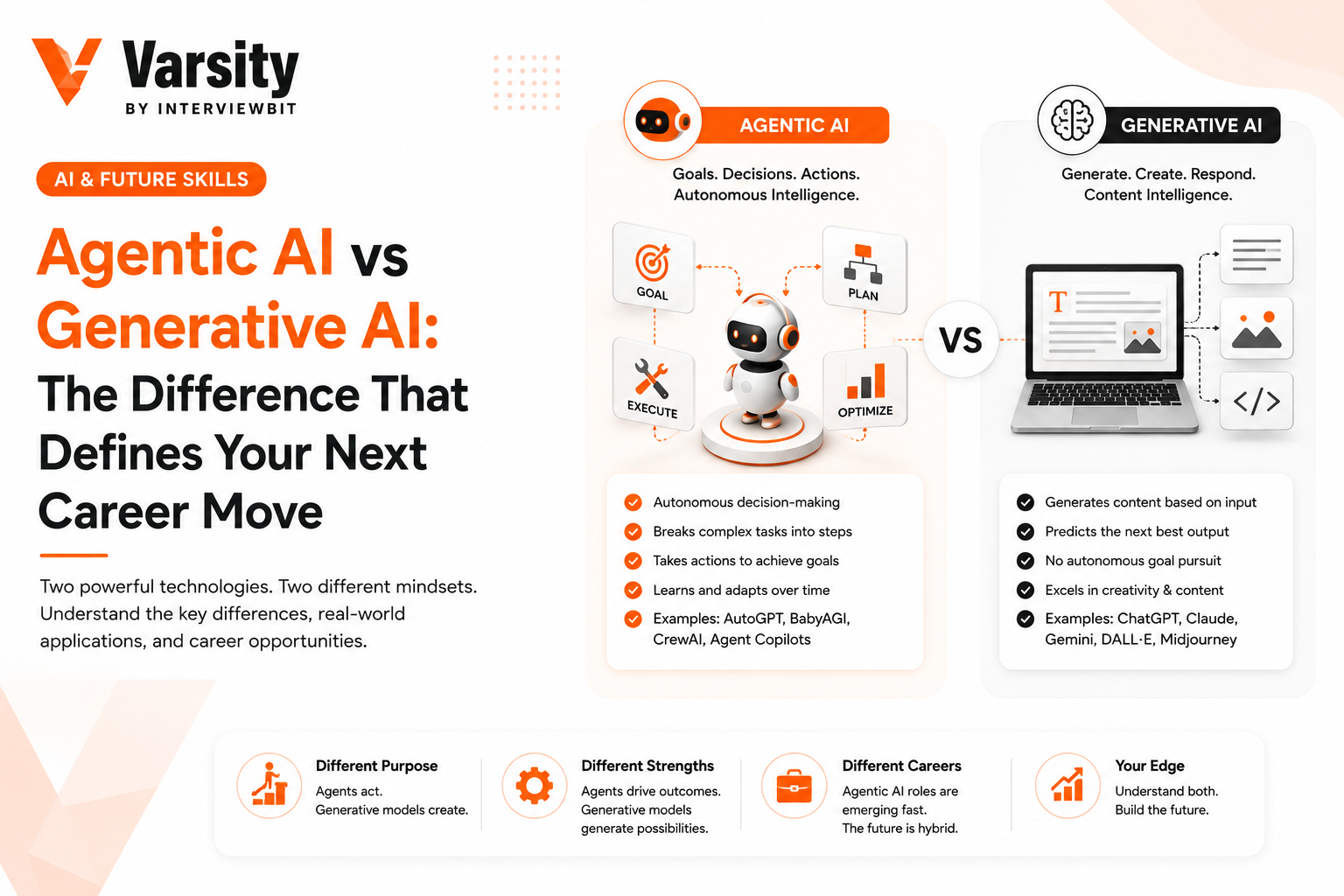
The difference in one line: generative AI creates content in response to a prompt, while agentic AI pursues a goal by planning, using tools and acting across systems with limited human input.
Generative AI produces an output for a human to review, then stops. Agentic AI decides what to do, executes it across real systems, checks the result and retries when it fails. One writes the email. The other reads the ticket, pulls the order record, issues the refund, updates the CRM and escalates only when policy requires a human signature.
The practical distinction is autonomy and the ability to act. A generative system needs a human in the loop at every step. An agentic system needs a human only at the boundaries you define.
That gap is not academic. It separates the engineer who uses an AI tool from the engineer who builds the system, and Indian hiring data is already pricing the two very differently.
Quick Questions and Answers
- What is the main difference between agentic AI and generative AI?
Generative AI responds to a prompt by creating content and then stops. Agentic AI receives a goal, plans the steps, calls tools and APIs, evaluates its own results and iterates until the goal is met or a guardrail stops it. - Is agentic AI just generative AI with extra steps?
No. Agentic AI uses a generative model as its reasoning engine, but adds planning, memory, tool access and a feedback loop. The model is one component of an agentic system, not the whole of it. - Which one should an engineer learn in 2026?
Both, in order. Generative AI fundamentals including prompting, embeddings and retrieval come first, because agentic systems are built on them. Agentic skills such as tool design, orchestration, evaluation and cost control are where the current hiring premium sits. - Can agentic AI work without generative AI?
In principle yes, since rule-based and reinforcement learning agents predate LLMs. In practice almost every agentic system shipping today uses a large language model for reasoning and tool selection. - Is agentic AI replacing generative AI?
No. It is a layer built on top of it. Demand for generative AI skills continues to grow while agentic skills grow faster from a smaller base.
Key Takeaways
- Generative AI creates. Agentic AI acts. GenAI is reactive and prompt-bound. Agentic AI is goal-driven, keeps state and calls external tools.
- Agentic AI is built on top of generative AI, not instead of it. An LLM is usually the reasoning engine inside an agent. This is not a replacement story.
- The risk profile changes completely. A hallucinating chatbot gives bad information. A misconfigured agent takes a bad action on a live production system.
- Gartner projects 40% of enterprise applications will embed task-specific AI agents by the end of 2026, up from under 5% in 2025. (Gartner)
- Predictive AI is the third category most people forget. It forecasts outcomes from structured historical data and still runs the majority of production ML in Indian enterprises.
- The career move is stacking, not switching. Fundamentals, then generative, then agentic orchestration, then evaluation and governance.
First, Fix the Category Confusion: AI vs Generative AI
Before comparing agentic and generative AI, it helps to place them correctly, because the phrase “ai vs generative ai” is itself a category error that shows up constantly in interviews.
Artificial intelligence is the parent field. It covers everything from search algorithms and constraint satisfaction to knowledge representation and probabilistic reasoning. If you want the full map of that field, Artificial Intelligence tutorial walks through it module by module.
Machine learning is a subset of AI where systems learn patterns from data rather than following hand-written rules.
Deep learning is a subset of ML using multi-layer neural networks. Scaler Topics covers the boundary in machine learning vs deep learning.
Generative AI is an application of deep learning that produces new content: text, images, code, audio, synthetic data.
Agentic AI is an architectural pattern that wraps models, memory, planning and tool access into a system that pursues goals.
So agentic AI is not a rival technology to generative AI. It sits one layer above it. Getting this right matters, because interviewers use exactly this question to separate people who have read headlines from people who have built things.
What is Generative AI?
Generative AI learns the statistical structure of a large training corpus and produces new content that fits those patterns. The dominant architecture is the transformer, and the dominant interface is the prompt.
The defining characteristics:
- Reactive. It produces nothing until a human prompts it.
- Stateless by default. Each inference call is independent unless you bolt on retrieval or memory.
- Single-turn. One request in, one response out.
- Output is a suggestion. A human decides whether to act on it.
Typical work: drafting documentation, summarising a specification, generating unit tests, producing marketing copy, writing a SQL query, creating synthetic training data.
Scaler’s primer on generative AI covers the model families and training approaches in more depth, and if you want the underlying language mechanics, start with natural language processing.
What Is Agentic AI?
Agentic AI describes systems that perceive a goal, decompose it into steps, execute those steps using external tools and adapt based on what comes back. The loop looks like this:
Goal → Plan → Tool call → Observe result → Evaluate → Re-plan or finish
The academic foundation is older than the current hype cycle. Classical AI has described perception-action agents for decades, and Scaler Topics covers the theory in agents in artificial intelligence and types of AI agents. What changed is that LLMs finally made the reasoning and planning layer good enough to be useful outside a research lab.
A production agentic system typically has five components:
- Reasoning engine. Usually an LLM that interprets the goal and decides the next step.
- Planner. Breaks a goal into an ordered, revisable sequence of subtasks.
- Memory. Short-term working context plus persistent state across sessions.
- Tool layer. Authenticated access to APIs, databases, file systems, browsers, internal services.
- Evaluation and guardrails. Success criteria, retry logic, cost ceilings, human-in-the-loop checkpoints, audit logging.
Gartner also flags a term worth knowing before your next interview: agentwashing, the common mislabelling of a simple embedded AI assistant as an “agent.” An assistant that waits for input and returns text is not agentic, regardless of what the product page claims.
Agentic AI vs Generative AI: Direct Comparison
| Dimension | Generative AI | Agentic AI |
| Core function | Produces content | Pursues goals and executes tasks |
| Trigger | Human prompt | Objective, schedule or system event |
| Interaction | Reactive, single-turn | Proactive, multi-step loop |
| Memory | Context window only unless augmented | Persistent state across steps and sessions |
| Tool access | None natively | Native API and system calls |
| Output | Text, image, code for a human to use | Completed actions, state changes, logs |
| Failure mode | Wrong or biased information | Wrong action taken on a live system |
| Cost profile | One inference per request | Repeated inference loops, harder to forecast |
| Infrastructure | Simple serving layer | Orchestration, durable memory, observability |
| Human role | Reviews every output | Sets goals, defines guardrails, handles exceptions |
| Core skill | Prompt design, RAG, fine-tuning | System design, orchestration, evaluation, security |
The pattern underneath the table: generative AI is a function call. Agentic AI is a distributed system. That single reframing explains why agentic roles pay more. Building one requires everything a backend engineer already knows about state, retries, idempotency, authentication and observability, plus the ML layer on top.
Generative AI vs Predictive AI: The Category Everyone Skips
Ask about “generative ai vs predictive ai” in an interview and you separate the hype-followers from the practitioners, because predictive AI still runs most of the ML actually deployed in Indian enterprises.
Predictive AI analyses structured historical data to forecast a future outcome or classify an input. It uses regression, decision trees, gradient boosting and similar methods, typically on labelled data, and it optimises for accuracy on a measurable target (Built In).
| Factor | Predictive AI | Generative AI | Agentic AI |
| Question answered | What will happen? | What could this look like? | Get this done |
| Data | Structured, labelled, historical | Large unstructured corpora | Live systems plus model context |
| Typical methods | Regression, tree ensembles, classical ML | Transformers, diffusion models | LLM plus planner plus tools |
| Output | A score, class or forecast | New content | Executed workflow |
| Banking example | Credit default probability | Draft the rejection letter | Pull documents, score, notify, log the case |
The three are complementary, and mature systems chain them. A predictive model flags a shipment likely to be delayed. A generative model drafts the customer notification. An agentic layer reroutes the order, updates inventory and sends the message.
If you want to build the predictive foundation properly, machine learning and deep learning on Scaler Topics are the right starting points, and reinforcement learning is directly relevant to agent decision-making.
The Same Task, Three Ways
Scenario: a customer reports a failed payment.
- Predictive AI: Scores the transaction for fraud risk at 0.83 and routes it to manual review.
- Generative AI: An engineer prompts a model to draft an apology email explaining the failure. The engineer reads it, edits it and sends it.
- Agentic AI: Detects the failed transaction event. Queries the payment gateway for the failure code. Checks whether the card was declined or the gateway timed out. If it was a timeout, retries once. If it was a decline, issues a payment link, sends the customer a message, creates a support ticket tagged with the reason code, and escalates to a human if the transaction value crosses the configured threshold.
Notice what the third one requires: gateway API credentials, retry logic, an idempotency guarantee so the customer is not charged twice, a policy threshold, and an audit trail. This is engineering work, not prompting work.
What This Means for Your Career in India
The demand signal is unusually clear.
On the market side. Gartner’s five-stage forecast puts task-specific agents in 40% of enterprise applications by end of 2026, collaborative multi-agent implementations at roughly one-third of deployments by 2027, and agent ecosystems spanning applications by 2028 (Gartner). Somebody has to build, secure and maintain all of it.
On the pay side. An analysis of 950 technology job postings across Mumbai, Pune, Delhi NCR, Bengaluru and Hyderabad found AI roles paying more than conventional IT at every experience band: ₹12 LPA versus ₹9 LPA at 3 to 5 years, ₹22 LPA versus ₹17 LPA at 5 to 10 years, and ₹36 LPA versus ₹26 LPA beyond 10 years, a 38% premium at the senior end (Business Standard). The same analysis notes around 64% of newly created GCC roles now require AI, data or automation expertise, concentrated in the 4 to 10 year experience band.
On the supply side. Demand for agentic AI skills is outrunning supply by more than 50%, with the sharpest premiums in senior architecture and AI safety positions (Economic Times). LinkedIn’s Jobs on the Rise 2026 list for India placed Prompt Engineer, AI Engineer and Manager of AI in the top four fastest-growing roles nationally, with AI Engineer ranked first in both Bengaluru and Hyderabad (Indian Express).
The counterweight you should know about. Gartner also predicts over 40% of agentic AI projects will be cancelled by the end of 2027, driven by escalating costs, unclear business value and inadequate risk controls. Read that as a hiring signal rather than a discouragement: the scarce skill is not spinning up an agent demo, it is shipping one that survives a cost review and a security audit.
The Skill Stack That Actually Gets Hired
Do not skip layers. Engineers who jump straight to agent frameworks without systems fundamentals build demos that fail the moment they touch production traffic.
- Layer 1: Engineering fundamentals. Data structures, algorithms, system design, distributed systems, API design. Agentic systems are distributed systems with a probabilistic component, and every hard problem in them is a classic systems problem wearing a new label. Scaler Academy is built around exactly this foundation.
- Layer 2: ML and deep learning core. Model training, evaluation metrics, overfitting, embeddings, transformer architecture. Without this you cannot debug why an agent’s reasoning step is failing.
- Layer 3: Generative AI application skills. Prompt engineering, retrieval augmented generation, vector databases, structured output and function calling, fine-tuning when it is genuinely warranted.
- Layer 4: Agentic orchestration. Planning strategies such as ReAct and plan-and-execute, tool and function calling, memory design, multi-agent coordination patterns, frameworks including LangGraph, CrewAI and AutoGen.
- Layer 5: Evaluation, cost and safety. This is where most candidates are weakest and where the premium sits. Trace-level observability, offline and online evaluation harnesses, token and latency budgeting, permission scoping for tool access, sandboxing, human-in-the-loop thresholds, and audit logging.
What is the main difference between agentic AI and generative AI?
Generative AI creates content in response to a prompt and stops. Agentic AI receives a goal, plans the steps, calls external tools to execute them, evaluates the result and adapts. Generative AI produces output for a human to act on. Agentic AI takes the action itself.
Is agentic AI replacing generative AI?
No. Most agentic systems use a generative model as their reasoning engine. Agentic AI is an architecture built on top of generative models, adding planning, memory, tool access and evaluation. Learning agentic AI without understanding generative AI is not possible.
Which pays more in India, generative AI or agentic AI roles?
Agentic and multi-agent architecture roles currently carry the higher premium because supply falls short of demand by more than 50%, with the steepest premiums in senior architecture and AI safety positions (Economic Times). Across AI roles generally, the premium over conventional IT ranges from about 20% at entry level to 38% at 10 years and above.
What is the difference between generative AI and predictive AI?
Predictive AI forecasts a future outcome or classifies an input using structured historical data and classical ML methods. Generative AI creates new content using deep learning on large unstructured datasets. Predictive AI answers what will happen. Generative AI answers what this could look like.
Do I need a degree to work on agentic AI?
Not for most applied roles, where a strong portfolio of production-grade agent systems carries more weight. A formal degree matters more for R&D positions, immigration and PR applications, and internal promotion criteria at large enterprises and GCCs.
Can I learn agentic AI without an ML background?
You can build simple agents with frameworks alone, but you will hit a ceiling fast. Debugging why an agent loops, hallucinates a tool call or blows a token budget requires understanding the model underneath. Start with machine learning fundamentals and work up.
Which frameworks should I learn for agentic AI in 2026?
LangGraph for stateful graph-based orchestration, CrewAI for role-based multi-agent setups, and AutoGen for conversational multi-agent patterns. Learn the underlying patterns rather than the framework syntax, because the tooling layer is still turning over quickly.