

IIT DelhiContinuing Education Programme

Certificate Programme in Generative AI (Batch-03)

Build it. Fine-tune it. Ship it. A programme offered by the Continuing Education Programme (CEP), IIT Delhi.

6 Months86 hrs · live onlineOptional IITD immersion
Applications Open · Batch 03

Enquiry about programme

Six months to build real Generative AI systems — and open doors across AI engineering, research and product roles.

+91

By submitting this form, you agree to our Terms of Service & Privacy Policy and to be contacted by us via Call/Email/WhatsApp/SMS.

PROGRAMME OVERVIEW

What this programme is?

This is not a tools workshop. You move from the mathematics under modern AI to the architectures defining its frontier — Transformers, fine-tuning, RLHF, RAG, multimodal AI and agentic systems — so you don’t just use Generative AI, you can build with it.

6 Months
live online
86 hrs
live + tutorials
6 Projects
+ 1 capstone
Online live
+ optional IITD immersion

Industry vetted curriculum

From first principles to your first real model

10 modules across 4 phases, 86 hours. Every session is listed with exactly what it teaches. Expand any module to see the topics it covers — then head to Projects for the six shipped builds and the final capstone.

How is this module future-proof

Architectures change every year; the mathematics of how models learn does not. This is the foundation every future model rests on.

Module 1 · Foundations · 5 sessions

Maths for GenAI

The mathematical language under modern AI.

Linear Algebra & ProbabilityOptimization & Gradient DescentIntro to MLEvaluation & Unsupervised LearningNeural Networks & Backprop

How this module is helpful

01

Builds the linear algebra, probability and optimization you need to reason about how models learn.

02

Takes you through the neural-network training loop and backpropagation from first principles.

03

Grounds ML terminology — regression, classification, regularization, evaluation, K-Means, PCA — before the deep-learning modules.

Want to dive deeper into the details?

Ready to join the Certificate Programme in Generative AI (Batch-03) and take your first step towards success?

PROJECTS YOU WILL SHIP

Built to ship, not just to study

Every module ends with a working artefact. Six graded builds accumulate into a portfolio-\ grade body of work - the kind that lets you walk into a GenAI interview and show, not tell. Projects shown are indicative and may be modified to fit the programme.

Project 01 · Foundations

Train a fully connected neural network

A fully connected network built in PyTorch or TensorFlow, trained on a task with its accuracy and loss visualised over epochs.

PyTorch / TensorFlowNeural NetAccuracy & Loss

Train a fully connected neural network — project concept illustration
Project deliverable icon

Ships: a trained neural network with accuracy and loss curves.

Project 02 · Foundations

Fine-tune a pre-trained Transformer

A pre-trained transformer fine-tuned on a text classification task, evaluated on a test set for accuracy, precision and recall.

TransformersFine-TuningPrecision / Recall
Fine-tune a pre-trained Transformer — project concept illustration
Project deliverable icon

Ships: a fine-tuned transformer with a precision/recall evaluation.

Project 03 · Foundations

Build a Transformer from first principles

A simplified transformer built around self-attention and positional encoding, trained on a small dataset and compared against a pre-trained model.

Self-AttentionPositional EncodingBenchmarking
Build a Transformer from first principles — project concept illustration
Project deliverable icon

Ships: a from-scratch transformer benchmarked against a pre-trained model.

Project 04 · Training & Tuning

Apply PEFT to a large LLM

PEFT applied to a large LLM for a specific task, with training time and resource usage compared against standard fine-tuning.

PEFTLoRAResource Comparison
Apply PEFT to a large LLM — project concept illustration
Project deliverable icon

Ships: a PEFT fine-tune with a cost/resource comparison vs full fine-tuning.

Project 05 · Training & Tuning

Build a reward model & RLHF loop

A reward model trained on human-labelled data for text generation, with a reinforcement-learning loop that improves the LLM’s responses.

Reward ModelRLHFTRL
Build a reward model & RLHF loop — project concept illustration
Project deliverable icon

Ships: a reward model plus an RLHF loop that improves LLM outputs.

Project 06 · Augmentation

Benchmark LLMs across prompting strategies

A comparison of open-source LLMs on reasoning tasks across zero-shot, few-shot, chain-of-thought and self-consistency prompting.

Zero / Few-shotChain-of-ThoughtSelf-Consistency
Benchmark LLMs across prompting strategies — project concept illustration
Project deliverable icon

Ships: a benchmarked comparison of prompting strategies on reasoning tasks.

LEARNING OUTCOMES

You will not just use AI. You will build with it.

Every concept is reinforced through a working build. By the end of the programme you have six shipped projects, a defended portfolio, and the hands-on confidence to take any GenAI idea from prototype to production.

01

Understand the mathematics — linear algebra, probability, optimisation and the neural-network training loop from first principles.

02

Master the architectures — Transformers, encoder-decoder stacks, attention and pretraining strategies: the modern LLM stack.

03

Fine-tune & align — SFT, PEFT, RLHF and reward modelling to shape LLMs to specific tasks and organisations.

04

Build RAG & agents — retrieval-augmented pipelines, tool use, planning, memory and multi-agent orchestration.

05

Go multimodal & efficient — vision-language models (CLIP, BLIP, SAM) and small, on-device model deployment.

06

Deploy responsibly — bias, safety, privacy and evaluation, to ship AI systems that hold up under audit.

Programme Coordinator

Taught by a researcher who defines the field

The programme is led by Programme Coordinator Prof. Tanmoy Chakraborty - an active author, editor and award-winner in NLP, LLMs and computational social science research.

Prof. Tanmoy Chakraborty, Programme Coordinator, IIT Delhi

Senior Faculty, Department of Electrical Engineering

Prof. Tanmoy Chakraborty

Rajiv Khemani Young Faculty Chair Professorin AI

Yardi School of Artificial Intelligence & Department of Electrical Engineering Indian Institute of Technology Delhi Founder and lead of the Laboratory for Computational Social Systems (LCS2), a research group specializing in Natural Language Processing and Computational Social Science.

TOOLS AND TECHNOLOGIES

The stack you build in

You build in the tools the industry actually uses. Named tools are illustrative of the current industry stack; TRL, vector stores and evaluation frameworks are introduced in the relevant modules and may be substituted at faculty discretion. Tools shown are indicative and may be modified to fit the programme.

  • Python
  • NumPy
  • pandas
  • PyTorch
  • TensorFlow
  • scikit-learn
  • Hugging Face
  • spaCy
  • NLTK
  • Jupyter

WHY NOW

The one skill every industry is racing to hire

Generative AI moved from research lab to enterprise core faster than any recent technology cycle. The gap between organisations that can build AI and those that can only buy it is widening — and the professionals who can build it are the scarcest resource in the market.

72%

Of employers report AI hiring difficulty, ahead of engineering & IT for the first time.

ManpowerGroup

ManpowerGroup Global Talent Shortage survey (39,000 employers, 41 countries), 2025

#1

AI skills are now the hardest technology skill to fill, for the first time in the annual survey.

ManpowerGroup

ManpowerGroup, most in-demand technology skills, 2025

3.2:1

Global demand-to-supply ratio for AI talent; LLM development is one of the most acute gaps.

Industry estimates

Industry AI-talent demand-to-supply estimates, 2026

34 - 41%

Projected compound growth of the Generative AI market through the early 2030s.

Analyst forecasts

Analyst forecasts (Grand View Research; MarketsandMarkets)

HOW YOU LEARN

Learn the way the work actually happens

A fully live online cadence — every concept reinforced through a working build, with an optional in-person immersion at IIT Delhi.

  1. 01

    Live, faculty-led online sessions

    Live theory and tutorials across 4 phases — 86 hours led by IIT Delhi faculty and Programme Coordinator Prof. Tanmoy Chakraborty.

  2. 02

    You don’t just learn AI - you build it

    Six shipped projects and a final capstone: a client-ready GenAI/Agentic AI application, presented with demo, architecture, prompt flow and evaluation logic.

  3. 03

    A role-readiness layer, powered by AI

    AI mock interviews with distinct interviewers for each round, plus an AI resume builder and review trained on GenAI hiring patterns — offered by Interviewbit (Varsity).

  4. 04

    A selective, screened cohort

    Admission is by the IIT Delhi Programme Coordinator based on eligibility and a screening review, so cohorts are matched in level. No prior AI experience required.

  5. 05

    Optional IIT Delhi campus immersion

    An optional in-person immersion at IIT Delhi, where the final capstone is presented live to faculty. Hybrid option available for those who cannot attend.

CAMPUS IMMERSION

We brought the same learning experience to you

This programme is delivered online, built to fit around a full-time job. An optional campus immersion adds an in-person experience at IIT Delhi, where the final capstone is presented live to faculty.

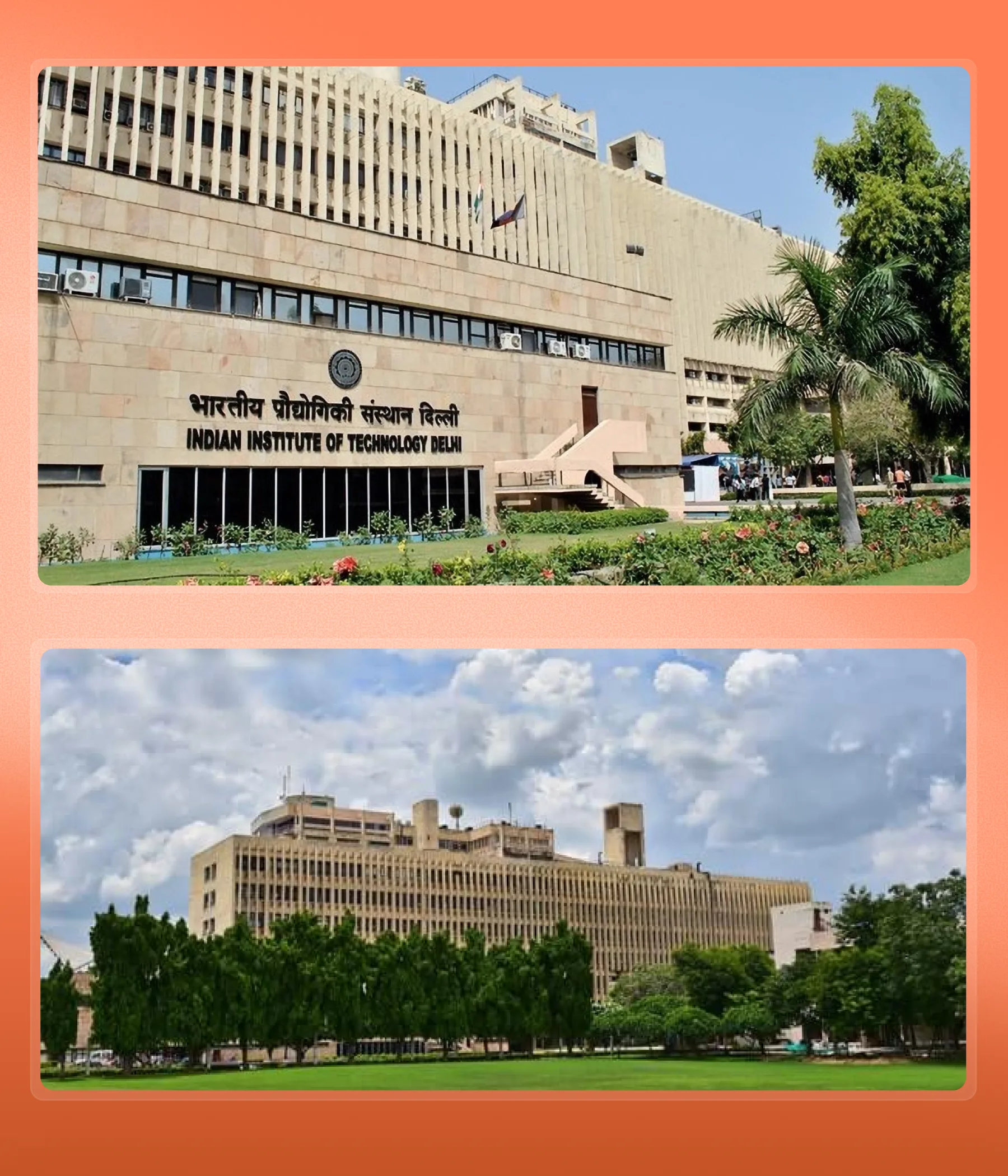
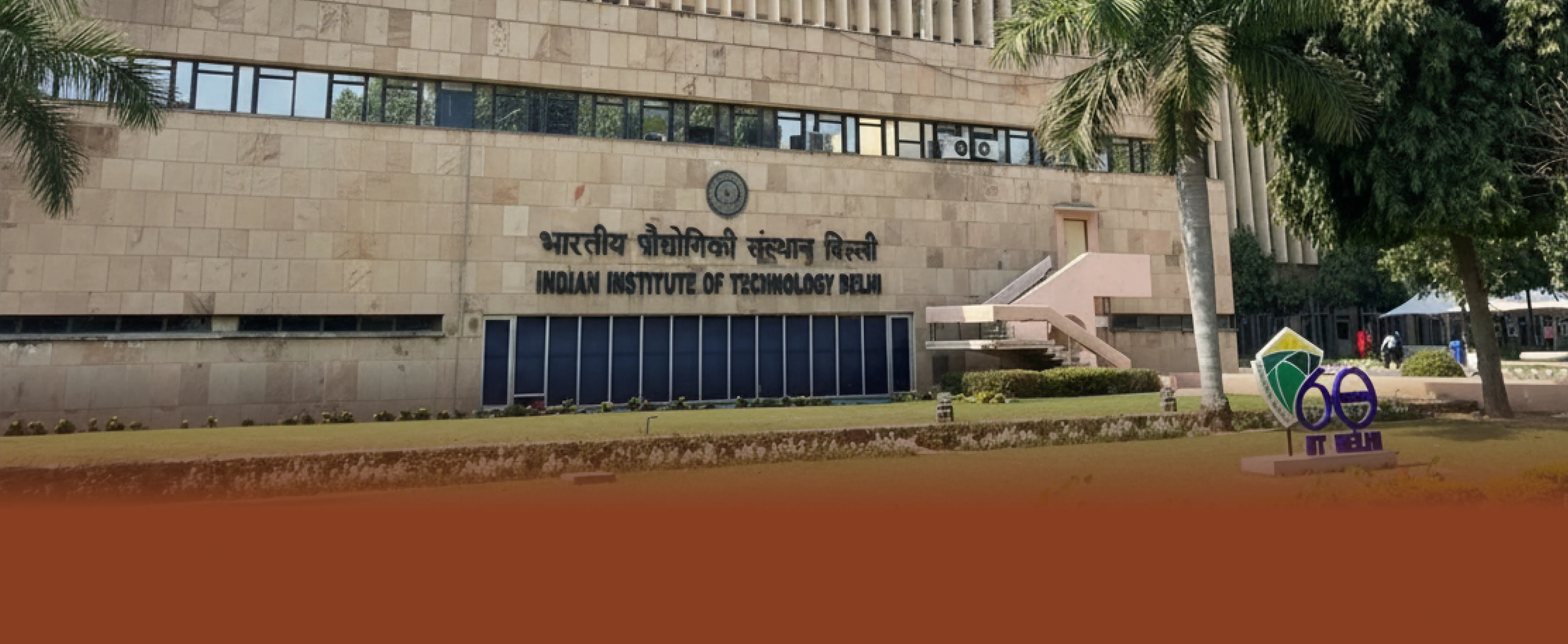
Indian Institute of Technology Delhi campus

Indian Institute of Technology - Delhi

An optional in-person immersion for interaction between faculty and learners on the IIT Delhi campus. Note: Travel and accommodation cost will be borne by the learners. IIT Delhi will not be responsible for the same. A hybrid option will be open to candidates who are unable to come on campus.

Campus Learning

In-person sessions and hands-on labs inside IIT Delhi's research facilities.

Faculty Interaction

Interact directly with IIT Delhi faculty, researchers, and industry mentors.

Peer Networking

Build a lasting network with a driven cohort of working professionals.

Certificate

A credential issued in the IIT Delhi name

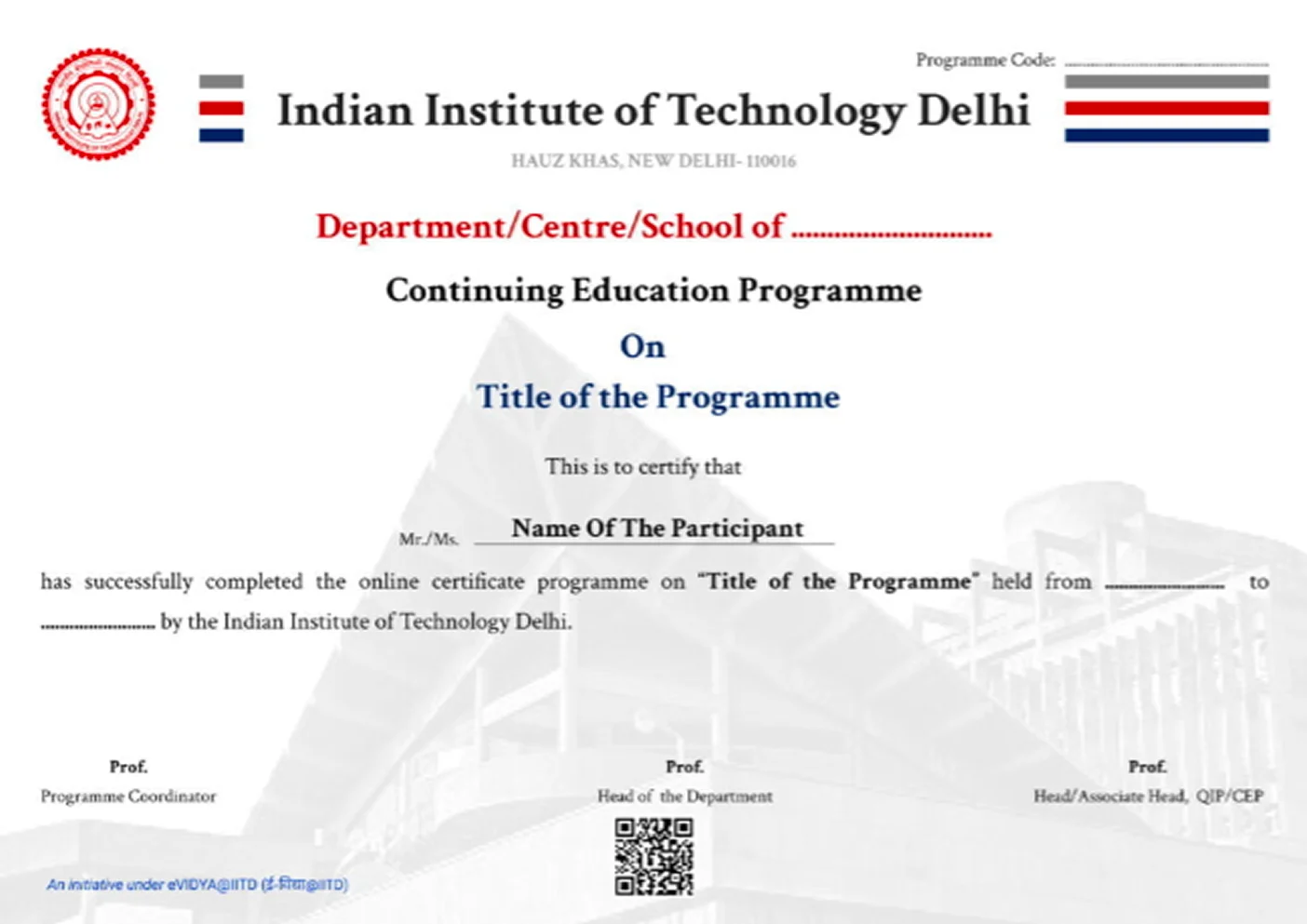
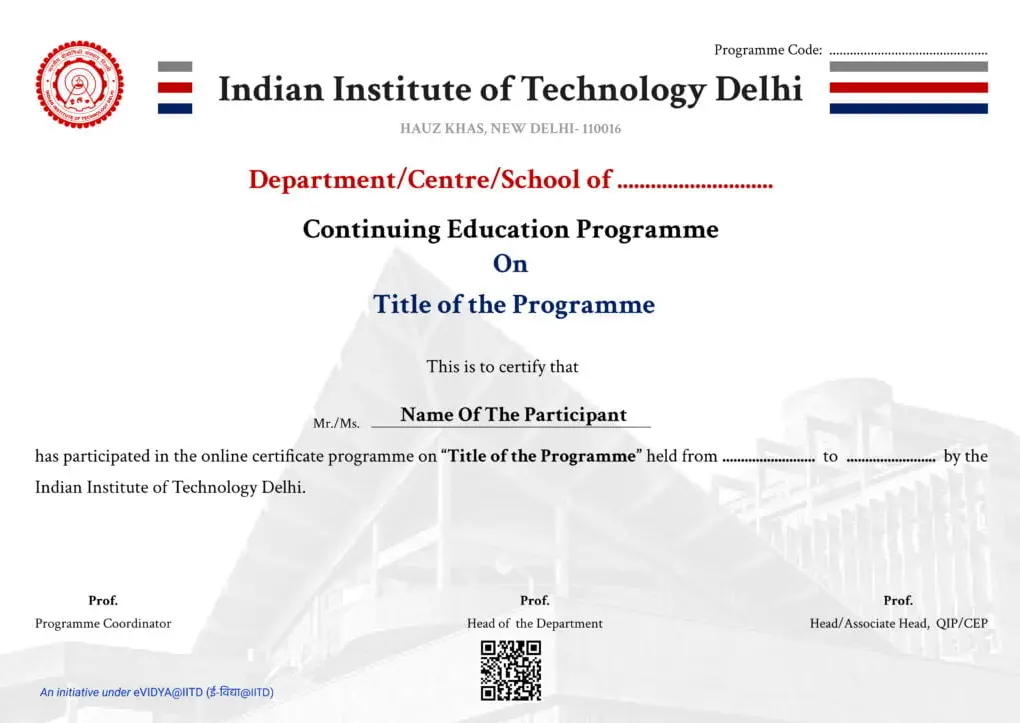
On completion, participants receive a certificate from the Continuing Education Programme (CEP), IIT Delhi. Two certificate types are issued, based on attendance and assessment performance. Only e-certificates are issued for this programme.

Certificate of Successful Completion

IIT Delhi CEP Certificate of Successful Completion

Awarded to candidates who score at least 60% marks overall and have a minimum attendance of 80%.

Certificate of Participation

IIT Delhi CEP Certificate of Participation

Awarded to candidates who score less than 60% marks overall and have a minimum attendance of 80%.

WHO SHOULD ENROL

Is this for you?

Admission is selective. You will fit if you have a working foundation in engineering, computing or a technical discipline. No prior AI experience required — the curriculum builds from foundational mathematics upward.

6 Months

DURATION

Online live

FORMAT

86 hrs

LEARNING HOURS

17th Oct'26

STARTS

01

Core engineering & computing

  • Final or pre-final year, or graduates in CSE, IS, EIE, ECE, EE, IT and related disciplines.

02

B.Sc / BCA students

  • In Mathematics, Statistics, Computing or Data Science, converting strong fundamentals into applied, hands-on AI skills.

03

STEM graduates & professionals

  • Graduates or post-graduates in any STEM field with demonstrated programming exposure. Professionals with coding experience are welcome — no prior AI/ML experience required.

Admissions

Know important dates and the admission process.

Follow the steps to understand how cohort information works.

Cohort Calendar

  1. 14th Oct'26Last date of application
  2. 17th Oct'26Cohort starts
  3. Apr' 2027Cohort Ends

Admission Process

  1. 1Submit your application - a 10-minute online form via the CEP, IIT Delhi programme page. ₹1,000 + GST application fee.
  2. 2Shortlist & screening - shortlisting and vetting by the IIT Delhi Programme Coordinator; shortlisted candidates are intimated by email.
  3. 3Offer & payment - confirm your seat by paying the first instalment (₹30,000) within 4 days of offer rollout.
  4. 4Orientation - join the live orientation on 10th Oct'26. Meet your faculty, cohort and learning team. Start building.
  5. 5Refund policy - withdraw within 15 days of the programme start date for an 80% refund of the total fee received (applicable tax not refunded); no refund after 15 days.

Starting at

₹10,137/month

Programme Fees : ₹1,69,000/-plus 18% GST, applicable

One investment, a career-long return - an IIT Delhi credential and the applied GenAI skills to put your learning to work from day one.

Payment

Application Fee ₹1,000 + GST(While filling the application form)
Instalment 1₹30,000 + GST(Within 4 days of offer)
Instalment 2₹1,39,000 + GST(Before 16th Oct'26)

Balance + GST as one-shot, or EMI via NBFC partners.

Refund Policy

Total Programme Fees₹1,69,000 + GST
Request A Callback

Note on instalments

  • The instalment timeline above is indicative. For enrolments closer to the programme start date, the intermediate instalment windows may not apply. Irrespective of when a candidate enrols, the full programme fee must be paid before the programme starts (17th Oct 2026).
  • Instalment amounts are fixed and apply uniformly to all enrolled learners.
  • *Balance payment: Can be paid via One-shot or EMI. For EMIs, interest applies as per NBFC terms and tenure.

FAQ

The questions you are already asking

Honest answers to the questions that might be holding you back.

Who is this programme for?
It is built for engineering and computing students and graduates (CSE, IS, EIE, ECE, EE, IT), B.Sc/BCA students in Mathematics, Statistics, Computing or Data Science, and STEM graduates or professionals with programming exposure who want to build Generative AI systems — not just use them.
Do I need prior AI or machine-learning experience?
No. No prior AI/ML experience is required — the curriculum builds from foundational mathematics upward. You do need a working foundation in engineering, computing or a technical discipline, and demonstrated programming exposure.
How selective is admission?
Admission is selective. Candidates are admitted by the IIT Delhi Programme Coordinator based on eligibility and a screening review; shortlisted candidates are intimated by email.

Build real Generative AI systems — become the one top companies are hiring for.

Request A Callback