Operations Management in the AI Era: The 2026 Playbook for AI-Native Managers

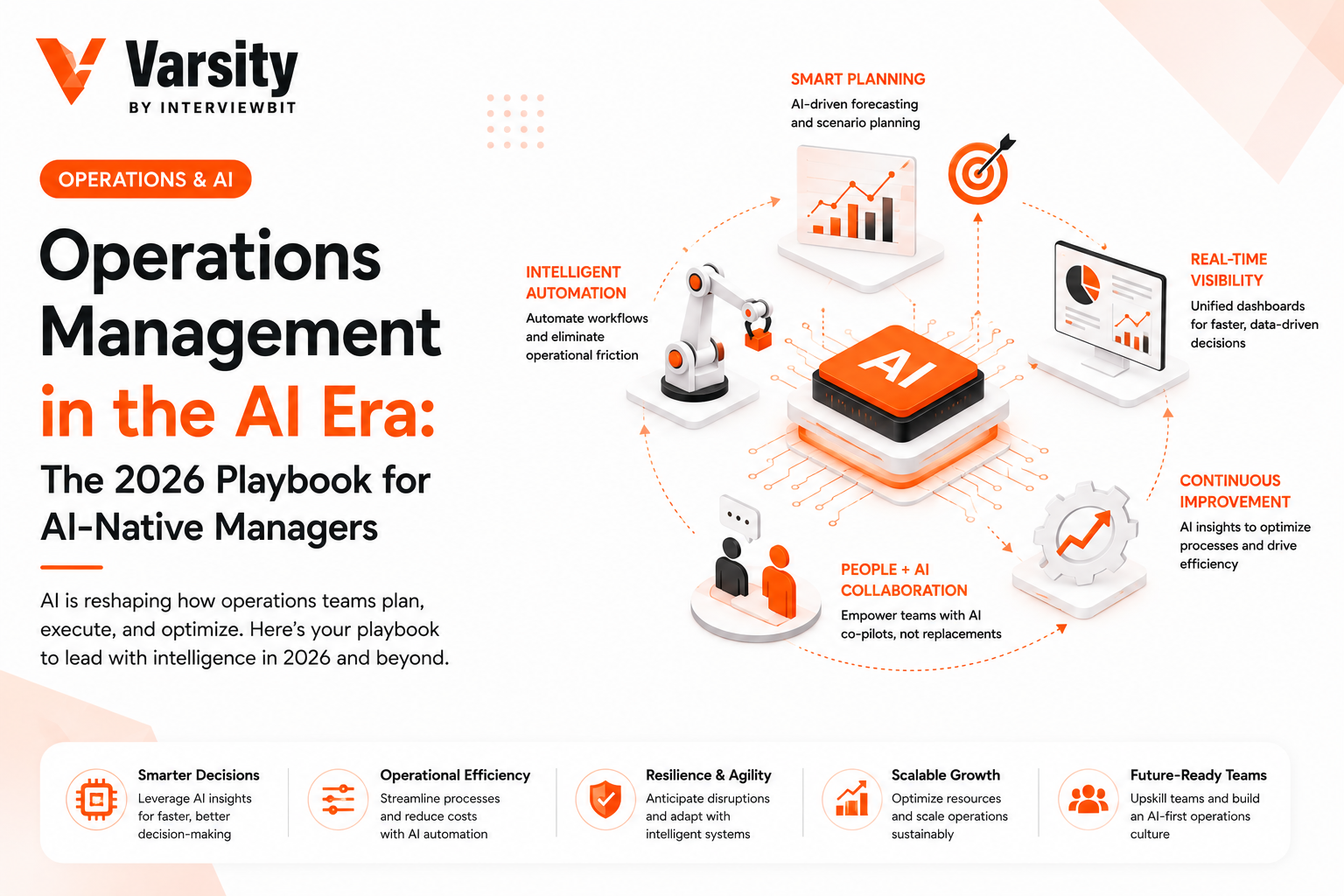
Operations Management in the AI Era: The 2026 Playbook for AI-Native Managers
Beautiful.ai’s 2026 survey of American managers found that 58% of managers now rate AI’s output as at least equal to an experienced manager, and some rate it better.
Daily AI use among managers jumped from 18% to 34% in a single year. Read that twice if you need to. A majority of managers are looking at what a language model produces and going, honestly, that’s about as good as what I’d have done.
That’s a strange thing to sit with if your job title has “operations manager” on it, because operations management has always been the discipline of judgement calls, staffing decisions, the messy real-time trade-offs between cost, speed and quality.
The bit that felt hardest to automate. Except it’s getting automated anyway, or at least heavily assisted, and the managers doing well out of this shift aren’t the ones resisting it. They’re the ones who figured out fast which parts of the job to hand off and which parts to hold onto tighter than ever.
This is the playbook version of that shift: what operations management actually means, what an operations manager’s day genuinely looks like, how it differs from the broader term “business operations,” and what “AI-native” is actually going to require of you in 2026, beyond just knowing how to open ChatGPT.
What Is Operations Management?
Operations management is the discipline of planning, organising and overseeing how a business turns its resources, people, materials, technology, into the goods or services it sells, as efficiently as possible. NetSuite’s breakdown of the field puts it plainly: it connects high-level strategy to everyday action, aligning workflows with business goals while hunting down waste and inefficiency wherever it hides.
In practice, that covers production planning, quality control, inventory and supply chain management, capacity planning, and process design, basically the plumbing that makes sure a company’s promises to its customers actually get kept, on time and without burning through the budget in the process.
It’s an old discipline, decades older than the AI conversation. Factories have been running some version of operations management since well before anyone called it that. What’s new isn’t the discipline itself, it’s the toolkit it now runs on.
What Does an Operations Manager Actually Do?
Strip away the job-description fluff and an operations manager’s week usually revolves around a handful of recurring jobs:
- Watching the numbers that actually predict trouble, cycle time, flow time, throughput, before trouble shows up as a missed delivery.
- Coordinating across departments, production, supply chain, HR, finance, who each optimise for something slightly different and occasionally disagree about what “good” looks like.
- Fixing process bottlenecks, which is a polite way of saying finding out why the same step keeps taking twice as long as it should.
- Managing people and schedules, because operations, at the end of the day, runs on humans showing up and doing their part.
- Staying compliant with whatever regulatory or quality standard applies to the industry, and documenting enough of it to prove it during an audit.
A quote worth stealing from Purdue’s operations management overview, which frames the two metrics that quietly run the whole job: flow time, how long it takes from a customer’s order to delivery, and cycle time, how fast the underlying process actually produces. Everything an operations manager does eventually traces back to moving one of those two numbers in the right direction.
Operations Management vs Business Operations
Worth untangling, since the two get used interchangeably constantly and they’re really not the same size of thing.
| Term | What it actually means | Scope |
| Business operations | The umbrella term for everything that keeps a company running day to day, finance, HR, IT, legal, facilities, and operations itself | Company-wide |
| Operations management | The specific discipline of managing how goods and services actually get produced and delivered efficiently | One function within business operations |
Every operations manager works inside business operations. Not everyone in business operations, an HR generalist, a finance analyst, works in operations management specifically. Mixing the two up in a job interview is a small, forgivable mistake. Mixing them up while designing an org chart is a slightly bigger one.
Why “AI-Native” Is Suddenly Part of the Job Description
Here’s the uncomfortable part of that Beautiful.ai number from the top of this article: 72% of managers now report using AI at least weekly just to help manage their teams, scheduling, performance feedback, resourcing calls. That’s not experimentation anymore, that’s infrastructure. The managers still treating AI as a novelty they’ll get around to eventually are, statistically, already behind most of their peers.
There’s a second, less flattering data point worth knowing about, though, and it’s the reason “AI-native” matters more than “AI-aware.” BCG’s research on workplace AI adoption describes something they call the silicon ceiling: roughly 75% of leaders and managers use generative AI regularly, compared to only about half of frontline employees. That gap is a genuine operations problem, not just a training-budget line item. If the manager is AI-fluent and the shop floor or the support team isn’t, you haven’t actually transformed the operation, you’ve just made the manager faster while everyone downstream stays exactly where they were.
An AI-native operations manager, then, isn’t just someone who personally uses AI well. It’s someone who designs the workflow so the whole team benefits from it, not just the person at the top of the org chart.
The Core Functions of Operations Management, Now Running Through AI
| Function | The traditional approach | The AI-native approach |
| Demand forecasting | Historical spreadsheets, gut-feel adjustments for seasonality | Predictive models pulling live sales, market and external signal data, refreshed continuously instead of monthly |
| Inventory management | Manual stock counts, reorder points set once and rarely revisited | Real-time tracking with automated reorder triggers that adjust as demand patterns actually shift |
| Quality control | Sample-based manual inspection, catching defects after the fact | Computer-vision and anomaly-detection systems flagging deviations mid-process, before a bad batch ships |
| Workforce scheduling | A manager building shift rosters by hand, juggling availability and labour law constraints | Scheduling software that optimises for coverage, cost and compliance simultaneously, in seconds |
| Process improvement | Periodic audits, usually annual, usually reactive | Continuous monitoring that surfaces bottlenecks as they emerge, not months after they’ve cost real money |
None of this means the manager’s judgement gets removed from the loop. It means the manager stops spending Tuesday afternoon manually recounting stock and starts spending it deciding what to actually do about the anomaly the system just flagged. That’s a meaningfully better use of a trained human’s time, and most operations managers, once they get past the initial suspicion, tend to agree.
The AI-Native Manager’s New Skillset
Not a tools list, tools change every quarter and any list of specific apps will look dated within a year. These are the underlying skills that don’t:
- Prompt and workflow literacy. Knowing how to actually instruct an AI system clearly enough that it does the task correctly the first time, rather than three frustrating attempts later.
- Data fluency. You don’t need to code, but you do need to read a dashboard critically enough to notice when a number looks suspicious rather than accepting it because it came from a system.
- Output auditing. The single most underrated skill right now. Knowing how to spot-check AI-generated schedules, forecasts or reports before they go live, because the failure mode of blind trust is expensive and often invisible until it isn’t.
- Change management, genuinely. Most AI rollouts don’t fail because the technology was bad, they fail because nobody managed how the team actually adopted it. That’s textbook operations management work, it’s just aimed at a new kind of change now.
- Knowing exactly where to draw the human line. Which decisions get automated, which get AI-assisted with a human sign-off, and which stay entirely human. Getting that boundary wrong in either direction is costly.
Where AI Still Can’t Run Operations Alone
A short, honest list, because the goal here isn’t hype:
- Difficult people conversations. Performance issues, conflict resolution, layoffs, none of that belongs to a chatbot, and employees can tell the difference instantly.
- Genuine crisis response. When a supplier collapses overnight or a safety incident happens on the floor, you need judgement under pressure, not a model that’s confidently guessing from historical patterns that don’t apply anymore.
- Cross-functional negotiation. Getting finance, production and sales to agree on a trade-off nobody’s thrilled about is a relationship skill, not a data problem.
- Ethical and values-based calls. Trading off cost against safety, or speed against sustainability, requires a values judgement no model should be quietly making on a company’s behalf.
A Simple Rule for What to Automate and What to Hold Onto
If it’s routine, well-documented, high-volume and has a clearly right answer, it’s a strong automation candidate. If it involves negotiating with a person, weighing values against each other, or handling something genuinely novel that’s never happened before, it stays with a human, at least for now.
That single filter clears up most of the debate teams have in these rollout meetings, and it’s a lot more useful than either extreme, automating everything because it’s technically possible, or automating nothing because it feels safer.
Staying Relevant as an Operations Manager in 2026
A few concrete moves, not vague career advice: get hands-on with agentic AI tools relevant to your industry before your company mandates it, rather than after. Own the KPI framework yourself instead of outsourcing the definition of “good performance” entirely to whatever the software defaults to. And treat this shift the way you’d treat any other structured operational change, define what success looks like, pilot it small, measure honestly, then scale what actually worked instead of what looked good in a vendor demo.
The uncomfortable truth in that Beautiful.ai stat isn’t that AI is coming for operations management. It’s that in a lot of narrow, well-defined tasks, it’s already arrived and already competent. The job isn’t disappearing. It’s shifting toward the parts machines still can’t do, which, if you think about it, were probably always the more interesting parts of the role anyway.
What is operations management?
Operations management is the discipline of planning, organising and overseeing how a business converts its resources, people, materials, technology, into the goods or services it delivers, as efficiently as possible. It covers production, quality, inventory, supply chain and process design.
What does an operations manager do?
An operations manager oversees the day-to-day running of a business function, tracking performance metrics, coordinating across departments, fixing process bottlenecks, managing staff schedules, and ensuring the operation stays compliant and cost-efficient.
What is the difference between operations management and business operations?
Business operations is the broad umbrella covering everything that keeps a company running, finance, HR, IT, and operations included. Operations management is one specific function within that umbrella, focused on how goods and services actually get produced and delivered.
Is operations management a good career in the AI era?
Genuinely yes, though the day-to-day is shifting. Repetitive tasks like manual scheduling and basic forecasting are increasingly automated, which frees operations managers to focus on judgement calls, cross-functional coordination and people leadership, the parts of the role that were arguably always the more valuable ones.
Will AI replace operations managers?
Unlikely as a wholesale replacement. AI is absorbing the repetitive, data-heavy parts of the job, forecasting, scheduling, quality monitoring, while decisions involving people, ethics, negotiation and genuine crisis response stay firmly human. The role is changing shape, not disappearing.
What skills do I need to become an AI-native operations manager?
Prompt and workflow literacy, enough data fluency to sanity-check a dashboard, the discipline to audit AI-generated outputs before trusting them, solid change-management skills, and clear judgement about which decisions should stay entirely human.