AWS Forward Deployed Engineer: Inside Amazon’s FDE Push for Generative AI

Key Insights
- AWS’s FDE initiative focuses on moving AI from experimentation into production, supported by a $1 billion investment announced in June 2026.
- AWS Partner FDE pathways cover three areas: Ground (enterprise context), Orchestrate (agent workflows), and Prove (testing, security, and production readiness).
- A strong portfolio project should demonstrate the full lifecycle: building an AI application, integrating business data, deploying it, evaluating performance, and documenting limitations.
- Interview preparation should cover coding, system design, cloud security, AI evaluation, and customer-facing problem-solving, not just prompt engineering.
- Candidates can explore both direct AWS vacancies and AWS Partner opportunities, but partner credentials do not guarantee employment at Amazon.
- AWS FDE salary estimates for India should be checked against individual vacancies, with base salary distinguished from bonuses and equity.
Amazon Web Services (AWS) is expanding its focus on enterprise AI deployment with a dedicated Forward Deployed Engineering (FDE) organisation backed by a $1 billion investment, announced on June 30, 2026. The initiative brings engineers into customer teams to build and deploy AI systems around real business needs.
On October 1, 2026, AWS introduced three partner-led FDE pathways: Ground, Orchestrate, and Prove. These focus on the technical capabilities required to deliver production-ready agentic AI systems. Explore the official partner announcement.
For software developers, cloud engineers, and AI specialists, this creates new areas to explore across engineering and customer-facing AI delivery. This guide covers relevant job opportunities, technical skills, interview preparation, salary considerations in India, and ways to prepare for FDE roles.
FDE salary & ROI calculator
Is FDE training worth it for you?
See what Forward Deployed Engineers with a profile like yours typically earn in India, and how quickly a programme fee is covered.
Indicative ranges based on public, self-reported salary data. Not a prediction or guarantee of your pay.
How this is calculated
- Typical Forward Deployed Engineer pay in India is about ₹10–30 LPA, blended from salaries people report on Glassdoor and Levels.fyi. The middle of the market sits around ₹15–18 LPA; the top quarter reaches about ₹42 LPA.
- Your experience places you in the lower (0–2 years), middle (3–6 years) or upper (7+ years) part of that range.
- Your current role and company type refine where you sit. Roles closer to FDE work rank higher: software engineering, then data/ML, solutions or customer engineering, DevOps/cloud, implementation or IT consulting, QA, and non-engineering roles last. By company type: product or MNC highest, GCC about 5% below that, startups about 7% below GCC, IT services about 10% below startups. That puts GCC about 20% above IT services, in line with reports that GCCs pay up to 20% more.
- Likely first move: moving into a new, AI-heavy role usually brings a bigger raise than a like-for-like job switch, and one move closes part of the gap to the middle of your range. Small gaps close almost fully; large gaps close up to a limit set by your background: up to +55% from product or MNC companies (employers in India expect AI-skilled workers' pay to rise 54%+), +50% from GCCs, +45% from startups and +40% from IT services. Roles further from FDE work reach a smaller share of that limit, from 100% for software engineering down to 72% for non-engineering roles. Everyone below the top of the all-India range gets at least 40% of their limit (it tapers off above your own range), and no estimate goes past the all-India top of ₹30 LPA.
- Fee covered in: the programme fee divided by the extra monthly pay (before tax) from that first move.
Sources
- Glassdoor India: Forward Deployed Engineer salariesAverage total pay ≈ ₹14.6 LPA (base ₹9–18 LPA + about ₹2 LPA variable); highest reported ≈ ₹22 LPA
- Levels.fyi: Forward Deployed Engineer, IndiaMedian ≈ ₹17.6 LPA; 25th percentile ≈ ₹16 LPA; 75th percentile ≈ ₹42 LPA; 90th percentile ≈ ₹46 LPA
- Michael Page India Salary Guide 2026 (reported by Outlook Business)Job-switch raises up to 30% in AI and other high-demand fields; 9.1% market average
- foundit Appraisal Survey 2026 (reported by Business Today)20% expect a 40%+ hike when switching jobs
- AWS, Accelerating AI Skills: Preparing the Asia-Pacific Workforce (reported by Outlook Business)Employers expect AI-skilled workers' salaries to rise 54% or more
- TeamLease Digital, Digital Skills & Salary Primer FY2025 (reported by People Matters)GCCs pay up to 20% more than IT services companies
- IIT Delhi AI Forward Deployed Engineering programme page₹1,65,000 + 18% GST = ₹1,94,700
Keep in mind
- Forward Deployed Engineer is a new title in India, so salary samples are still small.
- Figures are total compensation before tax, not in-hand pay.
- Figures are based on market benchmarks for Forward Deployed Engineer roles across India.
What is Amazon’s AWS FDE Initiative?
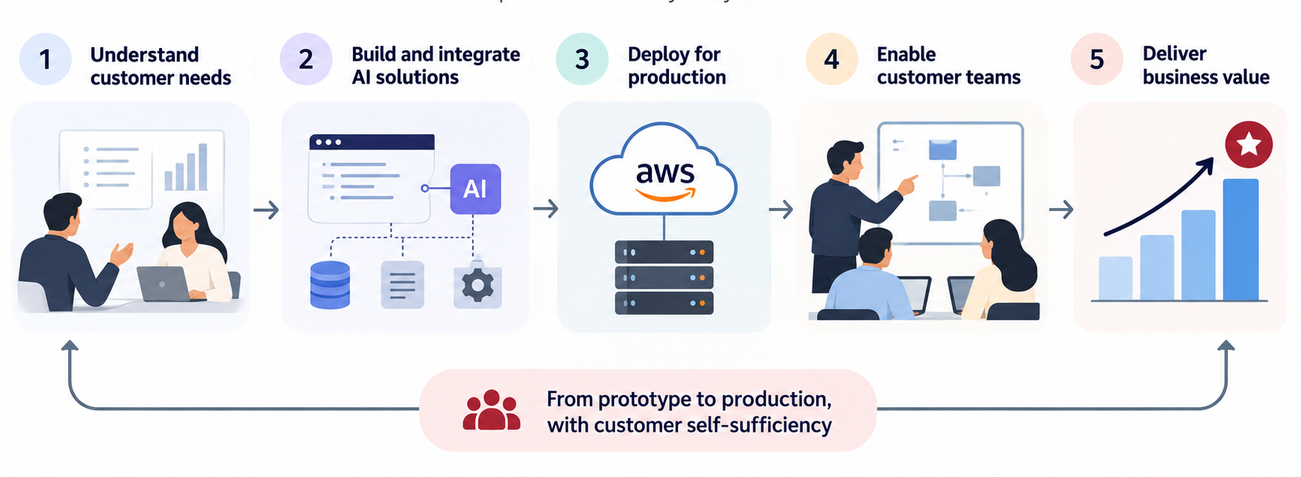
AWS’s FDE initiative changes how the company approaches enterprise AI implementation. Instead of limiting its involvement to recommendations or isolated prototypes, AWS engineers work alongside customer teams to build systems that fit existing data, infrastructure, security requirements, and business processes.
The approach has three defining features:
- Engineering alongside customers: AWS specialists collaborate with business, engineering, and security teams during development and deployment.
- AI-assisted development: Agentic systems and AI-powered engineering workflows support the development process, with human engineers guiding and verifying the work.
- Long-term customer capability: The engagement is designed to leave customers with deployed systems, documentation, reusable engineering practices, and the skills to operate their solutions independently.
AWS says its model aims to reduce deployment timelines from months to days. This is a stated objective, not a guaranteed timeline for every project. Read AWS’s explanation of the FDE model.
What do the partner-led FDE pathways cover?
AWS’s partner programme addresses three areas of production AI engineering:
| Pathway | Primary focus |
|---|---|
| Ground | Enterprise data, systems, and business context |
| Orchestrate | Agents, tools, workflows, identity, and recovery |
| Prove | Evaluation, observability, security, and controls |
AWS also introduced the FDE Validated and FDE Advanced credentials for AWS Partner builders. These require hands-on validation and have specific AWS certification prerequisites. They demonstrate partner delivery capabilities, not guaranteed eligibility for direct AWS jobs. Check the official AWS partner guidance for current requirements.
Which AWS Forward Deployed Engineer Jobs can you Apply for?
Candidates looking for forward deployed engineer jobs in India should explore three distinct routes: direct AWS FDE positions, related AWS engineering roles, and opportunities with AWS Partner organisations.
| Career pathway | Responsibilities to look for | Job search |
|---|---|---|
| Direct AWS FDE | Production software, customer integration, AI deployment | Search AWS FDE roles |
| Related AWS roles | Generative AI, solutions architecture, cloud implementation | Search generative AI roles |
| AWS Partner roles | Consulting delivery, enterprise integration, AI implementation | Explore AWS Partners |
Direct AWS Forward Deployed Engineer roles
These positions focus on engineering solutions with customers, from technical discovery to production delivery. Some senior listings specify experience leading software architecture, mentoring engineers, and deploying AI systems at scale.
For example, the Senior Forward Deployed Engineer listing on Amazon Jobs is a useful starting point. Check the individual vacancy for location, experience requirements, travel expectations, and whether applications remain open.
Related AWS generative AI roles
Solutions architecture, professional services, and AI engineering positions may involve prototyping, cloud architecture, and customer-facing implementation. They can be relevant alternatives for candidates building towards an FDE career, but their responsibilities and coding expectations can differ.
Partner-led FDE opportunities
AWS Partners may recruit engineers to implement AI solutions through the partner-led FDE model. These roles offer a route into customer-facing AI delivery without necessarily requiring direct employment with Amazon.
Candidates should check the hiring organisation, role description, certification requirements, and technical expectations before applying. The existence of an AWS programme does not guarantee that every partner has an open position in India.
What does an AWS Forward Deployed Engineer do?
The day-to-day work combines software development, cloud architecture, AI implementation, and customer problem-solving. Specific responsibilities depend on the team and the business problem being addressed.
- Customer discovery: Understand workflows, infrastructure, data access, and security constraints.
- AI application development: Build generative AI applications, retrieval-augmented generation (RAG) pipelines, and agentic workflows where appropriate.
- Enterprise integration: Connect applications to databases, APIs, internal services, and identity systems.
- Deployment and monitoring: Establish testing, deployment automation, observability, and recovery procedures.
- Performance optimisation: Evaluate latency, reliability, retrieval quality, model usage, and infrastructure costs.
- Customer enablement: Document the system and help customer engineers maintain and extend it.
A significant part of the job is dealing with conditions that are absent from a clean demonstration: inconsistent data, unexpected inputs, access restrictions, failed API calls, and competing business requirements.
The goal is not simply to make an AI model respond. It is to make the wider application dependable enough to perform useful work.
What Skills are Required for AWS FDE Roles?
Preparing for AWS FDE jobs requires strong software engineering fundamentals, cloud knowledge, and the ability to evaluate AI systems beyond their initial outputs.
| Skill area | What to learn |
|---|---|
| Programming | Python, TypeScript or Go, API development, testing |
| Software architecture | Microservices, distributed systems, asynchronous processing |
| AWS infrastructure | IAM, networking, monitoring, deployment, infrastructure as code |
| Generative AI | Foundation models, tool calling, agent workflows, prompt design |
| RAG and retrieval | Embeddings, chunking, vector search, retrieval evaluation |
| Production engineering | CI/CD, observability, error handling, reliability, cost control |
| Customer delivery | Requirements gathering, technical communication, documentation |
AWS services worth learning
- Amazon Bedrock: Learn how to build generative AI applications using supported foundation models and related capabilities.
- Amazon SageMaker AI: Understand relevant machine learning development and deployment workflows.
- Amazon CloudWatch: Practise monitoring application logs, metrics, and operational behaviour.
- AWS IAM: Learn how to implement least-privilege permissions and controlled access to resources.
- AWS CDK or CloudFormation: Understand how to define and manage infrastructure through code.
You do not need to master every AWS service before applying. Prioritise those that appear in your target vacancy, then practise combining them into a working application.
How does the AWS FDE Interview Process Work?
The interview process varies by role, team, location, and seniority. Use the recruiter-provided preparation material for the specific vacancy rather than assuming every FDE interview follows an identical sequence.
Prepare for these areas:
1. Coding and software engineering
Practise data structures, algorithms, API design, debugging, and writing testable code. Choose a language you can use confidently and explain your decisions clearly.
2. System design
Prepare to discuss scalability, reliability, security boundaries, monitoring, and failure recovery. Be ready to explain the trade-offs behind your architecture.
3. Applied AI engineering
Understand RAG pipelines, agent tool calling, model evaluation, prompt-injection risks, latency, and inference costs. Practise explaining how you would test an AI application before deployment.
4. Amazon Leadership Principles
Prepare examples demonstrating ownership, customer focus, technical judgement, and problem-solving. Structure behavioural answers using the STAR method:
- Situation: The context and problem.
- Task: Your responsibility.
- Action: The decisions and work you personally carried out.
- Result: The measurable outcome or lesson.
5. Customer-facing problem-solving
Prepare to explain how you handled ambiguous requirements, negotiated technical trade-offs, communicated limitations, or changed direction when an initial solution did not work.
Your examples should show both the engineering decisions you made and their practical impact.
What is the AWS FDE Salary in India?
A reliable, standard public salary range for direct AWS Forward Deployed Engineer roles in India has not been established here. Salaries reported for other AI engineering or cloud architecture roles should not be treated as confirmed AWS FDE compensation.
Before comparing offers, check the individual vacancy for the advertised base salary, bonus, equity, location, and job level. For roles with no published salary, use comparable vacancies as a guide rather than presenting an estimated range as verified AWS pay.
Compensation at AWS Partner organisations should be assessed separately, since partner employers set their own pay and benefits.
How can you Prepare for an AWS Forward Deployed Engineer Role?
The most useful preparation produces evidence that you can build, test, and operate a system. Follow this roadmap.
- Build an end-to-end AI application. Choose a realistic business problem and develop an application using Amazon Bedrock or another suitable model API.
- Add retrieval or tool use. Implement RAG or an agent workflow when it fits the use case. Document why you chose that approach.
- Implement security controls. Configure permissions, input validation, error handling, logging, and appropriate data protections.
- Evaluate performance. Measure answer quality, latency, cost, and failure cases. Record what you changed after testing.
- Deploy and document the application. Include setup instructions, architecture diagrams, test results, limitations, and operational guidance.
- Prepare behavioural examples. Develop STAR stories demonstrating ownership, technical judgement, customer focus, and measurable outcomes.
- Track relevant openings. Monitor Amazon Jobs and related generative AI positions. Check location, eligibility, experience, and travel requirements before applying.
A production-style project with documented design decisions and evaluation results gives you concrete material for technical interviews. It also helps you identify gaps in your understanding before you apply.
Conclusion
AWS’s Forward Deployed Engineering initiative puts production delivery at the centre of enterprise AI development. The work combines software engineering, cloud architecture, AI implementation, security, and customer collaboration.
For candidates in India, the practical route is to develop demonstrable production AI skills, prepare clear examples of technical ownership, and track vacancies that match their experience. Direct AWS FDE roles, related engineering positions, and partner-led opportunities should be evaluated separately.
Take the Next Step
Many AI projects never make it past the prototype stage. If you want to learn how to build and deploy AI solutions for real-world use, explore the IIT Delhi AI Forward Deployed Engineering programme and see how its curriculum fits your career goals.
FAQs
What deliverables might an AWS FDE produce?
Depending on the project, deliverables may include application services, retrieval pipelines, AI integrations, infrastructure-as-code scripts, automated tests, and deployment workflows. The precise scope depends on the customer’s requirements.
How is an AWS FDE different from an AWS Professional Services role?
The responsibilities can overlap. FDE roles emphasise embedded engineering and production delivery, while Professional Services roles may cover architecture, migration, implementation, and broader consulting engagements. Compare the actual job descriptions.
Which programming languages should AWS FDE candidates learn?
Python is a practical starting point for AI development and automation. TypeScript and Go can also be useful for application and backend engineering. Prioritise the languages listed in the vacancy.
How do Amazon Bedrock Knowledge Bases and Guardrails support enterprise AI?
Knowledge Bases can connect supported data sources to retrieval-augmented applications. Guardrails apply configured controls to model inputs and outputs. Their effectiveness depends on implementation and testing, and they do not eliminate every security risk or hallucination.
How can engineers manage latency and API limits in production AI systems?
Possible approaches include asynchronous processing, caching where appropriate, request throttling, monitoring, and selecting models suited to different tasks. The correct approach depends on workload, service limits, data sensitivity, and latency targets.
How can teams evaluate an LLM before deployment?
Teams can use task-specific test sets, human review, automated evaluation, and application-specific metrics. RAG systems may be evaluated for faithfulness, relevance, and retrieval quality. No single metric proves that a system is safe or production-ready.
How long does an AWS FDE engagement last?
The duration depends on the scope, customer environment, and delivery goals. AWS describes its FDE model as accelerating deployment from months to days, but this does not establish a fixed timeline for every engagement.
Are AWS certifications mandatory for FDE roles?
Requirements vary by vacancy. Check the individual job description for required certifications. AWS Partner FDE credentials have separate prerequisites and validation requirements and should not be confused with direct AWS hiring criteria.
Which vector databases and retrieval methods should candidates understand?
Useful concepts include vector search, keyword search, metadata filtering, and retrieval evaluation. Technologies may include Amazon OpenSearch Service, PostgreSQL with pgvector, and third-party vector databases. The appropriate choice depends on the existing infrastructure and application requirements.
Do AWS Partner FDE pathways create opportunities in India?
The pathways provide eligible AWS Partners with a structured way to develop and validate production agentic AI delivery skills. They may support opportunities with participating partners, but do not guarantee vacancies in India or employment with AWS.
What security controls matter when connecting AI systems to enterprise data?
Common considerations include least-privilege access through IAM, encryption, secure network configuration, input and output validation, secrets management, and careful handling of sensitive data. Controls should reflect the application’s threat model and be tested before deployment.