Finance and Operations in the AI Era: Prescriptive Analytics for Cost, Risk and Planning


What is prescriptive analytics in finance?
Prescriptive analytics in finance recommends the best feasible course of action by combining forecasts, business objectives and constraints.
- Predictive analytics forecasts what is likely to happen, while prescriptive analytics recommends what to do next.
- For example, a mid-sized business facing rising logistics costs may use a forecast to identify a potential budget overrun.
- Prescriptive analytics goes further by recommending how to reallocate spending to stay within budget while maintaining service commitments.
- The key difference is that predictive analytics estimates an outcome, whereas prescriptive analytics recommends an actionable decision based on what the business can realistically change.
The four rungs of the analytics ladder
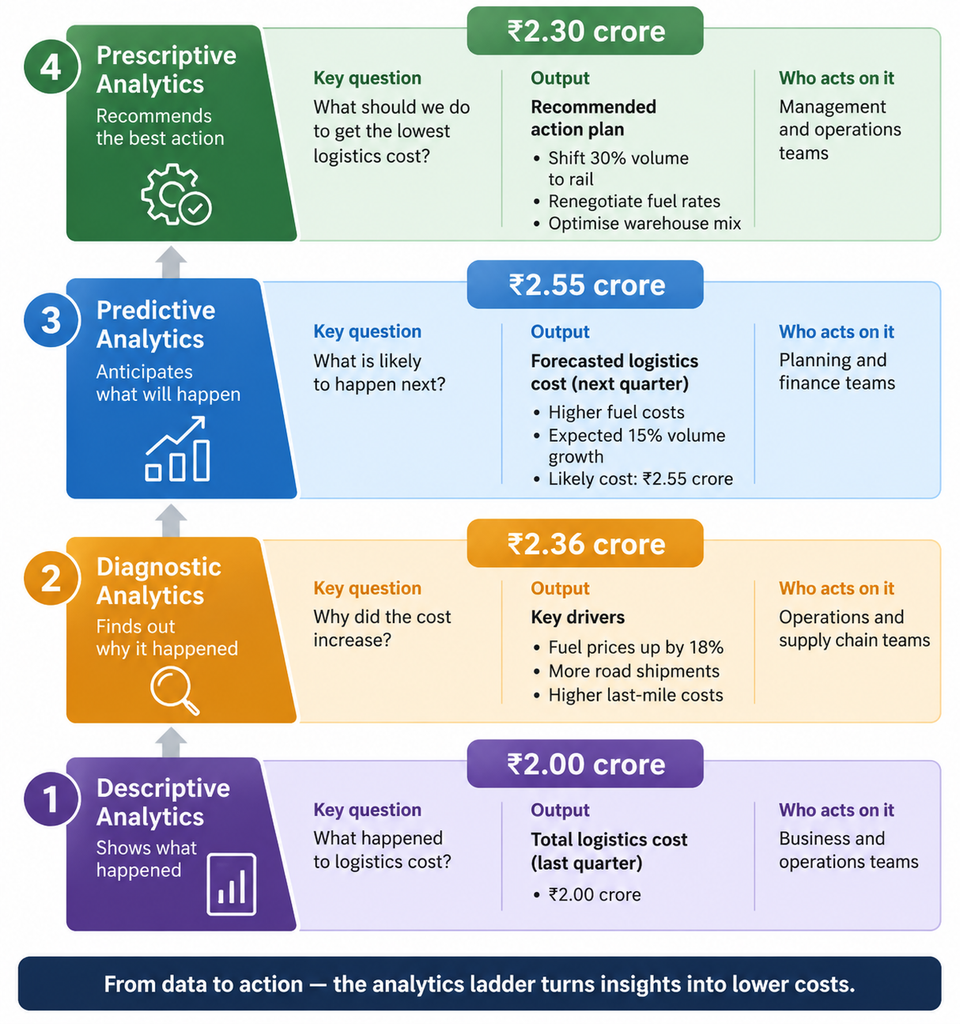
Descriptive : what happened
Logistics cost rose from ₹2.00 crore in Q1 to ₹2.36 crore in Q2 : an 18% increase quarter on quarter. A dashboard flags the variance against the ₹2.30 crore quarterly budget: the business is already ₹0.06 crore over plan.
This is standard reporting: a dashboard, a variance-to-budget line, a red cell in a monthly pack. There is nothing wrong with stopping here for many questions. If finance only needs to know that cost rose and by how much, descriptive reporting has already answered it.
Diagnostic : why it happened
An 18% increase is not one cause. Breaking it down tells finance whether the problem is structural (more shipments) or temporary (a fuel spike), and that distinction decides what, if anything, should be done next.
| Driver | Contribution to the 18% increase | What it means |
| Volume | +7% | More shipments moved this quarter |
| Rate | +5% | Carriers charged more per shipment |
| Mix | +2% | A shift toward costlier lanes or shipment types |
| Fuel | +4% | Fuel surcharges rose independently of volume or rate |
| Total | 18% | Matches the reported quarter-on-quarter increase |
Volume and mix point to genuine business growth. Rate and fuel point to cost pressure the business didn’t create. That split already narrows what a prescriptive model, later, would even be allowed to touch.
[Source :INFORMS, the professional body for the operations research discipline optimisation methods come from]
Predictive : what will happen next
Predictive analytics estimates future logistics costs based on current trends and historical data.
- If volume, rate and mix trends continue, Q3 logistics costs are projected to reach ₹2.55 crore, exceeding the ₹2.30 crore budget by ₹0.25 crore.
- The forecast helps finance anticipate a potential budget overrun. The specific forecasting model, its validation and error measurement are outside this article’s scope.
- However, a forecast alone cannot recommend a course of action. It estimates what may happen but does not account for business objectives or constraints.
- Prescriptive analytics builds on this forecast to recommend what the business can do to address the projected overrun.
Prescriptive : what to do about it
This is where an objective and a set of constraints enter the picture.
Objective: minimise total logistics cost for the quarter.
Constraints:
- Maintain a service level of at least 97% on-time delivery
- Honour the contracted minimum volume with each carrier
- Stay within the fixed ₹2.30 crore quarterly budget
What the model recommends
Prescriptive analytics recommends a specific action to reduce logistics costs while meeting budget and service constraints.
- Suppose Carrier A handles 60% of shipments and Carrier B handles 40%. Carrier A is more expensive, while Carrier B has spare capacity at a lower rate.
- Carrier A’s contract requires a minimum volume of 40%. The model recommends shifting volume to a 40/60 split, with Carrier B absorbing the remaining shipments.
- In this illustrative scenario, the reallocation reduces projected Q3 costs by ₹0.25 crore, bringing total spending to ₹2.30 crore, within budget.
- The recommendation maintains the 97% on-time delivery requirement and both carriers’ contractual minimums, provided the cost and capacity assumptions hold.
Predictive and prescriptive outputs, side by side, for the same quarter:
Predictive vs. prescriptive analytics
| Comparison | Predictive output | Prescriptive output |
| Question answered | What is Q3 logistics cost likely to be? | What should the business do about it? |
| Result | ₹2.55 crore, ₹0.25 crore over budget | Reallocate volume to the 40/60 split; land at ₹2.30 crore |
| What it needs | Historical cost and volume data | The forecast, plus an objective and constraints |
| Who acts on it | Finance reads it and raises a flag | A named approver signs off the reallocation |
How a prescriptive model is actually built
A forecast is a single number projected forward. A prescriptive model is that number, plus three things that turn it into a decision.
Objective function. This is the outcome the model is trying to make better , a number to minimise or maximise. In the logistics example, it’s “minimise total logistics cost.” In other settings it could be maximising contribution margin or holding a risk exposure inside a limit.
Decision variables. These are the levers the business is actually allowed to move, how much volume goes to which carrier, whether to open a second warehouse, how much inventory to hold. If a number can’t realistically be changed, it isn’t a decision variable; it’s a fact the model has to work around.
Constraints. These are the lines the model cannot cross : a budget ceiling, a service-level floor, a contracted minimum, a risk appetite. Constraints are what turn “the cheapest possible option” into “the cheapest option the business can actually run.”
A forecast can estimate what is likely to happen, but it doesn’t know what the business is allowed to change or what it can’t violate which is exactly why a forecast alone can’t tell you what to do next.
The methods, named
Different finance decisions call for different optimisation approaches, depending on whether the choice is a continuous allocation, a yes/no decision, or something with real uncertainty baked in.
| Method | What it is | Fits this kind of finance question |
| Linear programming | Finds the best continuous allocation across options, given constraints | “How should we split spend across carriers, suppliers or cost centres?” |
| Mixed-integer programming | Like linear programming, but handles yes/no or whole-number decisions | “Should we open a second warehouse, or not?” |
| Monte Carlo simulation | Runs a decision through many randomised scenarios to show a range of outcomes, not one answer | “What’s our exposure if fuel prices move unpredictably?” |
| Heuristics | Rule-based shortcuts that find a good-enough answer when a problem is too large to solve exactly | Large-scale allocation problems where an exact solver would take too long |
None of these needs to be ranked against the others ,they solve different shapes of problem. Readers who want to try the smallest version of this themselves can start in Excel’s built-in Solver for continuous allocation problems; for larger or code-driven problems, SciPy’s optimisation module and Google’s OR-Tools are both free and documented for exactly this kind of work.
Where the data comes from, and why it usually isn’t ready
Prescriptive analytics relies on financial, operational and contractual data to generate feasible recommendations.
- Key data sources include cost-centre and general-ledger data, vendor contracts, rate cards, volume history and service-level records. Much of this data already exists within the finance function.
- However, critical constraints, such as contracted minimums, payment terms and capacity limits, may not be captured in the data available to the model.
- If these constraints are missing, the model may generate a recommendation that is mathematically correct but operationally impossible.
- Ensuring that all relevant business rules and constraints are accurately captured is essential for generating practical, actionable recommendations.
Where prescriptive analytics helps in operations
Each use case below follows the same structure: the business problem, the objective, the constraints, and what the output actually looks like.
Cost modelling
Problem: a fixed spend has to cover several cost drivers without breaking service.
Objective: minimise total cost.
Constraints: service level, contract minimums, budget ceiling.
Output: a specific reallocation across drivers , the logistics-carrier split above is a direct example.
When you don’t need prescriptive analytics
Prescriptive analytics isn’t necessary for every finance decision. Use it only when optimisation adds clear value.
Before building a model, check whether multiple feasible options exist, constraints are documented, and the decision occurs frequently enough to justify the effort.
Consider whether the cost of a wrong decision outweighs the cost of building and maintaining the model.
If these conditions aren’t met, a forecast combined with sound human judgement is often faster, cheaper, and easier to defend.
| The question you’re asking | Which rung you actually need | Why |
| “How much did logistics cost us last quarter?” | Descriptive | It’s a reporting question with one factual answer |
| “Why did logistics cost jump this quarter?” | Diagnostic | It needs a decomposition, not a recommendation |
| “What will logistics cost next quarter if nothing changes?” | Predictive | It’s a projection, not a decision |
| “Which carrier split minimises cost within our budget and contracts?” | Prescriptive | Multiple feasible options exist and the constraints are documented |
| “Should we renegotiate one vendor contract we use twice a year?” | Predictive plus judgement | The decision is too infrequent to justify a standing model |
| “How should we allocate this quarter’s capex across three approved projects?” | Prescriptive | Real competing options, real capital constraint, worth the modelling effort |
| “Is our month-end close taking too long?” | Diagnostic | It’s a root-cause question, not an optimisation problem |
Who signs the recommendation?
- A prescriptive model proposes an action, but a named person remains accountable for approving the decision.
- Recommendations must be explainable, with clear assumptions and constraints that can be reviewed and updated when business rules change.
- Sensitivity analysis is essential. If a small input change alters the recommendation, flag the uncertainty rather than presenting the result as definitive.
- ERP execution, including posting, approval, and audit trails, is a separate system consideration beyond the model itself.
The skills behind this work
- Prescriptive analytics requires SQL to retrieve data, Excel to build and stress-test models, and basic Python to use solvers such as SciPy or OR-Tools.
- Business understanding is just as important as technical skill. Analysts must recognise constraints such as contract minimums and risk appetite as non-negotiable business rules.
- Finance context helps define the right objective. Optimising for the wrong goal can produce a worse outcome than having no model at all.
- The most valuable skill is combining business knowledge with optimisation methods to produce recommendations that are both mathematically sound and operationally feasible.
Build the skills behind AI-powered operations
The final rung of the analytics ladder is not just predicting what will happen; it is turning that prediction into a decision with an objective and constraints attached. If you want to build that broader AI, analytics and process-transformation capability, the
Certificate Programme in AI-Powered Operations & Process Transformation from IIM Tiruchirappalli includes learning on predictive and prescriptive analytics alongside AI-powered operations and process transformation.
The programme runs for approximately six months, with live online weekend sessions.
Frequently asked questions
What is prescriptive analytics in simple terms?
It’s analytics that recommends a specific action by combining a forecast with an objective and constraints, rather than only describing what happened or predicting what’s next. It answers “what should we do,” not just “what will happen.”
What is the difference between predictive and prescriptive analytics?
Predictive analytics estimates what is likely to happen : a projected cost, a demand number. Prescriptive analytics takes that estimate and adds an objective and constraints to recommend a specific action, as shown in the logistics-cost example above.
What are the four types of data analytics?
Descriptive (what happened), diagnostic (why it happened), predictive (what’s likely next) and prescriptive (what to do about it). Each rung builds on the one before it, and most finance teams already work at the first two.
What methods does prescriptive analytics use?
Mainly linear programming for continuous allocation, mixed-integer programming for yes/no decisions, Monte Carlo simulation for uncertainty, and heuristics for problems too large to solve exactly. The right method depends on the shape of the decision.
Where is prescriptive analytics used in finance?
Common applications include cost allocation, working-capital and cash-conversion decisions, risk limits and hedging, and scenario-based capital allocation , each pairing an objective with real business constraints.
Do I need machine learning to do prescriptive analytics?
No. Most prescriptive work is optimisation, not machine learning. Machine learning typically supplies the forecast that feeds into the optimisation, but the optimisation step itself is a separate technique.
When is prescriptive analytics not worth it?
When there’s only one feasible option, when the constraints aren’t actually documented, or when the decision comes up too rarely to justify building and maintaining a model. In those cases, a forecast plus human judgement is usually enough see the decision table above.