Forward Deployed Engineer Skills: What AI Companies Actually Hire For in 2026

The AI Job Market Is Creating a New Kind of Engineer
AI hiring is no longer just about building models. As companies move from AI experimentation to deploying solutions in real business environments, demand is growing for engineers who can bridge the gap between AI, software, and real-world implementation.
That shift is driving interest in the Forward Deployed Engineer (FDE) role. One 2026 analysis found FDE job postings grew from 643 in April 2025 to 5,330 in April 2026 , a 729% year-over-year increase.
The reason is simple: companies don’t just need AI prototypes. They need engineers who can build, deploy, integrate, troubleshoot, and adapt AI systems to actual customer problems.
So, what does it take to become an FDE? This guide breaks down the technical and problem-solving skills companies are looking for and how you can build them.
Core Technical Skills for a Forward Deployed Engineer
Companies hiring FDEs aren’t looking for people who can recite a list of tools. They’re looking for people who can build something, connect it to messy real-world systems, deploy it, and fix it when it breaks in a customer’s environment that looks nothing like a local dev setup.
Here’s a quick summary of the core skill areas before diving into specifics:
| Skill area | What an FDE should be able to do | Why it matters |
| Software engineering | Build and modify production-ready software | FDEs ship real solutions, not just demos |
| APIs/backend | Build services and connect systems | Customer environments rarely exist in isolation |
| Git/Docker | Manage code and package applications | Needed for reliable development and deployment |
| Cloud | Deploy and troubleshoot applications | FDE solutions often run outside a local laptop |
| Applied AI | Build practical LLM applications | AI is increasingly part of FDE work |
| Evaluation | Test and monitor AI behavior | AI systems need more than conventional testing |
| Integration | Connect enterprise systems | Customer workflows depend on existing infrastructure |
Software Engineering
FDEs need to build software that another team or a paying customer can actually rely on. That’s a different bar than building something that works once on your own machine.
In practice, this means being comfortable with:
- Python as a primary language for building services and automation
- Core data structures and software engineering fundamentals
- Writing code that’s maintainable, not just functional
- Debugging systems you didn’t originally build
- Writing basic tests so changes don’t silently break things
- Using Git for version control and collaborating on shared codebases
- Basic backend development : routing, request handling, data validation
There’s a real difference between “can build a demo” and “can build something that survives contact with a real customer.” A demo just needs to work once, in front of an audience, under ideal conditions. Production code needs to keep working when the input is malformed, the network drops, or someone else has to read it six months later.
For example, an FDE might take a working prototype that pulls data from a spreadsheet and rebuild it as a proper service with error handling, logging, and a clear API — so it can be plugged into a customer’s existing systems instead of running as a one-off script.
AI and LLM Application Development
Applied AI skills are now a standard part of the FDE toolkit, but the emphasis is practical, not theoretical. Most FDE roles don’t require training models from scratch. They require the ability to build useful applications around existing models.
| AI skill | Practical FDE use |
| Prompting | Guide model behavior for a specific workflow |
| RAG | Connect an LLM to customer-specific knowledge |
| Tool calling | Let AI interact with external systems |
| Structured outputs | Produce reliable machine-readable responses |
| Agents | Build workflows where models perform multiple actions |
| Evaluation | Measure whether the system actually works |
An FDE working with an enterprise customer might build a retrieval-augmented generation (RAG) pipeline that lets an LLM answer questions using the customer’s internal documentation, add tool calling so the model can look up live data instead of guessing, and then build evaluation checks to confirm the system gives accurate answers before it goes live.
Deployment and Systems Integration
A prototype running on a laptop and a solution running reliably inside a customer’s environment are two very different things. Deployment and integration skills are what separate the two.
This typically includes:
- Cloud deployment (AWS, GCP, Azure, or whichever platform the customer already uses)
- Docker for packaging applications consistently
- APIs and databases for connecting to existing systems
- Authentication to meet enterprise security requirements
- Monitoring and logging to catch failures before the customer does
- Working inside enterprise environments that weren’t designed with your tool in mind
In practice, this might look like connecting a new AI application to an enterprise database, authenticating it against the customer’s existing identity system, deploying it to their cloud environment, and setting up monitoring so you know immediately if it fails — rather than finding out when the customer emails you.
Customer-Facing and Problem-Solving Skills
Technical skill gets you to a working prototype. It doesn’t tell you what to build in the first place. FDEs need to understand what a customer actually needs — which is often different from what they initially ask for.
The general flow looks like this:
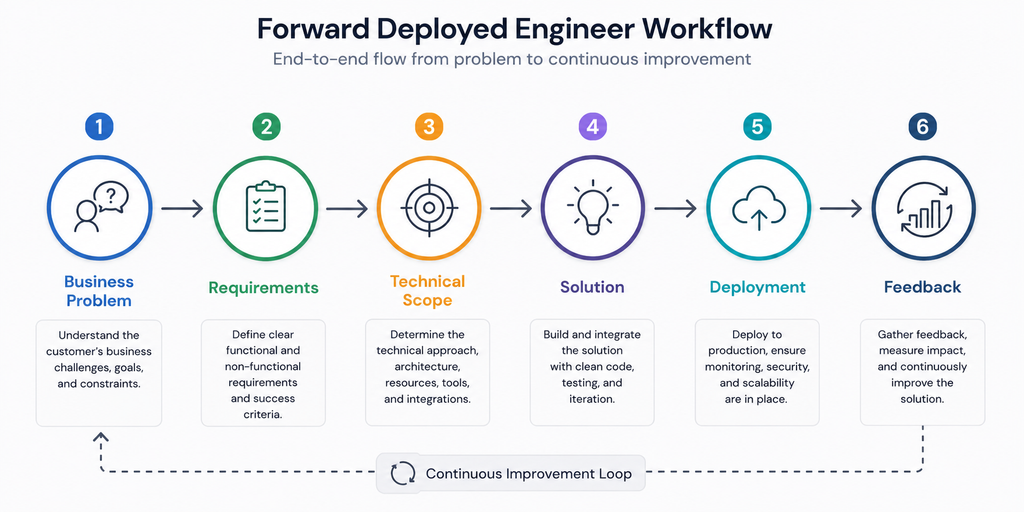
Problem Discovery
Say a customer tells you: “We need an AI chatbot.”
That’s a starting point, not a spec. A good FDE will dig further:
- What problem is the chatbot actually supposed to solve?
- Who will use it, and how often?
- What data does it need access to?
- What existing systems does it need to connect with?
- What happens when the model gives a wrong answer?
- What security or compliance constraints apply?
The goal isn’t to build whatever was initially requested , it’s to understand the underlying problem well enough to propose the right solution, which might not be a chatbot at all.
Communication and Stakeholder Management
FDEs regularly move between technical and non-technical audiences in the same day debugging a deployment issue in the morning, then explaining a trade-off to a non-technical stakeholder in the afternoon.
This means being able to:
- Explain technical trade-offs in plain language
- Set realistic expectations about timelines and capabilities
- Run clear, focused demos
- Ask clarifying questions instead of guessing
- Communicate the limitations of a system honestly
- Explain why a particular implementation decision was made
Communication isn’t a soft add-on to the technical work. A well-built system that no one understands or trusts won’t get adopted which means the communication directly affects whether the technical work succeeds.
What Skills Do Companies Actually Look For?
When companies evaluate FDE candidates, they’re generally less interested in how many tools appear on a resume and more interested in evidence of end-to-end ownership proof that you can take something from an ambiguous problem to a working, deployed system.
| Hiring signal | What demonstrates it |
| Can build and ship | A production project or deployed application, not just a tutorial |
| Can deploy/debug AI | A real LLM application with evaluation and monitoring in place |
| Can integrate systems | A project involving real API, database, or enterprise integration |
| Can handle ambiguity | A project where requirements weren’t fully defined upfront |
| Can communicate with users | Customer-facing work, demos, or stakeholder collaboration |
A candidate who has built and deployed one complete system end to end, with real integration and real debugging usually stands out more than a candidate who has dabbled in a dozen frameworks without shipping anything.
How to Build These Skills
Building FDE-level skills is less about following a strict curriculum and more about building end-to-end capability the ability to take a project from an unclear problem to a working, deployed solution.
A useful progression looks like this:
- Strengthen software engineering fundamentals.
- Build and deploy a backend application.
- Learn cloud and production basics.
- Build a practical LLM application.
- Learn evaluation and monitoring for AI systems.
- Integrate your application with real external systems.
- Take on a project with genuinely ambiguous requirements.
- Practice explaining technical decisions to a non-technical audience.
| Skill | How to practice it | Evidence you can show |
| Software engineering | Build a backend service | A GitHub project |
| AI | Build an LLM application | A working demo |
| Deployment | Deploy it to the cloud | A live deployment |
| Integration | Connect APIs and databases | An integrated project |
| Evaluation | Test model outputs systematically | Evaluation results |
| Communication | Present the solution to others | A demo or written documentation |
Certificates and courses can help you learn concepts, but projects are what demonstrate capability. A single project that goes from problem to build to deployment to debugging tells a hiring team more than a stack of completed courses.
It’s also worth being realistic about scope: FDE roles vary significantly between companies, and no one is expected to be an expert in every cloud platform or every AI framework. What matters more is the demonstrated ability to learn, build, integrate, and debug across a technical stack — not mastery of every tool that exists.
Ready to Build FDE Skills in Practice?
Turn the skills covered in this guide into hands-on capability with IIT Delhi’s Advanced Certificate in AI Forward Deployed Engineering. Build and deploy real AI systems, work through FDE case simulations, and develop a portfolio of projects designed around the full problem-to-production journey.
Explore the programme and see how you can build FDE-ready skills.
FDE Skills Checklist
Use this checklist to assess where you stand before applying for FDE roles.
| Skill | Can I do this? |
| Build production-ready software | ☐ |
| Build an applied AI/LLM application | ☐ |
| Deploy an application to cloud infrastructure | ☐ |
| Integrate APIs and databases | ☐ |
| Debug production systems | ☐ |
| Work with ambiguous requirements | ☐ |
| Explain technical decisions to stakeholders | ☐ |
| Evaluate AI system performance | ☐ |
| Consider AI security and reliability | ☐ |
FAQ’s
What skills are required for a Forward Deployed Engineer?
FDEs need software engineering fundamentals, applied AI skills (like RAG and tool calling), deployment and cloud experience, systems integration ability, and strong communication skills. The exact mix varies by company, but end-to-end capability matters more than any single too.
Do FDEs need strong coding skills?
Yes. FDEs are expected to build and modify production-ready software, not just prototypes. This includes writing maintainable code, debugging systems, using version control, and understanding backend development even if the role also involves customer-facing work.
What AI skills should an FDE learn?
Practical, applied skills: prompting, retrieval-augmented generation (RAG), tool calling, structured outputs, agent workflows, and evaluation. Training foundation models from scratch is generally not required the focus is building useful applications around existing models.
Do Forward Deployed Engineers need cloud skills?
Generally, yes. FDE solutions often need to run in a customer’s cloud environment rather than a local machine, so deployment, monitoring, and troubleshooting in the cloud are core parts of the job. The specific platform depends on the employer and customer base.
Are communication skills important for FDEs?
Very. FDEs regularly explain technical trade-offs to both technical and non-technical stakeholders, run demos, and set expectations. Strong technical work that isn’t communicated clearly often fails to gain customer trust or adoption.
How can I develop FDE skills?
Build complete projects rather than isolated tutorials ideally ones that involve building, deploying, integrating with real systems, and explaining the result to someone else. Projects that demonstrate the full problem-to-deployment cycle are more valuable than certificates alone.