Learn Six Sigma Black Belt in the Age of AI: What Changes, What Doesn’t, and What to Learn Next

A Lean Six Sigma Black Belt already knows how to define a measurable problem, test whether a cause is real, and prove whether an improvement worked. AI changes the tools around that discipline, not the need for it. The next step is knowing which traditional tools to keep, which to upgrade, and where modern data methods genuinely win.
What a Lean Six Sigma Black Belt actually does
A Lean Six Sigma Black Belt leads cross-functional improvement projects end to end using DMAIC: defining a measurable problem, validating the measurement system, finding root causes with data and statistics, testing improvements, and establishing controls that hold the gain. The role combines statistical analysis with project leadership and process-owner engagement.
Lean and Six Sigma solve related but different problems. Lean focuses on waste and flow; Six Sigma focuses on variation and defects; Lean Six Sigma combines both approaches.
In practice, belt levels usually reflect increasing responsibility. Yellow Belts support improvement work, Green Belts contribute to projects, Black Belts lead more complex projects, and Master Black Belts operate at a broader coaching or deployment level.
The important distinction is not the belt name. It is what the practitioner can do with the method.
A Black Belt can turn a vague operational complaint into a measurable problem, establish whether the data can be trusted, distinguish signal from noise, test a proposed cause, and leave the process owner with a control system rather than a presentation.
That workflow still matters when the data arrives through APIs instead of spreadsheets.
The Black Belt toolkit, tool by tool: what still wins and what has been overtaken
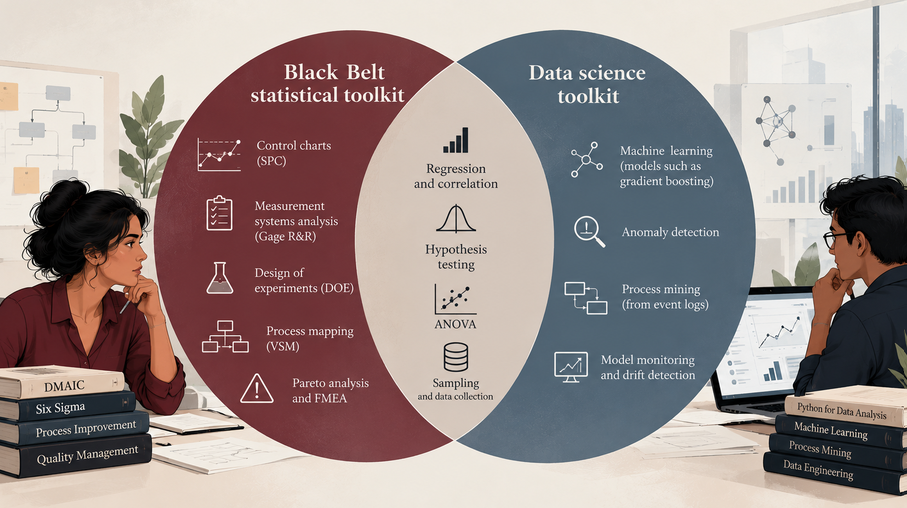
The traditional toolkit has not become obsolete. Some tools remain the right choice, while others now have faster or more scalable counterparts.
| Tool | Where it still wins | Modern equivalent / verdict |
| Control charts / SPC | Clear monitoring of a defined process metric | Automated SPC and drift monitoring, still the best tool |
| Hypothesis testing | Controlled comparisons and bounded questions | Automated statistical testing, still the best tool |
| Design of experiments | Establishing causal effects through controlled changes | Automated experimentation, irreplaceable |
| Regression and correlation | Interpretable relationships between defined variables | Gradient boosting and other ML models, has a stronger modern equivalent |
| MSA / Gage R&R | Validating whether the measurement system can be trusted | Automated data-quality checks, irreplaceable |
| Process mapping / VSM | Physical, manual or poorly logged processes | Process mining, has a stronger modern equivalent |
| Pareto / FMEA | Structured prioritisation and risk analysis | Risk analytics and anomaly detection, irreplaceable |
| Process capability / Cp/Cpk | Specification-driven processes | Automated capability monitoring, still the best tool |
| Data collection plan | Defining reliable data, sampling and ownership | Event schemas and telemetry, irreplaceable |
The NIST/SEMATECH Engineering Statistics Handbook continues to provide formal references for statistical methods including experimental design and process improvement.
The pattern is clear: tools that establish measurement quality, causal evidence and operational discipline remain difficult to replace. Tools built mainly for scanning large datasets are more likely to have modern equivalents.
Where the Black Belt beats the data scientist
Measurement systems analysis is the clearest example.
A model can process thousands of observations. It cannot tell you that the instrument, coding rule or collection method behind those observations is unreliable unless someone asks that question.
That is why Gage R&R still matters. If the measurement system cannot distinguish meaningful variation from measurement noise, a sophisticated model is simply learning from a weak foundation.
There is also a difference between finding a pattern and proving a cause.
A model can rank candidate drivers using feature importance, but a ranked feature is not automatically a causal explanation. The Black Belt still has to formulate the hypothesis, test the comparison and establish whether changing X actually changes Y.
Where the modern method genuinely wins
Machine learning genuinely adds value when a problem has too many variables, observations or interactions for manual analysis to scale.
Suppose a service operation records hundreds of attributes for every transaction. A Black Belt can still stratify the data, but the exercise becomes increasingly expensive. A tree-based model can scan a much larger candidate space and identify patterns worth investigating.
The same applies to monitoring. A control chart is excellent for a defined metric. It is not designed for a system producing hundreds of signals every second.
Automated anomaly detection and drift monitoring can continuously scan that environment. The Black Belt’s role shifts from watching every signal to deciding which signals matter, what threshold should trigger action, and what should happen next.
That is the route forward: let modern models widen the search, then apply process-improvement discipline to decide what deserves intervention.
DMAIC in the data era: what changes in each phase
DMAIC still provides the project structure. What changes is how much data is available, how quickly it can be analysed, and how improvement can be monitored. ISO 13053-1:2011 remains the current ISO standard for the DMAIC methodology and defines the five phases as Define, Measure, Analyse, Improve and Control.
Define: the charter survives, the problem statement gets sharper
The Define phase changes the least.
A project still needs a business problem, scope, customer requirement, CTQ and measurable outcome. What changes is the evidence available before the project begins.
Instead of relying entirely on interviews or workshop estimates, a team can examine transaction, customer or operational data to understand the scale and shape of the problem.
That makes the problem statement sharper. A vague statement such as “customers are unhappy with delays” can become a measurable question about cycle time, abandonment, rework or service-level performance.
Route forward: use existing operational data to strengthen the charter, then confirm the problem with the people who own the process.
Measure: the constraint moved from getting data to trusting it
The traditional bottleneck was often collecting enough data. In an instrumented process, the data may already exist across ERP, CRM, ticketing, workflow or production systems.
The harder question becomes: does the system producing the data measure what you think it measures?
That brings MSA, operational definitions, missing values, timestamps, duplicate records and data lineage back into focus. More data does not remove the need for measurement discipline.
A process can be fully digitised and still produce a misleading metric.
Route forward: treat the data-generating system as part of the measurement system. Validate the fields, definitions and collection logic before modelling them.
Analyse: from stratification by hand to feature importance
Traditional analysis often starts by stratifying the Y against suspected Xs, testing differences and looking for statistically meaningful relationships.
Modern models can examine many candidate variables at once. Gradient boosting, for example, can model complex relationships in tabular data and support regression or classification tasks.
But feature importance answers a predictive question, not automatically a causal one.
The useful combination is straightforward: the model narrows the search; the Black Belt establishes whether the suspected cause is actually causal.
That is where DOE remains valuable. When factors can be deliberately changed, an experiment can provide stronger evidence than an observational pattern alone. NIST describes DOE as a structured way to vary process factors and analyse their effects on responses.
Route forward: use machine learning to reduce the search space, then use hypothesis testing, controlled comparisons or DOE to establish what actually changes the outcome.
Improve: piloting a change versus predicting one
Improvement work can now happen with more information before implementation.
Forecasting can estimate what may happen next. Simulation can test scenarios. Predictive models can estimate which cases are most likely to fail.
That can reduce the number of options a team needs to pilot.
But prediction is not proof of improvement.
A process change still needs to be tested under controlled conditions, measured against the defined outcome and evaluated for unintended effects.
Route forward: use prediction and simulation to choose better experiments, then let the pilot provide the evidence.
Control: the phase that changed most
Control is where continuous data collection creates the biggest shift.
A traditional control plan may specify what to monitor, how often to check it and what action to take when performance moves outside the expected range.
An instrumented process can monitor those signals continuously. Automated SPC, anomaly detection and drift monitoring can surface changes without waiting for a periodic review. Machine-learning libraries now include dedicated approaches for anomaly and outlier detection. (Scikit-learn)
But automation introduces a new problem: interpretability and attention.
A chart on a dashboard can already be ignored. An automated alert can be ignored even more easily if the organisation receives hundreds of them.
Route forward: specify not only what the system monitors, but which threshold triggers action, who owns the response and when human review is required.
Process mining: Where a core Black Belt technique has a Stronger Modern Alternative
Process mapping becomes fundamentally different when the process leaves an event trail.
An event log typically contains three useful pieces of information: a case ID, an activity and a timestamp. From that structure, process-mining software can reconstruct how individual cases moved through a workflow.
That changes the nature of process discovery.
A workshop-based value-stream map records the process people describe. It may capture the intended sequence, major handoffs and known bottlenecks.
An event log can show what actually happened.
It can reveal that one workflow took three steps for most cases but seven for a particular customer group. It can show rework loops that nobody mentioned in the workshop. It can expose variants created by different teams, systems or exception paths.
For digitally recorded processes, this gives process mining a clear advantage over relying on workshop mapping alone.
It changes what the practitioner does with it.
VSM knowledge still matters. The skill shifts from manually reconstructing the process to checking actual behaviour against the intended process.
Instead of spending the entire discovery phase reconstructing the process manually, the Black Belt can compare the documented process with the process discovered from system data. That moves the skill towards conformance checking: identifying where actual behaviour diverges from the intended process.
The distinction matters because software can show that a path exists. It cannot decide whether that path is a legitimate exception, a broken control, a customer requirement or unnecessary rework.
Workshops also remain useful when processes are physical, informal or poorly logged. A factory-floor movement, a manual inspection or an undocumented decision may never appear in an event log.
Route forward: keep VSM for physical and unlogged work, but add process mining to every major workflow where reliable event data already exists.
What the Lean Six Sigma Black Belt does not change about being a Black Belt
The durable part of the role sits outside the statistical software.
Someone still has to decide which problem deserves a project, secure sponsorship, negotiate across functions and decide whether an apparent improvement is operationally meaningful.
A model can identify a likely driver. It cannot persuade a process owner to change the standard work, resolve conflicting KPIs or take ownership of the new control.
As analysis becomes cheaper, judgement becomes more important. A modern Black Belt needs enough technical fluency to question model outputs and spot weak assumptions, while retaining ownership of problem selection, causation, implementation and control.
Route forward: learn enough modern analytics to interrogate the output, then use process knowledge to decide what action is justified.
What to learn next: a route for someone who already knows the statistics
You do not need to start data analytics from zero. The faster route is to translate existing statistical knowledge into modern tools, then move closer to the data and automation layer.
Stage one: move your analysis out of Minitab
Start with the statistics you already know.
Use Python, pandas, SciPy and statsmodels to reproduce work you have already completed: t-tests, ANOVA, regression, capability analysis and exploratory analysis.
The objective is not to become a software engineer.
It is to make your existing analytical skill portable.
Take one completed improvement project. Recreate its data preparation, analysis and visualisation in a notebook. If you understand the statistical method already, the new learning is mostly about syntax, data structures and reproducibility.
That also gives you a better foundation for working with data that does not arrive as a tidy Minitab worksheet.
Build: one finished project reproduced in a Python notebook from raw data to conclusion.
Stage two: event logs and predictive models
Next, move from structured project datasets to operational data.
Pull an event log from a system you already work with. Identify the case ID, activities and timestamps. Discover the actual process and compare it with the documented process.
Then move beyond linear regression.
Learn how tree-based models work, when gradient boosting is useful, and how to interpret feature importance without treating it as proof of causation. Scikit-learn’s current documentation includes gradient-boosting models for regression and classification as well as anomaly-detection methods.
The goal is to use the model to narrow the search, then apply Black Belt discipline to determine whether a suspected driver is actually causal.
Build: one process-mining analysis and one predictive model, with a written explanation of what the model can and cannot establish.
Stage three: specify automation rather than build it
The final step is closer to operational design.
Learn how forecasting, anomaly detection and automated controls can fit into a process. Then learn to write the specification for the control itself.
That specification should answer:
- What does the system monitor?
- What threshold triggers an alert?
- What action can happen automatically?
- What requires human approval?
- What happens when the model is wrong?
- Who owns the response?
- How is model drift detected?
- When is the rule reviewed?
That is a different skill from simply knowing how to call a model.
It combines process knowledge, statistical thinking, risk management and automation design.
Build: one automated-control specification that defines the signal, threshold, action, escalation path and accountability.
Where this leaves the certification and what employers are asking for now
The credential still has a clear purpose: it signals structured knowledge of process improvement and the ability to work within a recognised methodology. ASQ describes its Certified Six Sigma Black Belt around DMAIC, team leadership, Lean concepts and the use of specific improvement tools. IASSC similarly describes its Black Belt around advanced Lean Six Sigma practice and leading complex improvement projects.
DMAIC itself is not a vendor-specific framework. ISO 13053-1:2011 remains the current international standard for the methodology and was reviewed and confirmed in 2022.
What changes is what sits next to the credential.
The credential therefore becomes one part of a broader professional profile: process-improvement expertise supported by modern data fluency.
There is already evidence of training providers adding AI to their Six Sigma offerings. For example, SSGI currently markets AI-Enhanced Green and Black Belt programmes that add its AI for Operational Excellence module to the certification path.
For broader skills trends, the World Economic Forum’s Future of Jobs Report 2025 surveyed more than 1,000 employers across 55 economies. It identifies analytical thinking as a leading core skill while AI and big data rank among the fastest-growing skills.
That is global employer research, not India-specific hiring evidence. It does, however, point to the combination this role increasingly needs: analytical depth plus technological fluency.
So the sensible route is not to abandon the belt. It is to extend what it lets you do.
Keep the methodology. Upgrade the tools. Move closer to real-time data. Learn enough AI to question its output. Then use your process knowledge to decide what should happen next.
Frequently asked questions
Is Lean Six Sigma still relevant with AI?
Yes. Its relevance depends less on whether the analysis is performed manually and more on whether the organisation can use data to improve a process reliably. DMAIC still provides a structured improvement framework, while AI expands the analytical methods available within that framework.
Will AI replace Lean Six Sigma Black Belts?
AI is more likely to change the Black Belt’s toolkit than eliminate the role. The bigger shift is that practitioners can spend less time on repetitive analysis and more time on project selection, interpretation, experimentation and implementation.
What is the difference between Six Sigma and data science?
Six Sigma is primarily a process-improvement discipline, while data science covers a broader range of statistical, computational and machine-learning methods. A Black Belt typically starts with a defined process problem; a data scientist may work across prediction, classification, recommendation or other data problems.
Should a Black Belt learn Python?
Python is useful when existing statistical work needs to move into larger datasets, automated workflows or reproducible analysis. A Black Belt does not need to become a software developer, but basic Python can make it easier to work alongside data and AI teams.
What is process mining and how does it relate to Six Sigma?
Process mining analyses event logs to show how a digitally recorded process actually behaves. For Six Sigma practitioners, its main value is process discovery and conformance checking. It can therefore extend traditional process-mapping skills when reliable system data is available.
Green Belt or Black Belt: which should I do?
The distinction is mainly about project responsibility and depth of practice. Green Belt training is generally suited to professionals contributing to improvement work, while Black Belt training is intended for deeper project leadership. The appropriate level depends on the role you expect to take on.
What does a Lean Six Sigma Black Belt do?
A Black Belt typically leads improvement projects and coordinates the people, analysis and implementation needed to move from a defined problem to a controlled result. The role sits at the intersection of statistics, process knowledge and project leadership.
Can Lean Six Sigma and machine learning be used together?
Yes. They can serve different parts of the same project. Machine learning can help identify patterns across large datasets, while Six Sigma methods can provide the structure for defining the problem, validating measurements and testing whether an identified factor actually produces the desired change.
Is Lean Six Sigma the same as Six Sigma?
No. Six Sigma focuses primarily on reducing variation and defects. Lean focuses on waste and flow. Lean Six Sigma combines the two approaches, using both process-flow and variation-reduction methods in improvement work.
What skills should a Black Belt learn next?
The most useful additions are not limited to AI itself. Python, event-log analysis, process mining, predictive modelling, anomaly detection and automated process monitoring can extend the traditional toolkit. The priority should be learning how these methods fit into real improvement projects rather than collecting tools individually.