Marketing Analytics Course: Syllabus, Skills and Certification

A good marketing analytics course should teach you how to measure marketing performance, understand customer behaviour and turn data into decisions. Look for practical coverage of web analytics, KPIs, attribution, dashboards and AI-assisted analysis, rather than a course that only teaches tools.
If you’re comparing marketing analytics courses in India, the right choice depends on what you want to do with the skill.
An analytics-focused course may make sense if you want depth in measurement and reporting. A broader AI-marketing programme can make more sense if you want analytics alongside strategy, performance marketing, customer insights and growth.
Marketing Analytics Course Syllabus: What Will You Learn?
A course that only introduces marketing metrics is unlikely to be enough.
Look for a curriculum that takes you from measurement to analysis, visualisation and actual marketing decisions:
| Syllabus area | What it covers |
| Marketing measurement | KPIs, campaign measurement, marketing metrics |
| Customer analytics | Customer behaviour, acquisition, CLV |
| Experimentation | A/B testing and hypothesis testing |
| Analytics tools | GA4, dashboards, spreadsheets or BI tools |
| Attribution | Understanding channel and customer journeys |
| Data visualisation | Dashboards, charts and actionable reporting |
Skills You Learn in a Marketing Analytics Course
A marketing analytics course should help you develop skills that go beyond using individual analytics tools. By the end of the course, you should be able to:
- Measure marketing performance: Define KPIs and evaluate campaign results.
- Analyse customer behaviour: Identify patterns in acquisition, engagement and customer value.
- Use web analytics: Navigate tools such as GA4 to understand traffic and conversions.
- Evaluate attribution: Understand how different channels contribute to customer journeys and conversions.
- Build and interpret dashboards: Turn marketing data into clear visual reports.
- Run experiments: Use A/B testing and hypothesis testing to evaluate marketing decisions.
- Turn data into insights: Translate analysis into recommendations for campaigns, channels and strategy.
How to Choose a Marketing Analytics Course
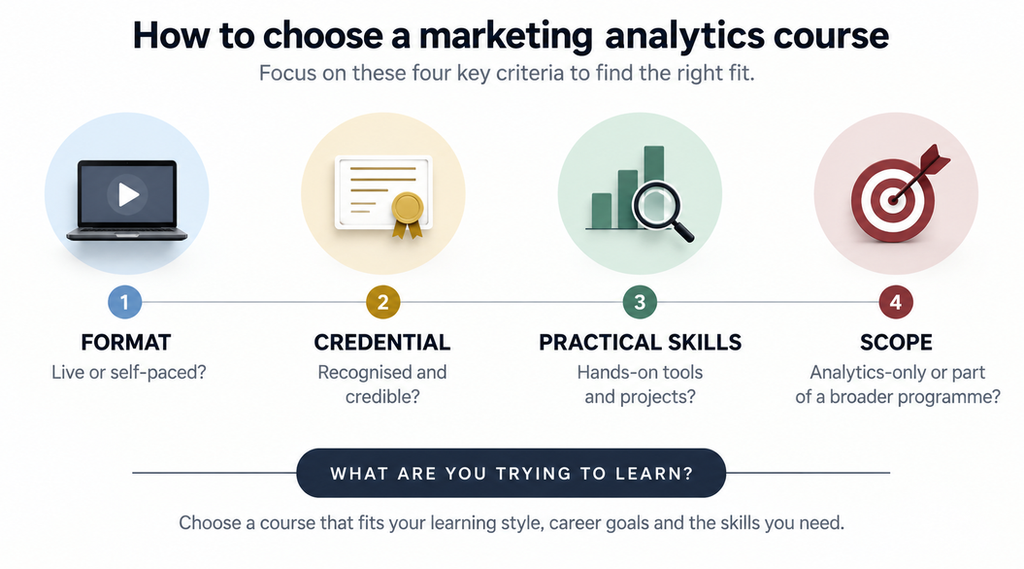
Use four criteria:
1. Check the format
Live classes can offer interaction and feedback. Self-paced courses give more flexibility. Choose based on how much structure and instructor access you need.
2. Look at the credential
Check who awards the certificate, who teaches the programme and whether the credential comes from the institution itself or the learning platform.
3. Look for practical analytics work
A syllabus should go beyond definitions. Look for GA4, measurement, attribution, dashboards, projects or case-based assignments.
4. Decide whether you need analytics alone
If analytics is the main skill you want to build, a focused marketing analytics course may be enough. If you’re a marketer looking to connect analytics with strategy, content, paid media, growth and AI, a broader programme may be more useful.
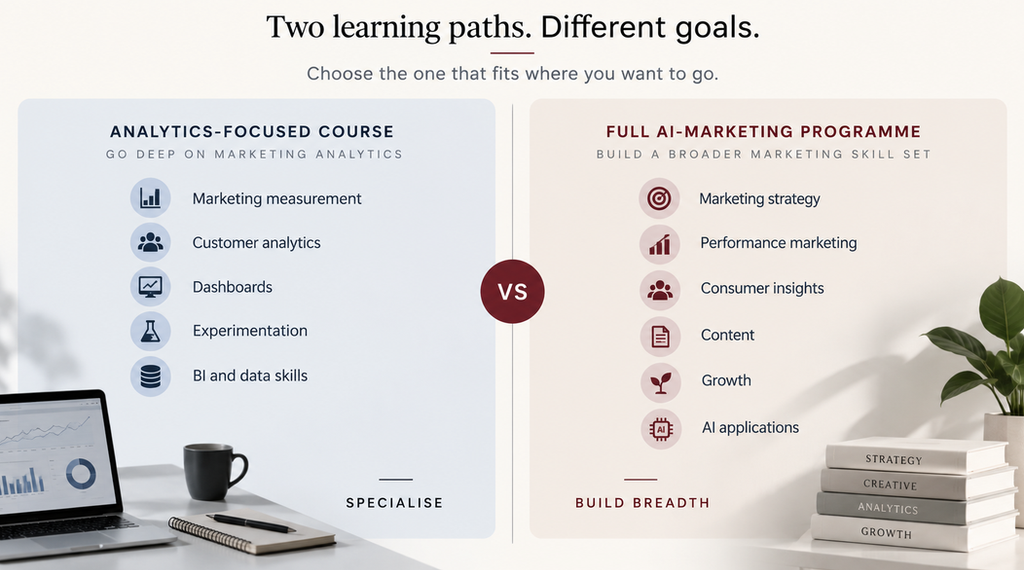
Analytics-Only Course vs Full AI-Marketing Programme
An analytics-focused course may suit you if you want to concentrate on:
- Measurement
- Customer analytics
- Experimentation
- Dashboards
- Data analysis
A broader AI-marketing programme may suit you if you want analytics alongside:
- Strategy
- Performance marketing
- Consumer insights
- Content
- Growth
- AI applications
The choice comes down to depth versus breadth: do you want to specialise in marketing analytics, or use analytics as one part of a wider marketing skill set?
How the IIM Tiruchirappalli programme covers analytics
The official IIM Tiruchirappalli page describes the programme as a six-month Certificate Programme in AI-Powered Marketing & Growth Strategy, covering marketing analytics alongside AI-powered marketing strategy, brand positioning, content, consumer insights, performance marketing, growth experimentation, agentic AI and responsible AI.
It is therefore not an analytics-only course.
Marketing analytics sits within Module 4 of the programme: Marketing Analytics, Measurement & Attribution. This module covers GA4 and web analytics, measurement frameworks for evaluating campaign performance, and multi-touch attribution across channels. It’s taught as one grounded module within the broader curriculum, not as a standalone analytics track.
The programme is designed for marketing professionals, growth managers, brand leaders, entrepreneurs, consultants and business operators with a bachelor’s degree and at least three years of professional experience. It uses live faculty-led lectures, case studies, assignments and quizzes.
Programme snapshot
| Detail | IIM Tiruchirappalli programme |
| Programme | Certificate Programme in AI-Powered Marketing & Growth Strategy |
| Duration | 6 months |
| Learning hours | 75 hours |
| Schedule | Saturdays, 2:30 p.m. – 5:45 p.m. |
| Modules | 9 |
| Format | Live online |
| Eligibility | Bachelor’s degree + 3 years of professional experience |
| Application fee | ₹1,000 |
| Programme fee | ₹1,77,000 including 18% GST |
| Certificate | Issued by IIM Tiruchirappalli |
| Analytics coverage | Module 4: Marketing Analytics, Measurement & Attribution |
If you want to build analytics skills as part of a broader AI-marketing programme, the IIM Tiruchirappalli Certificate in AI-Powered Marketing & Growth Strategy combines marketing strategy, analytics, performance marketing, AI and growth.
→ Explore the IIM Tiruchirappalli Certificate in AI-Powered Marketing & Growth Strategy.
Frequently Asked Questions
1. How do you become a marketing analyst?
You can become a marketing analyst by developing skills in marketing, data analysis, measurement and data interpretation, followed by practical experience with marketing data. A structured course can help build these skills through guided learning and projects.
2. What skills do you need for marketing analytics?
Marketing analytics requires skills such as data interpretation, KPI analysis, statistical thinking, data visualisation, customer insights and communicating data-driven findings. Knowledge of marketing principles is equally important.
3. What tools are used in marketing analytics?
Common marketing analytics tools include Google Analytics, Google Ads, Meta Ads Manager, Excel, SQL, CRM platforms and data visualisation tools. The specific tools required depend on the role and level of analytics involved.
4. What is the 7-step marketing analytics process?
A typical seven-step marketing analytics process involves defining the objective, identifying the required data, collecting and preparing data, analysing it, generating insights, taking action and measuring the outcome. The exact framework may vary across organisations and courses.
5. Do you need coding to learn marketing analytics?
No, advanced coding is not required to start learning marketing analytics. Basic data handling, analytical thinking and familiarity with spreadsheets are useful starting points, while SQL, Python and other technical skills can help with more advanced analytics.
6. Is marketing analytics difficult to learn?
Marketing analytics can be learned without an advanced technical background, although it requires comfort with numbers, data and analytical thinking. Learning the concepts progressively and applying them to real marketing problems can make the subject more accessible.
7. What is the difference between marketing analytics and digital marketing?
Digital marketing involves planning and executing marketing activities across digital channels, while marketing analytics focuses on measuring and interpreting the data generated by those activities. Analytics helps marketers understand what is working and where campaigns can be improved.
8. Is marketing analytics a good career?
Marketing analytics can lead to roles in areas such as campaign measurement, customer insights, web analytics, marketing intelligence and performance reporting. Career opportunities depend on factors such as skills, experience, industry and job role.
9. What salary can a marketing analyst earn?
A marketing analyst’s salary varies based on experience, location, organisation, industry and technical skills. Salary ranges can also differ significantly between entry-level, mid-level and specialised analytics roles.
10. Can a digital marketer learn marketing analytics?
Yes, digital marketers can learn marketing analytics by building skills in data interpretation, campaign measurement, attribution, KPIs and analytics tools. Existing knowledge of digital channels can provide useful context for analysing marketing performance.
11. What is the difference between marketing analytics and marketing automation?
Marketing analytics focuses on collecting and interpreting marketing data to evaluate performance and support decisions. Marketing automation uses technology to automate repetitive marketing activities such as email campaigns, lead nurturing and customer communication.
12. Does the IIM Tiruchirappalli programme cover marketing analytics?
Yes. Marketing analytics is covered within the IIM Tiruchirappalli Certificate Programme in AI-Powered Marketing & Growth Strategy. The programme takes a broader approach, combining analytics with areas such as AI-powered marketing, consumer insights, performance marketing and growth.