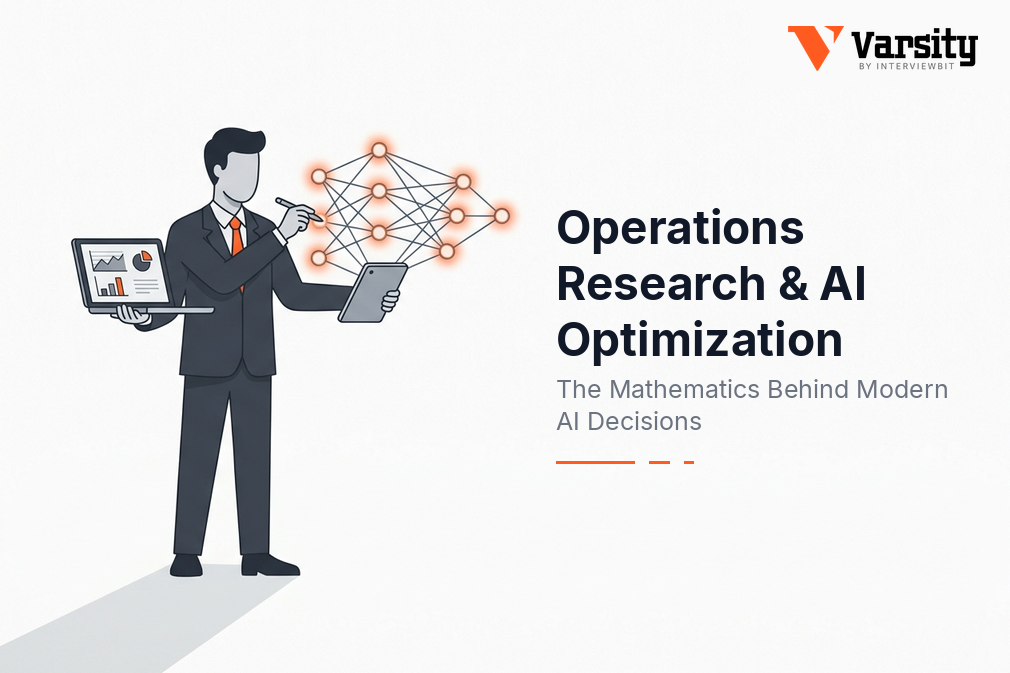
How Operations Research Became the Foundation of Modern AI Optimization

In 1940, a British physicist named Patrick Blackett assembled a genuinely odd team, physicists, mathematicians, a couple of biologists, and reportedly at least one lawyer, and set them loose on a very unglamorous problem: where exactly should radar stations be placed, and how should fighter planes actually be scrambled, to make the best use of Britain’s painfully limited early radar equipment. People called the group Blackett’s Circus. Nobody involved thought they were founding an academic discipline. They just needed the radar to actually work.
That group, and a handful of others like it working on convoy routing and anti-submarine tactics, effectively invented operations research. Eight decades later, the mathematics that came out of those wartime rooms is quietly running underneath a huge share of what gets marketed today as “AI-powered optimization,” delivery routing, staff scheduling, supply chain planning, even how a self-driving car decides which lane to merge into.
This piece covers what operations research actually is, the core techniques that make up its toolkit, and the part most “AI is optimizing everything now” articles skip entirely: that modern AI didn’t replace operations research, it built on top of it, and the best systems today genuinely need both.
What Is Operations Research?
Operations research (OR) is the discipline of using mathematical modelling, statistics and algorithms to help decision-makers choose the best course of action among many options, under real constraints, time, budget, capacity, competing priorities. INFORMS, the field’s professional body, traces the term back to exactly that British radar work in the early years of World War II, when it simply meant integrating new technology into military tactics through actual data and analysis instead of instinct.
The core idea hasn’t changed much since. Take a messy, real-world decision, build a mathematical model of it, and use that model to find the genuinely best answer, not just a reasonable-sounding one. What’s changed is the scale of problems the field can now tackle, thanks to computing power nobody in 1940 could have imagined.
A Short, Genuinely Dramatic History of OR
The wartime roots go deeper than just radar placement. British and American teams applied similar thinking to convoy routing, working out the optimal ship-group sizes and paths to minimise U-boat losses, and to search theory, calculating the most efficient patterns for aircraft hunting submarines. None of it involved a computer. It was mostly statisticians and physicists with slide rules, applying rigorous method to problems people had previously solved by gut feeling.
After the war, the pioneers didn’t just go back to their old jobs. Many of them noticed that a factory’s production schedule or an airline’s fleet routing had the exact same shape as the military problems they’d just spent years solving, scarce resources, competing demands, one genuinely best answer hiding among many mediocre ones. George Dantzig, working in the US Air Force, developed the simplex method for linear programming in 1947, arguably the single most consequential algorithm the field ever produced. Around the same period, John von Neumann and Oskar Morgenstern formalised game theory, and Richard Bellman later developed dynamic programming, techniques that, decades on, sit directly underneath modern reinforcement learning.
By the 1950s and 60s, OR had a professional identity, university departments, and a growing list of industries, airlines, oil, manufacturing, quietly running their operations on top of it.
The Core Techniques of Operations Research
| Technique | What it actually does | Where it shows up |
| Linear programming | Finds the best outcome in a model where relationships are straight-line and constraints are limits (budget, capacity, time) | Production planning, blending problems, resource allocation |
| Integer programming | Like linear programming, but forces answers to be whole numbers, since you can’t schedule half a nurse | Staff scheduling, facility location, network design |
| Queuing theory | Models how waiting lines behave, arrival rates, service rates, and the resulting delays | Call centre staffing, hospital triage, checkout counter planning |
| Simulation (Monte Carlo) | Runs a model thousands of times with randomised inputs to see the range of likely outcomes | Risk analysis, inventory planning under uncertain demand |
| Network optimization | Finds the most efficient path or flow through a network of connected points | Delivery routing, supply chain design, telecom capacity planning |
| Decision analysis / game theory | Models decisions where the outcome depends on what other rational parties do | Pricing strategy, auctions, competitive bidding |
None of these techniques are new. Most were fully developed by the 1960s. What’s new is that a laptop today can solve in seconds what would have taken a room full of mathematicians weeks in 1955, and that shift in raw computing power is a big part of why OR quietly re-entered the conversation once “AI” became the industry’s favourite word.
Where OR Quietly Runs Your Everyday Life
The single best real-world case study here is UPS’s ORION system, documented in detail by INFORMS itself. ORION recalculates the most efficient delivery route for each driver every day, evaluating well over 200,000 route combinations per driver in the process. By the time it was fully rolled out, it had already saved UPS more than $320 million, and it now saves the company an estimated 100 million miles driven every year. That’s not a hypothetical AI success story, it’s operations research, running at genuinely enormous scale.
The same underlying techniques show up constantly once you know to look: airline crew scheduling (an integer programming problem with an almost absurd number of constraints), hospital bed and staff allocation, traffic signal timing across a city grid, and how a warehouse decides where to physically place inventory so pickers walk the fewest possible steps. None of it makes headlines. All of it is running, quietly, every single day.
How OR Became the Foundation Under Modern AI Optimization
Here’s the part that gets genuinely interesting, and the part most “AI is transforming everything” content skips entirely. Training a machine learning model is itself an optimization problem, the entire process of gradient descent, the workhorse behind training neural networks, is a direct mathematical descendant of the optimization theory OR developed decades earlier.
Reinforcement learning leans on this even more directly. The mathematical framework behind it, Markov Decision Processes, and the core technique used to solve them, dynamic programming, both come straight out of Richard Bellman’s operations research work in the 1950s. When people talk about an AI agent “learning” the optimal policy for a task, under the hood, it’s frequently solving a problem OR had already formally defined before most modern AI researchers were born.
AI Predicts, OR Decides: Why You Genuinely Need Both
The cleanest way to hold this distinction in your head, and the one most marketing copy blurs on purpose: machine learning is generally excellent at prediction, what’s demand going to look like next Tuesday, how long will this shipment take, which customer is about to churn. Operations research is what turns a prediction into an actual, constrained, optimal decision, given everything else that has to be true at the same time.
| Machine learning’s job | Operations research’s job | |
| Core question | What’s likely to happen? | Given that, what’s the best thing to do? |
| Typical output | A forecast, a classification, a probability | An optimal schedule, route, allocation or plan |
| Handles constraints well? | Not natively, constraints have to be bolted on | Yes, constraints are built into the core of the model |
| Example | Predicting tomorrow’s package volume by region | Deciding the actual optimal route for every driver given that volume |
UPS’s ORION system is, again, the clean illustration: machine learning forecasts traffic patterns and delivery-time windows, and an operations research solver takes those forecasts and actually generates the optimal route. Neither half does the other’s job well. A forecasting model with no optimization layer just produces a prediction nobody’s acted on yet. An optimization solver with no forecast is optimizing against numbers that might already be stale.
Where the Two Fields Are Actively Merging
The frontier right now sits in hybrid approaches, using machine learning, especially reinforcement learning, to approximate solutions to optimization problems that are too large for classical OR solvers to crack in reasonable time. Vehicle routing at massive scale, chip layout design, and certain supply-chain network problems increasingly use learned approximations trained on top of, or alongside, traditional OR methods, rather than choosing one approach over the other.
This isn’t AI making operations research obsolete. If anything, it’s the opposite: the demand for people who understand both the statistical, predictive side of AI and the constrained, decision-making side of OR is growing, because the systems doing the most impressive real-world optimization work right now are the ones combining both well, not the ones treating them as competitors.
Why This Matters for Anyone Building a Career in AI
A genuinely useful, underrated skill for anyone heading into AI-focused roles right now: knowing enough operations research to recognise when a problem needs a constrained optimization solver, not just a bigger model. Plenty of “AI can’t solve this” frustrations in the wild are actually cases where someone tried to force a prediction model to make a decision that a decades-old OR technique would have nailed in milliseconds. Knowing the difference, and knowing which tool the problem in front of you actually calls for, is a genuinely rare and valuable skill.
Wrapping Up
It’s a little humbling, honestly, that so much of what gets sold today as cutting-edge AI optimization traces its mathematical DNA back to a room full of physicists trying to figure out where to point radar dishes in 1940. The technology has changed almost beyond recognition. The underlying question, given everything constraining me, what’s genuinely the best decision I can make, hasn’t changed at all.
FAQs
What is operations research?
Operations research is the discipline of applying mathematical modelling, statistics and algorithms to help make the best possible decision among many options, under real-world constraints like budget, time and capacity. It originated in World War II military planning and later expanded into business and industry.
What are operations research techniques?
Core OR techniques include linear and integer programming, queuing theory, simulation, network optimization, and decision analysis or game theory. Each is suited to a different type of constrained decision, from staff scheduling to delivery routing to risk modelling.
Is operations research the same as data science?
No, though they overlap and increasingly work together. Data science focuses heavily on extracting insights and predictions from data. Operations research focuses on using models to find the optimal decision given constraints, prediction and decision-making are related but genuinely different problems.
Is operations research part of AI?
It’s more accurate to say operations research is a foundation modern AI optimization builds on, rather than a subfield of AI. Techniques like dynamic programming and Markov Decision Processes, both OR inventions, sit directly underneath reinforcement learning, one of AI’s most active research areas.
What jobs use operations research?
Roles like operations research analyst, supply chain analyst, logistics optimization engineer, and increasingly AI or machine learning engineer working on scheduling, routing or resource-allocation problems, all lean on OR techniques regularly.
Do I need to learn operations research to work in AI?
Not strictly, but it helps significantly if you’re working anywhere near optimization, logistics, scheduling or resource allocation. Understanding constrained optimization rounds out a purely machine-learning skill set and is exactly the combination the strongest AI-powered operations systems are actually built on.