Programmatic Advertising Explained: How AI-Driven Bidding Works

Buying digital ads used to mean a lot of back-and-forth. A marketer would call a publisher, negotiate a placement, agree on a price, and wait for the ad to go live.
Programmatic advertising moved much of that buying process into software. Instead of negotiating every placement, marketers can let platforms handle the buying automatically.
But the interesting bit is not the automation itself. It includes what happens in the seconds between a page loading and an ad appearing.
Increasingly, that algorithm is running on AI.
What is programmatic advertising?
Programmatic advertising is the automated buying and selling of digital ad space through software, using data to decide which ad an individual person sees. Instead of negotiating each placement by hand, advertisers set an audience, a budget and a goal, and a platform does the buying.
A few things it can be useful to be clear about:
- It’s not one ad format. Display, video, native and audio ads can all be bought programmatically.
- It’s not the same as “automated.” Automated just means software is involved somewhere; programmatic specifically means the buying is automated, impression by impression.
- It scales without scaling effort. A campaign can run across thousands of sites and apps without a marketer picking each one.
Some people use “programmatic marketing” and “programmatic ads” interchangeably with programmatic advertising; they all point to the same buying model.
How does programmatic advertising actually work?
Strip away the jargon and programmatic is basically a matching problem.
A publisher has an ad space to sell. Several advertisers may want it. The system figures out which eligible buyer gets the opportunity.
Here’s what that can look like for one person loading one page.
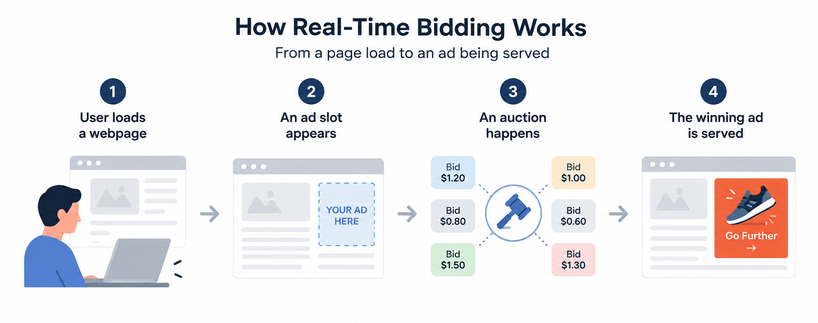
The auction, step by step
Someone opens a news article. There’s an empty ad slot on the page. And because a specific person is about to see it, that slot has a price.
- The publisher offers the impression. Its supply-side platform (SSP) packages details about the slot: page context, device, audience signals, and puts it up for bid.
- An ad exchange routes the request. The exchange broadcasts the opportunity to connect buyers.
- Demand-side platforms (DSPs) evaluate it. Each DSP checks the impression against its advertisers’ targeting rules: right audience, right context, worth the price, budget still available.
- Interested buyers bid. More than one advertiser can want the same impression at the same moment.
- The auction clears. The marketplace determines the winning eligible bid according to its auction rules, and the winning ad is served: all before the page finishes loading.
That entire sequence is what the industry calls real-time bidding (RTB): an individual impression is auctioned in real time. RTB is not separate from programmatic. It is the auction mechanism inside it. Programmatic buying also happens outside the open auction, through deals agreed in advance (more on that below).
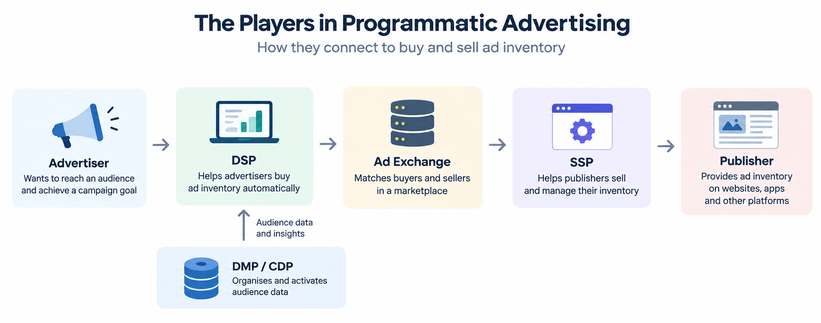
The main players
| Player | What it does |
| Advertiser | Wants to reach an audience and hit a campaign goal |
| DSP (demand-side platform) | Software advertisers use to buy inventory automatically |
| SSP (supply-side platform) | Software publishers use to sell and manage their inventory |
| Ad exchange | Connects the buying and selling sides |
| DMP/CDP | Organises and activates the audience data behind targeting |
The simplest way to remember it: DSP buys. SSP sells.
Where header bidding fits in
Early RTB gave the SSP a lot of control over which exchange got first look at an impression. Header bidding changed that: it lets a publisher offer the same impression to several exchanges and SSPs at once, before the primary auction runs, so more buyers compete and publishers capture more value.
Header bidding sounds more complicated than it is in practice. A publisher essentially gives multiple buyers a chance to compete for the same impression before the main auction runs.
What are the types of programmatic advertising?
Programmatic is not merely an open auction. There are four main ways inventory gets bought, and they differ in who has access and how the price is set.
| Type | How it works | When it’s used |
| Open auction | Any eligible buyer competes for the impression | Maximum reach and scale |
| Private marketplace (PMP) | A publisher invites a select group of buyers to bid on specific inventory | More control over where ads appear |
| Preferred deal | A buyer gets first right to buy at a fixed price before the impression goes to open auction | Priority access without a guaranteed commitment |
| Programmatic direct | Price and inventory are agreed upfront between buyer and publisher, executed through the same technology | Predictable access to specific, high-value placements |
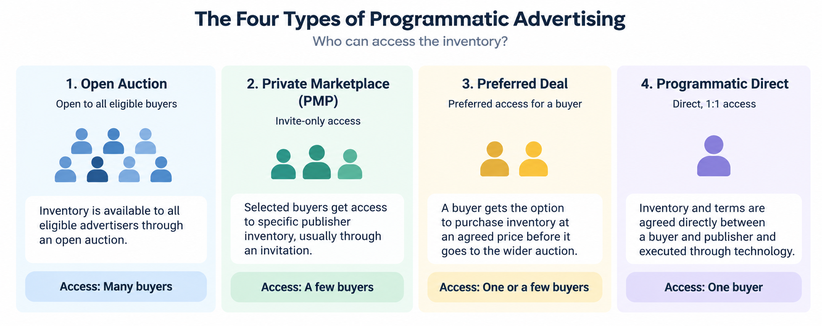
[Alt text: Four types of programmatic advertising: open auction, private marketplace, preferred deal and programmatic direct, compared by buyer access.]
This is where the two terms may be confused into one. Programmatic doesn’t always mean RTB. RTB is one way programmatic inventory gets bought, not the whole system.
Direct and preferred deals still use programmatic technology, just without a live auction deciding the winner.
What is an example of programmatic advertising?
Picture a travel brand that wants to reach people reading about weekend getaways. Its campaign is already live in a DSP.
Someone opens an article about short trips. The SSP puts that impression up for bid. The travel brand’s DSP checks whether the reader and the placement match its targeting, decides the impression is worth bidding on, and submits a bid. The auction clears, and the travel ad appears on the page, without anyone at the travel company calling that publisher directly.
That’s the practical change programmatic buying makes: reach without one-to-one negotiation.
Is Google Ads programmatic?
Partly. Google Ads uses automated auctions and bidding, but “Google Ads” and “programmatic advertising” are definitely not interchangeable terms.
- Google Ads lets advertisers buy across several of Google’s own environments (Search, YouTube, the Display Network) as well as partner sites and apps in that network, through auction-based auto-bidding.
- Programmatic buying, more broadly, spans many DSPs, SSPs and exchanges across the open web, well beyond Google’s own network.
- Display & Video 360 (DV360) is Google’s dedicated DSP; the product built specifically for the broader, cross-publisher programmatic buying that Google Ads alone doesn’t cover.
So “is Google Ads programmatic” doesn’t have a single yes or no. It depends on which Google product, and which inventory, you mean.
Where does AI fit into programmatic advertising?
AI can help decide how much to bid, where to allocate budget, and which impressions are worth chasing, continuously, across more signals than a person could track manually. A campaign can generate millions of bidding opportunities; there’s no manual way to evaluate each one.
This is where it is doing its most work in 2026:
| What AI helps with | What it does |
| Bid optimisation | Adjusts bids based on the predicted value of an impression |
| Budget allocation | Moves spend toward stronger-performing opportunities |
| Audience optimisation | Finds patterns in who is more likely to convert |
| Creative optimisation | Identifies which ad variations work better for different audiences |
| Pacing | Controls how quickly campaign budget is spent |
None of this makes AI a “set up and forget” button. It is only as good as the objective, the data and the constraints it has been given. Give it a poor objective, and it can spend very efficiently on the wrong thing.
Marketers don’t necessarily need to build the model. They do need to understand what it’s optimising for, and whether that optimisation is actually helping the business.
Such skills are what Module 6 attempts to focus on: understanding what an AI bidding system is doing well enough to be able to steer it.
What are the risks of programmatic advertising?
Automation solves one problem very well: speed. Although it does not automatically make every impression safe or worth the spend.
Here are the primary risks you can prepare for beforehand:
- Ad fraud: Fake clicks, impressions or bot traffic can eat into your budget and make campaign results look better as compared to their true performance.
- Brand safety: Your ad could appear next to content that does not fit your brand idea, even if the targeting itself is right.
- Viewability: An ad being served does not mean that someone will surely see it.
- Supply-chain transparency: Your ad can pass through several companies before it reaches the publisher, making it harder to see where your money goes.
- Privacy and data use: Programmatic advertising depends on user data, but privacy rules and changes to tracking can limit what data advertisers can use.
The IAB Tech Lab — the industry body behind the RTB standard — treats brand safety, ad fraud and supply-chain transparency as ongoing, unsolved problems, not settled ones. That’s worth taking seriously: technology reduces some of this risk, but it doesn’t remove the need for a human checking where the money’s actually going.
How can marketers make programmatic advertising safer?
A short, practical checklist:
- Set brand-safety and suitability rules before launch, not after a placement complaint.
- Buy through trusted, verified inventory sources.
- Actually check where ads are appearing, not just campaign-level metrics.
- Track viewability, not impressions alone.
- Watch for traffic patterns that look too good to be true.
- Ask for supply-chain transparency from vendors.
- Check whether an “optimized” result is moving a real business outcome, or just a platform score.
The more decisions AI is making automatically, the more this matters.
Learn programmatic advertising with AI-driven paid media
For marketers looking for a programmatic advertising course, Module 6 connects these mechanics to AI-driven bidding, optimisation and paid-media strategy.
Programmatic is where AI is increasingly involved in the buying process. Knowing how to steer that automation is the skill.
Performance Marketing & AI-Driven Paid Media is Module 6 of the IIM Tiruchirappalli Certificate in AI-Powered Marketing & Growth Strategy (Varsity by InterviewBit).
Frequently asked questions
How much does programmatic advertising cost?
There is no fixed price. Programmatic costs vary with the audience, inventory, format, competition and bidding strategy, and are often discussed in terms of CPM.
What is the difference between programmatic and traditional digital advertising?
Traditional buying involves direct negotiation for each placement. Programmatic uses software to evaluate and buy impressions automatically, at a scale manual buying can’t match.
What is header bidding?
A technique that lets publishers offer the same impression to multiple exchanges and SSPs simultaneously, before the main auction, so more buyers can compete for it.
Is programmatic advertising only for large brands with big budgets?
No. Programmatic advertising is not limited to large brands. Some more important concerns include your budget, campaign goal, targeting and the inventory you want to buy.
Can programmatic advertising be used for video?
Yes. Programmatic buying covers video and audio inventory as well as display, though video adds its own considerations: completion rates, placement quality and viewability.