Inside Quantum Hardware: How Quantum Computers Actually Work

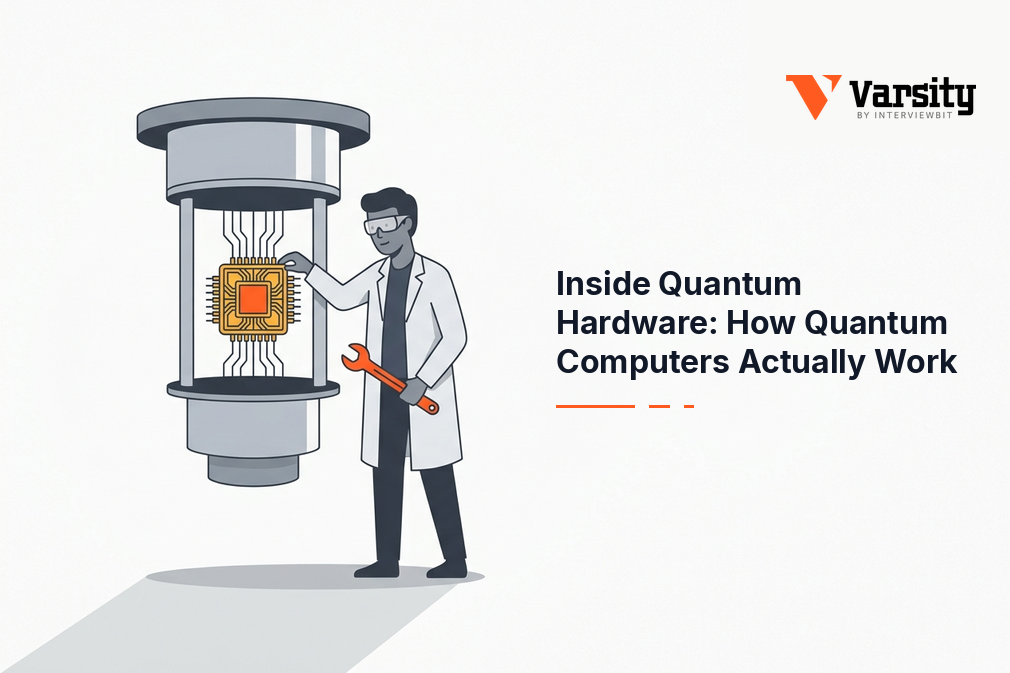
Quantum hardware is the physical machinery that stores and manipulates qubits. It includes the processor (a chip, ion trap or atom array) plus the refrigeration or vacuum systems, wiring, control electronics and readout chain that keep it working. The competing qubit technologies are genuinely different machines, not variations on one design.
This guide explains the machine rather than the metaphor. By the end, you should be able to name every part of a quantum-computer photograph and know which headline number actually matters.
How Quantum Computer Hardware Works: Processors, Control Systems, and Readout
Physically, a quantum computer is a small, fragile processor wrapped in systems that isolate it, control it and read it out.
The table breaks the machine into layers. The equipment changes with the qubit technology, but the jobs stay the same.
| Layer | What it physically is | Its job |
| Processor | Superconducting chip, ion trap, atom array or photonic circuit | Holds the qubits |
| Isolation | Dilution refrigerator, or vacuum chamber with lasers | Blocks heat and noise |
| Control | Waveform generators, FPGAs, lasers, cables | Delivers gate pulses |
| Readout | Resonators, amplifiers, cameras, photon detectors | Turns qubit states into bits |
| Classical computing | Compilers, controllers, decoders | Translates, schedules, corrects |
What the Parts of a Quantum Computer Look Like: Processor, Refrigerator, Wiring, and Electronics
The famous gold, chandelier-like image is almost entirely refrigerator, wiring and amplifiers. The computer itself is the smallest thing in the frame.
Why Quantum Computers Use Dilution Refrigerators for Cooling
It is the inside of a dilution refrigerator: a cooling system that lowers the temperature in stages until the processor reaches millikelvin, or thousandths of a degree above absolute zero.
Each plate is colder than the one above, like a wardrobe-sized thermos built as a staircase of temperatures. The gold is plating on copper, chosen to conduct heat and resist corrosion.
Why Superconducting Quantum Computers Need Extremely Low Temperatures
A superconducting qubit’s 0 and 1 differ by the energy of one microwave photon. At room temperature, stray heat would flip it constantly; near absolute zero, almost none is left.
Cooling is among the biggest burdens of a superconducting machine, and a key reason ion, atom and photonic approaches exist. Why qubits still lose their state when cold is covered in our quantum decoherence article.
What the Wiring and Cables Do Inside a Quantum Computer
The cables running down the plates carry control pulses in and readout signals out. Every control line passes through attenuators at each stage, which absorb part of the signal and, with it, noise from warmer stages.
This is the real scaling wall. Every qubit needs its own paths, and every cable leaks heat into a space held near 10 millikelvin. IBM says it is developing cryogenic control chips that work inside the fridge to ease this.
Where the Quantum Processor Is Located Inside the Hardware
The processor is a small square of silicon or sapphire, patterned with qubit circuits and bolted to the coldest plate inside a shield.
The part that computes would fit in your palm. Everything else in the photograph exists to keep it cold, quiet and connected.
Six Types of Quantum Qubits: Superconducting, Trapped-Ion, Neutral-Atom, Photonic, Silicon-Spin, and Topological
These types of qubits are not versions of one design. They differ in material, temperature, control, speed and connectivity. Coherence time, used below, is how long a qubit holds its state before noise scrambles it.
Start with the physical object that holds the 0 and 1. The last column shows what engineers point at it to make it compute.
| Technology | What the qubit physically is | Controlled by |
| Superconducting | A fabricated circuit (transmon) on a chip | Microwave pulses via coaxial lines |
| Trapped ion | Internal states of one charged atom | Laser or microwave pulses |
| Neutral atom | Internal states of one uncharged atom held by light | Laser pulses; Rydberg states for two-qubit gates |
| Photonic | Polarisation, path or timing of one photon | Optical circuits and measurement |
| Silicon spin | Spin of one electron in a quantum dot | Gate voltages and microwave pulses |
| Topological | A pair of Majorana zero modes (proposed) | Parity measurements |
The object dictates the environment, and every platform trades one strength for one weakness. Figures are attributed and dated; otherwise, comparisons are relative.
| Technology | Operating environment | Core trade-off |
| Superconducting | Dilution refrigerator, about 10 mK (IBM, Sep 2026) | Fastest gates, tens to hundreds of ns (Google, Nature, 2024), but shortest coherence |
| Trapped ion | Vacuum; ions cooled by lasers, no millikelvin fridge | Identical qubits, all-to-all connectivity and long coherence, but two-qubit gates of about 70 µs (Quantinuum, Nature, 2026) |
| Neutral atom | Vacuum; atoms cooled and held by lasers | Large, reconfigurable arrays, but slower cycles and atom loss |
| Photonic | Mostly near room temperature; detectors usually cryogenic | Little decoherence, but photons rarely interact and are easily lost |
| Silicon spin | Dilution refrigerator | Tiny and fab-compatible, but early-stage scale |
| Topological | Cryogenic, with strong magnetic fields | Could suppress errors in hardware, but the physics is disputed |
No platform wins every row. Longer coherence means little if the gates are a thousand times slower.
What Are Superconducting Qubits? How Transmon Qubits Work
A superconducting qubit is not a particle. It is a circuit called a transmon: a capacitor joined to a Josephson junction, a thin insulating barrier that Cooper pairs (electrons paired to flow without resistance) tunnel through.
Its frequency is set by design, which drew IBM, Google and Rigetti. As of September 2026, IBM lists processors of 120 to 156 qubits, each needing individual calibration because no two circuits are identical.
What Are Trapped-Ion Qubits? How Quantum Computers Control Ions
Each qubit is one charged atom, suspended in vacuum by oscillating electric fields in a Paul trap. Ions of one species are identical, so the qubits have no fabrication variability.
Quantinuum’s Helios, reported in Nature in June 2026, holds 98 barium-ion qubits and moves them so any pair can interact, which means fewer swap operations. The cost is speed. IonQ also builds trapped-ion systems.
What Are Neutral-Atom Qubits? How Optical Tweezers and Rydberg States Are Used
Optical tweezers, which are tightly focused laser beams, each hold one uncharged atom. Two-qubit gates use Rydberg states, where an atom is excited so strongly that it interacts with its neighbour.
Arranging light scales easily. A Caltech team reported more than 6,100 trapped atoms (Nature, September 2025), a scale demonstration rather than a processor. QuEra, Pasqal, Atom Computing and Infleqtion build on this approach.
What Are Photonic Qubits? How Quantum Information Is Encoded in Photons
The qubit is a property of one photon. Photons barely interact with their surroundings, so much of the machine needs no dilution refrigerator.
Photons barely interact with each other either, which two-qubit gates require. Designs therefore use measurement-based schemes and sensitive detectors that usually need cryogenics. PsiQuantum, Xanadu, Quandela, Orca and Quix pursue it.
What Are Silicon Spin Qubits? How Electron Spin Is Used for Quantum Computing
The qubit is the spin of one electron trapped in a quantum dot, a tiny gate-defined region of silicon. The devices resemble transistors, so success could borrow existing chip fabs.
Intel says its 12-qubit Tunnel Falls chip (June 2023) was made on 300 mm wafers. Diraq also works in this area. Devices remain small-scale and still need dilution refrigerators.
What Are Topological Qubits? Majorana Zero Modes and the Current Scientific Debate
This is the one modality whose core physics is disputed in peer review. The idea is to store information jointly in a pair of Majorana zero modes, predicted states at the ends of a special nanowire, so local noise cannot corrupt it.
The claim. Microsoft’s Nature paper of 19 February 2025 reported a parity measurement in indium arsenide–aluminium nanowires with 1% assignment error. It calls this a necessary ingredient, says it cannot alone rule out trivial look-alike states, and does not claim a qubit.
The challenge. A Nature critique by Henry Legg of the University of St Andrews (24 June 2026) argues the readout occurred in disordered, apparently gapless regions, which would point to trivial explanations.
The reply. In the same issue, Microsoft argues that its radio-frequency measurements assume no gap, and that a gapless system could not produce its stable signal. The question remains open.
How Quantum Gates Control Qubits and How Quantum Computers Read the Results
A program becomes physical pulses travelling down the fridge. A faint signal then travels back up and becomes bits.
How Quantum Gates Are Implemented With Microwave and Laser Pulses
There is no instruction set inside a qubit. A superconducting gate is a microwave pulse with a precise frequency, amplitude, duration and phase; on ions and atoms, it is laser light.
Room-temperature arbitrary waveform generators shape those pulses, and FPGAs time them to the nanosecond. Qubits drift, so calibration never stops. A large quantum computer is largely a demanding classical real-time control system. What gates do mathematically is covered in our quantum gates article.
How Quantum Computers Measure Qubits: Superconducting and Atomic Readout
Superconducting qubits use dispersive readout. Each qubit shifts the frequency of a small resonator, so the echo of a probe tone reveals 0 or 1. IBM describes quantum-limited and HEMT amplifiers boosting that faint echo.
Ions and atoms use fluorescence instead. One state scatters laser light, the other stays dark, and a camera photographs which atoms glow.
How Classical Computers Control, Compile, and Decode Quantum Computations
A compiler maps your circuit onto the chip’s native gates and connectivity, and a real-time stack runs every pulse. In error-corrected systems, a decoder must keep up too.
In Google’s 2024 Nature experiment, each error-correction cycle took 1.1 microseconds, and the real-time decoder kept pace with an average latency of 63 microseconds.
Quantum Annealing vs Gate-Based Quantum Computing: How the Two Machines Differ
A gate-based machine applies operations you choose. An annealer encodes a problem as an energy landscape and slowly evolves towards its lowest-energy state: you describe a cost function, not a circuit.
That changes what each machine is for and what its qubit count means. The comparison is below.
| Aspect | Gate-based machine | Quantum annealer |
| Input | A circuit of gates | A cost function |
| Purpose | General-purpose algorithms, in principle | Special-purpose optimisation |
| Qubit count | Qubits available for gates | Problem variables; not comparable |
D-Wave, the best-known annealing company, describes itself as dual-platform, offering both annealing and gate-model systems (January 2026). The distinction is between machine types, not companies.
What Does Qubit Count Mean? Physical Qubits, Logical Qubits, and Quantum Processor Performance
A qubit count tells you how many physical qubits exist, not what a machine can do. Error rates, connectivity and how many operations fit inside coherence time decide that.
Physical vs logical qubits. A physical qubit is one noisy hardware element. A logical qubit is one reliable qubit built from many physical ones with error correction. The ratio is not fixed; it depends on the code, the physical error rate and the reliability required.
Google’s 2024 Nature paper gives the one result worth citing precisely. For a single logical memory on its Willow processor, it reported:
- A 101-qubit distance-7 surface code with a 0.143% logical error per cycle.
- Logical errors more than halving each time the code grew (Λ = 2.14).
- A logical qubit lasting 2.4 times longer than its best physical qubit.
For the first time, adding physical qubits made the logical qubit better. It was one memory, not a computer; error-correction details are in our quantum error correction article.
Depth beats size, and the ratio of coherence time to gate time roughly sets how deep a circuit can run.
The State of Quantum Computing Hardware in 2026: Current Capabilities and Limitations
No fault-tolerant, general-purpose quantum computer exists today. Current NISQ (noisy intermediate-scale quantum) machines run shallow circuits on noisy physical qubits, and error rates are the binding constraint.
IBM’s Starling, planned for 2029 and aimed at 100 million gates on 200 logical qubits, is a stated target, not an achievement. The skills these machines run on, including RF, FPGA, cryogenics, photonics and classical software, are hired for today.
Quantum Computing Hardware in India: Current Processors, Qubit Counts, and Capabilities
India has two superconducting systems documented by the Press Information Bureau (PIB). Read the qubit count and the capability shown as separate claims.
| System | What PIB reports | What it shows |
| QpiAI-Indus, 14 April 2025 | 25 qubits; the country’s first full-stack system, “one of India’s most powerful quantum computers” | A complete hardware, control and software stack |
| DRDO–TIFR processor, 28 August 2024 | 6 qubits; circuit submitted via cloud, run, results returned | An end-to-end pipeline on a TIFR-designed ring-resonator qubit |
The DRDO–TIFR control apparatus combined off-the-shelf electronics with custom development boards, and TCS built the cloud interface. It is a capability milestone, not a performance one.
The gap is real: IBM and Quantinuum list processors of roughly 100 to 156 qubits. The component layer, meaning cryogenics, cabling, lasers and detectors, decides whether India builds a supply chain or imports one.
Of the National Quantum Mission’s four thematic hubs, two map onto that layer: Quantum Materials & Devices at IIT Delhi, and Quantum Sensing & Metrology at IIT Bombay.
Every decision in quantum computing, from which algorithm to write to which machine to run it on, is made against the hardware. To study that properly, the
Certification in Applied Quantum Computing and AI from IIT Delhi
runs over 6.5 months, live online with recorded sessions, including a hardware-and-security phase. No placement or alumni status is implied.
Frequently Asked Questions
Why are quantum computers so difficult to build?
Quantum hardware has to maintain extremely delicate quantum states while also controlling and measuring them precisely. That requires isolation from noise, specialised control systems, calibration, cooling or vacuum systems, and reliable readout.
What happens if a quantum computer gets too hot?
For platforms that depend on very low temperatures, excess heat can disturb the physical system and increase errors. In superconducting machines, for example, the processor must remain extremely cold so thermal energy does not interfere with the qubit states.
Why does each qubit need so much supporting hardware?
A physical qubit needs a way to receive control signals and produce a measurable output. Scaling therefore involves more than adding qubits: engineers also have to provide control, wiring, readout, calibration and error-management infrastructure.
Can quantum computers work without being connected to classical computers?
No quantum computer operates in isolation from classical electronics. Classical systems prepare and control the quantum operations, process measurement results and, in more advanced machines, help with tasks such as decoding error-correction information.
Why can’t we simply make quantum processors much larger?
Increasing the number of qubits also increases the difficulty of controlling, connecting and reading them without introducing excessive noise. Wiring, heat load, calibration, connectivity and error rates can all become scaling constraints.
What makes one quantum processor more useful than another?
The number of physical qubits is only one measurement. Factors such as gate accuracy, coherence, connectivity, operation speed and the ability to execute deeper circuits all affect what a processor can actually accomplish.
What is the difference between a physical qubit and a logical qubit?
A physical qubit is an individual hardware element that is susceptible to errors. A logical qubit is constructed using multiple physical qubits and error-correction techniques so that the information can be protected more reliably.
Why do different quantum computers use different control methods?
The control method depends on what physically stores the quantum information. Superconducting circuits can be manipulated with microwave signals, while trapped ions and neutral atoms can be controlled with laser-based techniques.
Can quantum hardware be upgraded like a normal computer?
Not in the same straightforward way as replacing a conventional CPU or adding RAM. Quantum systems depend on tightly integrated processors, control electronics, cooling or vacuum equipment, calibration systems and readout hardware, so increasing capability often requires changes across several layers.
Why is qubit count not enough to compare quantum computers?
Two machines with the same number of physical qubits can have very different error rates, connectivity, gate speeds and coherence times. A larger count therefore does not automatically mean that the machine can run more useful or complex quantum computations.