RAG vs Fine-Tuning vs Prompting: A Decision Guide for Production GenAI

Key Insights
- Each method changes a different layer. Prompting changes the input. RAG changes the information available at inference time. Fine-tuning changes the model’s parameters. Work out which layer is failing before you choose a fix.
- RAG leads enterprise adoption, and fine-tuning is rare. In Menlo Ventures’ 2024 survey of 600 US enterprise IT decision-makers, RAG reached 51% adoption, up from 31% a year earlier. Only 9% of production models were fine-tuned.
- Retrieval is better for adding facts. A 2024 study comparing knowledge injection in LLMs found that RAG consistently beat unsupervised fine-tuning. This held both for knowledge the model had already seen and for entirely new knowledge.
- Fine-tuning on new facts can raise hallucination risk. Research on fine-tuning LLMs with new knowledge found that such examples are learned much more slowly. Once learned, they linearly increase the model’s tendency to hallucinate.
- Fine-tuning is strongest for behaviour, even in smaller models. In the InstructGPT study on training models to follow instructions, people preferred outputs from a fine-tuned 1.3B-parameter model to outputs from the 175B-parameter GPT-3.
- Parameter-efficient fine-tuning lowers the barrier. LoRA (Low-Rank Adaptation) cut trainable parameters by 10,000 times and GPU memory by 3 times compared with fully fine-tuning GPT-3 175B. QLoRA fine-tuned a 65B model on a single 48GB GPU and kept full 16-bit fine-tuning task performance.
- Longer prompts are not always better. Research on how language models use long contexts found that performance drops sharply when the relevant information sits in the middle of a long input.
- Production is where projects stall. Gartner predicted that at least 30% of GenAI projects would be abandoned after proof of concept by the end of 2025. McKinsey’s 2025 State of AI survey found that 88% of organisations use AI, but only 7% of respondents said it was fully scaled.
- Start simple, then add layers. Begin with prompting. Add RAG for knowledge gaps and fine-tune for recurring behaviour. Compare every option on the same evaluation set.
When a large language model (LLM) prototype moves towards production, teams face a practical question: how should they improve its output? There are three main options.
Prompting gives an existing LLM instructions and context to guide its responses. It does not change the model’s parameters.
Retrieval-Augmented Generation (RAG) finds relevant external information and passes it to the LLM, so the model can give answers grounded in that context.
Fine-tuning trains a pretrained model further on a specialised dataset. This adapts its behaviour, response patterns or task performance.
These approaches solve different problems, and they can be combined. The choice matters: a technique that works in a demo can add cost at scale without fixing the real issue. This guide shows which approach fits your needs for accuracy, data, cost, latency and maintenance.
Your roadmap to becoming a Generative AI Engineer
See what you already know, what to learn next and how long the switch to a GenAI engineering role takes. Tap any step for what to study and build.
Personalise your roadmap3 quick questions · takes 30 seconds
What's inside8 stages · 30 steps to job-ready
- Python & engineering foundations
- ML & deep learning essentials
- How LLMs work
- Prompting & building LLM apps
- RAG & model customisation
- Agents & tool use
- Production, evaluation & safety
- Portfolio & job readiness
Stage 1 · Start here
Python & engineering foundations
What to study
- Core Python: data types, functions, classes, modules
- Virtual environments and package management (pip, uv)
- Writing clean, testable scripts
What to build
A command-line script that reads a CSV, cleans it and writes a summary report.
What to study
- SQL joins, aggregations and window functions
- pandas for cleaning and reshaping data
- Working with text data at scale
What to build
A notebook that cleans a messy text dataset and prepares it for a model.
What to study
- Git branching and pull requests
- How REST APIs work: HTTP methods, status codes, auth headers
- Reading and writing JSON
What to build
Call a public API from Python, handle errors and save the results as JSON.
What to study
- Vectors, matrices and dot products
- Probability and distributions
- Gradients and optimisation, intuitively
What to build
Implement cosine similarity and gradient descent from scratch in NumPy.
Stage 2 · Core concepts
ML & deep learning essentials
What to study
- Supervised vs unsupervised learning
- Train/test splits, overfitting and evaluation metrics
- scikit-learn workflows
What to build
Train and evaluate a text classifier with scikit-learn.
What to study
- Tokenisation and text preprocessing
- Word embeddings and semantic similarity
- Sequence models (RNN, LSTM) and why transformers replaced them
What to build
Build a semantic search over 500 short texts using sentence embeddings.
What to study
- Layers, activations, loss functions and backpropagation
- Training loops, batching and GPUs
- PyTorch tensors and autograd
What to build
Train a fully connected network on a small dataset and plot its learning curve.
Stage 3 · Understand the engine
How LLMs work
What to study
- Self-attention and multi-head attention
- Encoder, decoder and encoder-decoder models
- Positional encoding and why scale matters
What to build
Walk through a minimal transformer implementation and explain each block in a short write-up.
What to study
- The Transformers library, model hub and datasets
- Running open-weights models locally
- Fine-tuning a pre-trained model for a task
What to build
Fine-tune a small pre-trained transformer for sentiment or topic classification.
What to study
- Closed vs open-weights model families
- Tokens, context windows, temperature and sampling
- Comparing models on cost, latency and quality
What to build
A comparison table of three models answering the same 20 prompts, with cost and latency.
What to study
- Quantisation, pruning and distillation
- When a small model beats a large one
- On-device and low-cost inference
What to build
Quantise an open model and compare its speed and quality against the original.
Stage 4 · Start shipping
Prompting & building LLM apps
What to study
- System prompts, few-shot examples and chain-of-thought
- Prompt test sets and versioning
- Reducing hallucinations through prompt design
What to build
A prompt library with a 30-example test set and before/after scores.
What to study
- Calling LLM APIs: streaming, rate limits, keys
- Serving with FastAPI and simple UIs with Streamlit
- Caching and cost control
What to build
A small chat app with streaming responses, deployed for others to try.
What to study
- JSON schema outputs and validation
- Function / tool calling
- Retries and graceful failure
What to build
An invoice or resume parser that returns validated JSON.
What to study
- Chains, prompts and output parsers
- Document loaders and retrievers
- When a framework helps and when it gets in the way
What to build
Rebuild your chat app with LangChain and compare the code with your plain-API version.
Stage 5 · Make models useful
RAG & model customisation
What to study
- Embedding models and similarity search
- Vector databases (e.g. pgvector, Pinecone, Weaviate)
- Chunking strategies and metadata filters
What to build
Index a document set in a vector database and query it with filters.
What to study
- Supervised fine-tuning vs prompting vs RAG
- LoRA and other parameter-efficient methods
- Preparing instruction datasets
What to build
LoRA fine-tune an open-weights model on a narrow task and compare it with prompting alone.
What to study
- Vision transformers and CLIP-style models
- Image captioning and visual question answering
- Combining text and image retrieval
What to build
An image search app that finds photos from a text description.
What to study
- The RAG pipeline end to end
- Re-ranking, hybrid search and citations
- Measuring retrieval quality
What to build
A document Q&A assistant that cites its sources, with a retrieval-quality report.
What to study
- Instruction tuning and reward models
- RLHF and DPO, conceptually and with TRL
- Where alignment fits in real products
What to build
Train a small reward model and run a preference-tuning loop on a toy task.
Stage 6 · Automate workflows
Agents & tool use
What to study
- ReAct, planning and reflection patterns
- Single-agent vs multi-agent setups
- Memory: short-term, long-term and retrieval
What to build
A research agent that searches, reads and summarises sources on a topic.
What to study
- Model Context Protocol (MCP) servers and clients
- Connecting agents to databases, CRMs and internal APIs
- Permissions and audit trails for tool calls
What to build
An MCP server that exposes two tools from a real API, used by your agent.
What to study
- Graphs, state and checkpoints
- Human-in-the-loop approvals
- Error handling in multi-step workflows
What to build
Rebuild your research agent as a LangGraph workflow with an approval step.
Stage 7 · Make it reliable
Production, evaluation & safety
What to study
- Docker images for AI apps
- CI/CD basics
- Secrets and environment configuration
What to build
Containerise your RAG assistant and deploy it with a CI pipeline.
What to study
- Building evaluation datasets
- LLM-as-judge and its limits
- Regression testing prompts and models
What to build
An eval harness that scores your assistant on 50 cases and runs on every change.
What to study
- Tracing LLM calls
- Tracking token cost and latency
- Dashboards and alerting
What to build
Add tracing and a cost dashboard to your deployed app.
What to study
- Managed model platforms on AWS, GCP and Azure
- Serverless deployment and autoscaling
- Data privacy and region choices
What to build
Deploy your app on one cloud using a managed model endpoint.
What to study
- Hallucination, bias and privacy risks
- Prompt injection and defences
- PII handling and content filtering
What to build
Add input and output guardrails to your assistant and document the risks you tested.
Stage 8 · Get hired
Portfolio & job readiness
What to study
- GenAI system design questions
- Explaining trade-offs: RAG vs fine-tuning, cost vs quality
- Coding rounds in Python
What to build
Mock-interview notes for three GenAI system design questions.
What to study
- Choosing a domain problem (healthcare, fintech, edtech)
- Writing clear READMEs and architecture notes
- Recording a short demo
What to build
A client-ready AI agent for one domain, with a public demo and write-up.
Fine-tuned text classifier
Adapting a pre-trained transformer to a real task.
Fine-tune a small pre-trained transformer on a labelled dataset, evaluate it properly and compare it with a classic ML baseline.
Structured data extractor
Turning messy documents into clean JSON.
Use an LLM API with schema-validated outputs to extract fields from invoices or resumes, with a prompt test set to track accuracy.
Document Q&A assistant
Retrieval-augmented answers with citations.
Index a document collection in a vector database and build an assistant that answers questions with cited sources and a retrieval-quality report.
LoRA fine-tune of an open model
Customising a model when prompting isn't enough.
Fine-tune an open-weights model with LoRA on a narrow task and document when it beats prompting and RAG, and when it doesn't.
Reward model & preference tuning
Teaching a model what good looks like.
Train a small reward model on preference data and run a preference-tuning loop, with a write-up of what changed.
Multimodal image search
Finding images from plain-language descriptions.
Embed images and text in a shared space and build a search app that retrieves photos from a description.
Tool-using research agent
An agent that plans, acts and asks for approval.
Build a LangGraph agent that searches, reads and summarises sources, calls tools through an MCP server and pauses for human approval.
Deployed GenAI service
From notebook to a monitored production API.
Containerise an LLM app, deploy it on a cloud platform with CI/CD, and add tracing plus a cost and latency dashboard.
Eval harness with guardrails
Proving your AI app works, and stays safe.
Create a 50-case evaluation set, automate scoring on every change, and add input and output guardrails against prompt injection and PII leaks.
Domain AI agent capstone
A client-ready agent for a real industry problem.
Pick a domain such as healthcare, fintech or edtech and ship an agent that combines retrieval, tools, evals and guardrails, with a public demo and write-up.
GenAI glossary 17 terms
Tap a term to see what it means. You will hear these in every GenAI interview.
- LLM
- Large language model: a neural network trained on huge amounts of text to predict and generate language.
- Transformer
- The neural network architecture behind modern LLMs, built around the attention mechanism.
- Token
- A chunk of text (often part of a word) that a model reads and writes. Pricing and limits are counted in tokens.
- Context window
- The maximum number of tokens a model can consider at once, including your prompt and its answer.
- Prompt engineering
- Designing instructions and examples so a model reliably produces the output you need.
- Embeddings
- Numeric vectors that capture meaning, so similar texts end up close together.
- Vector database
- A database built to store embeddings and find the most similar ones quickly.
- RAG
- Retrieval-augmented generation: fetching relevant documents and giving them to the model so answers are grounded.
- Fine-tuning
- Further training a pre-trained model on your own data to specialise it.
- LoRA
- Low-rank adaptation: a parameter-efficient fine-tuning method that trains small add-on weights instead of the whole model.
- Agent
- An LLM system that plans steps, calls tools and acts towards a goal, often over several turns.
- Tool calling
- Letting a model call functions or APIs, such as search or a database query, with structured arguments.
- MCP
- Model Context Protocol: an open standard for connecting AI applications to tools and data sources.
- Evals
- Systematic tests that measure how well an AI system performs on representative cases.
- Guardrails
- Checks on inputs and outputs that keep an AI system safe, on-topic and compliant.
- Hallucination
- When a model states something false or unsupported with confidence.
- Prompt injection
- An attack where malicious text tricks a model into ignoring its instructions.
IIT Delhi CEP × Varsity
Close your gaps with a structured programme
The Certificate Programme in Generative AI from CEP, IIT Delhi covers transformers, fine-tuning, RAG, agents and responsible AI through live weekend classes and hands-on projects.
How do Prompting, RAG, and Fine-Tuning Work?
Prompting, RAG and fine-tuning affect LLM outputs at different points in the pipeline. Prompting changes the instructions the model receives. RAG adds relevant external information at inference time, which is the moment the response is generated. Fine-tuning changes the model’s learned parameters through additional training.
How does Prompting Work?
With prompting, developers shape the model’s input rather than the model itself. A prompt usually combines a system instruction, the user’s query, optional examples and formatting requirements.
The model writes its response from this context and the knowledge already stored in its parameters. Nothing about the model changes, so prompt engineering needs no retraining. You edit the prompt and test again.
For example, a system prompt might say: “You are a technical support assistant. Answer in three numbered steps, and ask for the device model if the user has not provided it.”
How does RAG Work?
RAG adds a retrieval step before generation, so the model can use information that isn’t stored in its parameters. The original RAG research by Lewis et al. paired a generator model with a searchable Wikipedia index. It set new state-of-the-art results on three open-domain question-answering tasks.
A typical RAG implementation runs in three stages:
- Ingest and index: Source documents are collected, cleaned, split into smaller chunks and indexed.
- Retrieve: The user’s query searches the index for the most relevant chunks.
- Augment and generate: The retrieved passages are added to the prompt along with the original question, and the LLM generates an answer.
Retrieval can use several methods. Embeddings are numerical representations of meaning, stored in a vector database. Keyword search matches exact terms. Hybrid retrieval combines the two, so it catches exact terms and related concepts.
How does Fine-Tuning Work?
Fine-tuning continues training a pretrained model on a task-specific dataset. Each training example pairs an input with the output you want.
During optimisation, the training algorithm adjusts the model’s parameters (its weights) to shrink the gap between the model’s outputs and those targets. The most common form is supervised fine-tuning (SFT), which uses labelled input–output pairs.
The adapted model can learn a particular tone, task behaviour, output structure or domain-specific pattern. It then applies that behaviour without needing examples in every prompt.
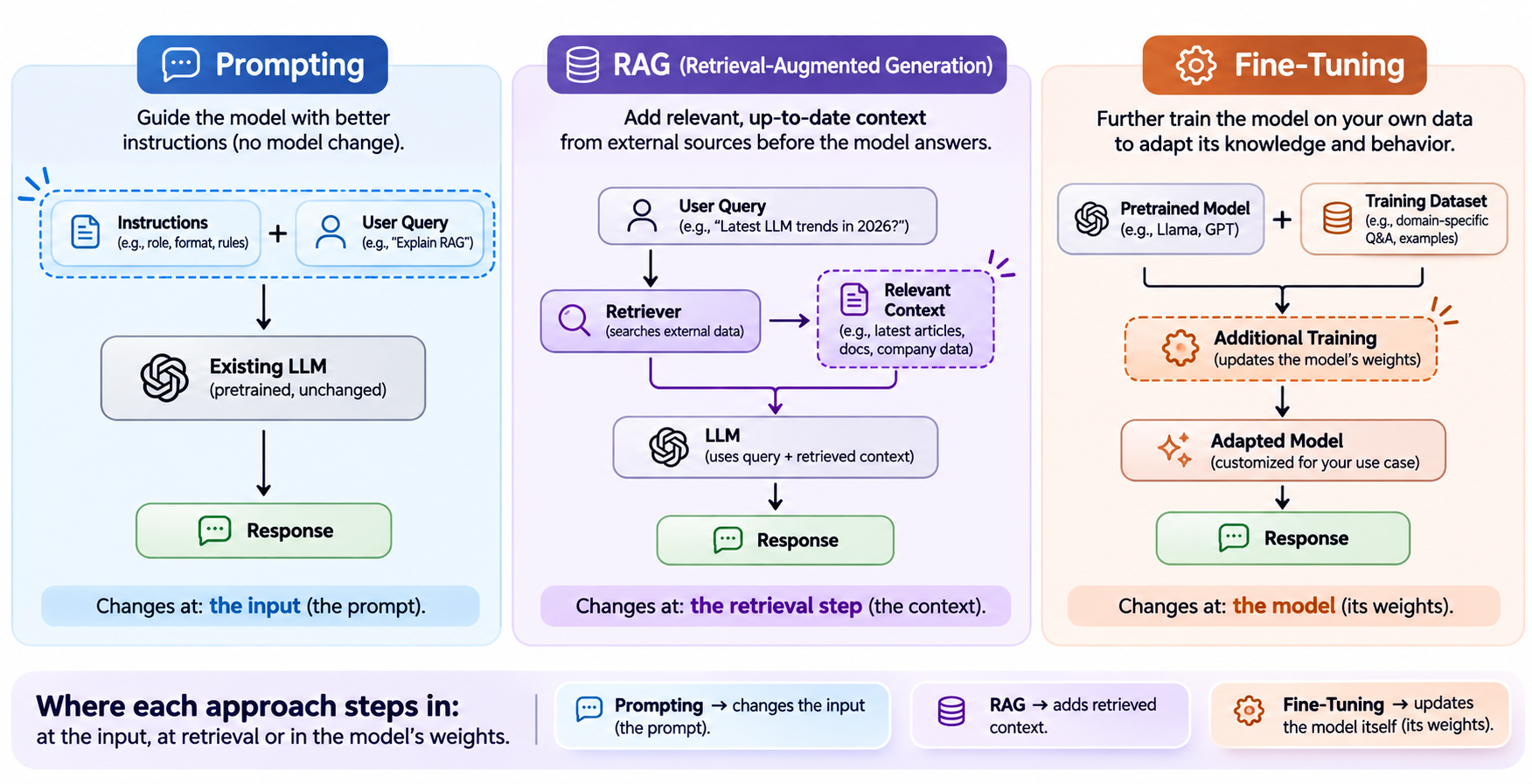
Key point: Prompting changes the input, RAG changes the information available to the model, and fine-tuning changes the model itself.
What is the Difference Between RAG, Fine-Tuning, and Prompting?
All three improve the performance of an existing LLM application, but they can’t stand in for each other. The right choice depends on what needs to change: the instructions, the knowledge available or the model’s behaviour. In practice, enterprises lean on retrieval: Menlo Ventures’ 2024 enterprise survey found 51% RAG adoption, while only 9% of production models were fine-tuned.
RAG vs Fine-Tuning vs Prompting: Key Differences
The table below compares the three approaches on eight parameters, from whether they change model weights to how they are maintained. Read it row by row to see each method’s strengths and costs. The “Updating information” row is often what decides it for enterprise AI applications.
| Parameter | Prompting | RAG | Fine-Tuning |
|---|---|---|---|
| Main purpose | Guide model responses | Provide external information | Adapt model behaviour |
| Changes model weights? | No | No | Yes |
| Uses external data at inference? | Through supplied context | Yes, through retrieval | Not necessarily |
| Requires training data? | No additional training dataset | Requires a searchable knowledge source | Yes |
| Updating information | Change the prompt or supplied context | Update the knowledge base or index | May require additional training |
| Best suited for | Instructions and simple tasks | Knowledge-intensive applications | Repeated specialised tasks |
| Implementation complexity | Usually low | Moderate to high | Moderate to high |
| Maintenance | Prompt updates and testing | Data and retrieval maintenance | Dataset and model maintenance |
What does each Approach Actually Improve?
Each technique fixes one specific weakness, so name the weakness before you choose the fix. The list below shows what each method improves in practice:
- Prompting improves instruction-following and response formatting.
- RAG improves access to relevant, current and external information.
- Fine-tuning improves task-specific behaviour and learned response patterns.
None of these approaches guarantees factual accuracy on its own. A clear prompt can still produce a confident error. Retrieval can bring back the wrong document. A fine-tuned model can learn mistakes from its training data.
Key point: These methods are not interchangeable. Each addresses a different limitation in an LLM application.
When should you Use Prompting?
Prompting is usually the simplest starting point for production GenAI. It fits when an existing model can already do the task but needs clearer instructions, examples or output constraints. It needs no new infrastructure or training, so it is also the cheapest approach to test and change.
When the Task is Simple and Well-Defined
Many tasks are already within what a capable general-purpose model does well. Summarisation, rewriting, sorting into a few clear labels and content generation often need direction rather than new knowledge.
Precise instructions make outputs more consistent. A structured prompt sets out the model’s role, the input it will get, the steps to follow and the exact output expected. This cuts down variation between responses.
When you Need to Control Response Format
Prompts can ask for JSON, tables, bullet points or a specific writing style. For example: “Return a JSON object with the keys sentiment, category and action.”
Few-shot prompting goes further by adding a few worked input–output examples, so the model can copy the pattern. Production systems should still validate outputs, for example by checking JSON against a schema, because models sometimes break the requested format. For more patterns, see our guide to prompt engineering techniques [Internal link: add URL].
When you Want to Prototype Quickly
Prompting lets developers test an idea without building retrieval infrastructure or training a model. Each new version of the prompt can go in front of users, which helps confirm what they need before a bigger investment.
The limits show up as prompts grow. Long, complex prompts are harder to maintain and add token costs to every request. Research on how language models use long contexts also found that performance drops sharply when the relevant information sits in the middle of a long input.
Example: A company wants an LLM to turn customer feedback into a structured summary with sentiment, issue category and suggested action. A capable model with a clear prompt and a few examples may be enough, with no retrieval or training needed.
Key point: Start with prompting when the task mainly needs better instructions rather than additional knowledge or specialised model behaviour.
When should you Use RAG?
RAG is useful when an application must answer questions from external, private, frequently changing or organisation-specific information. The model’s pretrained knowledge may not reliably include that information. RAG supplies it at inference time instead of expecting the model to remember it.
When you Need Access to Private or Domain-Specific Data
Pretrained models have never seen your company documents, internal knowledge bases, product manuals or support records. RAG connects the LLM to these sources and retrieves only the passages relevant to each question.
The model then answers from that source material instead of from general knowledge. It also saves you from pasting every document into the prompt by hand, which would soon exceed context limits and raise costs.
When Information Changes Frequently
Product catalogues, policies, pricing, documentation and inventory change all the time. With RAG, you update the retrieval source and the new information becomes available without retraining the LLM.
Research backs this choice. A 2024 study comparing knowledge injection in LLMs found that RAG consistently beat unsupervised fine-tuning, both for knowledge the model had seen and for entirely new knowledge.
Fresh answers still depend on fresh data. Teams need scheduled index refreshes, removal of outdated documents and data quality checks, so retrieval doesn’t bring back stale content.
When Source References and Traceability Matter
Each retrieved passage comes from a known document, so a RAG system can link its answers back to their sources. Citations let users check an answer and help reviewers audit the system.
However, a citation only shows which passage was retrieved. It doesn’t guarantee that the answer accurately reflects that passage, so you still need to evaluate whether answers stay faithful to the source.
When you Need Access-Controlled Knowledge Retrieval
Enterprise knowledge is rarely open to everyone. A RAG system can filter retrieval results by user role and permissions, so each user sees only the content they are allowed to access.
This usually means document-level access control, where each chunk carries permission metadata. In multi-customer products it also means tenant isolation, so one customer’s data never reaches another.
The retrieval system must enforce these checks before any content reaches the model. Prompt injection can talk an LLM out of an instruction like “ignore restricted content”, so the model should never act as the access-control layer. For build steps, see our step-by-step RAG implementation guide [Internal link: add URL].
Example: An enterprise support assistant answers employee questions from the latest HR policies and internal documentation. When the leave policy changes, the HR team updates the source document, and the assistant picks up the change after the next index refresh.
Key point: Choose RAG when the main challenge is giving the LLM access to the right information at the right time.
When should you Use Fine-Tuning?
LLM fine-tuning is useful when a model must learn consistent task-specific patterns, specialised output formats or behaviours that prompting alone can’t deliver reliably. It changes how the model behaves, not what it can look up. That makes it powerful for repeated tasks but costly for tasks whose requirements change often.
When you Need Consistent Output Behaviour
In high-volume, repeated tasks, small inconsistencies add up. Fine-tuning can make outputs more uniform. Examples are classification that always uses the same set of labels, or a domain-specific response style that follows house guidelines.
It doesn’t replace other safeguards. Clear prompts and output validation should stay in the pipeline, because fine-tuned LLMs can still produce unexpected outputs.
When you have High-Quality Domain-Specific Training Data
A fine-tuned model learns whatever its dataset teaches, mistakes included. The data must reflect real inputs and be labelled consistently.
Teams usually split their data into three sets. Training data updates the weights. Validation data is used to tune settings and catch overfitting. Test data is held back for a final, unbiased score.
Poor-quality, mislabelled or unbalanced examples can make the model behave unreliably, and the cause is hard to find after deployment.
When you Need to Adapt a Model to a Specialised Task
Some tasks follow patterns that a general model handles only roughly. Examples include sentiment classification with industry-specific nuances, extracting specific fields from contracts or invoices, and writing code that follows an internal framework’s conventions.
With suitable training data, fine-tuning can improve performance on these tasks. But learning a task pattern is not the same as accessing live information. A model fine-tuned to extract invoice fields learns how to read invoices, not this week’s supplier list.
When Prompting Alone is not Sufficient
Sometimes prompts grow into pages of rules and dozens of examples, and every request pays the token cost of sending them. These prompts are hard to maintain and can still behave inconsistently.
This is where the prompting vs fine-tuning decision tips towards fine-tuning. It can build these recurring patterns into the model’s parameters, so prompts can be shorter. The trade-off is extra training and evaluation cost, plus retraining when requirements change. For a closer look, see our guide to how LLM fine-tuning works in practice [Internal link: add URL].
Example: A company wants a model to sort technical support tickets into a fixed set of categories every time. Its archive of past tickets, already labelled by support agents, gives fine-tuning the training data it needs.
Key point: Fine-tune when the model needs to learn a recurring behaviour or specialised task, not simply because it lacks access to current information.
Can you Combine RAG, Fine-Tuning, and Prompting?
Yes, and many production GenAI applications do. Each method can handle a different part of the application instead of competing to solve the same problem. The combinations below show how the work is typically split.
Prompting + RAG
In this pairing, the prompt sets the assistant’s role and response rules.
For example: “Answer only from the provided context, and say when the answer is not there.” RAG retrieves the documents that supply the facts for each question.
For example, an internal knowledge assistant for engineering teams uses prompts to set its response format: a short answer followed by cited sources. RAG retrieves the relevant company security and engineering policies.
Prompting + Fine-Tuning
Here, fine-tuning sets the specialised behaviour, and the prompt gives the instructions for each request. The model already knows the house style and task pattern, so the prompt can stay short.
For example, a fine-tuned support model receives prompts that state the current customer’s issue, their product and the required response format.
RAG + Fine-Tuning
Fine-tuning can improve how a model responds, while RAG supplies current external knowledge. The two fill different gaps: one in behaviour, the other in information.
For example, a specialised legal-document assistant might use fine-tuned response patterns, such as clause-by-clause analysis. It would also retrieve relevant contracts and regulations at inference time. Domain-specific uses like this need expert review and evaluation before and after launch.
Using All Three Together in Production
In a complete generative AI architecture, prompts define the task, RAG provides relevant information and fine-tuning adapts the model’s behaviour. This design can support complex enterprise applications that need all three at once.
Every added layer is another part that can fail. Teams must monitor retrieval quality and model outputs, re-test whenever the prompt, index or model changes, and maintain each layer separately.
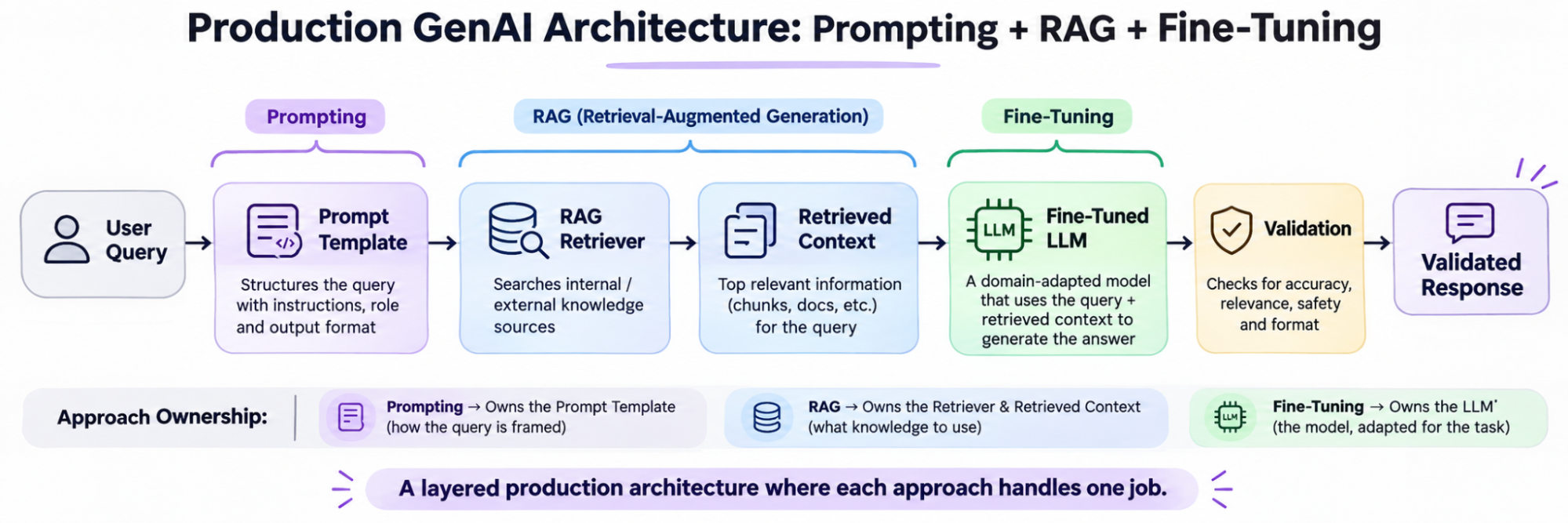
Key point: Combining approaches can be useful when an application needs better instructions, external knowledge and specialised behaviour at the same time.
How to Choose the Right Approach for Production GenAI?
Choosing an architecture means assessing what the application actually needs, not picking a technique because it is popular. The three steps below move from diagnosing the problem to comparing trade-offs and testing. Following them in order helps teams avoid building infrastructure they don’t need.
Evaluate the Type of Problem
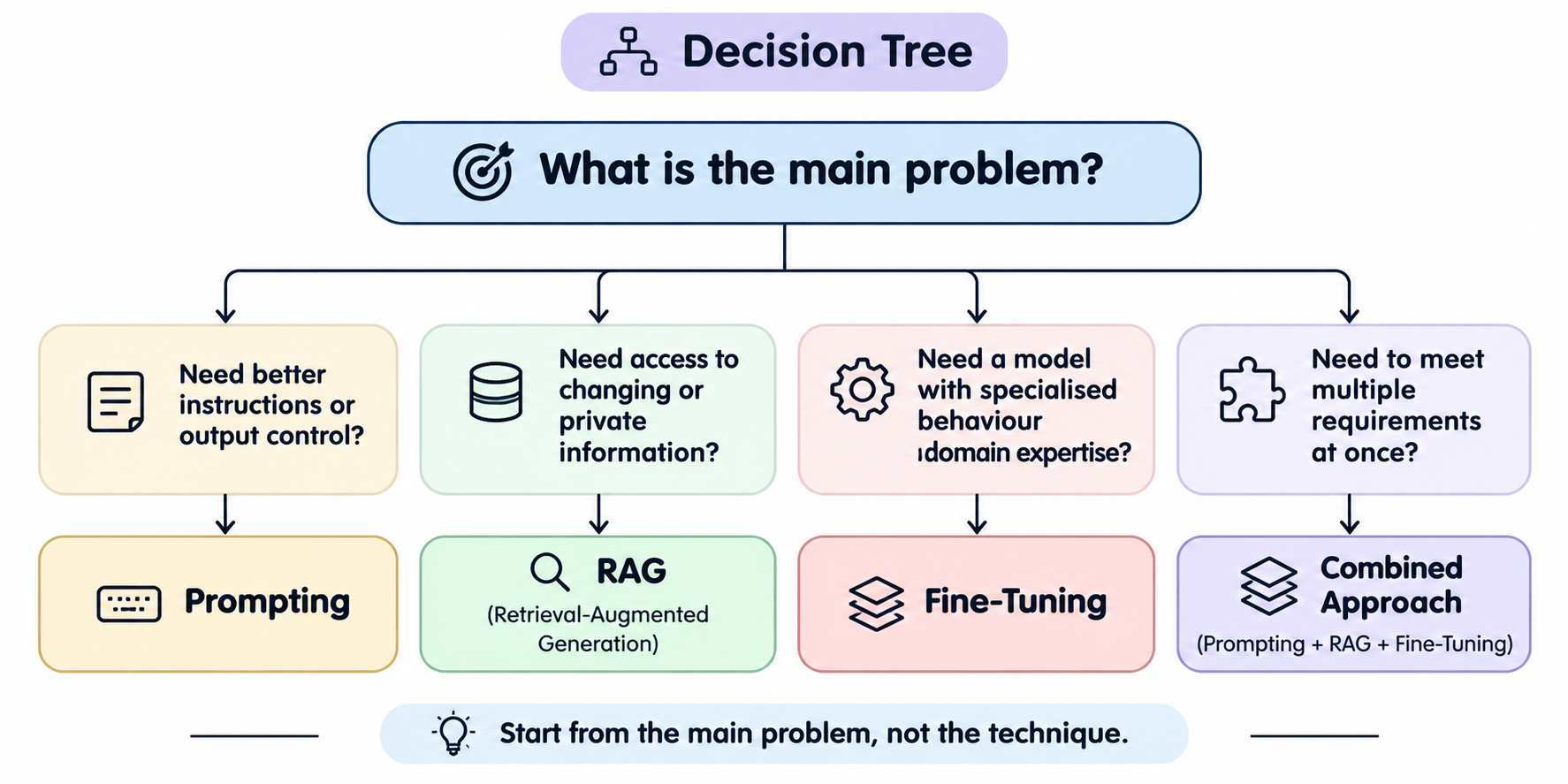
Start by naming the main reason the current output falls short. Each type of problem points to a different starting approach. Use these questions as a first filter, then confirm with testing:
- Need better instructions or formatting? Start with prompting.
- Need current or private information? Consider RAG.
- Need consistent specialised behaviour? Consider fine-tuning.
- Need multiple capabilities? Evaluate a combined approach.
Compare Cost, Latency, and Maintenance
Output quality is only part of the decision. Each approach comes with its own setup effort, running costs, response times and upkeep. The table below compares these factors so you can estimate the total cost of ownership, not just the cost of building.
| Factor | Prompting | RAG | Fine-Tuning |
|---|---|---|---|
| Initial setup | Usually low | Moderate to high | Moderate to high |
| Inference cost | Depends on prompt length and model | Includes retrieval and generation costs | Includes model inference costs |
| Training cost | No additional training | No model fine-tuning required | Requires training resources |
| Latency | Often simpler | Includes retrieval overhead | Depends on the resulting model and serving setup |
| Data updates | Update prompts or context | Update the retrieval source | May require retraining |
| Maintenance | Prompt testing | Index and data maintenance | Model and dataset maintenance |
Costs also grow with usage. Long prompts add tokens to every request. RAG adds a retrieval call to every query. Fine-tuning adds a training run each time the dataset changes.
Test Before Moving to Production
Prototype results rarely predict production behaviour by themselves. A structured evaluation shows which approach actually meets your requirements. Before launch, teams should:
- Build evaluation datasets from real user queries.
- Measure accuracy, relevance, latency, cost and failure rates.
- Test edge cases and security risks, such as prompt injection.
- Compare approaches using the same evaluation criteria.
- Monitor application performance after deployment.
Key point: The best production architecture is the simplest approach that consistently meets the application’s quality, cost, security and performance requirements.
Common Mistakes When Choosing Between RAG, Fine-Tuning, and Prompting
Picking the wrong technique can raise development costs without solving the underlying problem. Most of these mistakes come from misreading why the model’s output is poor. The four below are common and avoidable.
Fine-Tuning a Model to Store Frequently Changing Information
Teams sometimes fine-tune a model on product or policy facts and expect it to remember them. For facts that change, retrieval usually wins the RAG vs fine-tuning choice, because an update takes effect as soon as the index refreshes.
Storing facts in the weights means retraining every time they change, with new training, evaluation and deployment costs each time. Until then, the model may confidently repeat outdated information.
Using RAG When the Real Problem Is Poor Prompt Design
Retrieval can work perfectly and the answer can still be poor. If the prompt doesn’t tell the model to use the context, cite it or say when an answer is missing, the model may ignore the retrieved passages or mix them with guesses.
Before adding vector databases and ingestion pipelines, check whether clearer instructions fix the problem. Prompt changes are far cheaper to test than new infrastructure.
Assuming Fine-Tuning Guarantees Factual Accuracy
Fine-tuning shapes behaviour. It doesn’t guarantee correct answers, and a fine-tuned model can sound more confident and on-brand while still being wrong.
It also picks up whatever patterns its data contains, including inaccurate or biased ones. Research on fine-tuning LLMs with new knowledge found that such examples are learned much more slowly. Once learned, they linearly increase the model’s tendency to hallucinate.
Ignoring Evaluation and Monitoring
A prototype tested on a few hand-picked questions can look excellent and then struggle with real traffic. Production queries are messier and more varied, and they change over time.
Ongoing evaluation should track retrieval quality, model outputs, latency and cost. The stakes are real: Gartner predicted that at least 30% of GenAI projects would be abandoned after proof of concept by the end of 2025. The reasons it gave were poor data quality, inadequate risk controls, escalating costs or unclear business value.
Key point: Find the actual cause of poor model performance before adding more architecture or training complexity.
Conclusion
Choosing between RAG, fine-tuning and prompting starts with one question: what exactly needs to change? If the model needs clearer direction, change the prompt. If it needs information it can’t know, retrieve it. If it needs a behaviour it can’t reliably reproduce, train it.
Most production GenAI systems end up combining these techniques, but the order matters. Begin with the simplest option and measure it against real user queries. Add retrieval or training only when evaluation shows a gap they can close.
Ready to build production-grade GenAI applications? Turning these decisions into working systems takes hands-on practice with prompt design, RAG pipelines, fine-tuning and evaluation. Explore the Certificate Programme in Generative AI, offered by IIT Delhi’s Continuing Education Programme in collaboration with InterviewBit by Varsity to build these skills.
Frequently Asked Questions
How do you decide whether to use RAG, fine-tuning, or prompt engineering for a new AI product?
Start by testing a well-written baseline prompt on real examples and noting why it fails. Unclear instructions or formatting point to prompt changes. Missing private or current facts point to RAG. A recurring pattern the model can’t follow, even with good examples, points to fine-tuning. Re-evaluate after each change, because fixing one gap often reveals another.
Can prompt engineering improve LLM performance without increasing infrastructure costs?
Yes. Prompt changes run on the same model and infrastructure, so clearer instructions, step-by-step guidance and output schemas cost little to try. The trade-off is token usage, because longer prompts raise the cost of every request. Removing repeated instructions, and using prompt caching where your provider supports it, keeps that overhead under control.
What is few-shot prompting, and when should developers use it in production?
Few-shot prompting puts a small number of example inputs and outputs in the prompt so the model can copy the pattern. It suits formatting, labelling and tone. In production, pick examples that cover both common and edge cases, keep them under version control like code, and measure their effect. If the examples keep multiplying, fine-tuning may become cheaper.
How do you build a reliable evaluation dataset for comparing RAG and fine-tuned models?
Sample real user queries, including difficult and ambiguous ones, and have domain experts write or approve the reference answers. For RAG, also record which documents should be retrieved, so you can score retrieval and generation separately. Keep the evaluation set apart from any fine-tuning data, and refresh it as user behaviour changes.
What is parameter-efficient fine-tuning, and how does it reduce training requirements?
Parameter-efficient fine-tuning (PEFT) trains only a small number of new or selected parameters and keeps the base model’s weights frozen. This cuts GPU memory, training time and storage, because each task needs only a small set of extra weights rather than a full copy of the model. LoRA is a widely used PEFT method; adapters and prefix tuning are others.
How does LoRA fine-tuning differ from full model fine-tuning?
Full fine-tuning updates every weight in the model. LoRA freezes the original weights and trains small low-rank matrices added to the model’s layers. The LoRA paper reported 10,000 times fewer trainable parameters and 3 times less GPU memory than fully fine-tuning GPT-3 175B, with no added inference latency. QLoRA later fine-tuned a 65B model on a single 48GB GPU.
Can fine-tuning make a small language model perform better than a larger general-purpose model?
On specific tasks, it can. In the InstructGPT study, human evaluators preferred outputs from a 1.3B-parameter model, fine-tuned with supervised learning and human feedback, to outputs from the 175B-parameter GPT-3. Smaller models are also cheaper to run. The advantage is usually limited to particular tasks, so test on your own workload before replacing a larger model.
How do you prevent data leakage when preparing datasets for LLM fine-tuning?
Guard against two kinds of leakage. Evaluation leakage happens when test examples also appear in the training data, which inflates scores, so remove duplicates and split the data before training. Privacy leakage happens when a model memorises sensitive records, so remove or mask personal data, credentials and confidential content. Record each dataset’s sources and access rights.
What are the biggest challenges of maintaining RAG pipelines in enterprise applications?
Common challenges include keeping indexes in sync with source systems, handling duplicate or contradictory documents, keeping permissions intact as content moves, and parsing complex formats such as tables and scanned PDFs. Chunking and embedding choices also need revisiting as content grows. Without monitoring of retrieval quality, these issues wear answers down gradually instead of failing in an obvious way.
How does prompt length affect LLM latency, token usage, and inference costs?
Most commercial LLM APIs charge per input and output token, so every extra instruction or example adds to the cost of each request. Longer inputs also take longer to process, so it takes longer for the first word of the response to appear. Trimming repeated text, caching stable parts of the prompt where supported, and retrieving only the most relevant passages all help.
What should developers consider when migrating an LLM prototype to a production environment?
Plan for scale, reliability and governance. Add evaluation suites, logging, rate-limit handling, fallbacks for when the model or retrieval fails, and cost monitoring. Review risks such as prompt injection and data exposure. The gap is real: McKinsey’s 2025 State of AI survey found that 88% of organisations use AI, but only 7% of respondents said it was fully scaled.
How can organisations measure the return on investment of RAG, fine-tuning, and prompt engineering?
Compare a measured business result, such as hours saved, tickets resolved or errors reduced, against the total cost of ownership. Include build effort, inference, retrieval infrastructure, training runs, evaluation and maintenance, and measure against a baseline taken before launch. Unclear value is a real risk: Gartner lists it among the main reasons GenAI projects are abandoned after proof of concept.
Sources
2024: The State of Generative AI in the Enterprise
Retrieval-Augmented Generation for Knowledge-Intensive NLP Tasks
Fine-Tuning or Retrieval? Comparing Knowledge Injection in LLMs
Does Fine-Tuning LLMs on New Knowledge Encourage Hallucinations?
LoRA: Low-Rank Adaptation of Large Language Models
QLoRA: Efficient Finetuning of Quantized LLMs
Training Language Models to Follow Instructions with Human Feedback