RAG vs Fine-Tuning: The Decision Every Forward Deployed Engineer Makes on Day One

Key Insights
- Start fine-tuning with 50 well-crafted examples. OpenAI recommends starting with around 50 demonstrations, then evaluating results before expanding the dataset. The right number depends on the task.
- Establish a baseline before investing in training. Compare the base model with prompt engineering first, so you can measure whether fine-tuning delivers a meaningful improvement.
- Measure retrieval separately from answer quality. A RAG system can generate a fluent response from poor context. Evaluate document relevance and whether the final answer is grounded in the retrieved sources.
- Compare cost per successful task, not just cost per request. Include infrastructure, maintenance, latency, and incorrect outputs when comparing approaches.
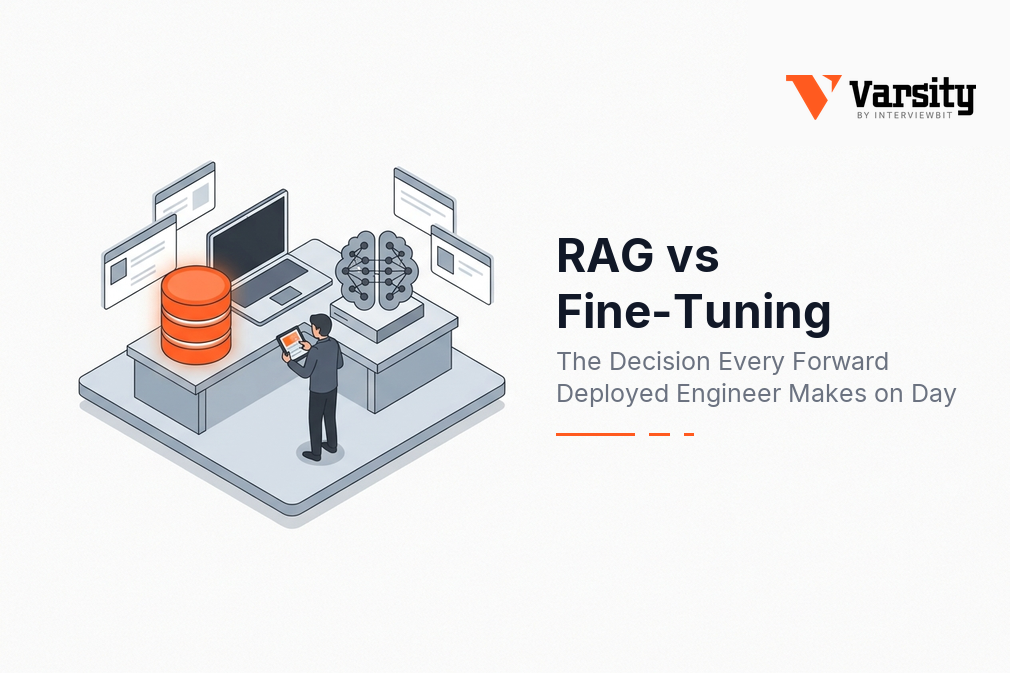
Retrieval-augmented generation (RAG), fine-tuning, and prompt engineering address different problems. RAG gives a model access to relevant external information, fine-tuning adapts its behaviour through additional training, and prompt engineering improves the instructions and examples it receives. But which approach works best for a given customer problem?
An LLM giving the wrong answer does not always need more training. Sometimes, it lacks the right information. At other times, it struggles to follow instructions or perform a specialised task consistently. For a Forward Deployed Engineer (FDE), identifying the cause is the first step towards choosing the right solution.
This guide compares all three, explains when to use or combine them, and explores their costs, real-world use cases, evaluation methods, and supporting tools to help FDEs make informed engineering decisions.
FDE salary & ROI calculator
Is FDE training worth it for you?
See what Forward Deployed Engineers with a profile like yours typically earn in India, and how quickly a programme fee is covered.
Indicative ranges based on public, self-reported salary data. Not a prediction or guarantee of your pay.
How this is calculated
- Typical Forward Deployed Engineer pay in India is about ₹10–30 LPA, blended from salaries people report on Glassdoor and Levels.fyi. The middle of the market sits around ₹15–18 LPA; the top quarter reaches about ₹42 LPA.
- Your experience places you in the lower (0–2 years), middle (3–6 years) or upper (7+ years) part of that range.
- Your current role and company type refine where you sit. Roles closer to FDE work rank higher: software engineering, then data/ML, solutions or customer engineering, DevOps/cloud, implementation or IT consulting, QA, and non-engineering roles last. By company type: product or MNC highest, GCC about 5% below that, startups about 7% below GCC, IT services about 10% below startups. That puts GCC about 20% above IT services, in line with reports that GCCs pay up to 20% more.
- Likely first move: moving into a new, AI-heavy role usually brings a bigger raise than a like-for-like job switch, and one move closes part of the gap to the middle of your range. Small gaps close almost fully; large gaps close up to a limit set by your background: up to +55% from product or MNC companies (employers in India expect AI-skilled workers' pay to rise 54%+), +50% from GCCs, +45% from startups and +40% from IT services. Roles further from FDE work reach a smaller share of that limit, from 100% for software engineering down to 72% for non-engineering roles. Everyone below the top of the all-India range gets at least 40% of their limit (it tapers off above your own range), and no estimate goes past the all-India top of ₹30 LPA.
- Fee covered in: the programme fee divided by the extra monthly pay (before tax) from that first move.
Sources
- Glassdoor India: Forward Deployed Engineer salariesAverage total pay ≈ ₹14.6 LPA (base ₹9–18 LPA + about ₹2 LPA variable); highest reported ≈ ₹22 LPA
- Levels.fyi: Forward Deployed Engineer, IndiaMedian ≈ ₹17.6 LPA; 25th percentile ≈ ₹16 LPA; 75th percentile ≈ ₹42 LPA; 90th percentile ≈ ₹46 LPA
- Michael Page India Salary Guide 2026 (reported by Outlook Business)Job-switch raises up to 30% in AI and other high-demand fields; 9.1% market average
- foundit Appraisal Survey 2026 (reported by Business Today)20% expect a 40%+ hike when switching jobs
- AWS, Accelerating AI Skills: Preparing the Asia-Pacific Workforce (reported by Outlook Business)Employers expect AI-skilled workers' salaries to rise 54% or more
- TeamLease Digital, Digital Skills & Salary Primer FY2025 (reported by People Matters)GCCs pay up to 20% more than IT services companies
- IIT Delhi AI Forward Deployed Engineering programme page₹1,65,000 + 18% GST = ₹1,94,700
Keep in mind
- Forward Deployed Engineer is a new title in India, so salary samples are still small.
- Figures are total compensation before tax, not in-hand pay.
- Figures are based on market benchmarks for Forward Deployed Engineer roles across India.
How should an FDE Choose Between RAG, Fine-Tuning, and Prompt Engineering?
Start by identifying what is going wrong. Use this framework to narrow the options.
| Question | What to consider |
|---|---|
| Does the model lack current information? | Consider RAG |
| Does it need customer-specific documents? | Consider RAG |
| Does it repeatedly fail at a specialised task? | Test fine-tuning |
| Are instructions unclear? | Improve the prompt first |
| Is response speed critical? | Compare end-to-end latency |
| Is there enough training data? | Check data quality and coverage |
| Can improvement be measured? | Establish an evaluation baseline |
These are starting points, not automatic answers. RAG adds retrieval steps, fine-tuning requires suitable examples, and prompt engineering may not solve persistent behaviour problems.
The key decision: Is the main failure caused by missing information, inconsistent behaviour, or unclear instructions? Diagnose that first, then test the simplest suitable solution.
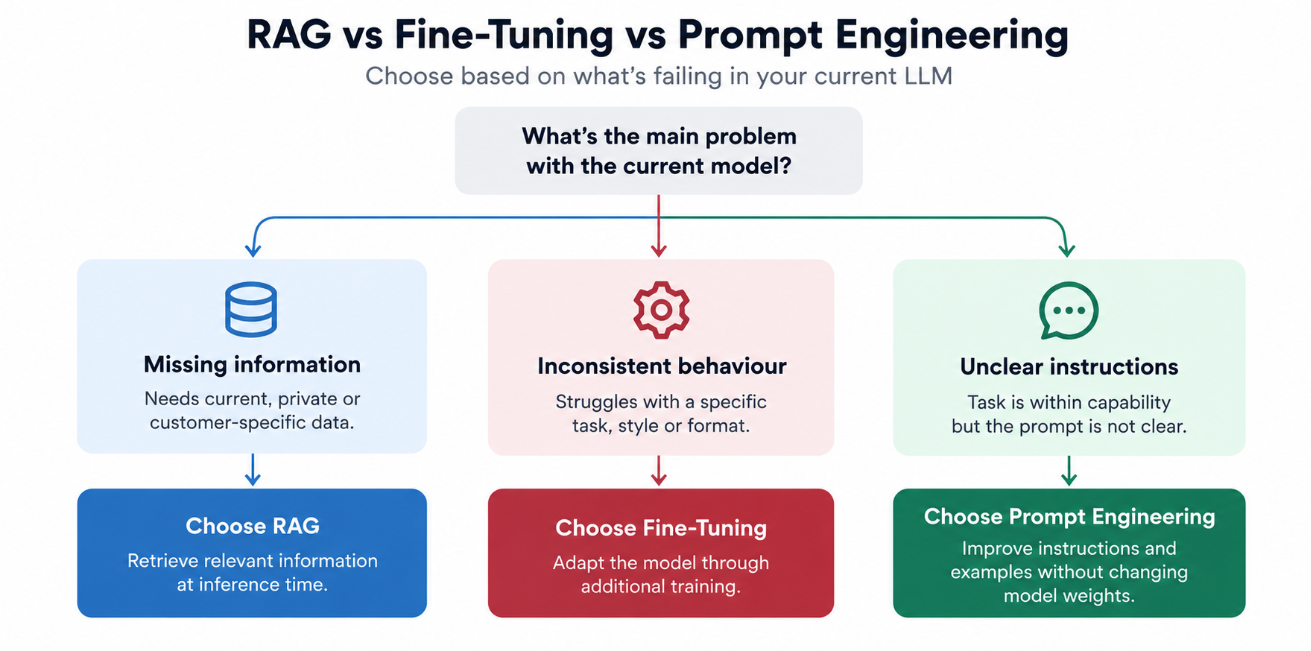
RAG vs Fine-Tuning vs Prompt Engineering: What Is the Difference?
The three approaches address different parts of an LLM application.
- RAG (retrieval-augmented generation): Retrieves relevant information from external sources and provides it to the model when generating a response.
- Fine-tuning: Further trains a model on curated examples to adapt its task performance or response patterns.
- Prompt engineering: Improves instructions, examples, context, and output constraints without changing the model’s weights.
Comparison table
| Approach | Best suited for | Main trade-off |
|---|---|---|
| Prompt engineering | Clear instructions and output formats | May not fix persistent behaviour issues |
| RAG | Private, changing, or source-grounded information | Requires retrieval infrastructure and maintenance |
| Fine-tuning | Repeated task patterns and specialised behaviour | Requires training data, evaluation, and training or hosting investment |
Fine-tuning does not automatically provide reliable access to current facts. RAG does not automatically fix poor instruction-following. Both need evaluation against the customer’s requirements.
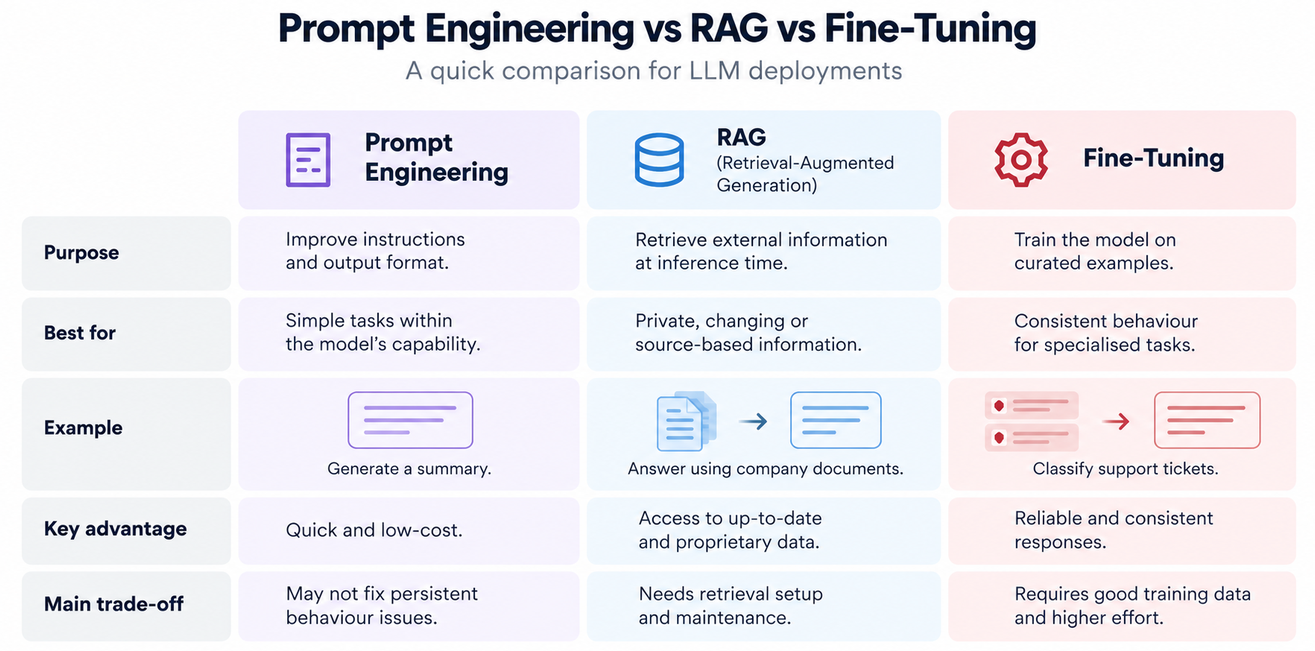
When should You Choose RAG or Fine-Tuning?
The right choice depends on what the model struggles with and what you need it to do. Here’s when to choose RAG, fine-tuning, or prompt engineering.
Choose RAG when
- Answers depend on frequently updated documents or customer records.
- Responses must be grounded in source material.
- Information needs updating without retraining the model.
- Access permissions determine which documents users can retrieve.
Choose fine-tuning when
- The model needs consistent output structures or specialised response patterns.
- Classification, extraction, or transformation remains unreliable.
- Prompt engineering has been tested but is insufficient.
- You have clean, representative training examples.
For a closer look at model adaptation, read our guide to fine-tuning LLMs, including SFT, LoRA and QLoRA.
Choose prompt engineering first when
- The task is already within the model’s capabilities.
- Instructions or output requirements are ambiguous.
- A quick, low-cost experiment can establish a baseline.
The right approach depends on the task, model, available data, and measured results. Do not select a technique simply because it is more advanced.
When Should You Combine RAG and Fine-Tuning?
Some deployments need both current information and consistent behaviour.
Consider a customer-support assistant that must answer questions using the latest refund policy.
- RAG retrieves the current policy.
- Prompt engineering sets response rules and requires policy-grounded answers.
- Fine-tuning may help establish consistent response patterns if simpler methods remain insufficient.
Evaluate the complete system for answer correctness, retrieval quality, latency, and failure handling. If RAG and a well-designed prompt already meet the requirements, fine-tuning may add cost without enough benefit.
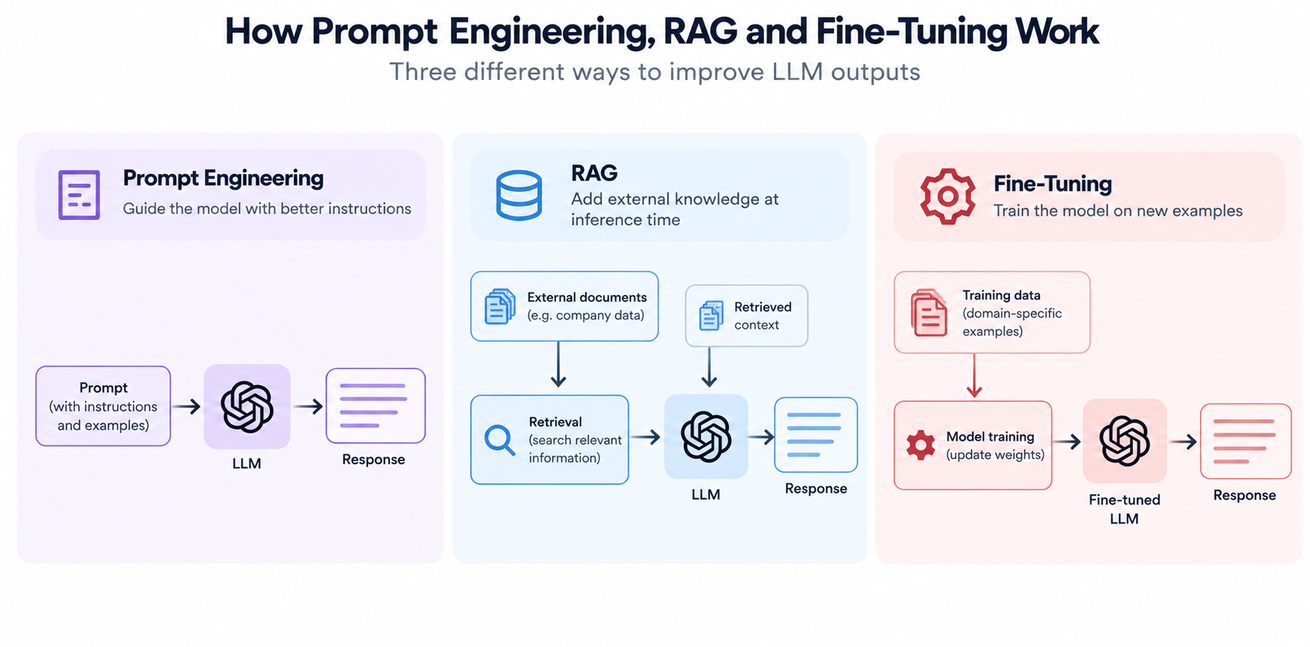
How do You Compare RAG and Fine-Tuning Costs?
Compare total costs over the same evaluation period and expected workload.
| Cost category | RAG | Fine-tuning |
|---|---|---|
| Setup | Document processing and indexing | Dataset preparation and training |
| Operations | Retrieval, generation, and infrastructure | Model hosting and inference |
| Maintenance | Knowledge-base updates | Evaluation and possible retraining |
| Quality checks | Retrieval and answer testing | Task accuracy and behaviour testing |
A combined system may incur costs from both approaches.
Total cost of ownership = Setup costs + Operating costs + Maintenance costs + Evaluation costs
Compare this total with measurable benefits, such as reduced manual work, fewer incorrect responses, faster task completion, or improved task success rates.
For an internal IT-support assistant, for example, estimate the employee time saved by retrieving relevant documentation. Compare the value of that time with the system’s operating costs. Treat the result as a hypothesis to test, not a guaranteed saving.
Measure cost per successful task, alongside quality and latency, rather than cost per request alone.
What are the Real-World Use Cases of RAG and Fine-Tuning?
Real-world examples make the differences between RAG and fine-tuning easier to understand. Here are three common scenarios and how to approach each one.
1. Enterprise knowledge assistant
Problem: Employees need answers from frequently updated internal documents.
Starting approach: RAG with document-level access controls and source citations where appropriate.
Evaluation: Retrieval relevance, answer correctness, source faithfulness, and access-control failures.
RAG fits because information can change without requiring model retraining.
2. Structured document extraction
Problem: A customer needs invoices or contracts converted into a predefined format.
Starting approach: Prompt engineering with representative examples and schema validation.
Next step: Test fine-tuning if the model remains unreliable across a varied evaluation set.
3. Customer-support assistant
Problem: A business needs current product information and consistent support responses.
Starting approach: RAG for product documentation and prompt engineering for tone and constraints.
Possible extension: Fine-tuning if testing reveals persistent behaviour problems.
In all three scenarios, the technique should follow the failure being solved. Neither RAG nor fine-tuning guarantees accuracy.
How should You Evaluate a RAG or Fine-Tuning Implementation?
Use a repeatable evaluation process before releasing the system.
- Establish a baseline: Test the existing model on a fixed set of representative requests.
- Prepare test data: Include normal requests, edge cases, ambiguous inputs, and failure examples.
- Choose relevant metrics: For RAG, assess retrieval relevance and groundedness. For fine-tuning, assess task accuracy, consistency, and format adherence.
- Compare alternatives: Test prompt-only, RAG, fine-tuning, and combined approaches on the same cases.
- Measure operational performance: Track latency, cost per successful task, reliability, and security.
- Set deployment thresholds: Release only when agreed quality and operational requirements are met.
Methods such as supervised fine-tuning (SFT), LoRA, and QLoRA can support model adaptation. LoRA trains a smaller set of additional parameters, while QLoRA combines parameter-efficient adaptation with quantisation to reduce memory requirements. Distillation may reduce serving costs, but quality must be checked against the intended use case.
What Tools Support RAG and Fine-Tuning?
The tool stack should follow the chosen architecture.
- RAG: Embedding models, vector databases, retrieval and reranking components, document pipelines, and access controls.
- Fine-tuning: Curated datasets, training frameworks, SFT, LoRA, and QLoRA.
- Evaluation: Fixed test sets, task-specific metrics, tracing, error analysis, and cost monitoring.
- Prompt engineering: System instructions, few-shot examples, structured output constraints, and validation.
Choose tools based on data access, integration requirements, security, technical expertise, and operating costs. More tools do not automatically produce a better system.
Conclusion
An FDE should identify the customer’s actual failure before choosing an LLM technique. Start with prompt engineering, use RAG when answers depend on external knowledge, and test fine-tuning when task behaviour needs more persistent adaptation. Combine approaches only when evaluation shows a meaningful improvement. The best deployment is the simplest one that meets the required quality, cost, latency, and security thresholds.
For FDEs, choosing the right LLM approach is only part of the job. Explore how these decisions translate into real-world engineering practice in the IIT Delhi AI Forward Deployed Engineering course.
FAQs
1. Is RAG more suitable for private company data?
RAG is often a suitable starting point when an application needs to retrieve private company documents. The implementation must still enforce access permissions, protect sensitive information, and prevent unauthorised retrieval.
2. Does RAG prevent hallucinations?
No. RAG can provide relevant evidence, but retrieval may return incomplete or incorrect information, and the model may still misinterpret it. Evaluate source relevance and answer faithfulness.
3. What happens when a RAG system retrieves irrelevant documents?
The model may produce an incorrect or unsupported response. Investigate document chunking, embedding quality, retrieval settings, reranking, and query formulation. Define what the system should do when suitable evidence is unavailable.
4. How much training data is needed for fine-tuning?
There is no universal minimum. The required amount depends on task complexity, model choice, example quality, and how varied the expected inputs are. Use a representative evaluation set to determine whether additional data improves performance.
5. What is catastrophic forgetting in fine-tuning?
It occurs when further training weakens some capabilities the model previously had. Evaluate both the target task and important existing capabilities after fine-tuning.
6. How do LoRA and QLoRA affect fine-tuning?
Both reduce the resources needed for certain fine-tuning workflows. LoRA trains a small set of additional parameters, while QLoRA also uses quantisation to reduce memory requirements. Neither guarantees better task performance.
7. Can a fine-tuned model use tools or APIs?
Yes. Tool use depends on the model, application logic, and integration. Fine-tuning may help the model follow tool-calling patterns, but the application must still validate requests and enforce permissions.
8. How should an FDE handle sensitive documents in RAG?
Apply access controls during retrieval, enforce permissions at document or chunk level, protect data in storage and transit, and log access appropriately. Test whether users can retrieve information outside their authorised scope.
9. When should a team retrain a fine-tuned model?
Consider retraining when task requirements or input patterns change, or when evaluation shows a meaningful decline in performance. Confirm that new training data is relevant and representative before starting another run.
10. How can an FDE compare approaches fairly?
Use the same evaluation cases, task requirements, and success criteria for every approach. Compare answer quality, latency, security, and total cost, then select the simplest approach that meets the agreed thresholds.