Supply Chain Risk Management with AI: Building Resilient, Self-Correcting Networks

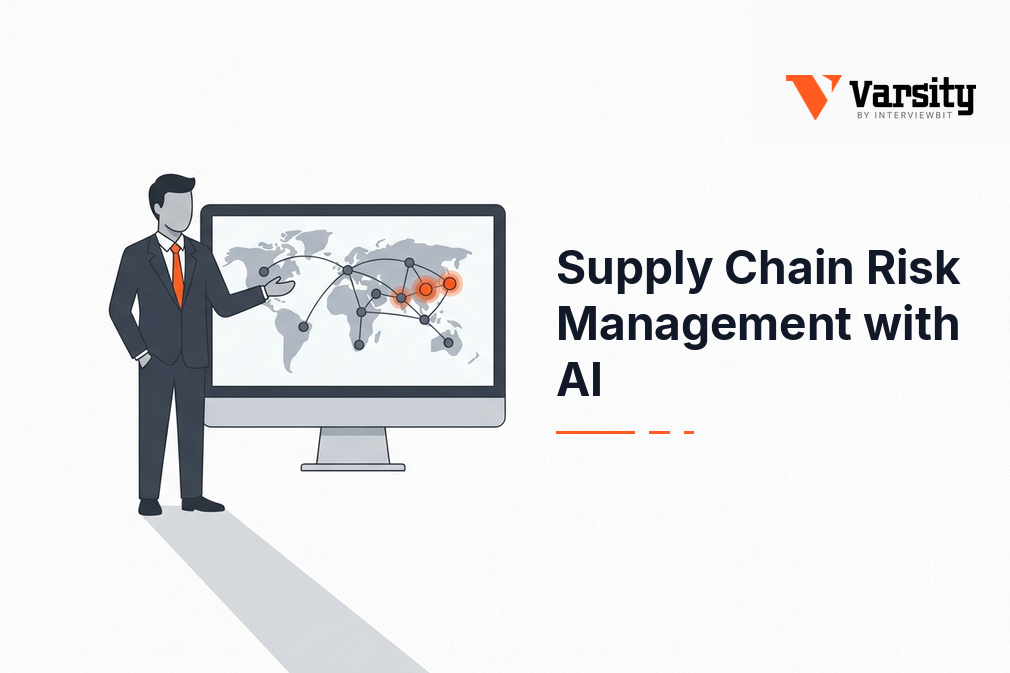
Supply chain risk management (SCRM) helps businesses identify, assess, and mitigate disruptions across their supply networks. With AI, organisations can detect emerging risks, anticipate disruptions, and respond faster to changing conditions. This guide explores how AI enables supply chain risk management, improves visibility, and builds resilient, self-correcting networks.
What supply chain risk management actually is
Supply chain risk management is the systematic work of finding what could interrupt the flow of materials, money and information into and out of your business, deciding which interruptions you can live with, and preparing for the rest.
One disambiguation first. In US government usage the same term means cyber supply chain risk management, the security of software and hardware components. If that is what you came for, follow that link. This guide covers the operational kind: suppliers, plants, ports, inventory and cash.
The difference from supply chain management (SCM) is simple. SCM optimises the flow. SCRM, the shorthand for this discipline, protects it.
The seven kinds of supply chain risk
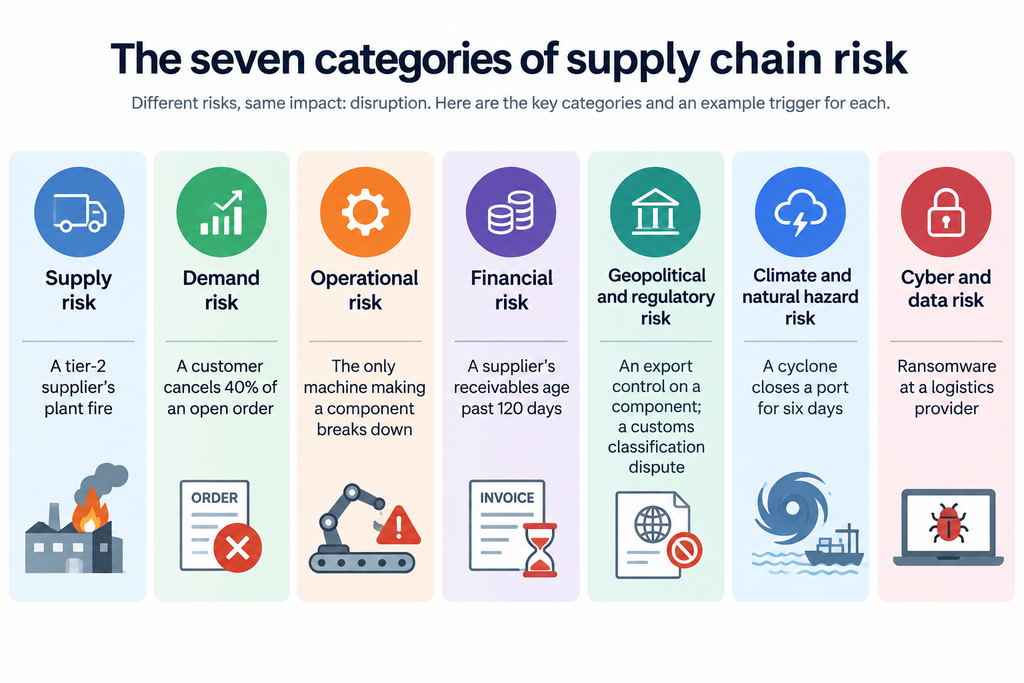
Splitting risk into “internal” and “external” tells you nothing about who should act. A functional split shows where each risk lands and who owns it. The table below gives one concrete trigger per category.
| Risk category | Examples of triggers | Impact and ownership |
| Supply, demand and operational | Tier-2 supplier plant fire; customer cancels 40% of an order; critical machine breakdown | Line stoppages, excess stock or missed deliveries. Owned by procurement, planning or plant head. |
| Financial, geopolitical and regulatory | Supplier receivables exceed 120 days; export controls; customs classification disputes | Late deliveries, payment risks or held consignments. Owned by finance, procurement or trade compliance. |
| Climate, natural hazard and cyber | Cyclone closes a port for six days; ransomware at a logistics provider | Missed vessel cut-offs, lost shipment visibility or halted dispatch. Owned by logistics, IT or relevant operations heads. |
Most real disruptions chain two or three of these together. A cyclone closes a port (climate), parts arrive late (supply), and a small supplier’s cash runs short (financial).
[IMAGE 1 — Alt: “The seven categories of supply chain risk: supply, demand, operational, financial, geopolitical, climate and cyber, each with an example trigger.”]
The n-tier problem: why you can’t see the risk that will hit you
Most companies see their direct suppliers clearly and almost nothing beyond them. Yet the failure that stops your line often sits two or three tiers down.
Follow one product. Your tier-1 contract manufacturer buys boards from a tier-2 supplier. That supplier buys capacitors from a tier-3 maker. Everything traces back to one tier-4 substrate plant. You have a contract with the first link only.
Why suppliers don’t tell you
This is rarely obstruction. Naming the real reason changes what you do about it.
- The supplier list is commercially sensitive. It is how a supplier gets competed with.
- They often don’t know either. Many suppliers see only their own tier 1.
- Nothing obliges them. Disclosure clauses are rarely in the contract.
Five ways to map tier 2 and tier 3 without being told
These methods need no software and can start this week. Apply them to your most critical parts first, not the whole bill of materials.
- Bill-of-materials teardown. Work backwards from what a part is physically made of to who can make it. Your own engineers and datasheets will name the specialist inputs.
- Trade and customs data. Your own bills of entry show origin ports, HS codes and often the shipper. The Department of Commerce’s trade statistics portal shows which countries dominate an HS code, which tells you where to expect tier-3 inputs. Company-level shipment records are sold commercially, and you don’t need them for a critical path.
- Certification and audit registers. Where published, ISO certification directories, BIS licence records and food or drug licence registers list plants and locations.
- Public filings. Listed suppliers name their own concentration risks in annual reports and exchange filings.
- Contract clauses going forward. Add a sub-tier disclosure clause at the next renewal. It costs nothing today.
The honest limit: this gets you the critical path, not the whole network. The critical path is what you needed.
Building a risk register you can actually maintain
A risk register is a living list of specific risks, each with a named owner and a trigger for review. The table below shows one filled-in entry, laid out as fields so it stays readable. All details are illustrative assumptions, not a real case.
| Field | Worked entry |
| Risk ID | R-014 |
| Description | Shutdown of the single tier-2 die-casting plant supplying our tier-1 machining vendor |
| Category | Supply |
| Affected node | Tier-2 die-caster (via Vendor A) |
| Likelihood | Medium (band 2 of 3) |
| Impact | 4 of 5 after buffer (5 of 5 without it): the main assembly line stops once stock runs out |
| Current controls | Five weeks of castings held across Vendor A and our plant; second foundry’s samples under evaluation |
| Residual rating | 8 (2 × 4): the buffer softens impact but does not close the gap |
| Owner | R. Nair, Head of Sourcing (illustrative name) |
| Review date | 15 December 2026 |
| Trigger condition | Vendor A reports a delay beyond 5 days, or the die-caster’s payments to its own vendors slip past 90 days |
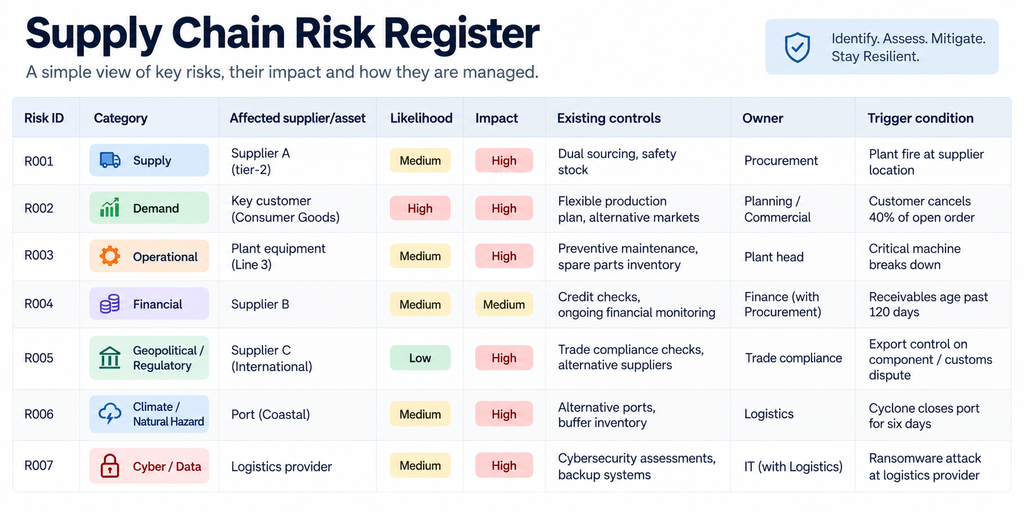
Two failure modes kill registers. One is 200 rows that nobody reads, so keep it to the risks that matter. The other is no owner column, or an owner that is a department rather than a person.
The maintenance rule is a quarterly review, plus an out-of-cycle review whenever a trigger condition fires. For most organisations this lives in a spreadsheet, and that is fine.
Scoring risk when you don’t have the data to score it
Likelihood × impact, and why it quietly fails
Multiplying likelihood by impact is the standard method, and it is sound for frequent, well-recorded events. Its weakness is rare, high-impact events, where nobody can estimate likelihood. The numbers then become opinion dressed as arithmetic.
The practical fix is to score impact rigorously, in lost output or rupees per week. Treat likelihood as a coarse three-band judgement, and stop pretending to a decimal.
The stress test that needs no probabilities: TTR and TTS
Simchi-Levi, Schmidt and Wei proposed a better question in “From Superstorms to Factory Fires: Managing Unpredictable Supply-Chain Disruptions” (Harvard Business Review, January–February 2014). Don’t ask how likely a node is to fail. Ask, if it fails, how long until it recovers (Time to Recovery, TTR), and how long can we operate without it (Time to Survive, TTS)? Where TTR exceeds TTS, you have an exposure regardless of probability. MIT News (15 June 2022) describes how Ford and others applied this research.
Here is the method on the register’s node, with illustrative numbers.
- TTR: replacing the die-caster means qualifying another foundry and rebuilding tooling, estimated at 14 weeks.
- TTS: 4,000 castings in stock ÷ 800 used per week = 5 weeks.
- Gap: 14 − 5 = 9 weeks of exposure.
- Options: pre-qualifying a second source might cut TTR to 6 weeks, shrinking the gap to 1. Or add buffer. Each option has a price (see mitigation below).
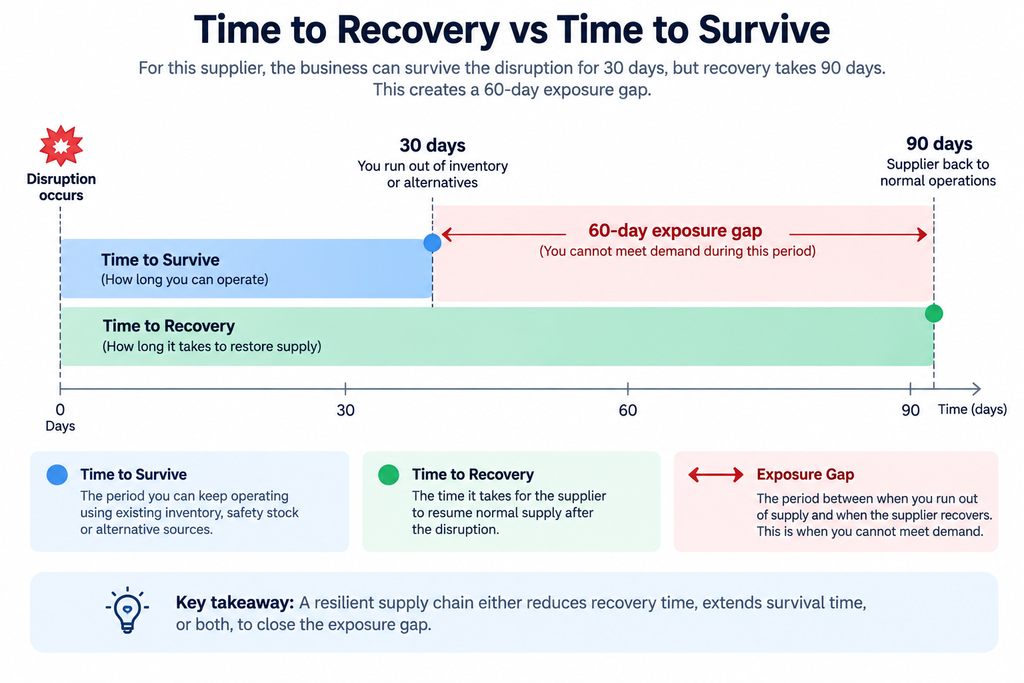
This works because it turns an unanswerable probability question into an inventory question you can answer from data you already hold.
Then write three or four scenarios. Each answers the same questions:
- What stops?
- When do we notice?
- What happens in the first 48 hours?
- What does it cost?
Writing them is most of the value. Having the argument before the event matters more than the document.
Early warning: what a real signal looks like
A signal is useful only if someone acts on it. The table below lists signal classes, where to find them, and an example pre-agreed rule for each. The thresholds are illustrative, so set your own.
| Signal class | Where to watch | Example escalation rule |
| Supplier financial distress | Your payment and receivables data, credit rating releases | Ageing past 120 days: procurement head told within 48 hours, revised delivery plan requested |
| Port and shipping congestion | Port and shipping-line advisories | Delay above agreed days: logistics head re-checks vessel bookings |
| Weather and cyclones | India Meteorological Department | Cyclone warning for a supplier or port region: pull forward dispatches |
| Export controls and sanctions | Official trade notices | Affected HS code in your BOM: trade compliance checks within one day |
| Local news, labour action | Regional news in supplier locations | Strike notice: call the supplier and confirm stock cover |
Now the problem every competitor skips: false positives. A monitoring setup that fires forty alerts a week gets switched off within a month.
The discipline is to define the escalation rule for each signal class in advance: the threshold, who is told, and what they must do. A signal with no pre-agreed action is noise.
Where AI genuinely helps, and where it’s being sold to you
AI is useful for some risk tasks and oversold for others. The table below separates the two, with a reason for each verdict.
| Claim | Verdict and reason |
| Classifying news and event feeds | Helps. Volume exceeds what any team can read. |
| Entity resolution: matching “Bharat Forge Ltd”, “Bharat Forge Limited” and a plant address to one supplier record | Helps. Unglamorous, but it is why most risk data is unusable. |
| Supplier clustering to expose hidden concentration | Helps. Finds patterns like six tier-1 suppliers relying on one tier-3 plant. |
| Simulating scenarios across many failure combinations | Helps. Combinations outnumber what people can enumerate. |
| “Predicting” genuinely unprecedented events | Marketing. A model trained on history cannot foresee what has no history. |
| Risk scores with an undisclosed method | Marketing. Unauditable, and impossible to defend to a board. |
| Fully autonomous mitigation | Marketing. Re-routing spend or switching suppliers is a commercial decision with contractual consequences, and a human signs it. |
What you actually do about it: the mitigation options and their price
Every mitigation buys protection at a price. The table summarises the trade-off before the detail below.
| Mitigation | Main cost | Worth it when |
| Dual or multi-sourcing | Higher unit cost, qualification effort, quality drift | Parts are critical and hard to qualify |
| Safety stock | Working capital, storage, obsolescence | TTR is long and TTS is short |
| Nearshoring, friendshoring, China+1 | Higher unit cost, set-up time, possible hidden concentration | Geopolitical or transit exposure dominates |
| Contractual and financial levers | Legal time, premiums, reservation fees | Almost always, as a first step |
Dual sourcing and multi-sourcing
Cost: less volume leverage per supplier, a higher unit price, qualification cost, and quality drift between sources. It is worth it for critical, hard-to-qualify components. It is over-engineering for parts a qualified alternative can supply within days.
Safety stock and where to hold it
Cost: working capital and obsolescence risk. The better question is where to hold it: components, sub-assemblies or finished goods. Holding further upstream is usually cheaper and more flexible, because a raw component fits many products. (A better demand forecast also reduces the buffer you need.)
Nearshoring, friendshoring and China+1
These are routinely conflated. Nearshoring moves sourcing closer to where you sell. Friendshoring moves it to politically allied countries. China+1 adds a second country while keeping China.
Cost: relocation reduces geopolitical and transit exposure but raises unit cost. Moving to a second country can also recreate concentration if tier-3 inputs still come from the same place. For Indian firms this cuts both ways. You may benefit from others’ relocations, and you may depend on concentrated imports yourself.
The contractual and financial levers nobody mentions
Capacity reservation agreements, tighter force majeure drafting, supplier disclosure clauses, trade credit insurance and dual-currency terms are the cheapest tools available. Cost: mostly legal time, plus insurance premiums and any reservation fees. Have counsel draft them.
Business continuity: the first 48 hours
Risk management is what you do before a disruption. Business continuity is what you do during it. These are the components:
- A playbook per scenario.
- A named decision-maker with pre-agreed spending authority.
- A communication order: customers, internal teams, suppliers, then regulators.
Authority defined during a crisis arrives too late.
The step most teams skip is the post-event review. Ask what you noticed, when, and what would have told you sooner. Feed the answers back into your register and triggers.
Supply chain risk in India: what’s specific here
India adds four variables that a translated American guide would miss. Each needs official data before you quote a number. Where you cannot pull it, keep the point qualitative.
- Port and corridor concentration. Container traffic is concentrated in a limited set of gateway ports, so one port disruption spreads quickly. [VERIFY before publish: port-wise throughput and year from the Ministry of Ports, Shipping & Waterways / PIB.]
- Monsoon and cyclone seasonality. Transit and port risk follows a predictable annual window, which makes it plannable rather than merely unfortunate. Confirm season dates with the IMD.
- Import concentration. For categories such as electronic components and bulk drugs or APIs, pull import data by HS code and origin from the Department of Commerce, and state the year.
- PLI schemes. Production-linked incentive schemes offer incentives tied to manufacturing in selected sectors, so they can shift where things are made and change exposure in both directions. [VERIFY: link the official DPIIT or administering-ministry scheme page.]
Your first 90 days, with nothing but a spreadsheet
This plan sequences everything above into six two-week blocks. Each block produces something you can show.
| Week | What you do | What you have at the end |
| 1–2 | List every tier-1 supplier; mark single-source items | Supplier list with concentration flags |
| 3–4 | Map the critical path to tier 2 or 3 using the five methods | Critical-path map |
| 5–6 | Build the register and assign named owners | Live register |
| 7–9 | Run TTR/TTS on the top ten nodes | Ranked exposure gaps |
| 10–12 | Write three scenario playbooks; set escalation rules | Playbooks and signal rules |
What a spreadsheet cannot do is continuous monitoring at scale, or n-tier data beyond the critical path.
The analytics and automation layer that turns a quarterly review into continuous monitoring is usually a skill gap rather than a budget gap. The Certificate Programme in AI-Powered Operations & Process Transformation from IIM Tiruchirappalli covers supply chain and asset operations as one of its six modules, alongside predictive and prescriptive analytics. It runs six months, live online, on weekends.
Common ways risk programmes go wrong
These failures are specific and avoidable. The list below names seven, each with its consequence.
- A register nobody owns. It goes stale within a quarter.
- Scoring theatre. It produces numbers no one acts on.
- Mapping tier 1 and stopping. The risk sits deeper.
- Monitoring with no escalation rule. Alerts become noise.
- Buying a platform first. Do this only after you know which twenty suppliers matter.
- Treating resilience as a project with an end date. Exposure changes as suppliers and routes change.
- Confusing a scorecard with a risk assessment. A scorecard measures performance and a risk assessment measures exposure. An excellent supplier can still be your biggest risk.
Build AI-powered operations expertise with IIM Tiruchirappalli
Understanding AI-driven supply chain risk management is one step towards building more resilient, data-driven operations. The next is learning how to apply AI across real-world business processes.
The Certificate Programme in AI-Powered Operations & Process Transformation , offered by IIM Tiruchirappalli, helps professionals develop practical AI and analytics skills across supply chain planning, inventory management, logistics, automation, and responsible AI governance.
- Learn through 75 hours of live online and campus-based instruction.
- Explore AI-driven demand planning, inventory matrixing, and next-generation logistics.
- Build practical skills through weekend sessions and a mandatory 2-day campus immersion.
FAQs
How can a business identify which suppliers are critical to its operations?
A business can identify critical suppliers by assessing how essential their materials or services are to production, how easily they can be replaced, and how much disruption their failure would cause. Suppliers supporting multiple products or lacking qualified alternatives may require closer monitoring and contingency planning.
How often should supply chain risk assessments be updated?
Supply chain risk assessments should be reviewed periodically, such as quarterly, and whenever a significant change occurs. Supplier changes, geopolitical developments, new sourcing arrangements, or disruptions can alter existing risk exposure and make previous assessments outdated.
How can small businesses manage supply chain risks with limited resources?
Small businesses can begin by identifying their most critical suppliers, tracking dependencies in a spreadsheet, maintaining essential inventory buffers, and establishing backup sourcing options. Focusing on a few high-impact risks helps them improve resilience without requiring expensive risk-management platforms.
What is the difference between SCM and SCRM?
Supply chain management optimises the flow of goods for cost, speed and service. SCRM protects that flow from interruption. They often pull against each other: the leanest, cheapest, single-sourced chain is usually the most fragile one.
What is n-tier visibility and why is it hard?
Seeing beyond your direct suppliers to their suppliers and beyond. It is hard because supplier lists are commercially sensitive, most suppliers genuinely do not know their own tier 2, and disclosure is rarely contractual. Trade data, bill-of-materials teardown and public filings partially close the gap.
How do you build a supply chain risk register?
One row per risk, with category, affected supplier or node, likelihood, impact, existing controls, a residual rating, a named owner, a review date and a trigger condition. A spreadsheet is sufficient. Registers fail when they have no named owner or grow too long to read.
Does AI actually help manage supply chain risk?
Genuinely, for four things: reading event and news feeds at scale, matching messy supplier records to one entity, clustering suppliers to reveal hidden concentration, and simulating scenarios. It cannot predict unprecedented events, and any risk score whose method is undisclosed cannot be defended to a board.
How can businesses reduce supply chain risk?
Businesses can reduce supply chain risk through dual sourcing, safety stock, nearshoring, supplier disclosure clauses, and capacity reservation agreements. The right approach depends on the risk, recovery time, inventory coverage, and cost of mitigation.
What are early-warning signals in supply chain risk management?
Early-warning signals are indicators of potential disruptions, such as supplier financial distress, port congestion, cyclone warnings, export controls, or labour strikes. Each signal should have a predefined escalation threshold, a responsible owner, and a required action.
How does AI improve supply chain risk visibility?
AI improves supply chain risk visibility by analysing news and event feeds, matching inconsistent supplier records, and identifying hidden supplier concentration across multiple tiers. It helps organisations detect risks that may not be visible through direct supplier relationships alone.
What is the difference between time to recovery (TTR) and time to survive (TTS)?
Time to Recovery (TTR) measures how long it takes a disrupted supplier or supply chain node to recover. Time to Survive (TTS) measures how long a business can continue operating without that node. When TTR exceeds TTS, the business faces a supply disruption exposure.
What is the role of business continuity planning in supply chain risk management?
Business continuity planning helps organisations respond to disruptions through predefined scenario playbooks, named decision-makers, pre-approved spending authority, and communication plans. Post-event reviews also help improve risk registers and early-warning triggers.