Superconducting Qubits Explained: IBM’s Quantum Secret

Key Insights
- Superconducting qubits use engineered electrical circuits to create controllable quantum energy levels, with Josephson junctions providing the nonlinearity needed for qubit operation.
- Transmons, built from a Josephson junction and capacitor, are a widely used superconducting-qubit design because they are less sensitive to charge noise.
- Microwave pulses control qubit operations, while resonators and readout circuits convert quantum states into measurable classical results.
- Dilution refrigerators cool superconducting processors to millikelvin temperatures, helping maintain superconductivity and reduce thermal excitation and noise.
- Coherence, gate fidelity, readout errors, crosstalk, connectivity and calibration all affect performance, so a higher qubit count does not automatically mean a better quantum computer.
- IBM and Google are advancing superconducting hardware toward error-corrected systems, where improving physical-qubit reliability and scaling cryogenic infrastructure are as important as increasing qubit counts.
Superconducting qubits are artificial quantum systems built from superconducting electrical circuits that operate at temperatures close to absolute zero. A key component called a Josephson junction gives these circuits the nonlinearity needed to create and control quantum states, while designs such as transmons encode information in discrete energy levels.
But how do these circuits actually become a working quantum computer? Superconducting qubits are manipulated with carefully shaped microwave pulses, measured through coupled readout circuits, and kept cold inside dilution refrigerators. This article explains how the hardware works, what limits its performance, and how IBM and Google, two of the best-known organizations developing superconducting quantum processors, are advancing the technology.
What are Superconducting Qubits?
Superconducting qubits are qubits built from superconducting electrical circuits that can behave like artificial atoms. Engineers design these circuits so their quantum energy levels can be controlled and used to represent |0⟩ and |1⟩. IBM and Google, for example, use superconducting qubits in their quantum processors.
How a Josephson Junction Creates a Qubit?
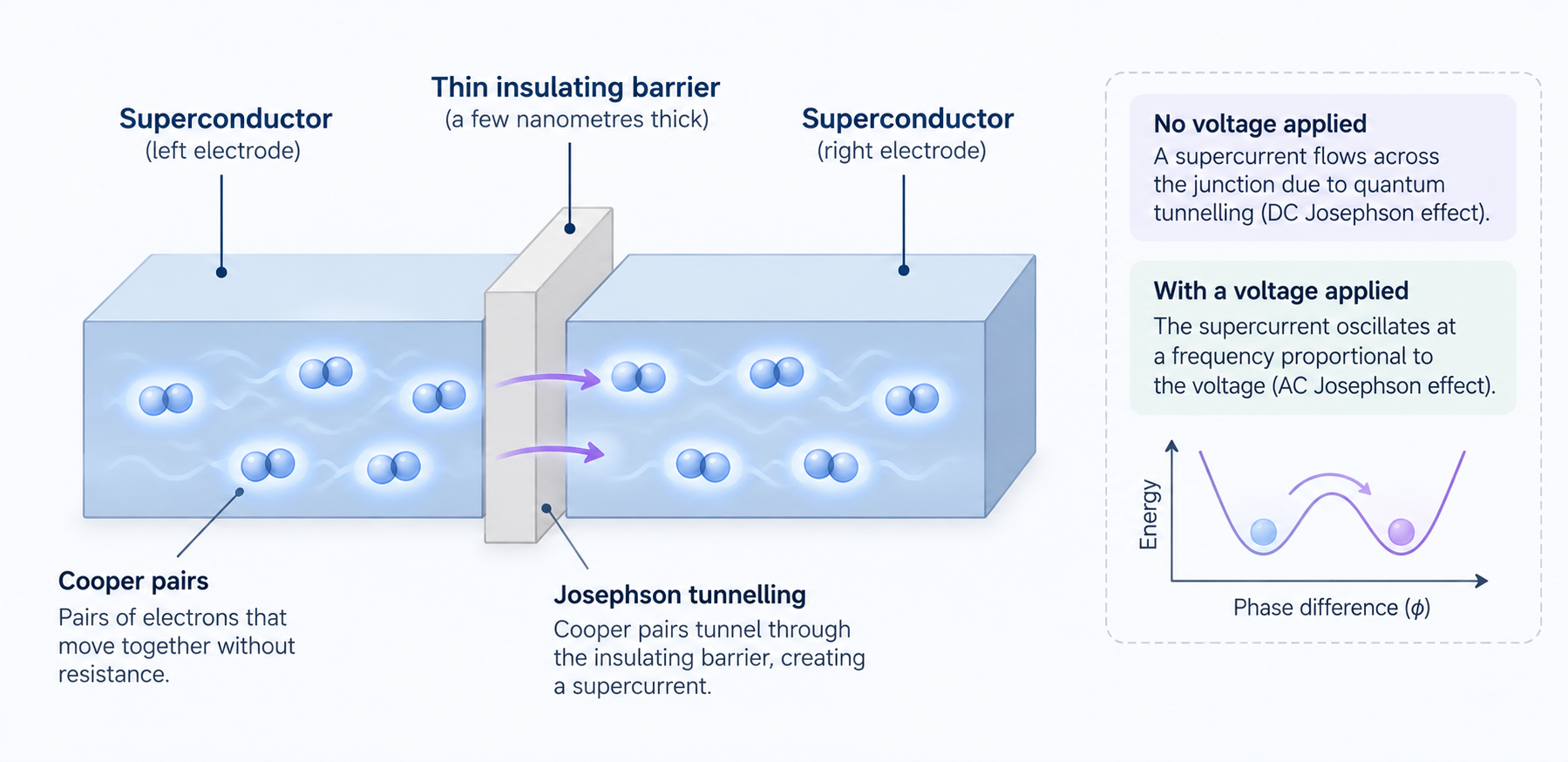
A Josephson junction consists of two superconducting regions separated by a thin insulating barrier. At very low temperatures, Cooper pairs can tunnel through the barrier, creating the Josephson effect.
The junction introduces the nonlinearity needed to create unevenly spaced energy levels. This allows engineers to isolate two levels as the qubit states |0⟩ and |1⟩. Without this nonlinearity, a simple electrical oscillator would have evenly spaced levels that are difficult to use as a qubit.
What is a Transmon Qubit?
A transmon is a widely used superconducting-qubit design that combines a Josephson junction with a capacitor. It evolved from the Cooper-pair box and was designed to reduce sensitivity to charge noise.
Transmons became a leading design for superconducting quantum processors and are used by organizations including IBM and Google. The resulting qubits can then be manipulated and measured using microwave signals.
This physical qubit is the foundation; the next step is understanding how microwave control and readout turn it into a usable quantum computing system.
How Do Superconducting Qubits Work?
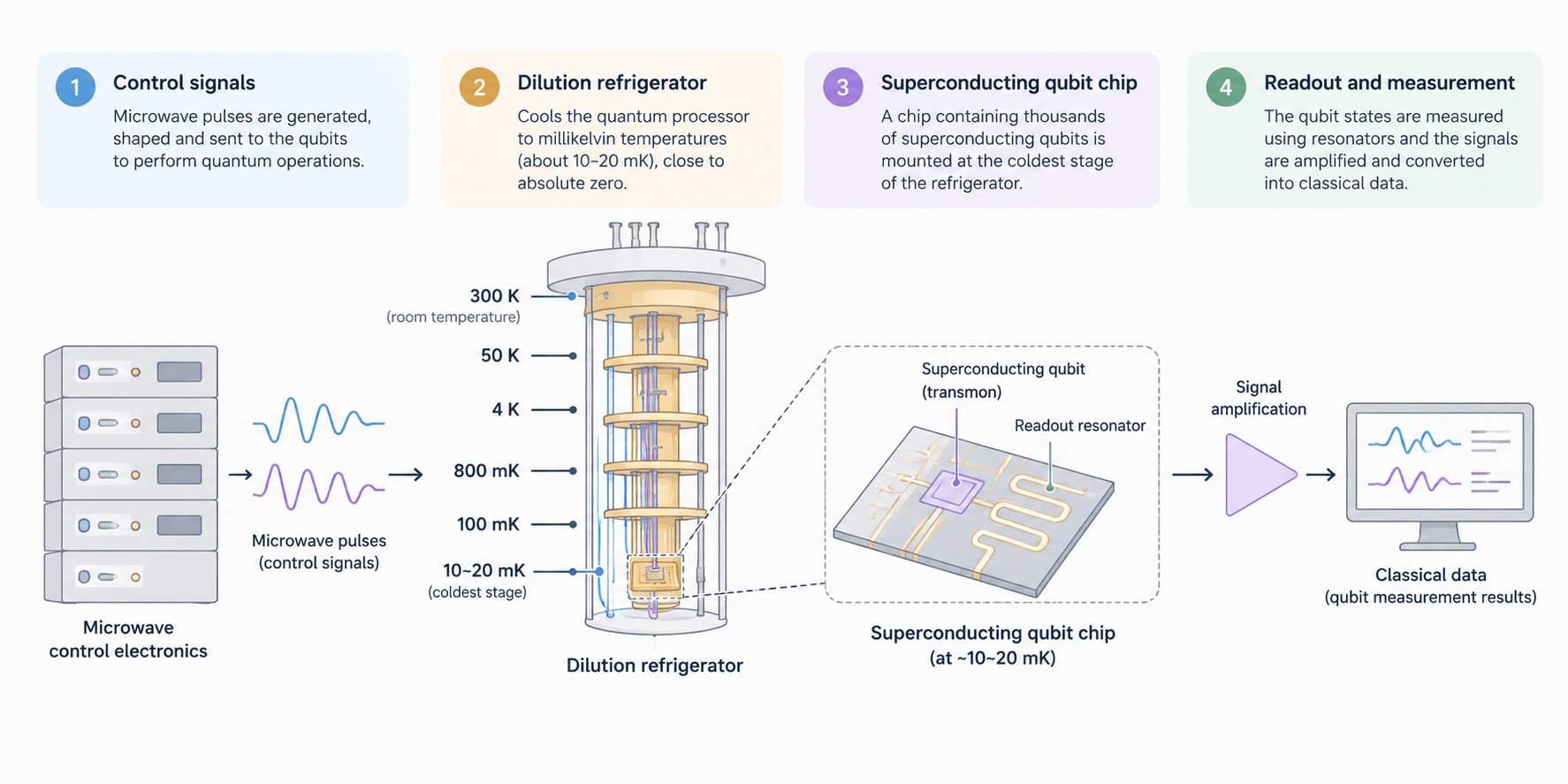
Superconducting qubits are controlled with microwave pulses and measured through coupled readout circuits. These systems translate electrical signals into quantum operations and measurement results.
Controlling Qubits With Microwave Pulses
Microwave pulses drive transitions between a qubit’s energy levels. By changing their frequency, amplitude, phase and duration, engineers can perform single-qubit operations and rotations. Two-qubit gates are created by coupling neighbouring qubits and applying calibrated pulses. Superconducting qubits can perform these operations on very short timescales.
How Superconducting Qubits Are Read Out?
To measure a qubit, engineers use a coupled microwave resonator rather than directly observing the qubit. The qubit’s state changes the resonator’s response to a probe signal. The resulting changes in amplitude or phase are detected by classical electronics and converted into a measurement result.
From Physical Qubits to Quantum Gates
The process can be simplified as:
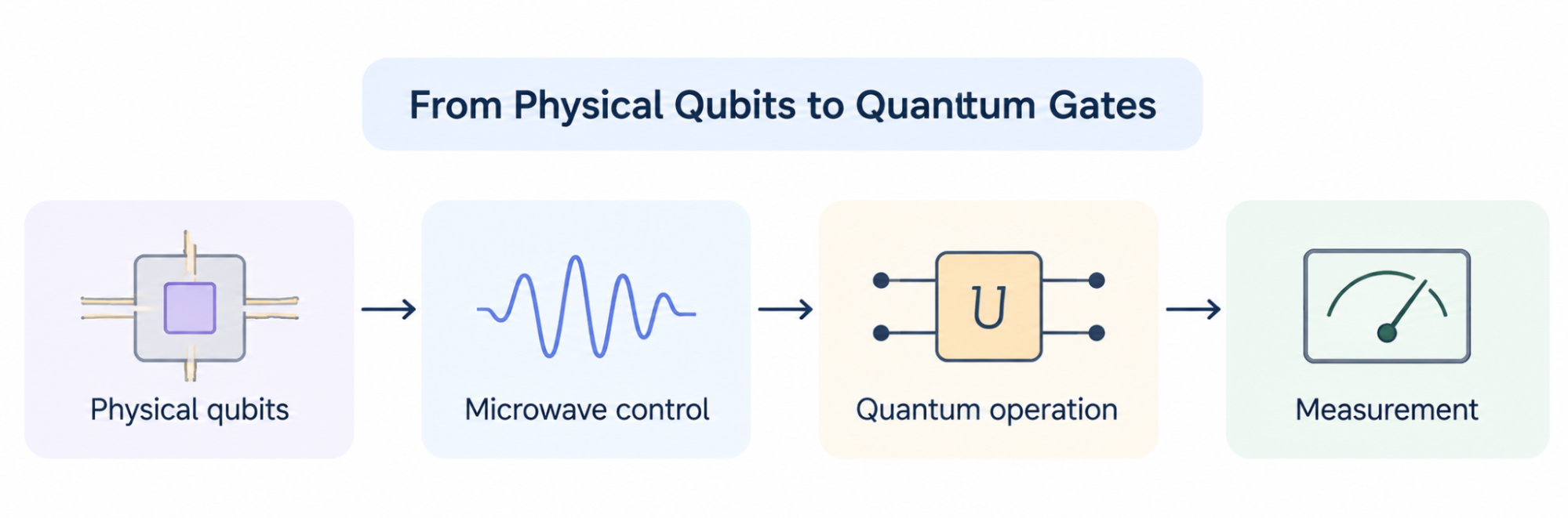
Together, qubits, couplers, resonators and control electronics form a programmable superconducting quantum processor.
Why Do Superconducting Qubits Need Dilution Refrigerators?
Superconducting qubits operate at extremely low temperatures to maintain superconductivity and reduce thermal noise that can disturb quantum states. Dilution refrigerators cool quantum processors to the millikelvin range, close to absolute zero.
What Does a Dilution Refrigerator Do?
A dilution refrigerator uses helium-3 and helium-4 to reach temperatures far below conventional refrigeration. The quantum processor sits at its coldest stage, providing the low-temperature environment needed for superconducting operation.
Why Low Temperature Matters for Quantum Computing?
Cooling keeps the circuit superconducting and reduces thermal excitation. This helps prevent unwanted states and allows qubits to retain quantum information long enough for operations and measurement.
What Makes Cryogenic Scaling Difficult?
As processors grow, they require more wiring, connections and control infrastructure, all of which can add heat to the refrigerator. Scaling superconducting qubits therefore means increasing computing capacity without exceeding the cooling and control system’s limits.
Even at these temperatures, however, qubits can still lose information and produce errors.
What Limits Superconducting Qubit Performance?
Superconducting qubits can perform fast operations, but their quantum states are fragile. Key challenges include limited coherence, gate and readout errors, crosstalk, calibration, and scaling the control infrastructure.
Coherence Time and Why It Matters
Two important measures are T1 and T2. T1 describes energy relaxation, while T2 describes the loss of phase coherence.
Longer coherence gives a computation more time to run before information degrades, but it is only one measure of performance. Gate fidelity, connectivity and readout quality also matter.
Where Do Errors Come From?
Errors can result from environmental noise, material defects, imperfect control pulses, crosstalk and measurement. Two-qubit gates can also be more error-prone than single-qubit operations.
There is no single superconducting-qubit error rate; performance varies by processor, gate, qubit pair and measurement.
Why More Qubits Do Not Automatically Mean a Better Quantum Computer?
Qubit count indicates scale, not necessarily usefulness. More qubits do not help if they have poor fidelity, limited connectivity or short coherence times.
For error correction, this distinction becomes even more important: multiple imperfect physical qubits may need to work together to form a more reliable logical qubit.
How are IBM and Google Advancing Superconducting Qubits?
IBM and Google both use superconducting processors, but their roadmaps emphasise different architectural and research milestones. IBM’s current hardware families include Heron and Nighthawk, while Google’s Willow work has focused heavily on quantum error correction.
IBM’s Superconducting Qubit Roadmap
IBM’s Heron family uses tunable couplers, while its newer Nighthawk family uses a 120-qubit square-lattice architecture designed to provide higher connectivity.
IBM’s current roadmap targets progressively deeper circuits on Nighthawk, with 7,500 gates in 2026 and up to 15,000 gates by 2028. IBM also plans Starling, a large-scale fault-tolerant system targeted for 2029. These are IBM’s stated roadmap goals, not guaranteed future outcomes.
Google’s Willow and the Error-Correction Path
Google announced its Willow processor in December 2024. Google reported that as its error-correcting surface-code lattice increased in size, the encoded error rate decreased, demonstrating what it described as below-threshold error correction.
The significance is broader than the physical qubit count: useful fault-tolerant quantum computing requires physical qubits to be combined into logical qubits whose errors can be detected and corrected.
What IBM and Google Are Actually Trying to Solve?
Despite differences in architecture and roadmap, the larger engineering objective is similar:
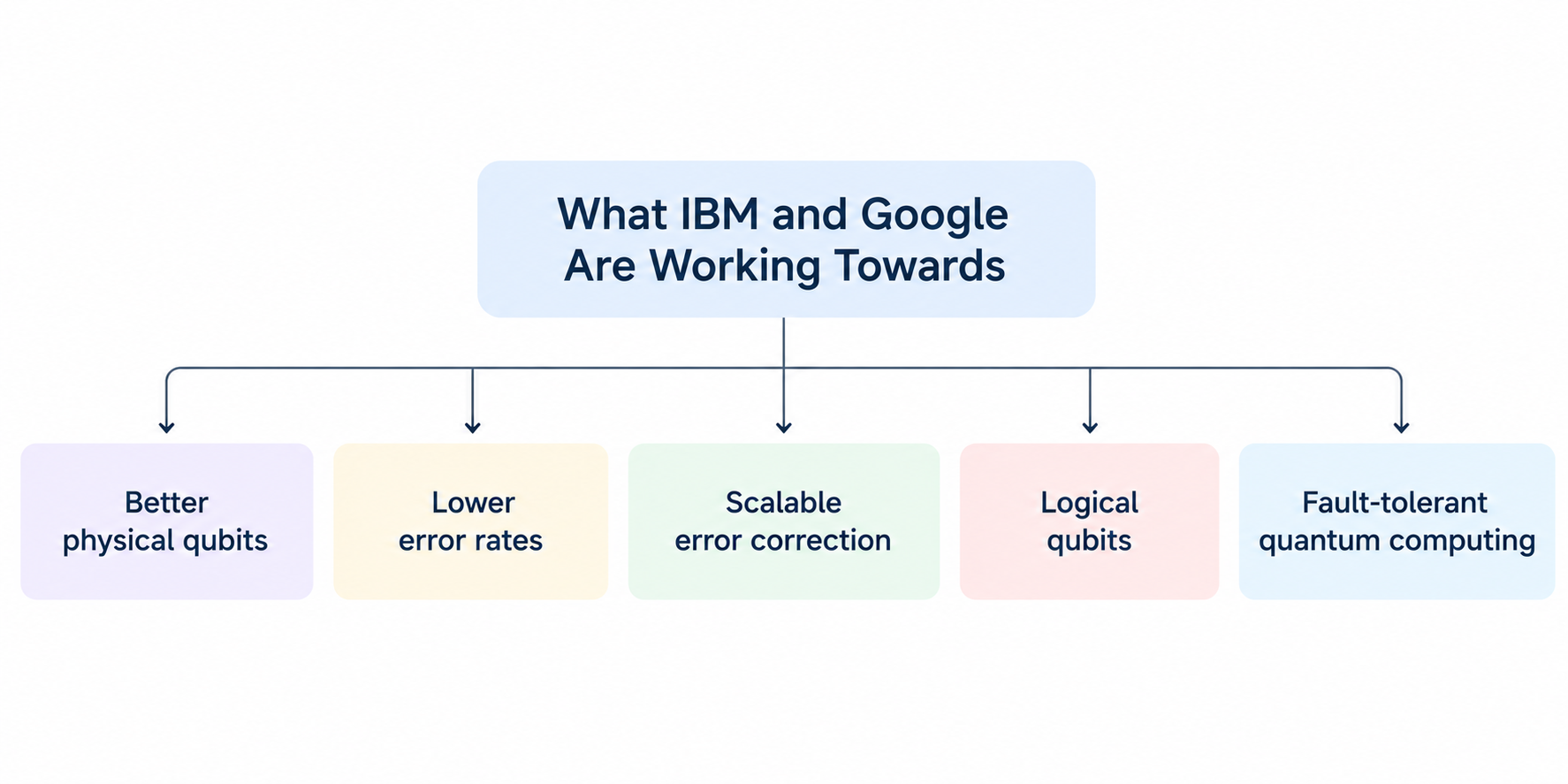
The important distinction is between what has already been demonstrated and what companies currently project for future hardware.
How Do Superconducting Qubits Compare With Trapped-Ion and Photonic Qubits?
No single hardware platform dominates every metric. Superconducting systems emphasise fast operations and chip-based fabrication, while trapped-ion and photonic approaches make different trade-offs.
| Factor | Superconducting | Trapped-Ion | Photonic |
|---|---|---|---|
| Physical basis | Superconducting circuits/Josephson junctions | Trapped atomic ions | Photons/light |
| Typical control | Microwave signals | Lasers/electromagnetic fields | Optical components |
| Operating environment | Millikelvin temperatures | Ultra-high vacuum | Often room-temperature optical components |
| Major strength | Fast gates + chip fabrication | Long coherence + high-fidelity operations | Networking/scaling potential |
| Major challenge | Cooling + errors | Slower operations + scaling complexity | Photon loss + optical complexity |
The goal of this comparison is not to identify a winner. Each approach represents a different engineering strategy for building scalable quantum hardware.
What are the Advantages and Disadvantages of Superconducting Qubits?
Superconducting qubits combine fast control with fabrication techniques that resemble established microelectronics, but they also require extreme cooling and remain vulnerable to noise and operational errors.
Advantages of Superconducting Qubits
- Fast quantum gate operations
- Chip-based fabrication
- Precise microwave control
- A mature experimental ecosystem
- Cloud-accessible quantum processors
- Significant investment from major research organisations
Limitations of Superconducting Qubits
- Millikelvin cooling requirements
- Limited coherence compared with some alternatives
- Complex control and readout systems
- Crosstalk and calibration challenges
- Significant error-correction overhead
- Difficult cryogenic scaling
These trade-offs explain why superconducting hardware is one route toward fault-tolerant quantum computing rather than a universally superior solution.
Conclusion
The real challenge in superconducting quantum computing is no longer simply building a qubit, but making thousands or millions of them reliable enough to perform useful computations. Coherence, gate fidelity, readout, connectivity, cryogenic infrastructure and error correction all become increasingly important as systems scale. These engineering constraints ultimately determine how far today’s processors can move toward practical, fault-tolerant quantum computing.
So are you ready to take your quantum computing skills beyond hardware fundamentals? Explore the Applied Quantum Computing & AI programme by IIT Delhi, delivered on Varsity by InterviewBit, takes you from quantum foundations and hardware concepts to Qiskit programming, real quantum systems, and hands-on projects with industry-focused capstones.
Frequently Asked Questions
Who made the first superconducting qubit?
Yasunobu Nakamura, Yu. A. Pashkin and J. S. Tsai reported coherent control of a superconducting charge qubit in 1999. Their single-Cooper-pair box used a Josephson junction to create an artificial two-level quantum system.
Why are superconducting qubits called artificial atoms?
They are called artificial atoms because engineered superconducting circuits can have discrete energy levels resembling those of natural atoms. Unlike actual atoms, however, these systems are much larger and can be fabricated and electrically controlled by engineers.
Are superconducting qubits made from actual superconducting materials?
Yes. The qubit is an engineered circuit made using superconducting materials, typically incorporating a Josephson junction and capacitor. It is not a naturally occurring atom; its quantum properties come from the behaviour of the fabricated circuit.
Can superconducting qubits work at room temperature?
Conventional superconducting-qubit processors cannot operate at room temperature. They require cryogenic temperatures close to absolute zero so the circuit remains superconducting and thermal excitations do not overwhelm the quantum states.
How fast can a superconducting qubit perform an operation?
Superconducting gates can operate on very short timescales, typically faster than many trapped-ion operations. However, there is no single universal gate duration because it varies with the processor, gate type and implementation.
How powerful is 50 qubits?
There is no simple answer based on qubit count alone. The usefulness of a 50-qubit processor depends on coherence, gate fidelity, connectivity, circuit depth, error rates and whether those qubits are physical or part of an error-corrected logical system.
Why does IBM use superconducting qubits?
IBM uses superconducting qubits because they offer fast microwave control, chip-based fabrication and an established path toward scaling processors. IBM’s current quantum hardware is based on superconducting transmon architectures.
How many superconducting qubits does a quantum computer need to be useful?
There is no fixed threshold. Useful performance depends on qubit quality, connectivity, gate fidelity, coherence, error correction and the computational task. A smaller processor with better-quality qubits can outperform a larger but noisier system on a particular workload.
Can I access a superconducting quantum computer through the cloud?
Yes. Cloud platforms allow users to submit quantum circuits to remote quantum processors without operating the physical hardware themselves. IBM provides cloud access to its quantum systems through IBM Quantum.
Is IBM’s superconducting quantum computer already fault tolerant?
Not yet in the sense of the large-scale fault-tolerant system described in IBM’s roadmap. IBM currently targets Starling for 2029, with 200 logical qubits and the ability to run 100 million quantum gates. This remains a stated roadmap target rather than an already-delivered system.