Prescriptive Analytics: How Operations Teams Decide the Best Next Action

Key Insights
- It recommends actions, not just forecasts. Descriptive analytics explains what happened and predictive analytics estimates what may happen. Prescriptive analytics recommends what to do about it.
- Decisions follow a six-stage flow. The flow runs Data → Prediction → Constraints → Optimization → Recommended Action → Execution. Results from each decision feed into the next one.
- Constraints make recommendations realistic. Budget, capacity, deadlines, workforce availability, inventory limits and supplier terms keep recommended actions workable.
- Optimization is the decision engine. Linear programming, integer programming and constraint optimization compare options. Machine learning supplies predictions, and simulation tests scenarios before teams commit.
- AI alone is not prescriptive. A system qualifies only when its analysis leads to an actionable recommendation or optimized decision.
- Operations use cases are broad. It applies to inventory replenishment, workforce scheduling, route optimization, production planning and warehouse operations. It helps most when teams face many possible actions, competing goals and real constraints.
- Recommendations are only as good as their inputs. Data quality, assumptions, model design and correctly defined constraints determine how reliable they are, and human judgment remains essential.
- Implementation starts with one decision. Begin with a specific, repeatable decision and build reliable data. Test through simulation, backtesting and pilots, and keep humans in the loop before automating.
Prescriptive analytics is a form of analytics that uses data, models, predictions and optimization techniques to recommend what action to take next. Descriptive analytics explains what happened; predictive analytics estimates what may happen. Prescriptive analytics answers what should be done.
- Output: A recommended action, not just a forecast or report.
- Example: If demand is expected to rise, it can recommend how much inventory to order, when and from which supplier.
- Used for: Inventory, staffing, routing, scheduling, capacity and resource allocation decisions.
- Why it helps: It weighs many possible actions against real-world constraints.
This shift from insight to action is why operations teams use it. Below, you will learn how it works, the technologies behind it, use cases, examples and limitations.
How Operations Teams Decide the Best Next Action
Operations teams decide the best next action through six connected stages. Each adds context, so the recommendation reflects what is likely, what the business wants and what is feasible.
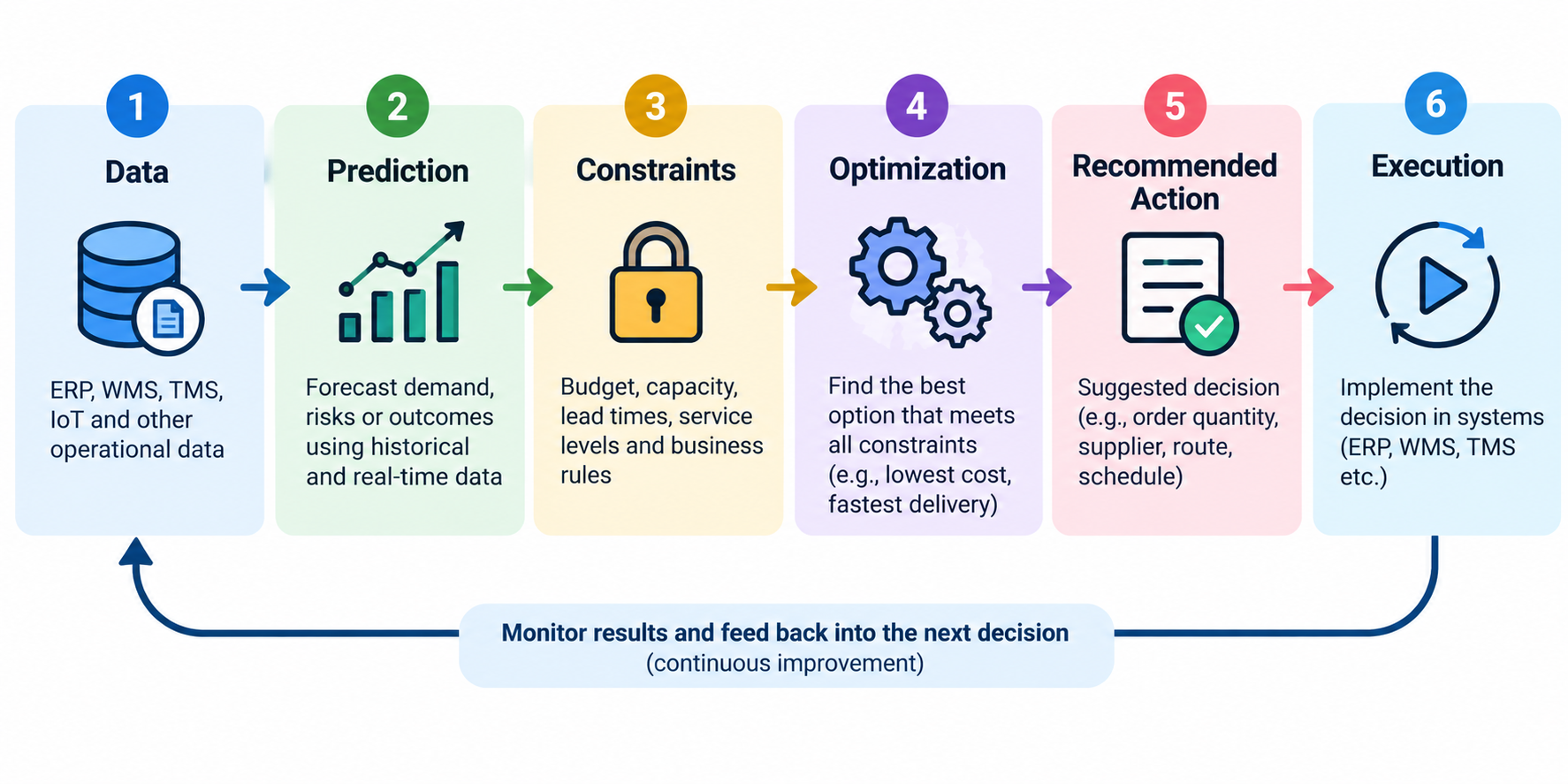
Data → Prediction → Constraints → Optimization → Recommended Action → Execution
1. Collect and Prepare Operational Data
Every recommendation starts with data on current operations, cleaned and matched across systems so errors do not spread. Typical sources include:
- ERP systems
- Warehouse and transportation management systems (WMS and TMS)
- IoT sensors
- Sales and demand data
- Supplier information
- Workforce and equipment data
2. Predict What Could Happen
Predictive models use historical and current data to estimate future conditions: what the team may face, not how to respond. Common predictions include:
- Future demand
- Delivery delays
- Equipment failures
- Inventory requirements
- Workload changes
3. Define Constraints and Business Objectives
Recommendations must be workable. Teams set an objective, such as lowest cost or highest service level, plus the real-world limits each decision must respect:
- Budget
- Capacity
- Delivery deadlines
- Workforce availability
- Inventory limits
- Supplier constraints
4. Evaluate Possible Actions
Optimization models compare possible decisions against the objective and constraints. They estimate each option’s expected outcome, such as total cost or on-time delivery, and reject any option that breaks a constraint.
5. Recommend the Best Next Action
The output is a specific action the team can take. “Best” means best against the defined objectives and constraints, not perfect in every circumstance. Typical recommendations include:
- Reorder inventory
- Change a delivery route
- Reallocate workers
- Adjust production schedules
- Prioritize specific orders
6. Execute and Monitor the Decision
Once approved, the action is carried out and results are tracked against the model’s expectations. That new data then informs the next decision.
The key distinction: prescriptive analytics does not stop at predicting an outcome. It combines predictions, objectives and constraints to recommend an actionable decision.
Prescriptive vs Predictive vs Descriptive Analytics: What’s the Difference?
The three analytics types answer different questions about the same operation. The table compares each type’s main question with an example output.
| Analytics Type | Main Question | Example |
|---|---|---|
| Descriptive | What happened? | Orders fell by 10% last month |
| Predictive | What is likely to happen? | Demand may fall next month |
| Prescriptive | What should we do? | Reduce production and reallocate inventory |
How the Three Types Work Together
In practice, the three types form a sequence rather than competing options. Each step supplies the context the next one needs:
- Descriptive → Understand the situation
- Predictive → Estimate what happens next
- Prescriptive → Decide what action to take
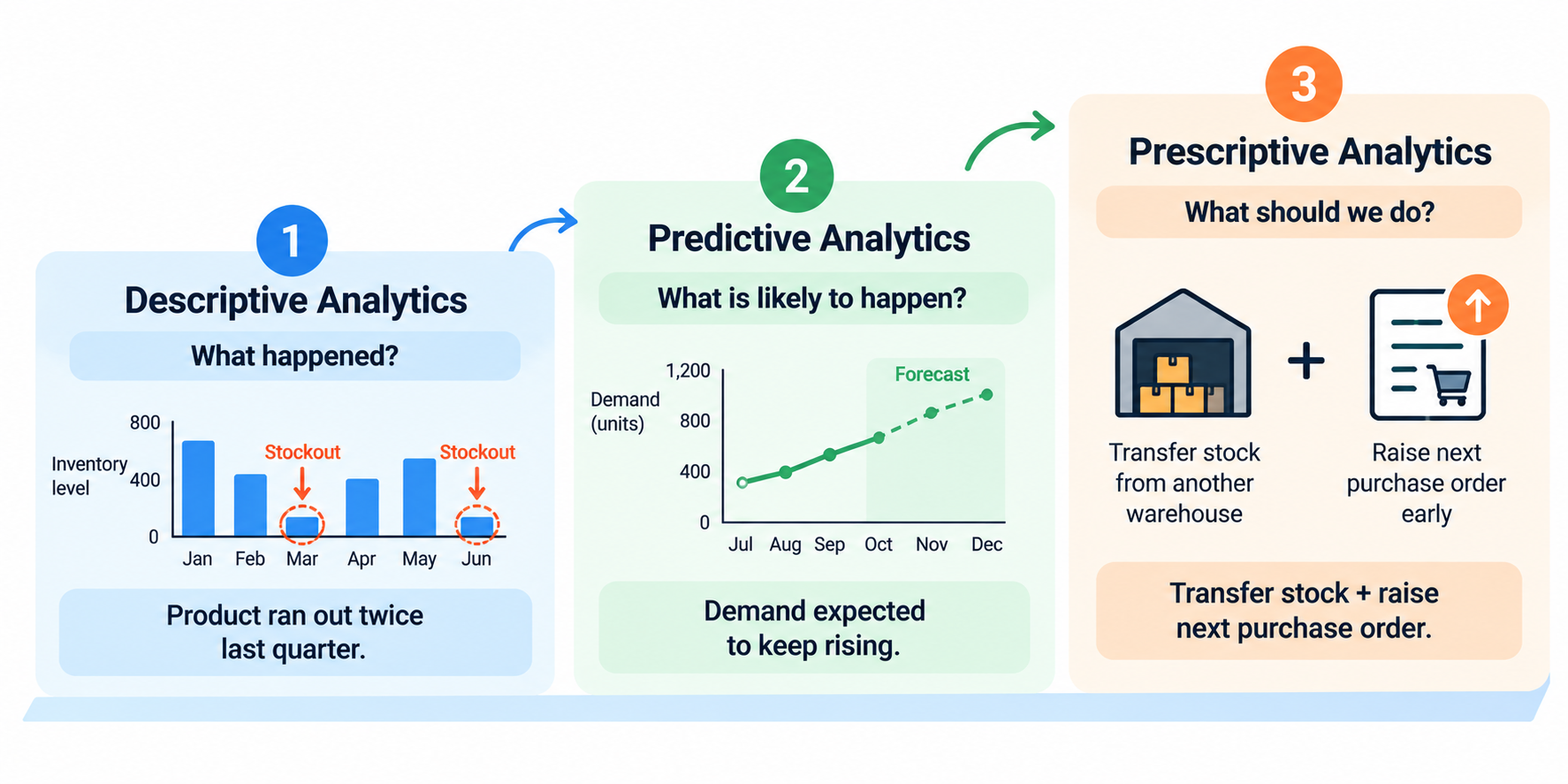
In inventory management, descriptive analytics shows a product ran out twice last quarter at one warehouse. Predictive analytics expects demand there to keep rising. Prescriptive analytics then recommends moving stock from a slower site and raising the next purchase order within budget.
Prescriptive analytics therefore builds on descriptive and predictive insights rather than replacing them. Academic research often frames it as the next step in analytics maturity.
What Technologies Power Prescriptive Analytics?
Prescriptive analytics combines several technologies, each with a distinct job. Some predict conditions, some test scenarios, and optimization chooses the action.
Optimization Models
Optimization selects the decision. It searches for the option that best meets an objective, such as minimum cost, while satisfying every constraint. Common methods include:
- Linear programming: Allocation problems with linear costs and limits
- Integer programming: Whole-number or yes/no choices, such as how many trucks to dispatch
- Constraint optimization: Rule-heavy problems, such as shift patterns
Machine Learning
Machine learning turns patterns in historical data into predictions. In a prescriptive system, those predictions feed the optimization model rather than being the final answer. Typical inputs include:
- Demand forecasting
- Risk prediction
- Failure prediction
Simulation
Simulation models how an operation behaves under different conditions, so teams can test a decision before implementing it. It helps answer questions such as:
- What happens if demand increases?
- What happens if a supplier is delayed?
- What happens if warehouse capacity falls?
Artificial Intelligence and Generative AI
AI can help interpret operational data, identify patterns and support decision workflows. Generative AI can also explain recommendations to planners in plain language.
However, AI alone does not make a system prescriptive. It qualifies only when the analysis connects to an actionable recommendation or optimized decision.
How Do Operations Teams Use Prescriptive Analytics?
Prescriptive analytics in operations applies wherever teams must choose among many possible actions under tight limits. These five areas are among the most common.
Inventory and Replenishment Decisions
Inventory decisions balance holding costs against the risk of stockouts. Using forecasts, lead times and budgets, prescriptive models can recommend:
- How much inventory to order
- When to reorder
- Which supplier to use
- Where inventory should be positioned
Workforce Scheduling
Labor needs shift by hour, day and season. Prescriptive models match staff to forecast workload within labor rules, skills and availability, optimizing:
- Employee schedules
- Shift allocation
- Staffing levels
- Workload distribution
Transportation and Route Optimization
Transport plans must balance vehicles, delivery windows, driver hours and road conditions. Prescriptive models evaluate these factors to recommend:
- Delivery routes
- Vehicle allocation
- Shipment consolidation
- Delivery sequences
Production Planning
Planners must meet demand with limited machines, materials and labor across product lines. Prescriptive analytics helps determine:
- Production quantities
- Production schedules
- Machine allocation
- Resource utilization
Warehouse Operations
Warehouses make many small decisions every hour, from which order to pick first to where stock should go. Prescriptive analytics supports:
- Picking priorities
- Inventory placement
- Labor allocation
- Robot and task assignment
Across all five areas, prescriptive analytics adds the most value when teams face many possible actions, competing objectives and real-world constraints.
What Are Some Examples of Prescriptive Analytics in Operations?
These examples show where a prediction ends and a recommendation begins. The prediction flags a likely situation; the prescriptive output says what to do.
Inventory Example
A retailer expects seasonal demand for one product line to rise and must act before stock runs short.
Prediction: Demand for the product is expected to increase.
Prescriptive recommendation: Increase the order quantity, place it with the supplier that best fits lead time and cost, and replenish before a defined date.
Delivery Route Example
A fleet has fixed customer time windows, and live traffic data shows congestion building on several planned routes.
Prediction: Several deliveries may be delayed due to traffic.
Prescriptive recommendation: Reassign vehicles and change delivery sequences to minimize total delay.
Workforce Example
A fulfillment center must plan labor ahead of a promotion that will briefly raise order volume.
Prediction: Warehouse order volume will peak during a specific period.
Prescriptive recommendation: Increase staffing during that period and allocate workers to the highest-priority tasks.
Manufacturing Example
A plant monitors machines through sensors, and recent readings suggest one is starting to degrade.
Prediction: A machine may require maintenance soon.
Prescriptive recommendation: Schedule maintenance during a low-production period and shift work to another machine.
The defining feature is the move from “what is likely to happen?” to “what should we do about it?”
What Are the Benefits and Limitations of Prescriptive Analytics?
Prescriptive analytics can make operational decisions faster and better informed, but it is not an automatic solution. Its value depends on the data, models and assumptions behind each recommendation.
Faster Operational Decision-Making
Comparing options by hand takes time, especially when conditions change mid-shift. A model evaluates them quickly and presents a recommendation, so planners spend more time reviewing decisions.
Better Resource Allocation
Optimization directs limited resources to where they best serve the stated objective, rather than by habit. It can help allocate:
- Inventory
- Labor
- Vehicles
- Machines
- Production capacity
Balancing Multiple Business Objectives
Operations rarely pursue one goal. Models can weigh competing objectives and show trade-offs, such as what faster delivery would cost. Common objectives include:
- Cost
- Speed
- Service levels
- Capacity
- Risk
Data Quality and Model Limitations
A recommendation is only as reliable as the inputs and logic behind it, however advanced the method. Quality depends on:
- Accurate data
- Appropriate assumptions
- Reliable models
- Correct constraints
Poor input data can produce poor recommendations.
Human Judgment Still Matters
Every model simplifies reality and misses details experienced staff can see. Review recommendations closely when decisions involve:
- Unexpected events
- Qualitative information, such as a key customer relationship
- Changing business priorities
- Constraints not represented in the model
Prescriptive analytics supports decision-making; it does not remove the need for human judgment and operational expertise.
How Can Businesses Implement Prescriptive Analytics?
Implementation works best as a staged process focused on one decision at a time, moving from defining the problem to building trust in the recommendations.
Start With a Specific Operational Decision
Begin with one clearly defined decision that repeats often and has measurable outcomes. Good starting points include:
- Inventory replenishment
- Route planning
- Workforce scheduling
- Production allocation
Build Reliable Data Foundations
Trustworthy recommendations need trustworthy inputs, so data work usually comes before modeling. Priorities include:
- Clean operational data
- Connected systems
- Consistent data definitions across teams
- Real-time or timely data where required
Define Objectives and Constraints
Teams must agree on the rules of a decision before a model can make it. Operations, finance and planning should jointly establish:
- What they are optimizing
- Which constraints cannot be violated
- Which trade-offs matter
Test Recommendations Before Automating Decisions
Validate recommendations before they drive real operations. Simulation tests different scenarios, historical testing compares the model’s recommendations with past outcomes, and pilots trial it on one site or product group.
Keep Humans in the Decision Loop
Planners should be able to review, override and improve recommendations based on real conditions. Logging why overrides happen reveals missing constraints or data issues.
Successful prescriptive analytics starts with a well-defined decision problem, not simply with adopting an AI or analytics tool.
Turn Data-Driven Decisions into Operational Results
Discover how AI can help optimize workflows, improve resource allocation, and transform business decision-making with the Certificate Programme in AI-Powered Operations & Process Transformation by IIM Tiruchirappalli.
Explore the programme and take the next step towards smarter, AI-driven operations.
Frequently Asked Questions
How accurate are prescriptive analytics recommendations?
There is no fixed accuracy level. It depends on data quality, forecast reliability, model design and realistic constraints, so measure recommendations against actual outcomes.
What is the ROI of using prescriptive analytics in operations?
ROI varies by decision, data maturity and starting performance, so no standard figure applies. Measure it against a baseline during a controlled pilot.
How can companies validate a prescriptive analytics model before deployment?
Backtest it on historical data, stress-test it through simulation and run a limited pilot. Planners should also confirm recommendations are feasible.
What challenges do companies face when adopting prescriptive analytics?
Common challenges include poor or fragmented data, unclear objectives, hard-to-model constraints, limited in-house skills and low user trust in recommendations.
How can businesses prevent bias in prescriptive analytics recommendations?
Bias can be reduced, not fully eliminated. Check data for gaps, test whether objectives favor certain sites or groups, add fairness constraints and monitor outcomes. NIST’s guidance on AI bias offers a broader framework.
How does prescriptive analytics handle unexpected operational disruptions?
When new data reflects a disruption, the model can be rerun for an updated recommendation. Events outside its data or assumptions still need human judgment.
Can prescriptive analytics work with incomplete or real-time data?
Yes, within limits. Stochastic and robust optimization handle uncertain inputs, and real-time data supports fast decisions like rerouting. Large gaps or delays reduce reliability.
How do businesses choose the right prescriptive analytics software?
Start from the decision you want to improve. Then assess system integration, optimization methods, scalability, explainability and how easily planners can override recommendations.
When should a company automate a decision based on prescriptive analytics?
Automate when a decision is frequent, well understood, low risk and has performed reliably in testing. High-impact or unusual decisions should keep a human approval step.
How can operations teams measure the success of prescriptive analytics?
Track the KPIs the decision targets, such as stockouts, on-time delivery or cost, against a baseline. Also monitor how often planners override recommendations.
What is the difference between prescriptive analytics and decision intelligence?
Prescriptive analytics recommends actions using data, models and optimization. Decision intelligence is broader: it covers how decisions are designed, made and improved, and can include prescriptive analytics as one component.
How can prescriptive analytics scale across different business operations?
Expand gradually from a proven use case. Reuse shared data and modeling approaches, adapt objectives and constraints to each area, and assign clear ownership for model monitoring.
Sources
- Lepenioti, K., Bousdekis, A., Apostolou, D. & Mentzas, G. (2020). Prescriptive analytics: Literature review and research challenges. International Journal of Information Management, 50, 57–70. https://doi.org/10.1016/j.ijinfomgt.2019.04.003
- Bertsimas, D. & Kallus, N. (2020). From Predictive to Prescriptive Analytics. Management Science, 1025–1044. https://arxiv.org/abs/1402.5481
- Schwartz, R., Vassilev, A., Greene, K., Perine, L., Burt, A. & Hall, P. (2022). Towards a Standard for Identifying and Managing Bias in Artificial Intelligence. NIST Special Publication 1270. https://doi.org/10.6028/NIST.SP.1270