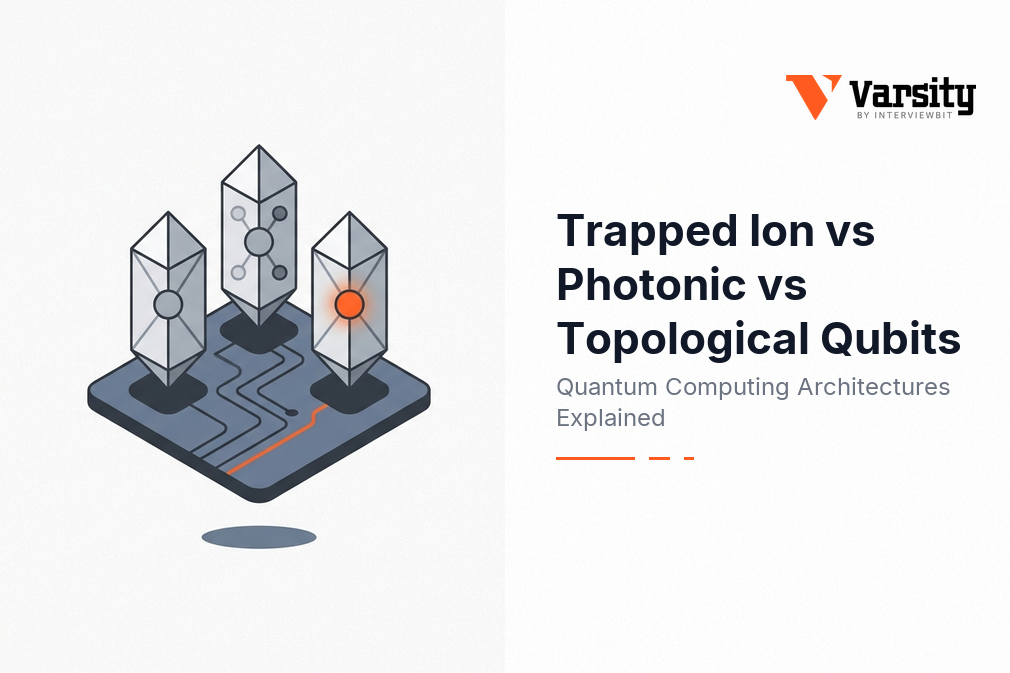
Trapped Ion vs Photonic vs Topological Qubits Explained

Key Insights
- Trapped-ion, photonic and topological qubits use different physical systems to encode quantum information, shaping how quantum computers operate and scale.
- Trapped-ion systems use charged atoms and laser-controlled operations, offering long coherence times and precise control.
- Photonic quantum computing uses particles of light to process and transmit quantum information, making it promising for quantum networking and modular architectures.
- Topological qubits aim to protect quantum information against certain errors through Majorana-based states, but their practical advantages still require further validation.
- Comparing these technologies involves more than qubit count: coherence, gate fidelity, connectivity, photon loss, error correction and scalability all influence performance.
- IonQ and Quantinuum develop trapped-ion systems, PsiQuantum and Xanadu pursue photonic architectures, and Microsoft is developing Majorana-based topological qubits. Their approaches represent different routes towards fault-tolerant quantum computing, with distinct levels of technological maturity.
Quantum computers can be built using different types of qubits, and the choice of hardware shapes how they process and store quantum information. Trapped-ion, photonic and topological qubits take three distinct approaches: using charged atoms, particles of light, and quantum states designed to resist certain errors. Each offers different advantages and challenges in terms of stability, accuracy and scalability. But how do these approaches compare, and which holds the most promise for future quantum computers?
This article explores how each technology works, compares its strengths and limitations, and examines the companies developing these systems and their potential for large-scale quantum computing.
Trapped-Ion Qubits: How Do They Work?
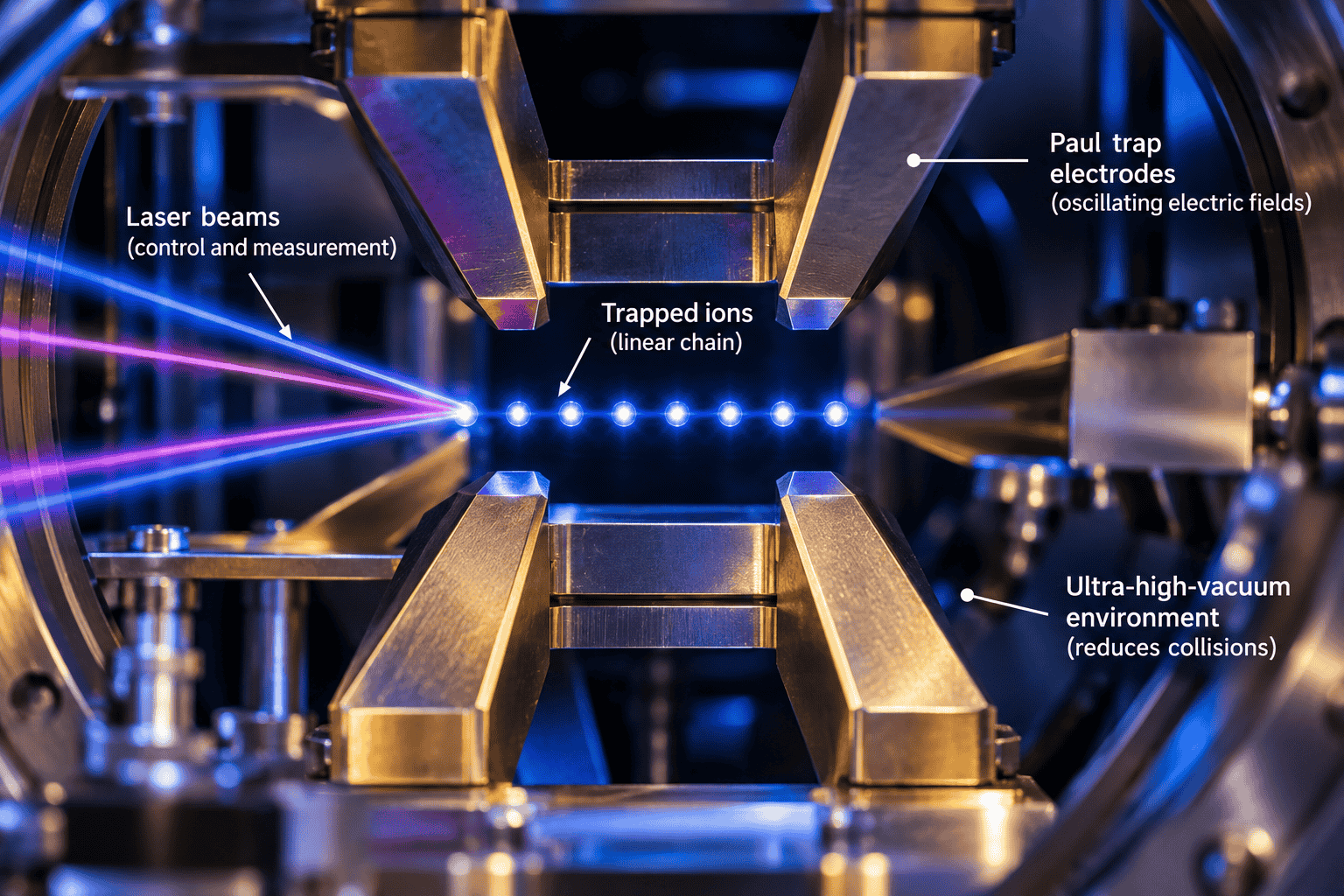
A trapped-ion quantum computer uses charged atoms, called ions, as qubits. Electromagnetic fields confine the ions, while lasers control and measure their quantum states. This approach benefits from the consistency of atomic systems and precise control over quantum operations.
How Ions Become Qubits
An ion is an atom that has gained or lost electrons, giving it an electric charge. Two internal energy states represent 0 and 1, but unlike classical bits, these states can also exist in superpositions.
Ions of the same species have identical physical properties, making them consistent for quantum operations. Their isolation from environmental disturbances also helps preserve quantum information, although specialised equipment is needed to maintain these conditions.
How Paul Traps and Lasers Control the Ions
A Paul trap uses oscillating electric fields to confine ions in a small region of space. They are typically held in an ultra-high-vacuum environment to minimise collisions with surrounding particles.
Lasers prepare and measure quantum states and perform quantum gates. The ions interact through their shared motion, enabling entangling gates that connect their states and allow the processor to execute quantum circuits.
Why Trapped Ions Have Long Coherence Times
Coherence describes how long a quantum state retains the phase relationships needed for computation. Trapped ions can preserve quantum information for relatively long periods because their internal states can be isolated from environmental noise.
Long coherence times allow more operations before information is lost. However, overall performance also depends on gate speed, operation fidelity, measurement errors and system size.
Photonic Qubits: How Does Photonic Quantum Computing Work?
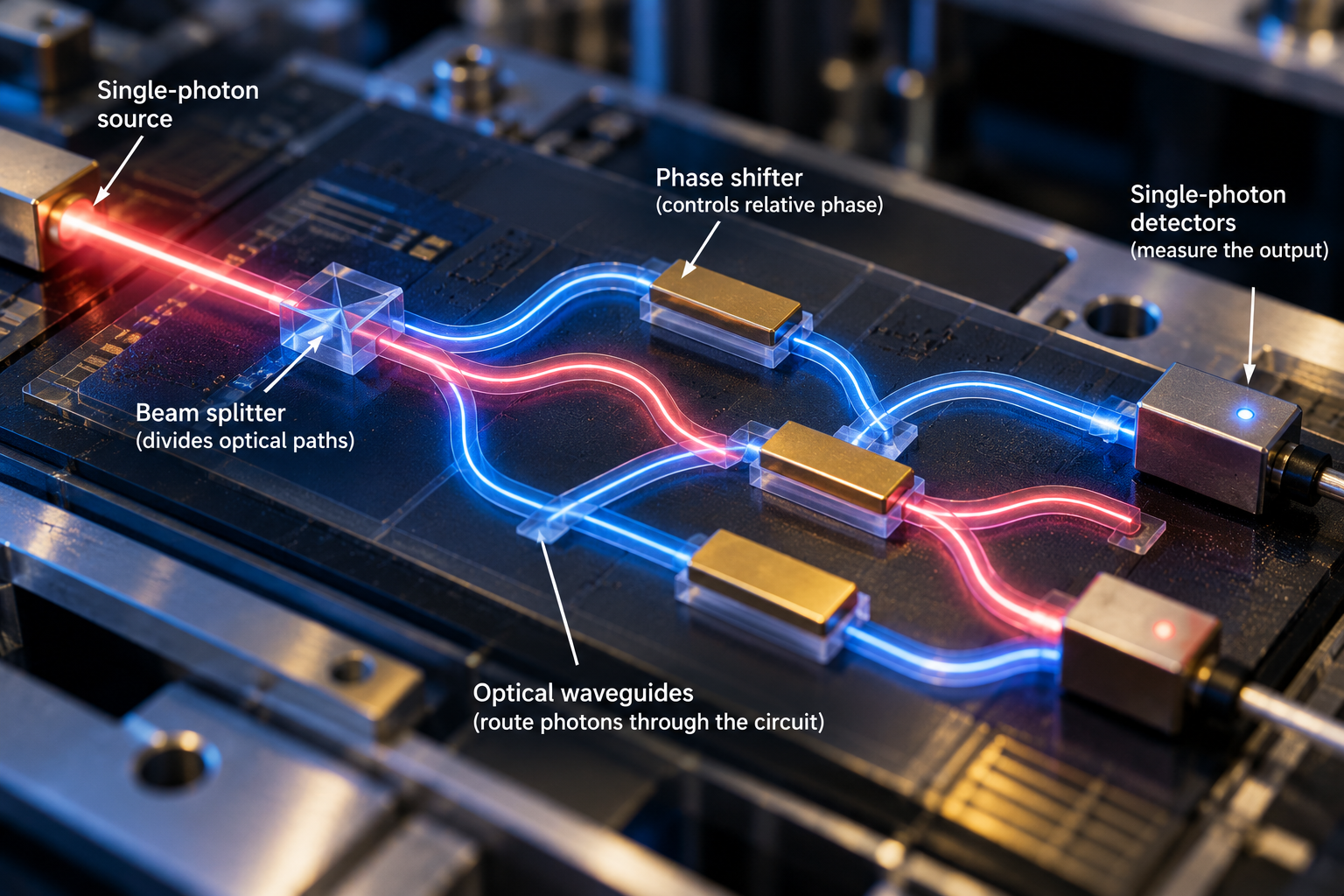
Photonic quantum computing uses photons, or particles of light, to carry quantum information. Qubits can be encoded in properties such as photon polarisation or optical paths, making this approach useful for both computation and quantum networking.
How Photons Encode Quantum Information
A photonic qubit uses two optical states to represent 0 and 1. For example, horizontal and vertical polarisation can represent the basis states, while a superposition combines them.
Photons interact weakly with their environment, helping them carry information over optical links. However, photon loss, imperfect sources and measurement limitations can still introduce errors.
How Optical Components Manipulate Photonic Qubits?
Photonic processors use optical components to prepare, manipulate and measure quantum states. Beam splitters combine or divide optical paths, phase shifters control relative phase, and optical circuits guide photons through the processor. Detectors measure the resulting signals.
Depending on the architecture, these components may be integrated into photonic chips or combined with separate control and detection systems. Reliable photon generation, manipulation and detection remain key engineering challenges.
Why Photonics Is Attractive for Quantum Networking?
Photons can carry quantum information through optical fibres, making them useful for quantum communication and connecting separate processors. Photonic links could enable distributed quantum computing without requiring every qubit to be physically adjacent.
However, scaling these networks requires reliable photon sources, efficient detectors and ways to manage photon loss. Companies such as PsiQuantum and Xanadu are developing photonic architectures with scalable and fault-tolerant computing as long-term goals.
Topological Qubits: What Makes Them Different?
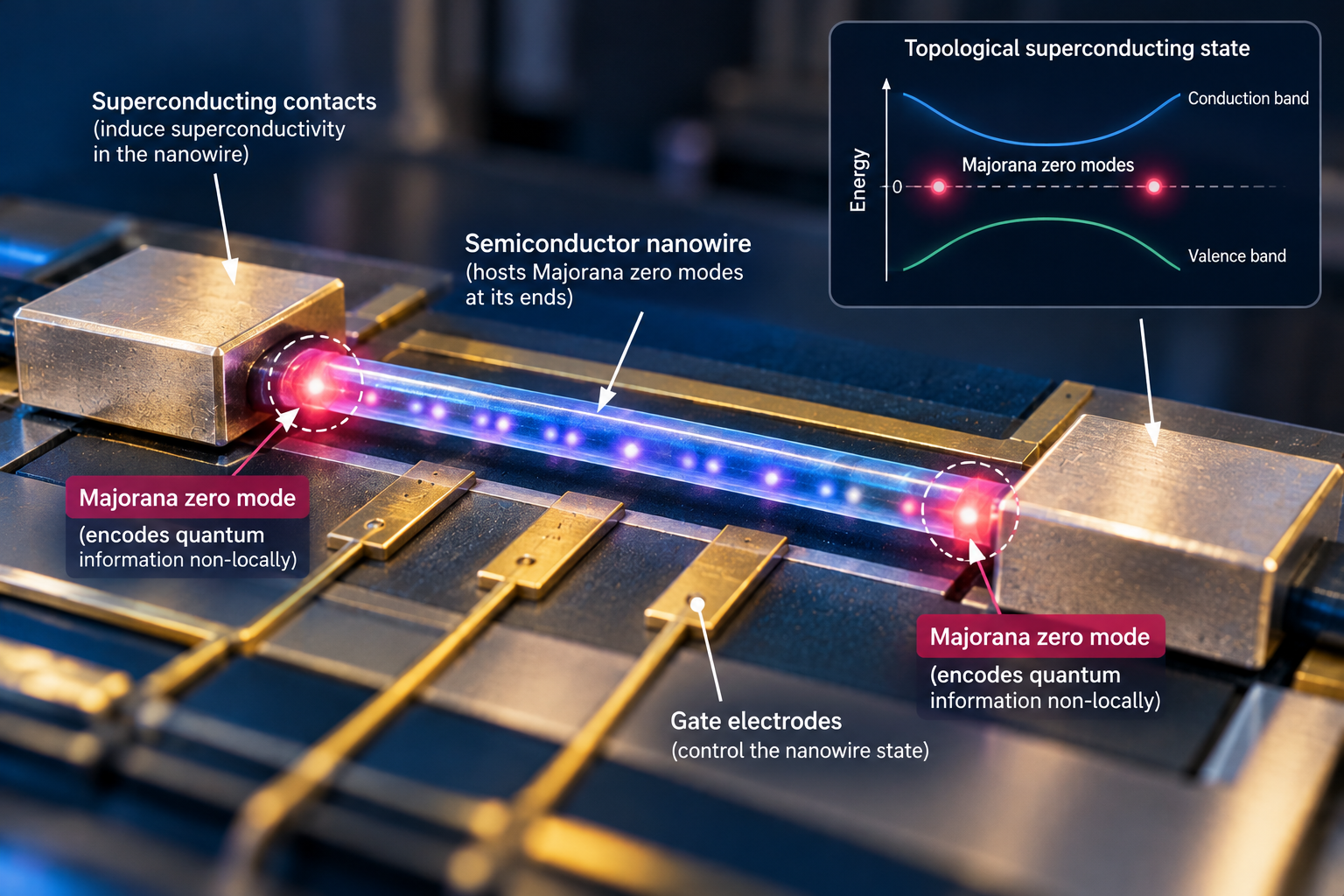
Topological quantum computing aims to encode information in properties that are less sensitive to certain local disturbances. If this protection can be realised, it could reduce the effort required for quantum error correction. However, reliably creating and controlling topological qubits remains a research challenge.
What are Majorana-Based Qubits?
Majorana-based qubits are a proposed form of topological qubit associated with Majorana zero modes. These modes are predicted to emerge under suitable conditions in engineered semiconductor-superconductor systems, including certain nanowires.
Quantum information could potentially be encoded in a way that makes it less vulnerable to local disturbances. Researchers must still demonstrate these states reliably, control them and perform useful quantum operations.
How Topological Protection Could Reduce Errors?
Topological protection aims to make quantum information less sensitive to certain local errors by encoding it in the properties of a suitable physical system.
This could reduce some sources of noise, but it would not make qubits entirely error-free or eliminate the need for quantum error correction. Its practical advantages must be demonstrated through reliable operations and scalable architectures.
Microsoft’s Approach to Topological Quantum Computing
Microsoft is pursuing Majorana-based topological qubits using engineered semiconductor-superconductor devices. Its research aims to use Majorana zero modes to encode and measure quantum information as part of a path towards scalable quantum computing.
Microsoft’s reported research milestones do not establish that a large-scale, fault-tolerant topological quantum computer is commercially available. The key challenge is demonstrating reliable qubit operations, effective error correction and the ability to scale the technology.
Trapped Ion vs Photonic vs Topological Qubits
The three quantum hardware architectures differ in how they encode information, control qubits, connect components and approach scalability. No single metric determines which is best: performance depends on the implementation and the task being considered.
| Factor | Trapped-ion | Photonic | Topological |
|---|---|---|---|
| Physical qubit | Charged atomic ion | Photon | Proposed Majorana-based quantum state |
| Control | Lasers and electromagnetic fields | Optical components and photonic circuits | Engineered topological material systems |
| Coherence | Often a strength of the architecture | Photons can preserve information during transmission; loss remains a challenge | Potentially robust if topological protection is achieved |
| Fidelity | High-fidelity operations are a major strength | Depends on sources, optical operations, detection and loss | Practical performance must be established experimentally |
| Connectivity | Some systems support all-to-all interactions | Well suited to optical links and networking | Depends on the developing architecture |
| Scalability challenge | Controlling and coordinating larger ion systems | Photon loss, sources, detectors and optical integration | Reliably realising and controlling topological states |
| Maturity | Deployed systems and cloud access | Active research and commercial development | Emerging research and engineering |
| Example companies | IonQ, Quantinuum | PsiQuantum, Xanadu | Microsoft |
This is a qualitative comparison, not a universal ranking. IonQ highlights all-to-all connectivity, while Quantinuum uses movable qubits and multiple gate zones. Photonic systems focus on optical networking and modular designs, whereas Microsoft’s topological approach aims to improve error resilience.
Which has Better Coherence and Fidelity?
Coherence measures how long quantum information retains its quantum properties, while fidelity measures how accurately a state or operation matches its intended result. Trapped ions offer long-lived states and precise operations. Photonic systems face challenges from photon loss and imperfect generation or detection. Topological qubits aim to resist certain disturbances, but this advantage is not yet established in practice.
How does Connectivity Differ Across the Three?
Trapped-ion systems can support interactions between many pairs of ions, depending on their architecture. Photonic systems are well suited to optical communication between separate processors, while topological connectivity depends on the device design. Connectivity affects how efficiently qubits interact and how much additional work a quantum circuit requires.
What is the Biggest Scalability Challenge for Each?
- Trapped-ion: Scaling precise control, laser systems and ion movement across larger processors.
- Photonic: Reducing photon loss while improving sources, detectors and integration across optical systems.
- Topological: Demonstrating reliable topological states and operations, then scaling them into a practical processor.
Which Companies Are Building These Quantum Technologies?
Several companies are developing quantum hardware using different approaches. Their work represents active research and engineering, not a ranking of which technology will ultimately succeed.
Trapped-Ion Quantum Computing — IonQ and Quantinum
IonQ develops trapped-ion quantum computers using laser-controlled operations and flexible connectivity. Quantinuum uses its Quantum Charge-Coupled Device (QCCD) architecture, which moves ions between gate zones. Both are working towards more capable processors and fault-tolerant computing.
Photonic Quantum Computing — PsiQuantum and Xanadu
PsiQuantum is developing silicon-photonic hardware for fault-tolerant quantum computing, while Xanadu focuses on photonic processors and modular, networkable architectures. Both aim to scale quantum systems using photons, though large-scale fault-tolerant operation remains a long-term goal.
Topological Quantum Computing — Microsoft
Microsoft is developing Majorana-based topological qubits designed to resist certain errors. However, a commercially available, large-scale fault-tolerant topological quantum computer should not be assumed to exist today.
Where is Each Qubit Technology Headed?
Trapped-ion and photonic systems are progressing towards larger processors and practical applications, while topological research is focused on validating its proposed protection against errors.
The Road Ahead for Trapped-Ion Quantum Computing
Key priorities include increasing usable qubit counts, improving control, implementing error correction and connecting processor modules. The challenge is scaling systems while maintaining reliable operations.
The Road Ahead for Photonic Quantum Computing
Researchers are working to reduce photon loss, improve sources and detectors, integrate optical components and connect modules. Photons offer opportunities for quantum networking, but fault-tolerant computing requires the entire system to operate reliably.
The Road Ahead for Topological Qubits
Key milestones include validating robust Majorana states, demonstrating reliable qubit operations and scaling beyond small experiments. The potential is significant, but this approach remains less mature as a practical computing platform than deployed trapped-ion systems.
Which Qubit Technology Is Most Suitable for Quantum Computing?
There is no universal winner. Trapped ions offer precise control and long coherence, photonics supports optical communication and modular networking, and topological qubits aim to reduce sensitivity to certain errors.
For High-Fidelity Quantum Operations
Trapped ions are promising when precise gates and flexible connectivity matter. Photonic performance depends on sources, optical operations and detectors. Topological qubits may eventually reduce certain errors, but their practical advantage remains to be demonstrated.
For Large-Scale Quantum Networking
Photonic systems are well suited to networking because photons can carry quantum information through optical fibres. Trapped-ion processors can also connect through photonic links. The best design depends on transmission losses, interface quality and network requirements.
For Long-Term Fault-Tolerant Quantum Computing
All three approaches are exploring fault tolerance. Trapped-ion and photonic systems focus on scaling and error correction, while topological research investigates whether built-in protection can reduce correction costs. No approach is a guaranteed winner until scalable performance is demonstrated.
Conclusion
Trapped-ion, photonic and topological qubits represent different paths towards scalable quantum computing. Understanding their strengths, limitations and demonstrated capabilities helps clarify how quantum hardware is evolving and what it may take to build fault-tolerant quantum computers.
Ready to explore the technologies shaping the future of computing? The Applied Quantum Computing & AI programme by IIT Delhi, delivered on Varsity by InterviewBit, takes you beyond quantum computing fundamentals into quantum algorithms, real-world applications and hands-on projects, helping you build the skills to understand and work with emerging quantum technologies.
Frequently Asked Questions
Are trapped-ion qubits more stable than photonic qubits?
Trapped ions can preserve quantum states for long periods, while photons are useful for transmitting quantum information. However, photon loss and detection errors complicate photonic computation, so stability depends on which property and system are being compared.
Why are photons useful for quantum computers if they can be difficult to detect?
Photons are effective carriers of quantum information and can travel through optical links. Their generation, manipulation and detection must still be sufficiently reliable for computation.
Can trapped-ion quantum computers be connected over a network?
Yes. Modular designs can connect trapped-ion processors through photonic links, although building reliable interfaces between processors remains an engineering challenge.
What is the difference between a Majorana qubit and a normal qubit?
A Majorana-based qubit aims to encode quantum information in topological states that are less sensitive to certain local disturbances. The distinction concerns how information is physically encoded and potentially protected.
Are topological qubits available on quantum cloud platforms today?
Microsoft has announced Majorana-based processors and research milestones, but these should not be confused with a broadly available, large-scale fault-tolerant topological quantum computer.
Why does quantum hardware need different types of qubits?
Different physical implementations offer different trade-offs in coherence, fidelity, control, connectivity, error rates and scalability. No single architecture optimises every requirement.
What makes a quantum computer scalable?
Scalability requires more than increasing qubit count. Reliable gates, quantum error correction, interconnects, control systems and reproducible manufacturing all contribute to building a useful larger processor.
Do photonic quantum computers need cryogenic cooling?
Requirements vary by architecture and component. Some photonic systems can perform much of their optical computation without cooling the entire processor to cryogenic temperatures, but specialised detectors or other components may still require cooling.
Can one quantum computer use more than one qubit technology?
Hybrid and modular architectures could connect different hardware technologies, using each where it offers an advantage. Doing so requires interfaces that transfer quantum information reliably between platforms.
What should I learn to understand quantum hardware architectures?
Start with qubits and quantum gates, then learn how physical hardware implements those operations. From there, study coherence, fidelity, connectivity, quantum error correction, NISQ systems and quantum cloud platforms.
Resources
- NIST — Quantum Computing with Trapped Ions
- Quantinuum — Quantum Systems
- Quantinuum — Hardware User Guide
- NIST — Quantum Networking with Trapped Ions
- PsiQuantum — Technology
- Xanadu — Photonics and Hardware
- Xanadu — Photonic Quantum Computing
- Microsoft Quantum — Majorana 1
- NIST — Quantum Information, Sensing and Networking