Best Quantum Computing Certifications in India (2026): Which Ones Actually Matter to Employers

Key Insights
- A quantum computing certificate’s value depends on the issuing institution, assessment method and skills it validates – not just the credential’s name.
- IIT Delhi CEP’s Applied Quantum Computing and AI programme combines 156 live learning hours with hands-on labs, mini-capstones and a final capstone.
- Quantum computing programmes differ in their focus: some emphasise quantum algorithms and machine learning, while others focus on programming tools such as Qiskit or Q#.
- An exam-based credential, such as IBM’s Qiskit certification, differs from a course-completion certificate or a learning path that does not award a professional certification.
- Practical evidence including quantum circuit implementations, simulation experiments and documented projects can help demonstrate skills beyond a certificate.
- Before enrolling, compare fees, prerequisites, assessment requirements, practical access and time commitment to determine which programme best matches your learning goals.
Choosing the best quantum computing certification depends on whether you want foundational knowledge, practical programming experience, or an assessed credential for a technical role. With options ranging from university-backed programmes to vendor examinations and free learning paths, comparing curriculum, assessment, practical exposure and fees is essential before enrolling.
Published by Varsity, this guide compares eight selected quantum computing programmes using issuer credibility, credential type, practical learning, hardware or simulator access, and overall value. The IIT Delhi CEP – Applied Quantum Computing and AI programme ranks first in this editorial shortlist because of its structured curriculum, live learning and project-based approach. The ranking is not a guarantee of employer recognition, and the programmes are not equivalent credentials.
Best Quantum Computing Certifications at a Glance
The table below compares the duration, format, fees and credential type of selected programmes. Check the official provider page before enrolling, as fees, availability and assessment requirements can change.
| Rank | Programme / institute | Duration | Mode | Fee |
|---|---|---|---|---|
| 1 | IIT Delhi CEP – Applied Quantum Computing and AI, via Varsity | 6.5 months | Live online, with recordings | ₹2,50,000 + 18% GST |
| 2 | EICTA Consortium, IIT Kanpur – Advanced Certificate Programme in Quantum Computing and Machine Learning | 8 months | Live online | ₹94,990, including GST |
| 3 | IIT Delhi CEP – Executive Programme for Quantum in ML and AI Systems | 6 months | Online | ₹1,50,000 + 18% GST |
| 4 | IBM – Certified Quantum Computation using Qiskit v2.X | Self-paced preparation; exam-based | Online exam | Not publicly listed |
| 5 | IBM Quantum Learning – Quantum Computing in Practice | Self-paced; approximately 8 hours in the brief | Online | Current access terms to be checked |
| 6 | Microsoft Learn – Get Started with Azure Quantum | 3 hours 20 minutes | Self-paced | Free learning path |
| 7 | University of Chicago – Quantum Computing for Everyone via edX | Two-course programme; duration to be checked | Online | Current certificate price to be checked |
| 8 | Delft University of Technology – Quantum 301 via edX | 3 months | Self-paced | Listed at US$333 discounted; verify current price |
Fees and availability for the remaining listings should be reconfirmed before publication.
1. IIT Delhi CEP – Applied Quantum Computing and AI
This programme is designed for learners who want to develop applied skills across quantum computing, programming, AI and practical applications. Offered by the Continuing Education Programme (CEP) at IIT Delhi and delivered by InterviewBit Software Services Pvt Ltd through Varsity, it combines foundational concepts with technical projects.
What Will You Learn?
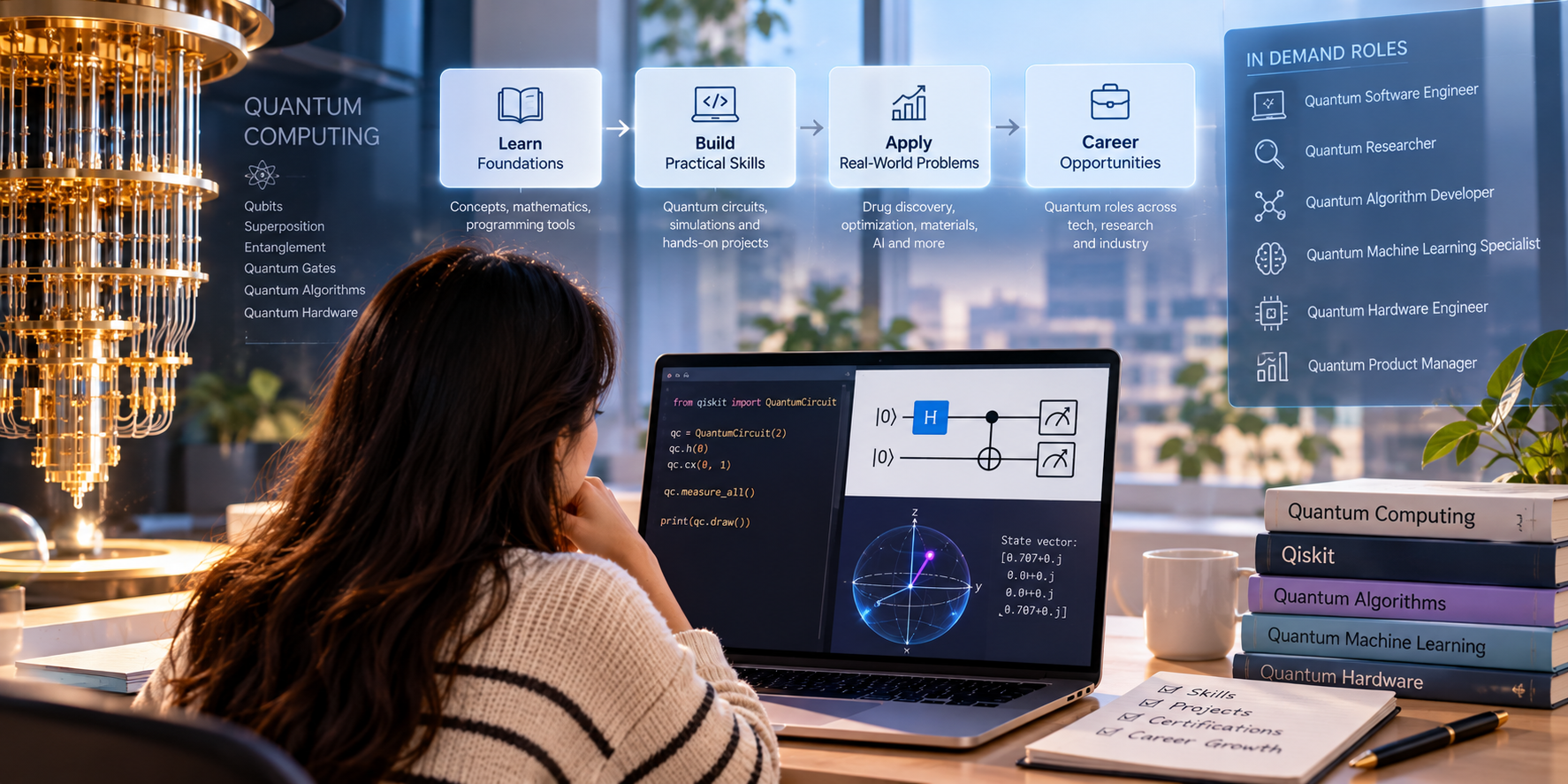
The curriculum spans mathematical foundations, quantum computing fundamentals, quantum gates and circuit design, Qiskit programming, quantum algorithms, quantum hardware, security and quantum-AI applications. The programme page lists 15 modules across four phases, with 156 hours of live, hands-on learning.
Its practical components include quantum programming labs, experiments on real quantum hardware and four mini-capstones that build towards a final capstone project. Examples include quantum optimisation, quantum error correction and hybrid quantum-classical machine learning. These activities are intended to help learners practise implementation and evaluate results rather than focus only on theoretical concepts.
Programme Snapshot
- Institute: IIT Delhi CEP, delivered through Varsity
- Duration: 6.5 months
- Live learning hours: 156 hours
- Mode: Live online, with recordings
- Fee: ₹2,50,000 + 18% GST
- Certificate: IIT Delhi CEP e-certificate, subject to institute criteria
- Practical learning: Quantum programming labs, hardware experiments, mini-capstones and a final capstone
- Best for: Learners seeking structured quantum computing and AI training
Why it Ranks #1
The programme ranks first in this shortlist because its documented structure combines live instruction, practical work, hardware experiments and a portfolio-oriented capstone. Its breadth also connects quantum computing with AI, optimisation and security. The principal trade-offs are its fee and time commitment, so learners seeking only an introduction or a single technical exam may prefer a shorter option.
Explore the IIT Delhi CEP — Applied Quantum Computing and AI programme.
2. EICTA Consortium, IIT Kanpur — Advanced Certificate Programme in Quantum Computing and Machine Learning
The Advanced Certificate Programme in Quantum Computing and Machine Learning, offered through the EICTA Consortium at IIT Kanpur, focuses on quantum computing concepts and their relationship with machine learning. It is suited to learners who want to explore quantum algorithms and hybrid quantum-classical methods through structured instruction and practical exercises.
The programme covers topics such as the Variational Quantum Eigensolver (VQE), Quantum Approximate Optimization Algorithm (QAOA), Grover’s algorithm and quantum principal component analysis. Its combination of algorithmic concepts, labs and a capstone makes it relevant for learners who want to connect theoretical foundations with computational applications.
Programme Snapshot
- Exact programme name: Advanced Certificate Programme in Quantum Computing and Machine Learning
- Provider: EICTA Consortium, IIT Kanpur
- Duration: 8 months
- Live learning hours: 100 hours
- Mode: Live online
- Fees: ₹94,990, including GST, as listed on the programme page
- Certificate: Professional certificate from the EICTA Consortium, subject to programme requirements
- Practical learning: Labs, capstone work and exposure to quantum simulators and cloud-based quantum hardware
- Best for: Learners interested in quantum algorithms, machine learning and hybrid quantum-classical computing
Explore the EICTA Consortium, IIT Kanpur — Advanced Certificate Programme in Quantum Computing and Machine Learning.
3. IIT Delhi CEP — Executive Programme for Quantum in ML & AI Systems
IIT Delhi CEP’s Executive Programme for Quantum in ML & AI Systems focuses on the intersection of quantum computing, machine learning and AI systems. It is intended for learners who want to understand how quantum approaches relate to emerging computational methods and potential applications in AI.
The programme provides an alternative for learners specifically interested in quantum applications within machine learning and AI systems. Before enrolling, prospective participants should review the current programme details to understand the curriculum depth, teaching format and practical work involved.
Programme Snapshot
- Exact programme name: Executive Programme for Quantum in ML & AI Systems
- Provider: Continuing Education Programme, IIT Delhi
- Duration: 6 months, as specified in the programme brief
- Live learning hours: Confirm the current programme listing
- Mode: Online; confirm the current delivery details
- Fees: ₹1,50,000 plus 18% GST
- Certificate: E-certificate from IIT Delhi CEP, subject to attendance and assessment requirements
- Best for: Learners and professionals interested in quantum computing applications in machine learning and AI systems
Explore the IIT Delhi CEP — Executive Programme for Quantum in ML & AI Systems.
4. IBM — Certified Quantum Computation Using Qiskit v2.X
IBM’s Certified Quantum Computation Using Qiskit v2.X Developer Associate credential is designed for learners who want to demonstrate practical knowledge of quantum computing using Qiskit, IBM’s open-source quantum computing software development kit. Unlike a course-completion certificate, it is an exam-based professional credential that tests knowledge of quantum programming and the use of IBM’s quantum computing tools.
The certification assesses areas including Qiskit SDK, quantum circuits, quantum operations, Qiskit Runtime, and executing circuits and interpreting results. It is particularly relevant to developers who want an externally assessed credential aligned with a specific technical toolkit.
Programme Snapshot
- Exact credential name: IBM Certified Quantum Computation Using Qiskit v2.X Developer Associate
- Provider: IBM
- Duration: Self-paced preparation; no fixed programme duration specified
- Live learning hours: No scheduled live learning requirement specified
- Mode: Online certification exam
- Fees: Check the current IBM certification listing
- Certificate: IBM professional certification, awarded upon passing the required examination
- Best for: Developers and technically oriented learners who want to validate their Qiskit skills
Explore the IBM — Certified Quantum Computation Using Qiskit v2.X Developer Associate.
5. IBM Quantum Learning — Quantum Computing in Practice
IBM Quantum Learning’s Quantum Computing in Practice course focuses on how quantum computing can be explored using existing quantum systems. It introduces practical considerations involved in working with quantum computers, including their current capabilities, potential applications and best practices for using quantum hardware.
The course is more appropriate for learners who already understand basic quantum information and circuits than for complete beginners. A separate examination is available for learners seeking an IBM Training badge, allowing them to pursue an additional credential beyond completing the learning material.
Programme Snapshot
- Exact course name: Quantum Computing in Practice
- Provider: IBM Quantum Learning
- Duration: Self-paced; check the current course listing
- Live learning hours: No scheduled live learning requirement specified
- Mode: Online and self-paced
- Fees: Check the current course and examination listings
- Certificate or credential: IBM Training badge available after passing the associated examination
- Best for: Learners with foundational quantum computing knowledge who want to explore practical quantum computing workflows
Explore the IBM Quantum Learning — Quantum Computing in Practice.
6. Microsoft Learn — Get Started with Azure Quantum
Microsoft Learn’s Get Started with Azure Quantum learning path introduces learners to quantum computing through Microsoft’s Azure Quantum ecosystem. It provides an entry point for understanding quantum computing fundamentals and exploring quantum programming concepts using Q# and related tools.
The learning path is useful for beginners who want to start experimenting with quantum programming within a familiar cloud-development environment. However, it should be understood as a learning path rather than a professional certification. Learners seeking a formal credential will need to distinguish the knowledge gained through the modules from an independently assessed certification.
Programme Snapshot
- Exact programme name: Get Started with Azure Quantum
- Provider: Microsoft Learn
- Duration: Approximately 3 hours and 20 minutes
- Live learning hours: No scheduled live learning requirement specified
- Mode: Online and self-paced
- Fees: Free
- Certificate: No separate professional certification specified for the learning path
- Practical learning: Introduction to Q# and Azure Quantum
- Best for: Beginners and developers looking for a free introduction to quantum computing and quantum programming
Explore Microsoft Learn — Get Started with Azure Quantum.
7. University of Chicago — Quantum Computing for Everyone Professional Certificate
The University of Chicago’s Quantum Computing for Everyone Professional Certificate, available through edX, offers a structured introduction to quantum computing for learners who want to build their understanding of the field. Its professional-certificate format groups courses into a broader learning pathway rather than treating a single short module as a complete qualification.
The programme is worth considering for learners who want an academic introduction to quantum computing before progressing to more specialised technical study. Prospective learners should review the current course descriptions to understand the mathematical expectations, programming requirements and assessment methods before deciding whether the certificate aligns with their goals.
Programme Snapshot
- Exact programme name: Quantum Computing for Everyone Professional Certificate
- Provider: University of Chicago, through edX
- Duration: Check the current edX programme listing
- Live learning hours: No scheduled live learning requirement specified
- Mode: Online; check the current listing for course availability and pacing
- Fees: Check the current edX listing
- Certificate: Professional Certificate through edX, subject to the applicable completion requirements
- Best for: Learners seeking a structured academic introduction to quantum computing
Explore the University of Chicago — Quantum Computing for Everyone Professional Certificate.
8. Delft University of Technology — Quantum 301: Quantum Computing with Semiconductor Technology
Delft University of Technology’s Quantum 301: Quantum Computing with Semiconductor Technology programme focuses on quantum computing through the lens of semiconductor-based quantum technologies. It is particularly relevant for learners interested in how quantum hardware is developed and how semiconductor technology can contribute to quantum information processing.
The programme also connects quantum computing with computational methods used in research and device development. Its specialised focus makes it different from broader introductory courses: learners should consider it when they want to explore the hardware side of quantum computing rather than only quantum algorithms or general programming.
Programme Snapshot
- Exact programme name: Quantum 301: Quantum Computing with Semiconductor Technology
- Provider: Delft University of Technology, through edX
- Duration: Approximately 3 months
- Study commitment: Around 6–7 hours per week
- Live learning hours: No scheduled live learning requirement specified
- Mode: Online; check the current edX listing for pacing and availability
- Fees: Check the current edX listing for the applicable price
- Certificate: Professional Certificate through edX, subject to completion requirements
- Best for: Learners interested in quantum hardware, semiconductor technology and specialised quantum computing applications
Explore the Delft University of Technology — Quantum 301: Quantum Computing with Semiconductor Technology.
How We Ranked the Best Quantum Computing Certifications
The ranking uses the following proposed 100-point framework to compare credential clarity, assessment, practical learning, cost and relevance. These weights describe the editorial method; they are not scores awarded to individual programmes.
| Criterion | Weight | What to evaluate |
|---|---|---|
| Issuer credibility and credential clarity | 25% | Who issues the credential and what it represents |
| Assessment and skills validation | 25% | Exams, graded assignments, projects and transparent completion criteria |
| Practical learning | 25% | Programming, circuit building, simulation, hardware access and capstone work |
| Fees and overall value | 15% | Cost relative to curriculum depth, support and assessment |
| Relevance to learners and employers | 10% | Demonstrated skills and fit with the intended technical or research pathway |
| Total | 100% |
The IIT Delhi CEP programme is placed first as required by the editorial brief. Its published live hours, hands-on labs, hardware experiments and capstone support the rationale for this placement. The article does not assign numerical scores to individual programmes because comparable evidence is not available for every criterion across all eight options. The ranking is an editorial shortlist, not an independently validated survey of employer preferences.
Certificate vs Skills: What Hiring Managers Check
A quantum computing certificate can signal structured learning, but it does not automatically prove practical ability or guarantee employer recognition. Understanding what a credential validates – and how to demonstrate your skills through projects – can help you assess its value.
What the certificate actually proves
A completion certificate generally records that a learner finished a course or met its completion conditions. A digital badge may require a separate assessment, while an exam-based professional certification tests specified competencies against a defined examination. These credentials should not be treated as equivalent.
Before enrolling, verify the issuer, assessment method, certificate wording and credential-verification process. No certificate guarantees universal employer recognition or a job.
Evidence of practical ability
A portfolio can demonstrate skills beyond a credential title. Useful examples include quantum circuit implementations, Qiskit or Q# projects, simulation experiments and documented comparisons between expected and observed results. Explain the problem, tools, approach, results and limitations of each project.
Access to real quantum hardware can provide valuable experience, but it is not necessary for every foundational learning objective. What matters is whether the work demonstrates relevant skills and whether the learner can explain their decisions.
How to Choose the Right Quantum Computing Certification
The right quantum computing certification depends on your existing knowledge, career goals, preferred learning format and budget. Use these factors to compare programmes and choose one that offers relevant learning outcomes rather than relying on the credential title alone.
For beginners and students
Start with clear explanations, manageable prerequisites and guided exercises. A free learning path can help you test your interest before committing to a longer quantum computing course online.
For developers and engineers
Prioritise circuit design, programming, debugging and assessed practical work. Compare Qiskit-focused options with Q# learning paths according to the ecosystem you want to explore. A quantum computing certification for developers should be evaluated by its assessment and technical scope, not its title alone.
For working professionals and researchers
Compare live hours, weekly commitments, capstones and schedule flexibility. If your goal is quantum machine learning certification, look for a curriculum that explicitly covers quantum ML and hybrid workflows. For a specialised research direction, consider whether the programme’s focus matches your intended work.
For budget-conscious learners
Compare quantum computing course fees against teaching depth, support, assessment and practical work. Free resources can build foundations, but check whether they offer a badge or merely provide learning material. For quantum computing online course fees in India, also account for GST, examination charges and any optional travel or immersion costs.
Conclusion
The right quantum computing certification depends on your goals, existing skills and budget. Compare the issuer, assessment, practical learning, credential type and fees rather than assuming that every certificate carries the same value. For learners seeking a structured programme spanning quantum computing and AI, the IIT Delhi CEP programme ranks first in this shortlist because its published curriculum combines live learning, hardware-based labs and multiple projects with a final capstone.
Ready to build a practical foundation in quantum computing and AI? Explore the Applied Quantum Computing and AI programme by IIT Delhi, delivered by Varsity, to review its curriculum, learning format, projects, eligibility criteria and certificate requirements before deciding whether it fits your goals.
Frequently Asked Questions
Do employers recognise online quantum computing certificates?
Recognition varies by employer and credential. The issuing organisation, assessment method and relevance of demonstrated skills matter. A portfolio of well-documented projects can help provide evidence beyond the certificate itself.
Do I need a physics degree to learn quantum computing?
Not always. Introductory courses may be accessible to learners from different backgrounds, while advanced programmes can require mathematics, programming or physics knowledge. Check each programme’s prerequisites.
Is a digital badge the same as a professional certification?
No. A digital badge may recognise completion of a course and its assessment. A professional certification typically involves a defined competency assessment, such as a formal examination. Check the issuer’s exact requirements.
Can I learn quantum computing using Python?
Yes. Python is widely used in quantum programming ecosystems such as Qiskit. You will also need to develop an understanding of quantum concepts, linear algebra and probability.
How much mathematics should I know before enrolling?
Linear algebra, probability and complex numbers are useful foundations. The depth required depends on the programme: introductory learning paths may build these concepts gradually, while advanced technical courses can assume prior knowledge.
Can an online course provide access to a real quantum computer?
Some platforms and programmes support cloud-based quantum hardware access, while others use simulators. Confirm whether hardware access is included, optional or simply discussed in the curriculum.
Are free quantum computing courses worth adding to a CV?
They can demonstrate initiative and foundational learning. Their value depends on the quality of the material, whether an assessment is included and whether you can show what you learned through practical work.
How can I verify who issues a quantum computing certificate?
Check the official programme page, the sample credential, the issuing organisation, completion criteria and any verification facility. Confirm whether the certificate is issued by the university, a continuing education programme, a consortium or a learning platform.
Can I pursue a quantum computing course while working full-time?
Self-paced paths generally offer more scheduling flexibility. Live programmes require time for scheduled sessions, assignments and projects, so review the weekly commitment before enrolling.
What should I include in a quantum computing project portfolio?
Document the problem, tools, circuit or algorithm design, testing process, results and limitations. Explain your own contribution and include code or notebooks where appropriate so that others can understand and evaluate the work.
Resources
- IIT Delhi CEP — Applied Quantum Computing and AI programme
- EICTA Consortium, IIT Kanpur — Advanced Certificate Programme in Quantum Computing and Machine Learning
- IIT Delhi CEP — Executive Programme for Quantum in ML & AI Systems
- IBM — Certified Quantum Computation Using Qiskit v2.X Developer Associate
- IBM Quantum Learning — Quantum Computing in Practice
- Microsoft Learn — Get Started with Azure Quantum
- University of Chicago — Quantum Computing for Everyone Professional Certificate
- Delft University of Technology — Quantum 301: Quantum Computing with Semiconductor Technology