Inbound vs Outbound Logistics: Differences and Examples

Key Insights
- Core difference: Inbound logistics moves materials, components or stock from suppliers into a facility. Outbound logistics moves finished products from that facility to customers, retailers or distributors.
- Different triggers and end points: Inbound usually starts with a purchase order and ends when goods enter inventory or production. Outbound starts with a customer order and ends at delivery.
- Different partners: Inbound depends on suppliers, inbound carriers and receiving teams. Outbound depends on customers, distributors, delivery carriers and fulfillment teams.
- Inventory is the link: Inbound replenishes stock and outbound draws it down. In manufacturing, production sits between the two flows.
- Inbound doesn’t end at the dock: Goods must be scheduled, received, inspected, put away and recorded before they can be used.
- Outbound is about accuracy and timing: Order processing, allocation, picking, packing, dispatch and delivery all aim to get the right product to the right place on time.
- Returns follow a different path: Returned products start reverse logistics rather than forming part of normal outbound delivery.
- Problems travel downstream: Late or short inbound deliveries cause stock shortages, production delays and, finally, late customer orders.
- Perspective matters: A shipment from a retailer’s distribution center to a store is outbound for the distribution center but inbound for the store.
- Measure both sides: Inbound metrics track supplier on-time delivery, receiving speed and accuracy, freight cost and inventory accuracy. Outbound metrics track fulfillment time, on-time delivery, order and picking accuracy, shipping cost and perfect order rate.
- Improve them together: Supplier coordination, warehouse visibility (barcodes, RFID, WMS), task automation and transportation data work best when applied across both flows.
Inbound logistics is the movement, receiving and management of materials, components, products or supplies into a business or facility from suppliers. Outbound logistics is the movement and distribution of finished products from a business or facility to customers, retailers or other destinations. Put simply, inbound brings goods in; outbound moves goods out.
- Direction: Inbound flows from suppliers into a warehouse, factory or store. Outbound flows from that facility to customers, retailers or distribution points.
- Starting point: Inbound usually begins with a purchase order. Outbound usually begins with a customer or sales order.
- Partners: Inbound involves suppliers, vendors and inbound carriers. Outbound involves customers, retailers, distributors and delivery carriers.
- Core activities: Inbound covers receiving, inspection, putaway and inventory updates. Outbound covers order processing, picking, packing, dispatch and delivery.
- Transportation: Inbound often moves larger, consolidated loads from fewer sources. Outbound often moves smaller, more frequent shipments to many destinations.
- Performance measures: Inbound tracks supplier reliability and receiving accuracy. Outbound tracks fulfillment speed, on-time delivery and order accuracy.
- Shared link: Both flows meet in inventory. Inbound replenishes stock, and outbound draws it down to fill orders.
Both are essential parts of the supply chain, but each involves different activities, partners, transportation needs and performance measures. The sections below explain how each flow works, compare inbound vs outbound logistics side by side and walk through practical examples.
How do Inbound and Outbound Logistics Work?
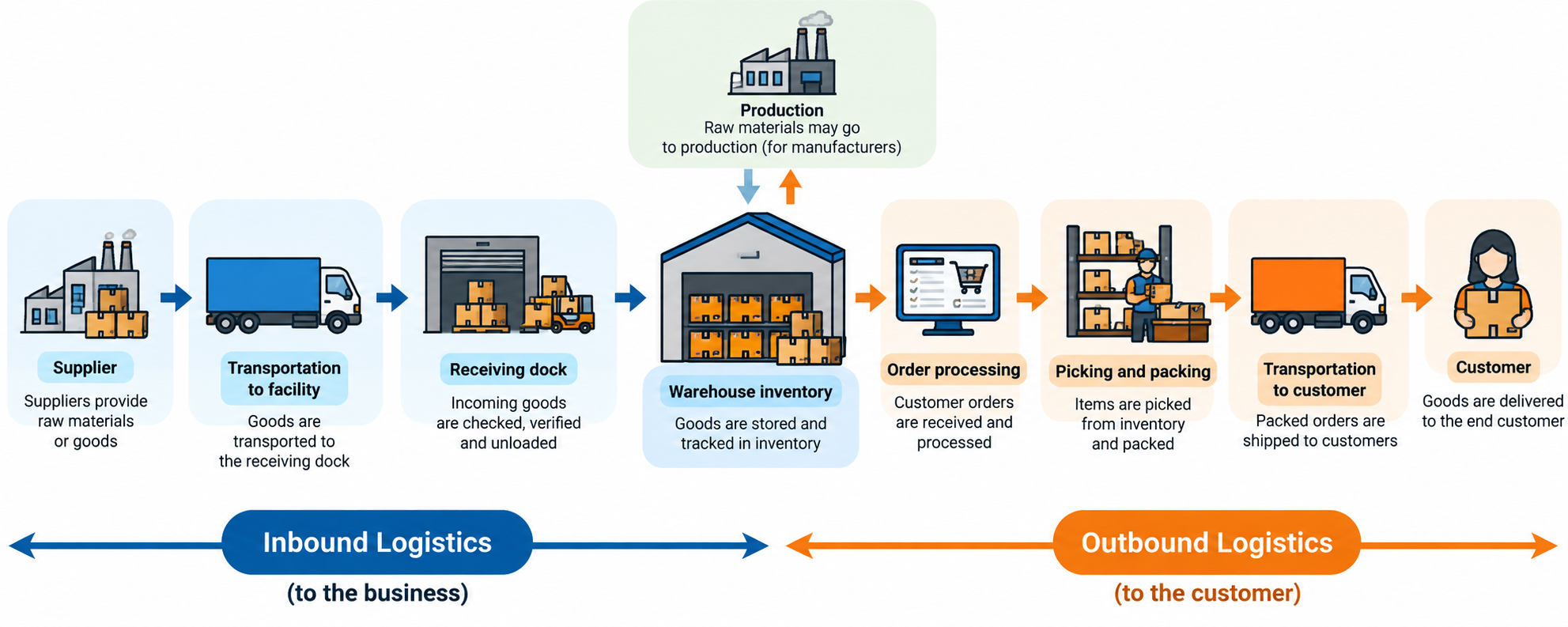
Inbound and outbound logistics are two separate flows of goods, each with its own sequence of steps. Seeing both flows first makes the differences between them much easier to understand.
The simplified flows below show where each process starts and ends. Exact steps vary by business, but most operations follow this basic pattern:
- Inbound: Supplier → Transportation → Receiving → Warehouse → Production/Inventory
- Outbound: Warehouse → Order Processing → Picking/Packing → Transportation → Customer
How Inbound Logistics Works
The inbound logistics process turns a supplier shipment into usable, recorded inventory. A typical flow looks like this:
Supplier → Shipment → Receiving → Inspection → Storage → Inventory Update
It starts when the business issues a purchase order and agrees on quantities and delivery dates with the supplier. The supplier or a carrier then ships the goods, ideally within a scheduled delivery window.
At the facility, the team unloads the shipment and checks it against the purchase order. Accepted goods are put away in storage, and the inventory system is updated.
Once that record exists, the materials are available for production, sale or other business operations.
How Outbound Logistics Works?
The outbound logistics process moves finished goods from available inventory to the customer. It usually follows this sequence:
Customer Order → Picking → Packing → Dispatch → Transportation → Delivery
An order arrives through a sales channel, and the system checks it and allocates available stock. Warehouse staff or automated systems then pick the items and pack them for shipment.
Shipment preparation adds labels, invoices and carrier documents. The order is then dispatched, transported by the company’s own fleet or a carrier, and delivered to the customer or destination.
Where Inbound and Outbound Logistics Connect?
Inbound and outbound logistics are different flows, but they share the same inventory, warehouse space and, in manufacturing, the same production schedule. What one flow puts into stock, the other takes out.
In a manufacturing business, the connection typically looks like this:
Inbound materials arrive → Inventory is stored → Products are manufactured/assembled → Finished goods enter inventory → Outbound orders are fulfilled
Inbound logistics ends when materials are stored and recorded. Outbound logistics begins when finished goods are ready to fill orders, with inventory and order fulfillment acting as the bridge.
Businesses that don’t manufacture, such as distributors and retailers, have the same link without production. The goods they receive inbound are the goods they later ship outbound.
What is the Difference Between Inbound and Outbound Logistics?
The difference between inbound and outbound logistics comes down to direction, partners and purpose. Inbound secures supply for the business; outbound fulfills customer demand.
The two are often confused because they can share the same warehouse, dock doors, staff and software. The comparison below separates them by where each flow starts, who it involves and where it ends.
| Inbound Logistics | Outbound Logistics |
|---|---|
| Moves goods into a business or facility | Moves finished goods out to customers or distribution points |
| Primarily involves suppliers | Primarily involves customers, retailers or distributors |
| Focuses on receiving, inspection and storage | Focuses on order fulfillment, dispatch and delivery |
| Often begins with a purchase order | Often begins with a customer order |
| Ends when materials enter inventory or production | Ends when products reach the customer or destination |
Inbound vs Outbound Logistics: Key Differences
Beyond start and end points, the two flows differ in who they serve and how they operate. The first three differences describe direction, people and core work:
- Direction of movement: Inbound runs upstream, from the supply base into the business. Outbound runs downstream, toward the market.
- Primary stakeholders: Inbound works with suppliers, inbound carriers and procurement and receiving teams. Outbound works with customers, distributors, delivery carriers and sales and fulfillment teams.
- Main activities: Inbound centers on bringing in, checking and storing supply. Outbound centers on allocating, preparing and delivering orders.
The remaining differences are operational. They affect how goods are handled, moved and measured:
| Factor | Inbound Logistics | Outbound Logistics |
|---|---|---|
| Type of goods | Raw materials, components, packaging or stock for resale | Finished products ready for customers |
| Transportation requirements | Often larger, consolidated loads from fewer sources | Often smaller, more frequent shipments to many destinations |
| Warehouse activities | Unloading, inspection, putaway and stock recording | Picking, packing, staging and loading |
| Performance metrics | Supplier on-time delivery, receiving accuracy, inventory accuracy | Fulfillment time, on-time delivery, order accuracy |
Are Inbound and Outbound Logistics the Same?
No. They are closely related, but the terms are not interchangeable and the two flows cannot be managed as one process. The simplest way to separate them:
- Inbound logistics = supply coming into the business
- Outbound logistics = products going to the customer
Each serves a different partner, starts with a different type of order and is judged by different results.
How Inbound and Outbound Logistics Work Together
Efficient operations depend on coordinating both flows, because outbound can only ship what inbound has supplied. An inbound problem rarely stays inbound; it usually travels downstream like this:
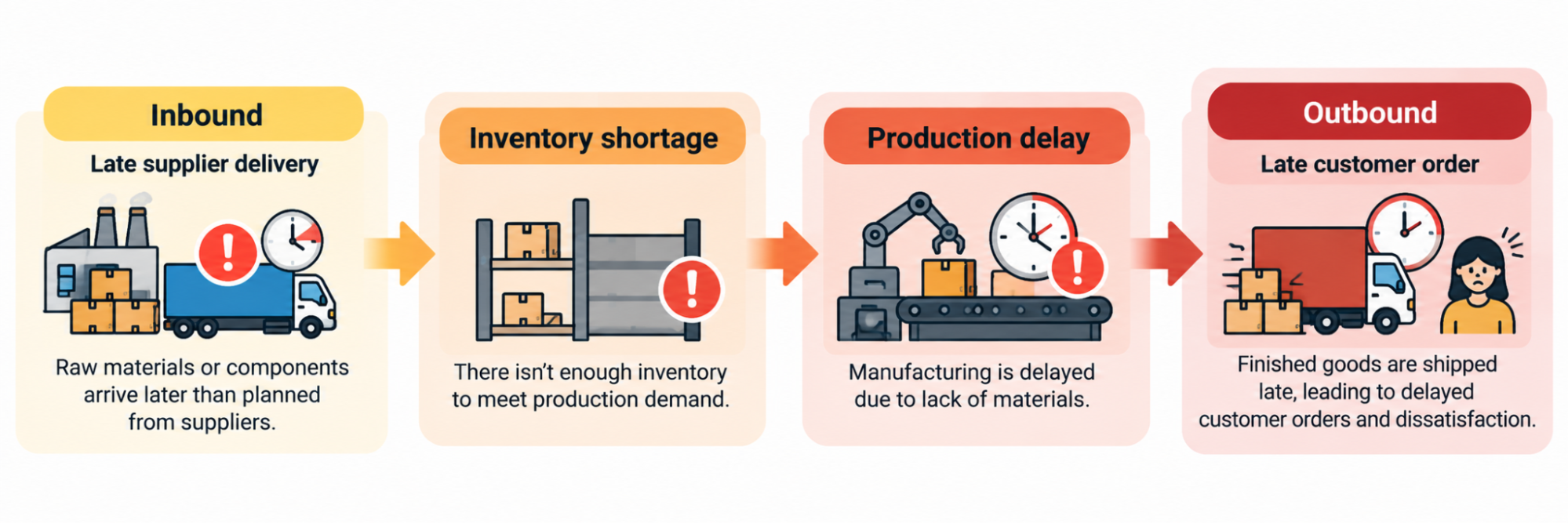
Poor inbound planning → Inventory shortage → Production delay → Outbound fulfillment delay
If a supplier delivery arrives late or short, production lacks the materials it needs. Finished goods aren’t ready on time, so customer orders ship late even when the outbound team performs perfectly.
What are the Main Activities in Inbound Logistics?
Inbound logistics activities cover everything that happens as goods enter an organization. Each one reduces a specific risk, from late deliveries to inaccurate stock records.
Supplier and Purchase Order Coordination
Supplier coordination sets clear expectations before anything ships. It lets the business plan labor, dock space and storage in advance. Businesses typically align:
- Purchase orders: what is being bought, at what price and on what terms
- Supplier schedules: when goods will be ready to ship
- Delivery quantities: full orders or partial shipments
- Expected arrival times: the date or time window at the facility
Transportation and Receiving
This stage brings inbound shipments to the facility and through the dock without congestion or errors. It is where planned deliveries meet physical reality. The main tasks are:
- Delivery scheduling: booking arrival slots so trucks don’t arrive all at once
- Dock management: assigning doors, equipment and labor to each arrival
- Unloading: moving goods safely from the vehicle to a receiving area
- Shipment verification: matching the delivery to the purchase order, packing list or advance shipping notice
Inspection and Quality Checks
Inspection confirms that incoming goods match the order before they enter stock. Catching a problem at the dock is usually easier than finding it during production or after a customer complaint. Depending on the product, goods may be checked for:
- Quantity: the count matches the order
- Damage: goods and packaging arrived intact
- Quality: goods meet the required standard
- Specifications: correct item, size, grade or version
- Documentation: invoices, packing lists and certificates are complete
Some businesses inspect every delivery; others sample-check suppliers with a strong track record.
Putaway and Inventory Management
Putaway moves accepted goods from the receiving area to assigned storage locations. The inventory system records each item’s location and quantity so it can be found and used.
Locations may be assigned by product type, demand, size or storage conditions. Faster putaway frees dock space and makes stock available sooner.
Key point: Inbound logistics does not end when a truck reaches the warehouse. Goods must be received, verified, stored and made available for the next operation.
What are the Main Activities in Outbound Logistics?
Outbound logistics activities move finished products toward the customer. Each step protects speed, accuracy or delivery reliability.
Order Processing and Inventory Allocation
Order processing confirms that a customer order is valid and can be fulfilled. Orders are checked for products, quantities, delivery address and payment or credit terms.
The system then allocates the order against available inventory. Allocation reserves that stock so it isn’t promised to another customer.
Picking and Packing
Picking and packing turn reserved inventory into a shipment ready to leave the building. Mistakes here reach the customer directly, so warehouse teams or automated systems:
- Pick the required products from storage
- Verify quantities against the order
- Pack shipments to protect goods in transit
- Prepare documentation such as packing slips, labels and invoices
Shipping and Transportation
Shipping moves packed orders out of the facility and into the transport network. Orders are first staged by carrier, route or dispatch time, then loaded onto vehicles.
Once dispatched, shipments are transported by the company’s own fleet, a carrier or a third-party logistics (3PL) provider to their destinations.
Final Delivery and Returns
Final delivery completes the outbound flow. Confirmation may come from a signature, photo, barcode scan or carrier update, which closes the order and supports invoicing.
Some products come back damaged, incorrect or unwanted. These returns start reverse logistics, where goods are inspected and then restocked, repaired or disposed of.
Key point: Outbound logistics focuses on getting the right finished product to the right destination at the right time.
What are Some Examples of Inbound and Outbound Logistics?
These inbound and outbound logistics examples show how the same two flows apply across industries. Each one identifies which side of the flow it represents.
Inbound Logistics Example in Manufacturing
Consider a manufacturer of brake assemblies that buys steel and components from several suppliers. Getting those materials into the factory and ready for use is inbound logistics:
Supplier → Steel/components → Factory → Receiving → Quality check → Production inventory
The receiving team checks counts and material certificates. Accepted materials are stored as production inventory, ready for the assembly line.
Outbound Logistics Example in Manufacturing
Once the brake assemblies are finished, outbound logistics takes over. The flow now runs from finished stock to the buyer:
Finished product → Warehouse → Customer order → Picking → Shipping → Customer
Finished units move into the finished-goods warehouse. When a distributor places an order, the warehouse picks and packs the units, and a carrier delivers them.
Inbound and Outbound Logistics in E-Commerce
E-commerce shows both flows clearly, because one fulfillment center typically handles bulk receipts and individual orders. The two sides look like this:
- Inbound: Products arrive from suppliers, often in cartons or on pallets, and are stored in the fulfillment center.
- Outbound: Customer orders are picked, packed and shipped to individual customers, usually as parcels.
Inbound and Outbound Logistics in Retail
Retailers run both flows through distribution centers, stores or both. Which flow applies depends on the facility you look from:
- Inbound: The retailer receives products from manufacturers or distributors at a distribution center or directly at stores.
- Outbound: The distribution center ships products to stores or sends online orders to customers.
A store delivery is therefore outbound for the distribution center but inbound for the store.
How do Companies Measure Inbound and Outbound Logistics?
Inbound and outbound logistics metrics show where each flow performs well and where it slows the business down. Tracking both sides makes it easier to trace a problem to its source.
Inbound Logistics Metrics
Inbound metrics focus on supplier reliability and how quickly and accurately goods enter stock. They help spot delays and errors before they affect production or customer orders.
| Metric | What It Measures | Why It Matters |
|---|---|---|
| Supplier on-time delivery | Deliveries arriving on the agreed date or window | Flags suppliers that put stock availability at risk |
| Receiving time | Time to unload, check and record a delivery | Slow receiving delays production and fulfillment |
| Receiving accuracy | Receipts recorded with the correct item and quantity | Receiving errors carry into every later process |
| Inbound transportation cost | Cost of moving goods from suppliers to the facility | Adds to the landed cost of goods |
| Inventory accuracy | Match between system records and physical stock | Outbound teams rely on it to promise orders |
Outbound Logistics Metrics
Outbound metrics show how quickly, accurately and affordably orders reach customers. They are usually the measures customers notice first.
| Metric | What It Measures | Why It Matters |
|---|---|---|
| Order fulfillment time | Time from order receipt to shipment or delivery | Shapes delivery promises |
| On-time delivery | Orders delivered by the promised date | Measures reliability from the customer’s view |
| Order accuracy | Orders shipped with the correct items and quantities | Errors cause returns, reshipments and complaints |
| Picking accuracy | Picks with the correct item and quantity | Shows where order errors start |
| Shipping cost | Cost to deliver an order or unit | Directly affects margin per sale |
| Perfect order rate | Orders delivered complete, on time, undamaged and correctly documented | Combines several measures into one view of service |
Why These Metrics Matter Together
Inbound and outbound metrics are linked through inventory. Improving one side in isolation can shift a problem rather than solve it.
For example, faster outbound fulfillment is difficult if inbound logistics cannot maintain adequate inventory availability. Quicker picking doesn’t help when the item isn’t in stock.
The reverse also applies. Cutting inbound freight costs with fewer, larger deliveries can raise storage needs or leave stock gaps. Reviewing both sets of metrics together shows whether a change helps the whole flow.
How can Businesses Improve Inbound and Outbound Logistics?
The most effective improvements target the points where goods and information pass between suppliers, the warehouse and customers. The four areas below strengthen both flows.
Improve Supplier and Delivery Coordination
Inbound reliability depends on suppliers delivering the right goods at the expected time. Better coordination reduces surprises at the dock.
Practical steps include sharing demand forecasts, requesting advance shipping notices and booking delivery appointments. Regular reviews of supplier performance help resolve recurring issues early.
Improve Warehouse Visibility
Visibility means knowing what stock is on hand, where it is and what is already committed to orders. These tools keep that information accurate across receiving, storage and fulfillment:
- Real-time inventory tracking: updates stock levels as goods are received, moved or shipped
- Barcode scanning: confirms items and locations at receiving, putaway and picking
- RFID: reads tags without direct line of sight, speeding up receiving and counts
- Warehouse management systems (WMS): direct tasks and keep one inventory record across both flows
Automate Repetitive Logistics Tasks
Automation suits high-volume, repetitive work where speed and consistency matter. The right level depends on order volume, product mix and budget. Common uses include:
- Receiving: scanners and dimensioning systems capture item data quickly
- Putaway: systems direct or move goods to assigned locations
- Picking: pick-to-light, goods-to-person systems or robots reduce walking and errors
- Sorting: conveyors and sorters route items to the right order or dock
- Packing: automated systems select and prepare the right carton
- Shipment tracking: carrier integrations update teams and customers automatically
Use Data to Optimize Transportation
Transportation is a major cost in both inbound and outbound logistics. Shipment and carrier data shows where time and money are being lost and can improve:
- Route planning: more efficient routes for deliveries and supplier pickups
- Shipment consolidation: combining smaller loads into fuller vehicles
- Delivery scheduling: matching arrivals and departures to dock capacity
- Transportation costs: comparing carriers, modes and lanes
Key point: The goal is not simply to make inbound or outbound logistics faster. It is to create a coordinated flow of goods, information and inventory across the supply chain.
Frequently Asked Questions
How can businesses reduce inbound logistics costs?
Consolidate supplier shipments, negotiate freight terms, schedule deliveries to avoid waiting time at the dock and reduce receiving errors that cause rework.
What causes delays in inbound logistics?
Common causes include late supplier dispatch, transport disruptions, missing paperwork, dock congestion and slow inspection or putaway.
How can companies improve supplier performance in inbound logistics?
Set clear delivery requirements, share forecasts, track on-time delivery and accuracy, and review the results with suppliers regularly.
How does inventory accuracy affect inbound and outbound logistics?
Inaccurate records cause wrong reorders on the inbound side and broken order promises on the outbound side. Both flows depend on a trustworthy stock count.
What is the role of a warehouse management system in inbound and outbound logistics?
A WMS directs and records receiving, putaway, picking, packing and shipping, keeping one accurate inventory view across both flows.
How can businesses coordinate inbound and outbound shipments?
Plan dock schedules for both flows together, separate receiving and shipping doors or time slots, and share inventory data. Some operations use cross-docking to move inbound goods straight onto outbound vehicles.
How do inbound logistics affect customer order fulfillment?
Orders can only ship from stock that has been received and recorded. Late or inaccurate inbound deliveries lead to stockouts, backorders and delayed shipments.
What is the difference between inbound and outbound transportation?
Inbound transportation brings goods from suppliers to the business. Outbound transportation carries finished goods from the business to customers or distribution points.
How can companies reduce outbound shipping costs?
Right-size packaging, consolidate orders, compare carriers and service levels, optimize routes and cut the errors that cause reshipments.
How does automation improve warehouse inbound and outbound processes?
It speeds up repetitive tasks such as scanning, picking and sorting, reduces manual errors and keeps inventory data current.
How can businesses improve on-time delivery in outbound logistics?
Keep inventory accurate, set realistic order cut-off times, monitor carrier performance and track shipments to resolve delays early.