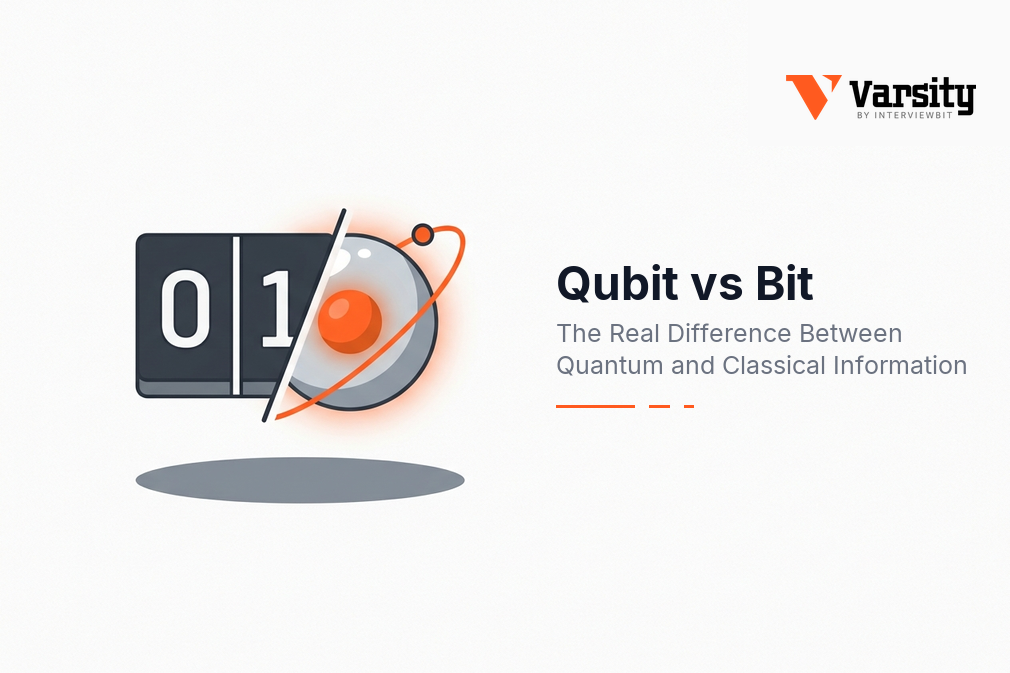
Qubit vs Bit: The Real Difference Between Quantum and Classical Information

Key Insights
- A classical bit always holds one definite value, 0 or 1, and can be read and copied freely. A qubit’s state is described by two complex amplitudes, α and β, where |α|² + |β|² = 1.
- Measuring a qubit returns a single 0 or 1. The amplitudes only set the odds, so one measurement can never reveal a qubit’s full state.
- Describing n qubits takes up to 2ⁿ amplitudes, yet Holevo’s bound caps what can be read out at n classical bits, or 2n with pre-shared entanglement.
- Quantum speedups come from interference that amplifies useful answers and cancels wrong ones, not from reading every possible answer at once.
- Error correction is the central bottleneck. On Google’s Willow chip, a 101-qubit surface code protected one logical qubit at 0.143% error per cycle, with errors falling 2.14 times at each step up in code size.
- Hardware is scaling but not yet fault tolerant. Caltech has trapped 6,100 atom qubits with about 13 seconds of coherence, and Quantinuum’s 98-qubit Helios reports about 99.92% two-qubit gate fidelity.
- Verified quantum advantage is still narrow. Google’s 2025 Quantum Echoes experiment produced results estimated to take about 13,000 times longer on a leading supercomputer, but on a physics benchmark, not a commercial task.
- The threat to encryption is real but future-facing. A 2025 estimate puts RSA-2048 within reach of under one million noisy qubits running for under a week, and NIST approved three post-quantum standards in August 2024.
- Classical bits still run nearly all computing. Qubits are a specialized tool, most often used today inside hybrid quantum-classical workflows.
Every digital system runs on bits. A classical bit is the basic unit of information, and it stores exactly one value: 0 or 1.
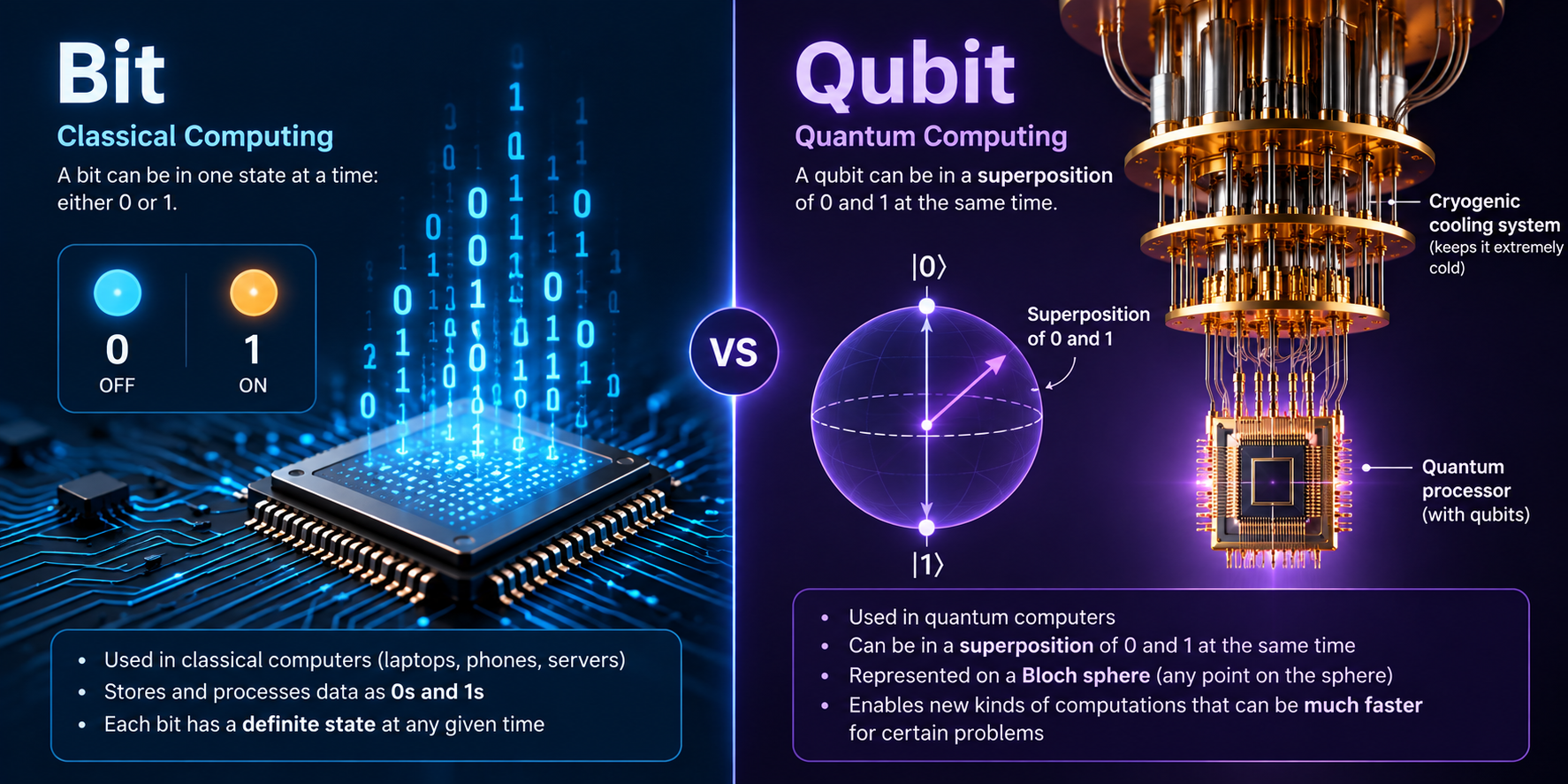
A qubit, or quantum bit, is the basic unit of quantum information. It can exist in a quantum superposition of 0 and 1.
That difference changes the rules. Qubits follow quantum mechanics, so measurement, superposition, and entanglement shape how they behave. A qubit doesn’t simply store more data than a bit; it supports different kinds of computation.
This guide compares qubit vs bit side by side: how each represents information, how gates process it, and what happens when you measure it.
How do Bits and Qubits Work?
Bits and qubits both encode information, but in fundamentally different ways. A bit always holds a definite 0 or 1, while a qubit can be prepared in a quantum state that combines both basis states.
Both are processed by gates. Classical logic gates follow Boolean rules, while quantum gates follow the physics of quantum states.
What is a Classical Bit?
A bit is the smallest standard unit of digital information. It takes one of two values, 0 or 1, and keeps that value until an operation changes it.
Strings of bits encode everything digital: numbers in binary, text as character codes, and images as pixel values. The binary number 1011, for example, contains four bits and equals 11 in decimal.
Inside chips, transistors act as switches, and circuits read voltage levels as 0 or 1. Logic gates such as AND, OR, and NOT combine these signals into arithmetic and decisions.
What is a Qubit in Quantum Computing?
A qubit is the basic unit of quantum information. Its state lives in a two-dimensional space built from the computational basis states |0⟩ and |1⟩, and a general pure state combines both:
|ψ⟩ = α|0⟩ + β|1⟩
Here, α and β are complex probability amplitudes, with |α|² + |β|² = 1. A computational-basis measurement gives 0 with probability |α|² and 1 with probability |β|².
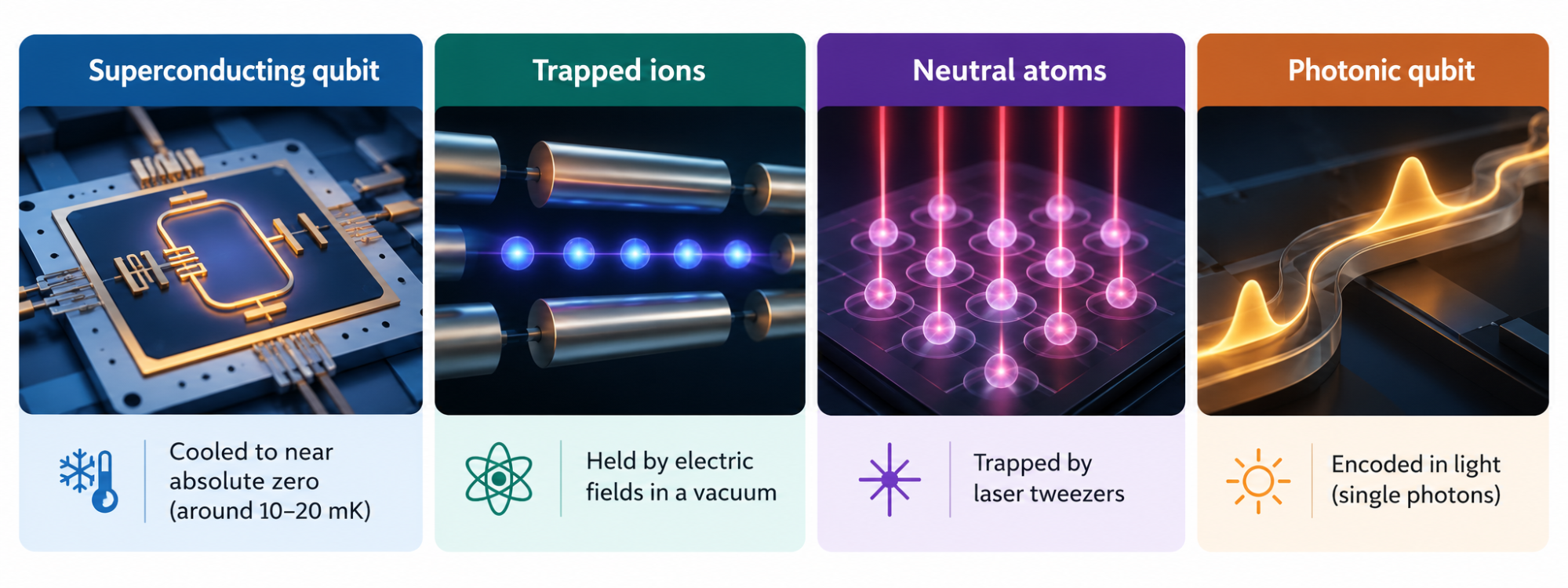
Physical qubits are built from superconducting circuits, trapped ions, neutral atoms, photons, and other controllable quantum systems.
Key point: A qubit isn’t a bit that flips quickly between 0 and 1. It can occupy states that have no classical-bit equivalent.
Qubit vs Bit: What are the Key Differences?
Bits and qubits both represent information, but they differ in state representation, measurement, copying, and the operations they support. These differences shape how classical and quantum computers process data, as the table below shows feature by feature.
| Feature | Classical Bit | Qubit |
|---|---|---|
| Basic unit | Classical information | Quantum information |
| Possible basis states | 0 or 1 | |0⟩ or |1⟩ |
| General state | One definite binary value | Quantum superposition of basis states |
| Measurement | Reads the stored value (ideal model) | Gives an outcome with probabilities set by the state |
| Operations | Classical logic gates | Quantum gates and quantum measurement |
| Copying | Can be copied freely | An unknown state cannot be perfectly cloned |
| Correlations | Classical correlations | Can also show quantum entanglement |
| Error handling | Classical error detection and correction | Quantum error correction protects states and their correlations |
| Hardware | Transistors and digital circuits | Quantum systems such as superconducting circuits, ions, atoms, or photons |
| Main role | Everyday computing and digital data processing | Quantum algorithms and quantum information processing |
Key point: Qubits are not universally better than bits. Classical computers remain the practical choice for most everyday tasks, while quantum computers may offer advantages for specific problems.
How does Superposition Make Qubits Different From Bits?
Superposition lets a qubit occupy a combination of |0⟩ and |1⟩ rather than one definite value. It is the main reason quantum information can’t be treated as ordinary binary data.
It is not a classical mixture. A random classical bit is secretly 0 or 1, while a qubit’s amplitudes carry phases that can interfere. Measurement still returns one definite outcome, never both values.
What does a Qubit in Superposition Look Like?
The simplest example is the equal superposition, often called the plus state. It gives both computational basis states the same amplitude, 1/√2, so neither outcome is favoured:
|+⟩ = (|0⟩ + |1⟩) / √2
Measuring it in the computational basis gives 0 or 1 with equal 50% probability. Yet it isn’t a randomly stored bit: a Hadamard gate turns |+⟩ back into |0⟩ every time.
Relative phase matters too. The minus state, (|0⟩ − |1⟩) / √2, has the same measurement odds, but a Hadamard gate sends it to |1⟩ instead.
How does Superposition Help Quantum Computing?
Quantum gates rotate and recombine amplitudes, much like overlapping waves. Aligned amplitudes add up through constructive interference, while amplitudes with opposite signs cancel through destructive interference.
Algorithms are designed so wrong answers cancel and useful answers grow before measurement. Superposition alone guarantees no speedup; without the right interference, measurement simply returns a random result.
How does Measurement Affect Bits and Qubits?
Reading a classical bit reveals its value without changing it, in the ideal model. Measuring a qubit is different: the outcome depends on the state and the chosen measurement, and measuring can change the state.
A computational-basis measurement returns 0 or 1 with probabilities set by the amplitudes. Estimating those probabilities takes many measurements on identically prepared qubits.
What happens When You Measure a Qubit?
Measure the plus state in the computational basis, and you get 0 or 1 with equal probability. In an ideal projective measurement, the qubit then collapses to match: read 0, and it is now |0⟩.
The basis matters. Measure |+⟩ in the plus/minus basis instead, and you get “+” every time. The same state can look random or certain depending on the measurement.
Why can’t You Read All of a Qubit’s Information at Once?
One measurement returns one classical bit, while α and β are continuous complex numbers. A single outcome can’t reveal them, and measuring disturbs the state you wanted to learn.
Quantum state tomography rebuilds a state by measuring many identical copies in several bases, but its cost grows quickly with qubit count. Algorithms are therefore designed to end where one measurement gives a useful answer with high probability.
Key point: Quantum computation never lets you read all amplitudes as classical answers in a single measurement.
What is the Difference Between Quantum and Classical Gates?
Classical gates apply Boolean logic to definite bits. Quantum gates transform whole qubit states, changing amplitudes and phases to create the interference and entanglement that algorithms rely on.
Quantum gates are also reversible, and they don’t simply compute 0 and 1 the way classical gates do.
Common Classical Logic Gates
Classical logic gates take one or two input bits and return one output bit by fixed rules. These four gates are the building blocks of digital circuits:
- AND: outputs 1 only when both inputs are 1.
- OR: outputs 1 when at least one input is 1.
- NOT: reverses a single bit, turning 0 into 1 and 1 into 0.
- XOR: outputs 1 when the two inputs differ.
The AND truth table below lists every possible input pair. It shows how a classical gate maps definite inputs to one definite output.
| Input A | Input B | AND output |
|---|---|---|
| 0 | 0 | 0 |
| 0 | 1 | 0 |
| 1 | 0 | 0 |
| 1 | 1 | 1 |
Three input pairs give 0, so the output can’t reveal the inputs. Quantum gates, by contrast, are always reversible.
Common Quantum Gates
Quantum gates are reversible operations on qubit states. Some resemble classical gates, while others change phases or create superpositions that have no classical counterpart:
- Pauli-X gate: swaps |0⟩ and |1⟩, similar to a NOT operation on the basis states.
- Hadamard gate: turns |0⟩ into |+⟩ and |1⟩ into |−⟩, transforming a basis state into a superposition.
- Pauli-Z gate: flips the sign of the |1⟩ component, changing its phase while leaving |0⟩ alone.
- CNOT gate: a two-qubit gate that flips the target qubit when the control qubit is 1.
Every quantum gate is unitary, so it keeps total probability equal to 1 and can always be undone.
How do Multiple Qubits Differ From Multiple Bits?
Adding bits grows classical storage in a simple way: n bits hold exactly one of 2ⁿ possible strings at a time. The joint state of n qubits is described by amplitudes across all 2ⁿ basis states.
That description grows fast. Just 65 qubits need 2⁶⁵ amplitudes, more than any supercomputer can store exactly, yet one measurement still returns only one bit string.
How Much Information Can Bits and Qubits Represent?
Two classical bits hold exactly one of four strings at a time: 00, 01, 10, or 11. Two qubits can occupy a superposition across the four matching basis states, |00⟩, |01⟩, |10⟩, and |11⟩.
But amplitudes aren’t readable information.Holevo’s bound shows that n qubits can convey at most n classical bits, or 2n with pre-shared entanglement. Two qubits don’t store four readable bits.
What is Quantum Entanglement?
Entanglement is a quantum correlation in which a joint state can’t be written as a product of independent single-qubit states. The best-known example is a Bell state:
|Φ⁺⟩ = (|00⟩ + |11⟩) / √2
Measured in the computational basis, it gives 00 or 11, each with 50% probability. The two results always match, and 01 or 10 never appear.
Entanglement doesn’t allow faster-than-light communication. Each side sees random results on its own; the correlation appears only when results are compared over an ordinary classical channel.
Why are Qubits Important for Quantum Computing?
Qubits let quantum algorithms combine superposition, interference, and entanglement in ways classical bits cannot. In a circuit, qubits start in a known state, pass through gates, and are then measured.
The algorithm’s job is to make the right answer likely at that final measurement, and any benefit depends on the problem being solved.
Proven advantages remain narrow. Google’s 2025 Quantum Echoes experiment on 65 qubits produced results estimated to take about 13,000 times longer on a leading supercomputer, but on a physics benchmark, not a commercial task.
Problems Quantum Computers May Help Solve
Research targets areas where quantum physics or problem structure gives qubits a plausible edge. Each area below sits at a different level of maturity:
- Quantum simulation: modelling molecules, materials, and other quantum systems that are hard to simulate classically at scale.
- Cryptography: Shor’s algorithm could break RSA on a large fault-tolerant machine. A 2025 estimate puts RSA-2048 at under one million noisy qubits running for under a week.
- Optimization: quantum and hybrid methods for selected optimization problems, with no broad, proven advantage yet.
- Search and sampling: Grover’s algorithm offers a quadratic speedup for unstructured search, under specific assumptions.
Why can’t Quantum Computers Replace Classical Computers?
Quantum computers are specialized machines, not faster PCs. They rely on classical computers for control, compilation, and processing results, and they help only with certain problems.
Today’s hardware is noisy and costly, and large-scale error correction is still being built. Most everyday tasks gain nothing from it, and any claimed advantage must beat the best classical methods, which keep improving.
Key point: Qubits make new computational approaches possible; they do not make every computation faster.
What are the Practical Challenges of Working With Qubits?
Classical bits are robust: digital circuits hold and copy them with tiny error rates. Many physical qubits are fragile, disturbed by heat, noise, and stray fields, and every gate and measurement adds a small error that accumulates.
So more physical qubits don’t automatically mean more computing power. Quality, connectivity, and error correction matter as much as raw count.
What is Quantum Decoherence?
Decoherence is the loss of quantum coherence through unwanted interaction with the environment. As it sets in, superpositions decay into classical mixtures and interference stops working.
Platforms counter it with isolation, cooling, and precise control. A NIST and Chalmers team reset a superconducting qubit to 22 mK, colder than the 40–49 mK of earlier reset methods.
Coherence also varies by platform. Caltech’s 6,100-atom array kept qubits in superposition for about 13 seconds while controlling them with 99.98% accuracy.
How does Quantum Error Correction Work?
Classical systems protect data with backup copies, but the no-cloning theorem forbids perfect copies of an unknown quantum state. Quantum error correction instead spreads one logical qubit across many physical qubits.
Repeated checks on helper qubits detect errors without directly measuring the encoded data. A physical qubit is one hardware device; a logical qubit is the error-protected unit that algorithms use.
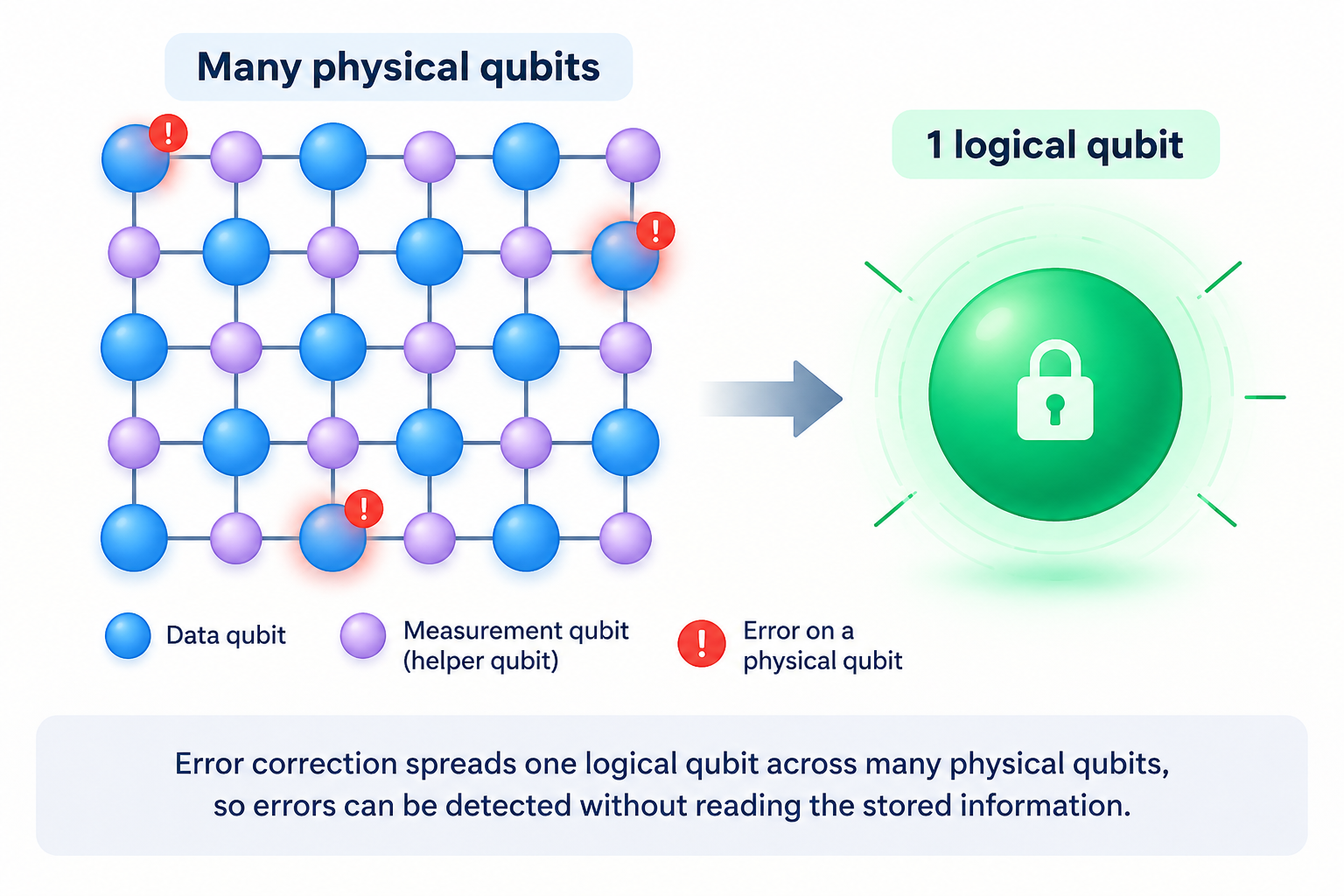
The overhead is large. On Google’s Willow chip, a 101-qubit code protected one logical qubit at 0.143% error per cycle, with errors falling 2.14 times at each step up in code size.
Key point: The challenge is not merely creating qubits; it is controlling them reliably enough to perform useful computations.
How do You Decide Whether a Bit or Qubit Is Needed?
Bits are the right choice for nearly all conventional computing, from websites to databases. Qubits matter only when a problem suits a quantum algorithm and suitable hardware or a cloud quantum service is available.
The table below matches common use cases to the better approach.
| Use case | More suitable approach | Why |
|---|---|---|
| Websites and mobile apps | Classical bits | Efficient, mature hardware and software |
| Storing documents and photos | Classical bits | Reliable digital storage and retrieval |
| Everyday arithmetic | Classical bits | Fast and practical for ordinary workloads |
| Simulating quantum molecules | Quantum methods may help | Quantum systems are difficult to simulate classically at scale |
| Exploring quantum algorithms | Qubits or simulators | Allows experimentation with quantum state transformations |
| Large-scale business data processing | Usually classical computing | Established systems are broadly efficient and accessible |
Can Classical and Quantum Computers Work Together?
Yes, and most practical quantum work today is hybrid. The classical side handles everything around the circuit, while the quantum processor runs only the part that benefits from qubits. A typical loop runs in four steps:
- A classical computer prepares the data and builds the quantum circuit.
- The quantum processor runs the circuit and returns measurement results.
- The classical computer processes the results and tunes the circuit’s parameters.
- The loop repeats until the answer converges.
Hybrid systems remain an active research area, and practical gains depend on the workload.
Key point: The useful question is not which technology is universally better, but which computational model best fits the problem.
Key Takeaways: Qubit vs Bit
Bits and qubits both carry information, but they follow different physical rules and suit different jobs. These six points sum up the core qubit vs bit comparison:
- A bit is a classical information unit with a value of 0 or 1.
- A qubit is a quantum information unit that can occupy superposition states.
- Measuring a qubit produces a definite outcome, with probabilities determined by its state and the measurement.
- Superposition and entanglement do not automatically guarantee a computational speedup.
- Classical bits remain essential for everyday computing, while qubits support specialized quantum algorithms.
- Quantum computers may provide advantages for selected problems, but practical usefulness depends on hardware, error rates, and the algorithm.
Frequently Asked Questions About Qubits and Bits
How are qubits physically created in quantum computers?
Qubits are built from physical systems with two well-controlled states. Engineers fabricate superconducting circuits, trap ions or neutral atoms with fields and lasers, or encode qubits in photons, then steer them with precise pulses.
What are the different types of qubits used in modern quantum hardware?
The main types are superconducting qubits, trapped ions, neutral atoms, photonic qubits, and silicon spin qubits, each trading off speed, connectivity, and coherence.
for example, uses trapped barium ions at about 99.92% two-qubit gate fidelity.
Why do quantum computers require extremely precise environmental control?
Quantum states fade when heat, vibration, or stray fields disturb them. Superconducting qubits run at millikelvin temperatures, while ion and atom systems need ultra-high vacuum and stable lasers. Imprecise control pulses add errors too.
Can classical bits and qubits communicate with each other?
Yes. Classical bits decide how qubits are prepared and which gates run, and measurement turns qubit states back into classical bits. Quantum teleportation even moves a qubit’s state using shared entanglement plus two classical bits.
How does quantum information differ from ordinary digital data storage?
Digital data can be stored for years, copied freely, and read without change. Quantum information can’t be cloned, is disturbed by measurement, and lasts only briefly, so qubits act as processors, not storage drives.
Why is it difficult to scale quantum computers to thousands of reliable qubits?
Each added qubit brings more wiring, calibration, crosstalk, and cooling load, while error rates must stay below the error-correction threshold everywhere. Caltech has trapped 6,100 atom qubits, but reliable error-corrected logic at that scale is the next hurdle.
What is the difference between a physical qubit and a logical qubit?
A physical qubit is one hardware device, such as a superconducting circuit or trapped ion. A logical qubit is encoded across many physical qubits with error correction, forming the reliable unit large algorithms need.
How do quantum computers handle noise during calculations?
Current machines combine better hardware, error mitigation, and error correction. Mitigation reduces noise statistically, for example by extrapolating to zero noise, while error correction detects and fixes errors in real time.
Can quantum computers process ordinary files, images, and databases directly?
Not efficiently. Loading large datasets into qubits is slow, and each measurement returns only a few classical bits. Classical systems handle files and databases, while quantum processors take on compact, well-structured subproblems.
How does quantum entanglement help quantum computers process information?
Entanglement links qubits so gates shape their joint state, and algorithms pair those correlations with interference to reach useful answers. Weakly entangled circuits are usually easy to simulate classically, so entanglement is necessary but not sufficient for a speedup.
What are the biggest misconceptions about qubits and quantum computing?
Common myths are that a qubit stores readable 0 and 1 values at once, that quantum computers try every answer in parallel, and that more qubits always mean more power.
Another is that quantum computers will replace PCs. Measurement, error rates, and algorithm design make each claim misleading.