Quantum Computing Basics: A Simple Guide for Beginners

What is Quantum Computing, in Simple Terms?
Quantum computing basics come down to one idea: instead of processing information the way your laptop does, quantum computers use the rules of quantum mechanics to represent and manipulate information. That’s the whole concept in a sentence , everything else is detail.
Classical computers, including the one you’re reading this on, store information as bits. A bit is either 0 or 1, and every program you’ve ever run , every spreadsheet, every video call, every game is built from long strings of these two values switching on and off billions of times per second.
Quantum computers use a different building block: the qubit. Qubits behave according to the laws of quantum mechanics, which gives quantum algorithms access to phenomena that classical bits simply don’t have superposition, entanglement, and interference. These aren’t buzzwords for the sake of sounding impressive; they’re the actual mechanisms that let certain quantum algorithms solve specific problems more efficiently than any known classical approach.
That word “specific” matters a lot. Quantum computers are not simply faster laptops, and they’re not a replacement for the computer in your pocket or under your desk. They’re a different kind of computational tool, useful for a narrow but genuinely important class of problems and not useful, at least with current technology, for most of what computers do every day.
How is quantum computing different from a normal computer?
Bits vs qubits — the core difference
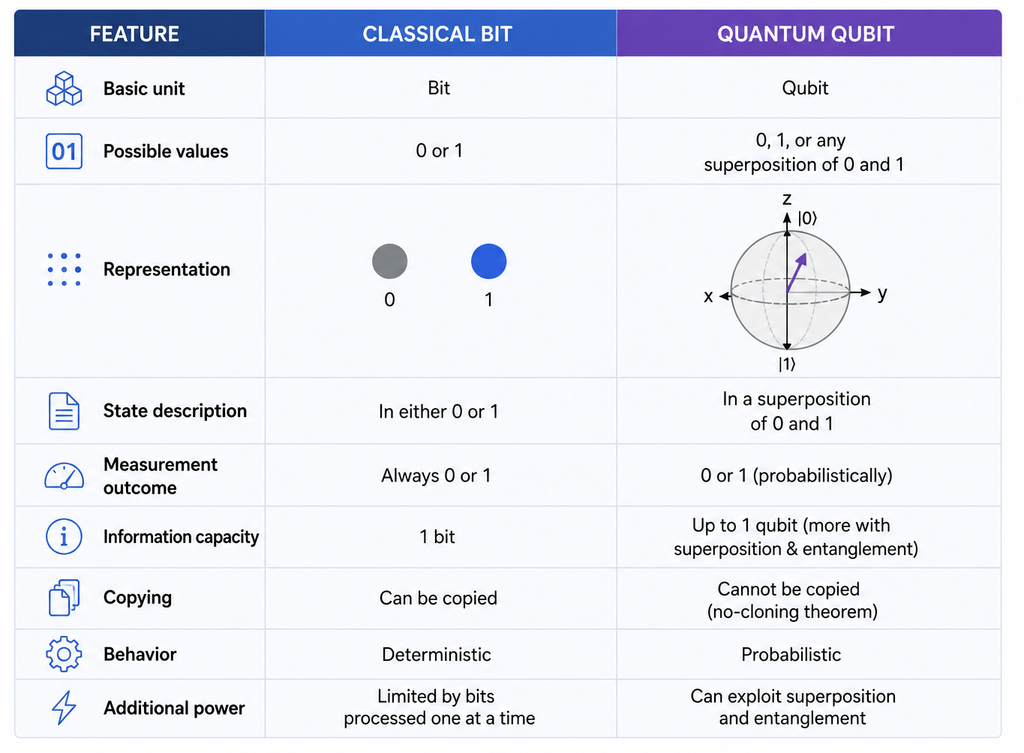
A classical bit is like a light switch. It’s either off (0) or on (1), full stop. A qubit is more like a dimmer switch that can hold a blend of both states at once, at least until you measure it — at which point it settles into a definite 0 or 1. This blended state is what makes quantum computing behave so differently from anything a normal processor does, and it’s also what makes qubits far harder to build and control.
Quantum Computing vs Classical Computing: A Side-by-Side Comparison
Where a normal computer still wins
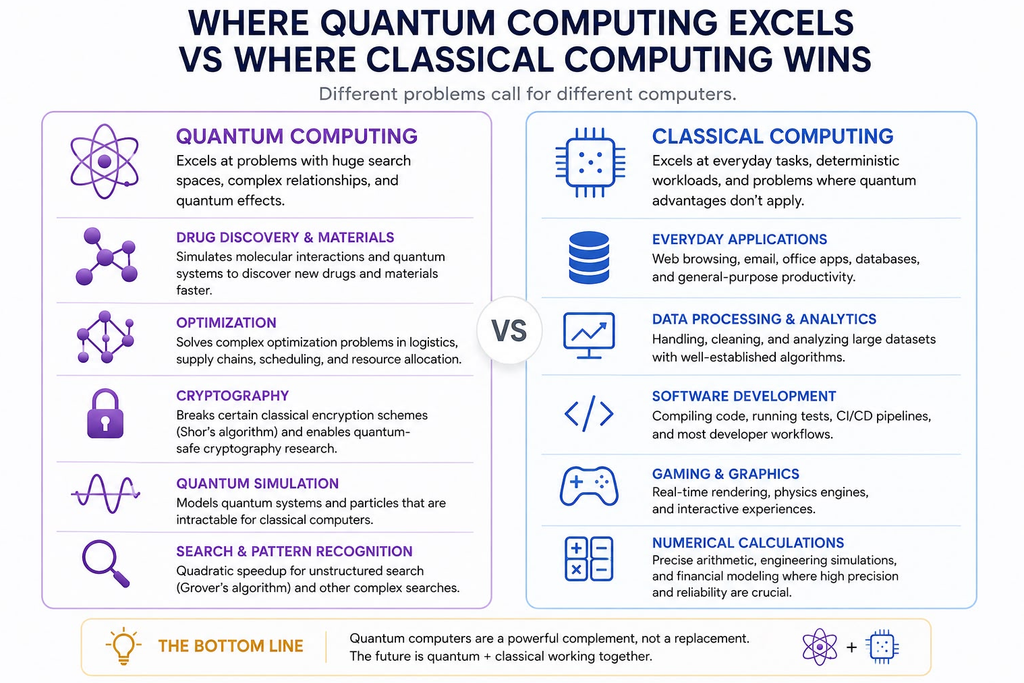
It’s worth being blunt here: for almost everything you do with a computer, a classical machine is the better, and often the only sensible choice. Email, websites, games, mobile apps, video streaming, and everyday business software all run on classical logic, and there’s no realistic scenario where quantum hardware takes over these jobs. Quantum computers aren’t on a path to replacing normal computers; they’re being developed to sit alongside them, handling a small set of problems that classical machines struggle with.
Qubits, superposition and entanglement (without the maths)
What is a qubit?
A qubit is the basic unit of quantum information, playing a role similar to a bit in classical computing. But where a bit always has one definite value, a qubit can exist in a state that blends 0 and 1 together, and it can also become linked to other qubits in ways that have no classical equivalent. Physically, qubits are built from things like superconducting circuits, trapped ions, or photons — each a genuinely difficult engineering feat to keep stable.
What is superposition?
A common way to picture superposition is a spinning coin. While it’s in the air, it isn’t simply heads or tails, it’s in a state that involves both possibilities. Once it lands, though, you get one definite outcome. Qubits work a bit like this: while they’re being processed, they exist in a state involving both 0 and 1, and only settle into a specific value when measured.
It’s tempting to describe this as a quantum computer “trying every possible answer at once,” but that framing is misleading. Superposition doesn’t hand a quantum computer the power to check every possibility for free — the real advantage comes from carefully designed algorithms that use interference to make correct answers more likely to appear and incorrect ones more likely to cancel out. It’s a subtler and more limited kind of parallelism than the popular explanation suggests.
What is entanglement?
Entanglement is a connection between qubits where their states become linked in a way that can’t be described as each qubit having its own independent, separate value. Measuring one entangled qubit tells you something about the state of the other, even though neither had a fixed value before measurement. This correlation is stronger and stranger than anything in classical physics, and it’s a key resource that quantum algorithms rely on. It doesn’t, however, let information travel instantly between the two qubits that popular idea is a misunderstanding of what entanglement actually does.
Why these explanations aren’t the full picture
Analogies like spinning coins are useful starting points for beginners, but they’re approximations, not the real physics. The actual mathematics of quantum mechanics involves complex probability amplitudes and behaviour that doesn’t map cleanly onto everyday objects. If you go on to study quantum computing more seriously, expect these simplified pictures to be replaced with more precise and more surprising ideas.
What is quantum computing actually used for?
Where is quantum computing actually used in drug discovery?
Molecules follow quantum mechanical rules, which makes them notoriously hard for classical computers to simulate accurately as they grow larger. Quantum computers, at least in theory, are naturally suited to modelling this kind of quantum behaviour, which is why researchers are exploring their use in drug discovery and computational chemistry. This remains largely a research direction rather than a solved industry practice current hardware can only simulate very small molecules with real precision, so don’t expect quantum-designed drugs on pharmacy shelves anytime soon.
Materials science in quantum computing
A similar logic applies to materials. Scientists hope quantum computers will eventually help model new battery chemistries, catalysts, and superconducting materials at a level of detail that’s currently out of reach. Some early experiments have shown promise on small, simplified systems, but simulating industrially useful materials at scale remains firmly in the research and development stage rather than something companies can rely on today.
Quantum computing uses in optimisation (logistics, routing, scheduling)
Optimisation problems like finding efficient delivery routes or scheduling shifts are another area of interest. Certain quantum algorithms may eventually offer advantages for specific optimisation structures, but this isn’t a blanket rule. Quantum computers don’t automatically speed up every optimisation problem, and many real-world logistics problems are still solved faster and more reliably by classical algorithms running on ordinary hardware.
Cryptography and security :Could quantum computing break today’s systems?
Some of the cryptographic systems that protect today’s internet traffic, including widely used public-key methods, rely on mathematical problems that a sufficiently powerful, fault tolerant quantum computer could theoretically solve much faster than any classical machine. No such machine exists yet, but the theoretical threat is serious enough that governments and standards bodies are already preparing defences well ahead of time.
What’s real today vs what’s still research
| Category | What it means | Examples |
| What quantum computers can do today | Run small, experimental algorithms on noisy hardware with limited qubits. | Research, testing, and benchmarking |
| What’s being actively researched | Scientists are working to make quantum computers more capable and reliable. | Chemistry simulations, error correction, specialised optimisation |
| What remains a future possibility | Applications that require large-scale, fault-tolerant quantum computers. | Breaking modern encryption, outperforming classical computers on major commercial problems |
| The bigger picture | Quantum computing applications are still being developed and tested. | Early lab results ≠ finished commercial technologies |
Why quantum computing worries security experts
The problem “harvest now, decrypt later”
Security researchers are concerned about a strategy sometimes called “harvest now, decrypt later.” The idea is that an attacker could intercept and store encrypted data today,
even without the ability to break it, and simply wait until quantum computers become powerful enough to decrypt it later. This makes long-lived sensitive data medical records, government communications, trade secrets , a target now, even though the decryption capability doesn’t exist yet.
What post-quantum cryptography is
Purpose: Protect sensitive data against quantum-powered attacks.
How it works: Uses mathematical problems that quantum computers are not currently known to solve efficiently.
Major milestone: In August 2024, NIST finalised its first post-quantum cryptography standards.
What they cover: Key exchange and digital signatures.
Why it matters now: Organisations with sensitive or long-lived data are encouraged to start migrating early, rather than waiting for powerful quantum computers to arrive.
Official guidance: NIST provides the standards and latest guidance through its Post-Quantum Cryptography project.
Quantum computing in India
The National Quantum Mission
India’s main government initiative in this space is the National Quantum Mission, approved by the Union Cabinet on 19 April 2023 under the Department of Science and Technology. It has a total outlay of roughly ₹6,003.65 crore, spread across the period from 2023–24 to 2030–31 — an eight-year program. The mission’s stated objectives include developing intermediate-scale quantum computers with somewhere between 50 and 1,000 physical qubits using platforms such as superconducting circuits and photonics, alongside goals in satellite-based quantum communication, inter-city quantum key distribution, and high precision quantum sensors. Four thematic hubs are being set up across the country to coordinate work in these different areas, with additional funding contributions from bodies including the Department of Space and the Department of Atomic Energy.
Which institutes and companies are working on it
- IITs — Research in quantum hardware, algorithms and applications.
- IISc — Quantum computing and quantum technology research.
- TIFR — Fundamental quantum science and technology research.
- Quantum startups — Developing quantum computing and communication technologies.
- Current stage: Much of India’s work is still in the research and prototype phase, rather than large-scale commercial deployment.
Should you learn quantum computing right now?
The honest answer
- Learn first, specialise later: For most readers, it makes sense to understand quantum computing before committing to it as a career.
- The industry is still small: Most quantum computing roles are research-focused and found in universities, national labs, and specialised companies.
- Advanced roles need specialised skills: Many positions expect a background in physics, mathematics, or a related field.
- Mainstream tech offers more opportunities: Software engineering, data science, and AI currently have far more job opportunities.
What to learn instead, and why it overlaps
| Focus on | Why it matters |
| Mathematics | Builds the foundation for quantum concepts and algorithms |
| Programming | Helps you work with quantum frameworks such as Qiskit |
| Core computer science | Gives you transferable skills for software and computing roles |
| Machine learning basics | Useful across today’s tech industry and increasingly relevant to quantum applications |
The key point: You don’t have to choose between “learning quantum computing” and “building practical skills.” These fundamentals are useful on their own and also form the foundation for specialising in quantum computing later.
Learn Quantum Computing Through a Structured Programme
If you want to move beyond quantum computing basics and explore how the technology is applied in practice, a structured programme can provide a useful next step. The IIT Delhi Continuing Education Programme in Applied Quantum Computing and AI covers several areas that are relevant to learners looking to build a stronger foundation:
- Quantum computing fundamentals — Understand the principles behind quantum technologies.
- Qiskit and practical learning — Get hands-on exposure to building and working with quantum circuits.
- Quantum algorithms and optimisation — Explore how quantum approaches can be applied to computational problems.
- Quantum hardware — Learn how quantum computing works beyond the software layer.
- Quantum cryptography and post-quantum cryptography — Understand the security implications of quantum technologies.
- Quantum computing and AI — Explore how quantum computing intersects with artificial intelligence and machine learning.
- Hands-on projects — Apply what you learn through practical projects rather than relying only on theory.
For readers serious about pursuing quantum computing as a career or area of study, structured learning can help turn foundational knowledge into practical skills. Explore the IIT Delhi Quantum Computing programme to deepen your understanding and build job-relevant expertise.
What is quantum computing in simple terms?
It’s a way of processing information using qubits, which follow the rules of quantum mechanics instead of behaving like ordinary 0-or-1 bits. This lets certain algorithms solve specific problems, like simulating molecules, more efficiently than classical computers can.
Is quantum computing available to use today?
Yes, through cloud platforms like IBM Quantum, but access and capabilities are limited. Current hardware is small-scale and noisy, and much of the field remains firmly in the research stage rather than everyday commercial use.
Will quantum computers replace normal computers?
No. Classical computers remain far better suited to everyday tasks like browsing, apps, and business software. Quantum computers are designed to handle a narrow set of specialised problems alongside classical machines, not to replace them.
Do I need to know physics to learn quantum computing?
Not for the basics — you can experiment with tools like Qiskit using just programming skills. Advanced, research-level work, however, generally requires stronger training in physics and mathematics.
What programming language is used for quantum computing?
Python is the most common choice, largely thanks to frameworks like IBM’s Qiskit, which let you design and run quantum circuits without needing to write low-level hardware instructions.
Are there quantum computing jobs in India?
Yes, but the field is still relatively small and research-focused, concentrated in institutions like the IITs, IISc, and TIFR, along with a growing number of startups. It’s an area to watch rather than a large employment market right now.