Quantum Machine Learning: Where Quantum Meets AI

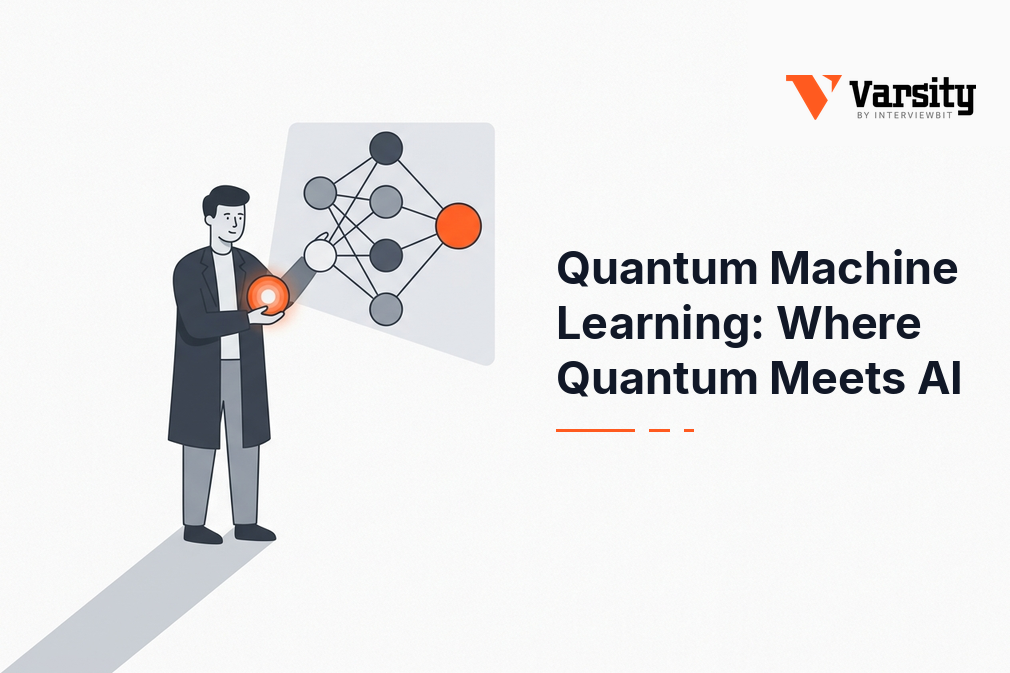
Quantum machine learning is the use of quantum computers to run part of a machine learning workflow, usually one specific step rather than the whole pipeline. It’s a research field today, not a production technology, and nothing in this article should be read as a claim that quantum machine learning currently beats classical machine learning on real-world tasks.
People are interested anyway because some of the math underneath machine learning, especially linear algebra on very high-dimensional data, looks structurally similar to the kind of math quantum computers are naturally suited to. That resemblance is where the excitement comes from. Whether it translates into a practical advantage is a separate question, and it’s the one this article spends most of its time answering honestly.
If you already understand quantum computing basics and quantum gates, you have enough background to follow everything below.
What Is Quantum Machine Learning?
QML is machine learning where a quantum computer handles one part of the process, most often a piece of the model’s training or feature calculation, while a classical computer manages everything else. It is not a wholesale replacement for machine learning; it’s an emerging combination of two fields, and today it’s overwhelmingly hybrid.
The three ideas worth holding onto from this section: QML is research-stage, it’s a component inside a larger classical workflow rather than a standalone system, and its appeal comes from a mathematical resemblance, not a demonstrated speed advantage.
How Classical Data Gets Into a Quantum Computer
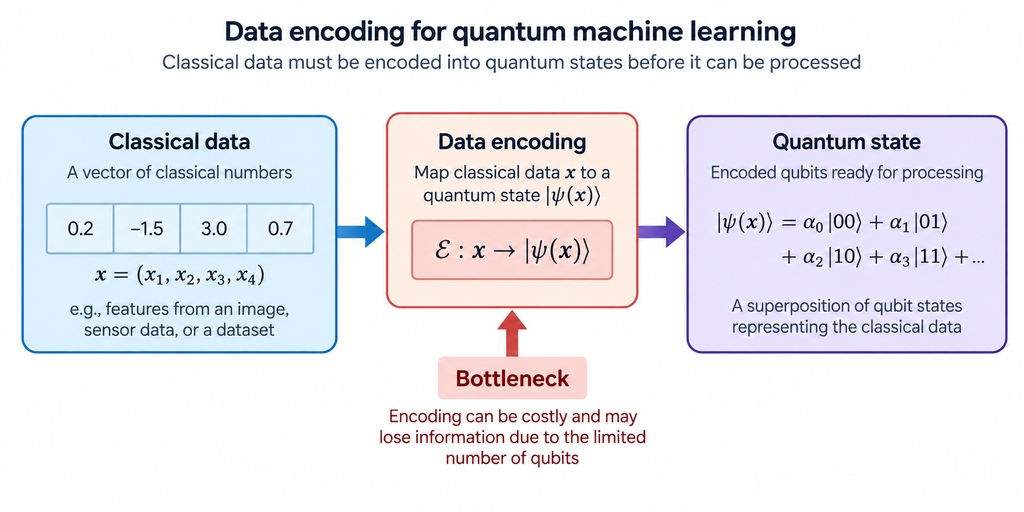
A quantum computer can’t open a CSV file. Every number in your dataset has to be converted into the physical state of a set of qubits before any quantum computation can touch it, and that conversion step is where a lot of QML’s promised advantages quietly disappear.
What Data Encoding Means
Encoding is the translation layer between your dataset and the quantum hardware. A classical machine learning model reads numbers directly from memory. A quantum circuit can only act on qubits, so your feature values first have to be written into the amplitudes, angles, or basis states of those qubits, a process usually handled by a small circuit called a feature map.
The Common Encoding Methods
Three encoding approaches show up repeatedly in QML work, and each makes a different trade-off between how many qubits you need and how expensive the encoding step becomes.
| Method | How it works | Trade-off |
| Basis encoding | Each classical bit maps directly to a qubit in the 0 or 1 state | Simple, but needs as many qubits as you have bits, so it scales poorly |
| Angle encoding | A data value is written into the rotation angle of a qubit | One qubit per feature, straightforward to build, but doesn’t compress data |
| Amplitude encoding | Data values are packed into the amplitudes of a superposition state | Can represent 2ⁿ numbers using just n qubits, which is why it gets so much attention |
Amplitude encoding is the one people get excited about because it looks like a shortcut: exponentially many numbers, loaded into a tiny number of qubits. The catch is in the next section.
Why Encoding Often Eats the Speedup
This is the single most important technical point in this article. Amplitude encoding’s exponential compression only means something if the state can actually be prepared efficiently. Loading n classical numbers into that compressed quantum state generally still takes work proportional to n, using standard techniques, on real hardware available today.
If preparing the quantum state takes about as long as just doing the classical calculation directly, the theoretical speedup disappears before the “interesting” part of the algorithm even starts. Some of the most-cited early QML speedups sidestepped this problem by assuming access to a quantum random-access memory, or QRAM, capable of loading data in a special way, a device that exists as a theoretical construct in these papers but not as something you can buy or build at any practical scale today. A result that depends on QRAM being available is a result about a different, hypothetical machine, not about the hardware anyone actually uses.
The Three Main Approaches You’ll Actually See
Almost every practical QML method in current use falls into one of three families. None of them has been shown to beat well-tuned classical methods on real-world data.
Variational Quantum Circuits
A variational quantum circuit is a circuit with adjustable parameters, sometimes called an ansatz, that a classical optimiser tunes step by step to reduce error, much like training the weights of a neural network. This is the dominant practical approach in QML today, because it’s designed to survive on noisy, near-term hardware by keeping circuits short and pushing the heavy computational lifting onto a classical computer.
Quantum Kernels
Instead of learning features directly, a quantum kernel method uses a quantum circuit to compute how similar two data points are to each other, then hands that similarity measurement to an ordinary classical algorithm, typically a support vector machine. Quantum kernels have a genuinely interesting theoretical property: researchers have constructed specific, artificial problems where a quantum kernel provably separates from anything a classical kernel can achieve. That result is real, but it applies to problems engineered to be hard for classical methods, not to typical real-world datasets.
Quantum Annealing and Related Approaches
Quantum annealing runs on different hardware entirely, built to solve optimisation problems rather than train general-purpose ML models. It’s mostly adjacent to mainstream machine learning rather than part of it, useful for scheduling- and routing-style problems more than for prediction tasks. Claims of annealing-based “quantum advantage” have repeatedly been challenged by improved classical algorithms once researchers looked closely, a pattern worth keeping in mind throughout the rest of this article.
The Hybrid Quantum-Classical Loop: How QML Actually Runs
Essentially all practical QML today runs as a loop between a classical computer and a quantum processor, not as a standalone quantum program.
- A classical computer prepares and encodes the data.
- Initial parameters are chosen for the quantum circuit.
- Those parameters are sent to the quantum circuit.
- The circuit runs, typically thousands of times.
- Measurements come back as statistics, not a single clean answer.
- A classical optimiser evaluates how good the result was.
- The optimiser updates the parameters.
- The loop repeats until the result stops improving.
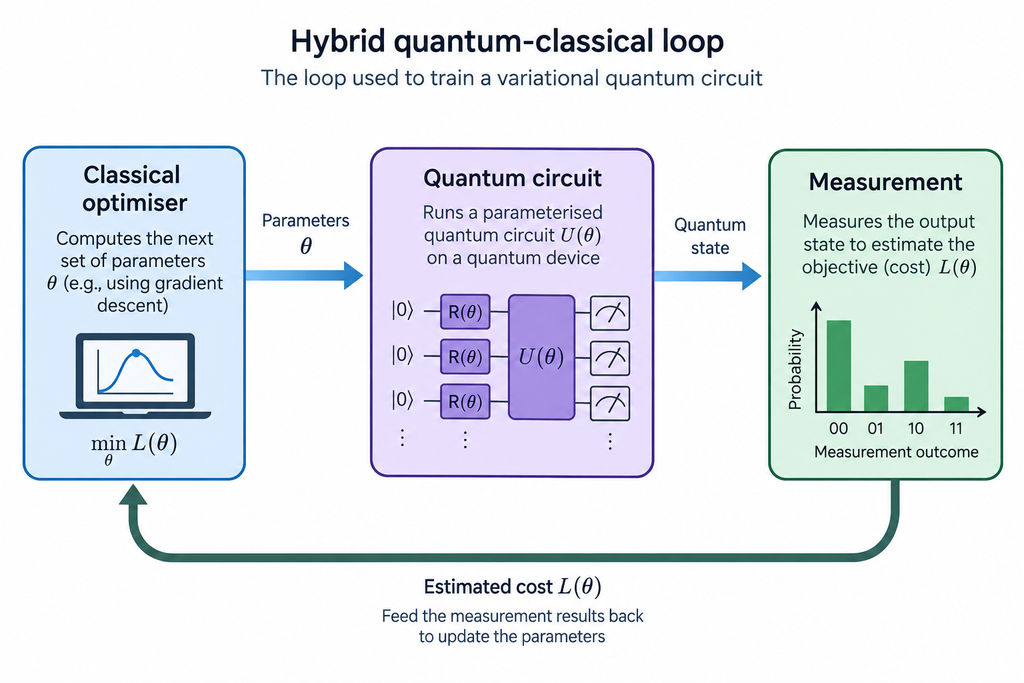
The quantum processor here is acting as a specialised co-processor inside a classical training loop, closer to how a GPU gets called from inside a classical program than to a replacement for the classical computer itself.
What’s Actually Been Proven, and What’s Contested
This is where most QML content on the web gets vague or overconfident. Every claim below is attributed, dated, and flagged if it’s contested.
What Is Genuinely Established
QML algorithms exist, run on real quantum hardware today, and work on small, toy-sized datasets. Quantum kernel methods have provable separations from classical kernels, but specifically on problems constructed to be hard for classical computers, not on typical business or research datasets. That’s a real, citable theoretical result, and it’s also a narrower claim than it sounds.
The Dequantization Problem
Several early, celebrated quantum speedups didn’t hold up once researchers looked for classical alternatives. The clearest example: a 2016 quantum algorithm for recommendation systems claimed an exponential speedup over classical approaches. In 2018, computer scientist Ewin Tang, then an undergraduate, published a classical algorithm that matched its performance using only polynomially more time, effectively dequantizing the result. Tang has since dequantized several other QML algorithms using similar techniques.
Tang’s own account of this pattern, published in Nature Reviews Physics in 2022, makes the underlying lesson clear: many of these speedups depended on specific assumptions about how data was accessed or stored, not on the quantum hardware itself doing something classical computers fundamentally cannot. Once those assumptions were examined closely, a classical algorithm could often exploit the same structure. This isn’t a story about quantum computing being disproven. It’s a caution about checking what a speedup actually assumes before repeating the headline number.
What Has Not Been Shown
No practical advantage over classical machine learning has been demonstrated on real-world data, for any commercially useful task, as of this writing. That statement applies broadly across variational circuits, quantum kernels, and annealing-based approaches alike.
What Working Researchers Actually Say
The skepticism here isn’t a fringe position. IBM’s own Qiskit-based machine learning course explicitly discusses dequantization as a live concern for the field, which is a strong signal that this caution is mainstream among people building the tools, not an outsider critique. The honest, current consensus among researchers working in the field is that QML is a promising research direction with real open theoretical questions, and not yet a source of practical computational advantage.
The Tools People Use
If you want to experiment with QML yourself, three software frameworks cover almost everything you’ll encounter. Each connects to a different hardware or ecosystem approach, so the right one depends on what you’re already using.
| Tool | Who makes it | Best for | What you need to know first |
| Qiskit Machine Learning | IBM | Running circuits on IBM’s real quantum hardware and simulators | Basic Qiskit circuit-building; see getting started with Qiskit |
| PennyLane | Xanadu | Combining quantum circuits with PyTorch or JAX for hybrid training | Comfort with a standard deep learning framework |
| TensorFlow Quantum | Building hybrid models inside an existing TensorFlow pipeline | A working TensorFlow/Keras background |
These libraries change their APIs frequently, so treat any code sample you find online, including this one, with caution unless it states an exact tested version. This article deliberately doesn’t include a QML code sample for that reason: an untested snippet goes stale within months and does more harm than good.
Where Quantum Machine Learning Is Taught and Researched in India
Interest in QML is growing in India alongside the country’s broader quantum push. IIT Delhi runs a continuing-education certification covering quantum computing and its applications, including QML topics, through its Continuing Education Programme; details, batches, and fees change between cohorts, so check the programme’s current listing on IIT Delhi’s own site before applying. Research groups at IISc Bengaluru and TIFR work on quantum algorithms and quantum information more broadly, with QML as one strand among several. The National Quantum Mission, approved by the Union Cabinet in April 2023 with an outlay of ₹6,003.65 crore through 2030–31, funds quantum computing research through thematic hubs, including one anchored at IISc Bengaluru, and QML sits inside that wider research agenda rather than as a dedicated, separately funded track.
Should You Learn Quantum Machine Learning Right Now?
Why Classical ML Skills Come First
You cannot understand a variational quantum circuit without already understanding gradient descent, because that’s exactly what the classical optimiser in the loop is doing. You cannot understand a quantum kernel without already understanding what a kernel does in classical machine learning, since a quantum kernel is a drop-in replacement for that same idea. QML is machine learning with a quantum step inserted into it, not a separate discipline you can approach from zero.
The Hybrid Skill Stack, in Order
The order below matters more than the individual items: each step is a genuine prerequisite for the one after it, not just a suggested sequence.
- Python
- Linear algebra and probability
- Core machine learning
- Deep learning basics
- Quantum computing fundamentals
- A QML framework (Qiskit Machine Learning, PennyLane, or TensorFlow Quantum)
Who Should Go Deeper
Going further into QML specifically makes the most sense for physics or mathematics postgraduate students, PhD-track researchers, engineers already working inside organisations with a dedicated quantum team, and professionals who are deliberately moving toward quantum research as a career, not a side skill. Completing a QML course doesn’t automatically lead to a QML job; the honest picture of hiring and roles is worth reading separately in quantum computing careers in India.
Ready to build your quantum-AI edge?
Quantum computing is moving from research labs into real-world applications—and the professionals who build this future will need more than familiarity. They’ll need the ability to understand, apply, and build with quantum technology.
Certification in Applied Quantum Computing & AI , IIT Delhi CEP
A 6.5-month, 156-hour programme combining quantum computing, AI/ML, optimisation, cybersecurity, hands-on Qiskit labs, and portfolio-grade capstones.
Learn the concepts. Build real quantum systems. Develop a portfolio that demonstrates your capability.
Frequently Asked Questions
What is quantum machine learning in simple terms?
It’s machine learning where a quantum computer handles one step of the process, usually part of training or a feature calculation, while a classical computer manages the rest of the workflow.
Is quantum machine learning better than classical machine learning?
No practical advantage has been demonstrated on real-world data. Some early speedup claims were later matched by classical algorithms through a process called dequantization, which is a central reason for that caution.
Do I need to know machine learning before learning QML?
Yes, and it’s not optional. Variational circuits rely on gradient descent and quantum kernels rely on kernel methods, both core classical ML concepts that QML builds directly on top of.
What programming language is used for quantum machine learning?
Python, through frameworks like Qiskit Machine Learning, PennyLane, or TensorFlow Quantum, all of which integrate with standard Python-based ML tooling.
Can I learn quantum machine learning for free?
Yes. IBM Quantum Learning’s QML course and PennyLane’s QML demos are both free and run directly in a browser, with no local installation required.
Are there quantum machine learning jobs in India?
Very few, and most are research-oriented roles at institutions rather than industry positions. Treat any specific job-count or salary figure you see elsewhere with scepticism unless it’s sourced and dated.
Which Indian institutes teach quantum machine learning?
IIT Delhi’s continuing-education certification covers QML alongside broader quantum computing content, and research groups at IISc Bengaluru and TIFR work on related quantum algorithms. Verify current programme details directly on each institution’s own website.
What is quantum machine learning in simple terms?
It’s machine learning where a quantum computer handles one step of the process, usually part of training or a feature calculation, while a classical computer manages the rest of the workflow.
Is quantum machine learning better than classical machine learning?
No practical advantage has been demonstrated on real-world data. Some early speedup claims were later matched by classical algorithms through a process called dequantization, which is a central reason for that caution.
Do I need to know machine learning before learning QML?
Yes, and it’s not optional. Variational circuits rely on gradient descent and quantum kernels rely on kernel methods, both core classical ML concepts that QML builds directly on top of.
What programming language is used for quantum machine learning?
Python, through frameworks like Qiskit Machine Learning, PennyLane, or TensorFlow Quantum, all of which integrate with standard Python-based ML tooling.
Can I learn quantum machine learning for free?
Yes. IBM Quantum Learning’s QML course and PennyLane’s QML demos are both free and run directly in a browser, with no local installation required.
Are there quantum machine learning jobs in India?
Very few, and most are research-oriented roles at institutions rather than industry positions. Treat any specific job-count or salary figure you see elsewhere with scepticism unless it’s sourced and dated.
Which Indian institutes teach quantum machine learning?
IIT Delhi’s continuing-education certification covers QML alongside broader quantum computing content, and research groups at IISc Bengaluru and TIFR work on related quantum algorithms. Verify current programme details directly on each institution’s own website.