What Is Quantum Technology? A Guide to the Field Powering the Quantum Decade

Quantum technology is an emerging field of science and engineering that uses the principles of quantum mechanics to build technologies with capabilities beyond conventional systems. From ultra-precise sensors and secure communication networks to processors that could solve specialised problems beyond the reach of classical computers, it is changing how we measure, compute and transmit information.
At its core, quantum technology relies on phenomena such as superposition, entanglement and quantum measurement. While these principles may sound abstract, they are already being applied in real-world systems, including atomic clocks, quantum sensors and quantum key distribution.
But quantum technology is not synonymous with quantum computing. It is a much broader field built around four interconnected pillars: quantum computing, quantum communication, quantum sensing and metrology, and quantum materials and devices. Each serves a different purpose, operates at a different stage of technological maturity, and contributes to what is increasingly called the quantum revolution.
Understanding these four pillars and how far each has progressed from research to real-world use is essential to understanding the quantum decade. Quantum technology is not a new concept, but the ability to control individual quantum systems has opened a new phase of technological development. This section explains the difference between the first and second quantum revolutions.
Why the term means more than quantum computing
Quantum technology is not a new concept, but the ability to control individual quantum systems has opened a new phase of technological development. This section explains the difference between the first and second quantum revolutions.
The first quantum revolution you already use
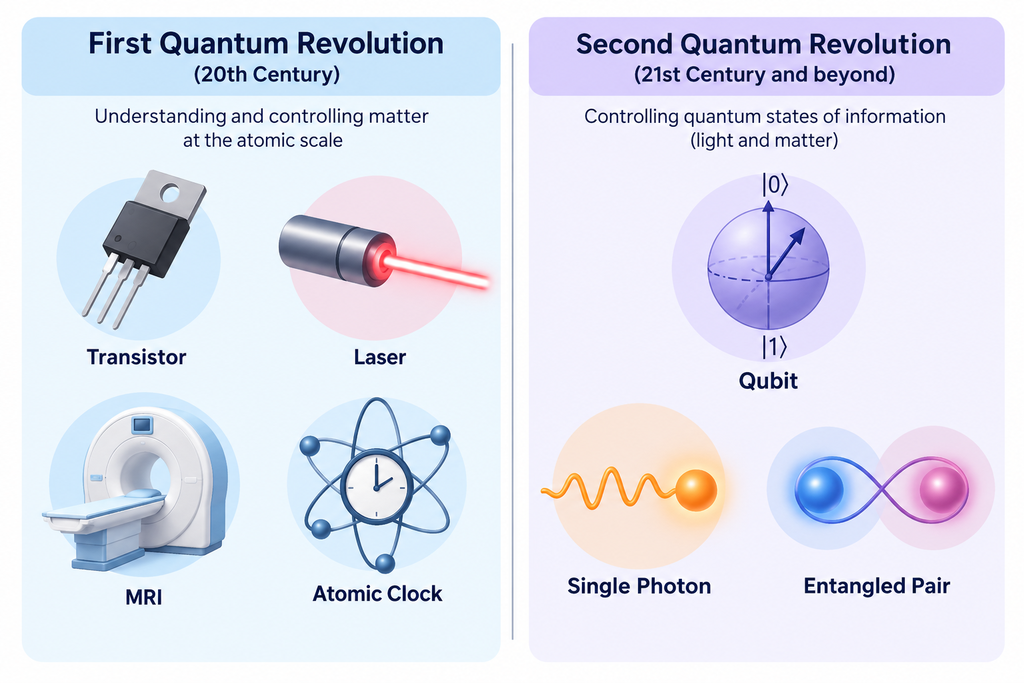
Quantum mechanics has powered many technologies for decades, even before the term quantum technology became widely used. These systems rely on quantum effects across large numbers of particles.
Key examples:
- Transistors and semiconductor chips
- Lasers and LEDs
- MRI scanners
- Caesium atomic clocks used in precision timekeeping and GPS
The second quantum revolution, and what changed
The second quantum revolution centres on controlling individual quantum systems and using entanglement as a practical resource. Researchers can now prepare, manipulate and measure individual atoms, photons and superconducting circuits.
| First quantum revolution | Second quantum revolution |
| Uses quantum effects in bulk | Controls individual quantum systems |
| Transistors, lasers, MRI | Qubits, single photons, entangled pairs |
| Established technologies | Emerging and developing technologies |
First vs. Second Quantum Revolution: From Quantum Devices to Quantum Information
The four pillars of quantum technology
Quantum technology is organised into four pillars, each addressing a different technological challenge. India’s National Quantum Mission follows this structure through four Thematic Hubs, with each hub focused on a specific area of quantum research and development.
The four pillars at a glance:
| Pillar | What it does |
| Quantum sensing and metrology | Measures time, gravity, magnetic fields and motion |
| Quantum communication | Enables quantum-secure key exchange and future quantum networks |
| Quantum computing | Uses qubits to tackle specialised computational problems |
| Quantum materials and devices | Develops the components that enable quantum systems |
How the pillars are organised in India:
| Pillar | India’s hub host |
| Sensing and metrology | Qmet Tech Foundation, IIT Bombay |
| Communication | IITM CDOT Samgnya Technologies Foundation, IIT Madras |
| Computing | Foundation for QC Innovation, IISc Bengaluru |
| Materials and devices | QMD Foundation, IIT Delhi |
Quantum sensing and metrology: the pillar that already works
Quantum sensing is among the most commercially mature areas of quantum technology. It uses the sensitivity of quantum systems to measure physical quantities such as time, gravity and magnetic fields with high precision.
What quantum sensing actually measures
Quantum sensors use quantum states as highly sensitive measurement tools. Their applications range from precision timekeeping to navigation and magnetic-field detection.
| Technology | What it measures |
| Atomic clocks | Time and frequency |
| Magnetometers | Magnetic fields |
| Gravimeters | Gravitational acceleration |
| Atom-based inertial sensors | Motion and navigation |
Where it is used today
Uses already in the field include navigation where GPS is jammed or unavailable, mineral and groundwater survey, brain imaging, and precision timing for telecom networks. The three instruments below are commercial products, not lab prototypes, and each comes from a named manufacturer or university source.
- Chip-scale atomic clocks. Microchip’s SA65, announced in August 2021, provides precise timing when satellite navigation signals are unavailable. At that point the company said it had delivered more than 138,000 chip-scale atomic clocks. microchip
- Quantum gravimeters. Exail launched its Absolute Quantum Gravimeter in 2015. It infers gravity by tracking a falling cloud of laser-cooled atoms, and it is used in geophysics, civil engineering and metrology. copernicusexail
- Wearable brain scanners. OPM-MEG images brain activity using optically pumped magnetometers. The University of Nottingham reports that its spin-out Cerca Magnetics commercialised the technology in 2021.
“Deployed” doesn’t mean “better at everything”. In a 2025 evaluation, Germany’s Federal Agency for Cartography and Geodesy found its quantum gravimeters were not yet as accurate as the best classical instruments, but offered advantages for continuous operation. springer
India’s sensing hub
India’s sensing and metrology hub is the Qmet Tech Foundation at IIT Bombay. The mission’s sensing goals centre on highly sensitive atomic magnetometers and atomic clocks for timing, communication and navigation. Among DST-supported ventures, QuPrayog in Pune works on optical atomic clocks.
Quantum communication: secure links that are already in the ground
Quantum communication uses quantum states to support secure key exchange and, eventually, connect quantum devices. Point-to-point quantum key distribution (QKD) is already deployed, while large-scale quantum networks remain under development.
What quantum key distribution does, and what it does not do
QKD enables two parties to establish an encryption key using quantum states of light. Because measuring these states can disturb them, interception can be detected through errors.
What QKD does and doesn’t do:
- Enables quantum-based key exchange over dedicated links.
- Requires specialised hardware at both ends.
- Does not encrypt the entire internet.
- Does not protect compromised endpoints
The quantum internet
Quantum networks aim to connect quantum devices, but the technology still faces major engineering challenges. Existing networks can use trusted relays, whereas a more advanced quantum internet would require components such as quantum repeaters and quantum memories.
| Existing capability | Remaining challenge |
| Fibre-based QKD links | Long-distance quantum-state transfer |
| Satellite QKD links | Scalable quantum networking |
| Trusted relay networks | Networks without trusted intermediate nodes |
Post-quantum cryptography: the part that is genuinely urgent
The threat is “harvest now, decrypt later”.
An adversary can record encrypted traffic today and store it until a large enough quantum computer exists to break the public-key cryptography protecting it. For data that must stay secret for decades, an uncertain timeline is not a reason to wait.
The defence has already shipped, and it is classical software.
NIST published its first three post-quantum standards on 13 August 2024. They are FIPS 203 (ML-KEM, from CRYSTALS-Kyber), FIPS 204 (ML-DSA, from CRYSTALS-Dilithium) and FIPS 205 (SLH-DSA, from SPHINCS+). NIST selected HQC as an additional key-encapsulation algorithm on 11 March 2025, and its standardisation is still underway. nistnist
These algorithms run on ordinary computers. Post-quantum cryptography is not quantum hardware. It is classical cryptography designed to survive quantum attack, and NIST says the three standards can and should be used now. The details are on NIST’s page on its post-quantum cryptography standards. nist
The irony is worth stating plainly: so far, the largest real-world impact of quantum computing has come from defending against it.
India’s communication hub in Quantum communication
India’s communication hub is the IITM CDOT Samgnya Technologies Foundation at IIT Madras, run with C-DOT. Bengaluru-based QNu Labs, one of the ventures DST selected for support, develops end-to-end quantum-safe networks.
Quantum computing: the pillar everyone means, and the least finished
Quantum computing is the most widely recognised branch of quantum technology, but practical, fault-tolerant machines remain a work in progress. Today’s quantum processors can run experiments and specialised circuits, but noise and error correction remain major challenges.
What a quantum computer does differently
A classical bit is 0 or 1. A qubit can hold a superposition of both, and entangled qubits share correlations that let a machine attack certain structured problems in ways classical machines cannot. The advantage is narrow. It applies to a small set of problem types, chiefly simulating other quantum systems, and it does not make a faster general-purpose computer.
Where the hardware actually is
Several hardware platforms are being developed, and no single approach has emerged as the universal solution.
- Superconducting circuits
- Trapped ions
- Photons
- Neutral atoms
Important distinction: Physical qubits are not the same as logical qubits. Useful, error-corrected computation requires logical qubits, which may need many physical qubits to support them.
What it is genuinely good for, and when
Quantum computing’s strongest potential use case is simulating quantum systems, such as molecules and materials. Other proposed applications remain under investigation.
| Application area | Current status in the article |
| Chemistry and materials simulation | Strong potential |
| Finance | Pilot or projection |
| Logistics | Pilot or projection |
| Weather and machine learning | Pilot or projection |
India’s computing hub
India’s computing hub is the Foundation for QC Innovation at IISc Bengaluru. According to a government press release, NQM-supported startup QpiAI announced QpiAI-Indus, a 25-qubit superconducting system, on World Quantum Day 2025, which fell on 14 April. Press Information Bureau
Quantum materials and devices: the pillar nobody writes about
Quantum materials and devices form the technological foundation of the other three pillars. From superconductors and photon sources to cryogenic systems, these components determine what quantum technologies can be built and how reliably they can operate.
Why the other three pillars depend on this one
This pillar is the supply chain. Every clock, QKD link and quantum processor is assembled from physical components, and each of the following is a field of engineering in its own right:
- Superconductors form the qubits in many quantum computers and the most sensitive photon detectors.
- Topological materials have unusual electronic states that researchers hope will yield more robust qubits.
- Single-photon and entangled-photon sources supply the light that QKD and photonic computing run on.
- Single-photon detectors read out quantum signals in communication and sensing.
- Cryogenic systems cool superconducting hardware to within a fraction of a degree of absolute zero.
- Photonic chips and control electronics route light and drive qubits.
None of these is optional. A QKD link without a reliable photon source, or a quantum computer without cryogenics, is not a product.
The strategic point most readers miss
A country that can design quantum devices but cannot make the materials and components depends on whoever can. Even the US faces this. Stanford’s 2026 review notes that the US does not dominate enabling technologies such as electronics and cryogenics, and that its quantum hardware supply chain relies heavily on foreign suppliers.
That is why materials is a funded national pillar rather than a research topic, and why India has a hub dedicated to it. It is also where much of the field’s practical engineering work sits.
India’s materials hub
India’s materials and devices hub is the QMD Foundation at IIT Delhi. DST-supported ventures work on the unglamorous but essential parts, including cryogenic cables (Dimira Technologies), precision diode lasers (Prenishq) and superconducting nanowire single-photon detectors (Quan2D Technologies).
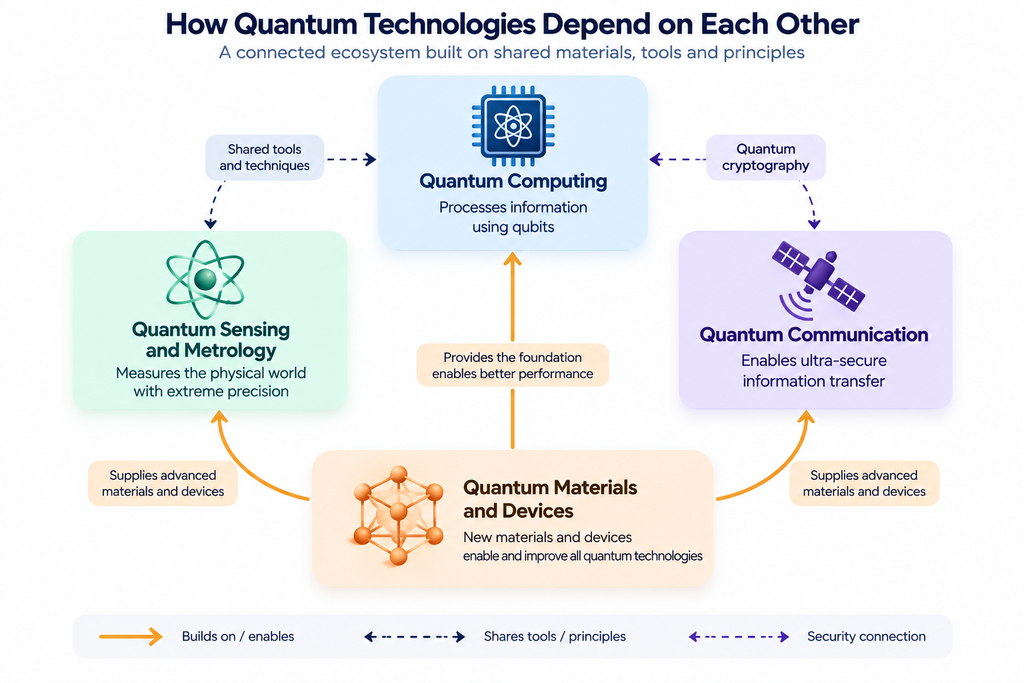
How the four pillars of Quantum computing fit together
The four pillars address different technological goals, but they share components, engineering methods and research challenges. Understanding these connections shows why progress in one area can accelerate or constrain another.
Three key connections:
- Materials feeds everything: Photon sources, superconductors, detectors and cryogenics support all three other pillars.
- Sensing and computing share tools: Lasers, control electronics and atomic manipulation techniques are relevant to both.
- Communication and computing intersect through cryptography: Quantum computing creates future encryption risks, while QKD and PQC offer different forms of protection.
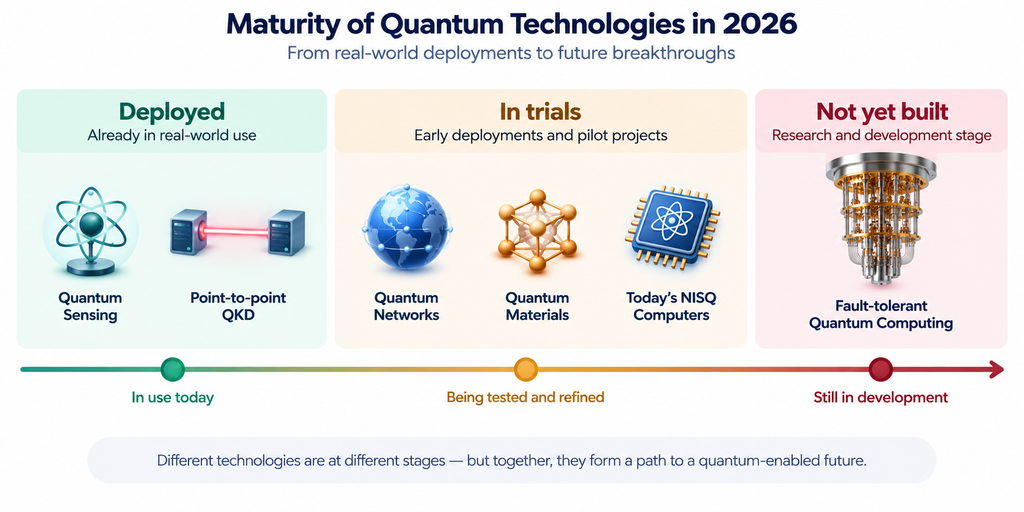
The Maturity of Quantum Technology in 2026
The four pillars are not progressing at the same pace. Some applications are commercially deployed, while others are still being tested or developed.
| Maturity stage | Technologies |
| Deployed | Quantum sensing; point-to-point QKD |
| In trials | Quantum networks; current NISQ computers; materials and devices |
| Not yet built | Fault-tolerant quantum computers |
Bottom line: Quantum technology is already delivering practical applications, but the maturity of each pillar differs significantly.
What to learn if you want to work in this field
Start with linear algebra, above everything else. Quantum states are vectors and the operations on them are matrices. If you are comfortable with linear algebra, the rest is learnable. Add probability next, then enough quantum mechanics to follow the arguments. Python is the working language across all four pillars.
The bigger point is that the four pillars need very different people:
- Sensing and materials hire physicists, cryogenics engineers and photonics engineers.
- Communication hires network and cryptography engineers.
- Computing hires control-electronics, FPGA, embedded and HPC engineers alongside algorithm researchers.
A large share of quantum jobs are classical engineering jobs inside a quantum organisation. For a working software engineer, that is the most useful thing on this page.
One free first step: build and run a two-qubit entangled circuit in a browser-based quantum simulator. It takes minutes, and it turns entanglement from a word into something you have actually seen.
Ready to Go Beyond the Quantum Fundamentals?
Quantum technology is moving from research labs to real-world applications and building the right skills today can help you prepare for the opportunities ahead. Take the next step with the Certification in Applied Quantum Computing and AI with IIT Delhi, and explore how quantum principles translate into practical applications.
Explore the programme and take your first step into the quantum era.
Frequently asked questions
Which countries are developing quantum technology?
Several countries are actively developing quantum technology, including the United States, China, India, the United Kingdom, Japan, Germany, Canada, and Australia. These countries are investing in quantum computing, communication, sensing, and research infrastructure, although their capabilities and priorities differ.
Is quantum technology the future?
Quantum technology is considered an important emerging technology with the potential to transform fields such as computing, cybersecurity, healthcare, materials science, and precision sensing. However, many applications are still under development, and widespread adoption will depend on overcoming technical and commercial challenges.
What is quantum technology in physics?
In physics, quantum technology refers to the practical application of quantum mechanics the study of matter and energy at atomic and subatomic scales. It uses phenomena such as superposition, entanglement, and quantum measurement to develop technologies that go beyond conventional systems.
How can quantum technology impact cybersecurity?
Quantum computing could eventually threaten some widely used public-key encryption methods. At the same time, quantum communication and post-quantum cryptography are being explored to strengthen information security against future threats.
Is quantum technology used in real life today?
Yes, partly. Quantum sensors such as atomic clocks, magnetometers and gravimeters are commercially deployed, and so is point-to-point quantum key distribution. Quantum networks are still in trials. Fault-tolerant quantum computing has not been built by anyone yet, though smaller, error-prone quantum computers are available for research.
Is quantum technology the same as quantum computing?
No, and this is the most common misconception. Quantum computing is one of four pillars. The other three are communication, sensing and materials, and each is a separate field with its own industry. Two of them, sensing and point-to-point communication, are further along commercially than computing is.
Will quantum computers break encryption?
Not today’s machines. A future large-scale quantum computer could break widely used public-key encryption. That is why “harvest now, decrypt later” matters: data stolen now could be decrypted later. The defence has shipped. NIST published its first three post-quantum cryptography standards on 13 August 2024, and migration is underway.
What is the difference between quantum sensing and quantum computing?
Sensing uses a quantum system’s extreme sensitivity to its environment to measure time, magnetic fields or gravity with exceptional precision. Computing tries to shield a quantum system from that same environment long enough to calculate. They are opposite engineering problems built on the same physics, and they share many of the same tools.
How is India investing in quantum technology?
India invests mainly through the National Quantum Mission, run by the Department of Science and Technology. It funds four Thematic Hubs, one per pillar, hosted at IISc Bengaluru, IIT Madras, IIT Bombay and IIT Delhi. It also supports deep-tech startups working across computing, communication, sensing and materials.