Quantum AI Explained: How Quantum Computing and Machine Learning Are Converging

Quantum AI is the overlap between quantum computing and artificial intelligence. It is an active research field not a mature, widely deployed technology.
- It can mean running part of a machine-learning workload on a quantum computer.
- It can mean using quantum-inspired mathematics on ordinary computers.
- It can mean using AI to build, calibrate, or control quantum computers.
- Researchers are investigating whether quantum computers’ ability to manipulate quantum states can offer a meaningful advantage for certain machine-learning tasks. That question remains open.
This guide explores how the two fields are converging, the research behind their progress, current limitations, and the skills needed to work in Quantum AI.
Are quantum computing and machine learning really converging?
Yes, but unevenly. Machine learning now helps decode errors, simulate quantum systems and learn from quantum experiments, with peer-reviewed results. Quantum computing helping machine learning has shown advantages only on quantum data and purpose-built problems. No practical advantage on everyday classical data has been demonstrated.
The two fields meet because they speak the same mathematical language: vectors, matrices, probabilities and optimisation. That shared language makes cooperation natural. It does not automatically make it faster.
The two directions of convergence
“Convergence” hides a direction. Asking which way the help flows is the quickest way to tell a working result from a speculative one.
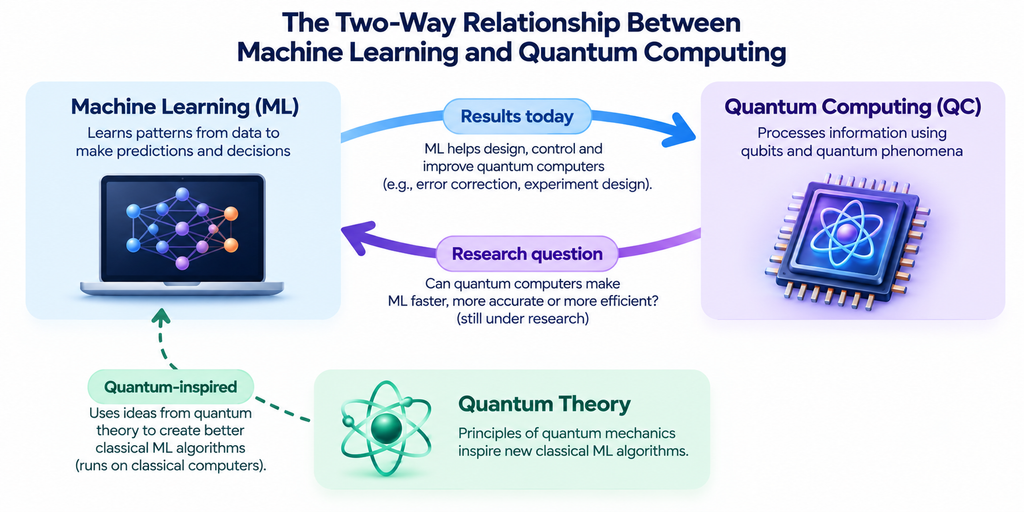
Three flows are worth separating. The table shows what moves in each direction, the strongest peer-reviewed evidence behind it, and which evidence state that result is in.
| Direction | What happens | Evidence and current state |
| Machine learning → quantum computing | Neural networks decode errors, represent quantum states, and learn from quantum experiments. | AlphaQubit (Nature, 2024) and Carleo and Troyer (Science, 2017). Demonstrated using classical hardware. |
| Quantum computing → machine learning | Quantum circuits act as feature maps, kernels, or trainable models. | Advantages demonstrated on quantum data (Science, 2022 and 2025); speedup proven on paper for a purpose-built problem (Nature Physics, 2021). |
| Quantum theory → classical ML | Quantum mathematics is applied on ordinary hardware. | Tang’s quantum-inspired algorithm (arXiv, 2018; STOC, 2019). Proven on paper, with quantum-inspired methods running on standard hardware. |
Machine learning for quantum computing: where convergence is working
This is the direction with the most concrete results, and it surprises people. Quantum hardware produces enormous volumes of noisy measurement data, and modelling that data is what machine learning does best. All of the work below runs on ordinary classical computers.
Decoding errors in real time, almost
Error correction spreads one “logical” qubit across many physical qubits. A decoder then reads a stream of error signals and works out what went wrong. Google’s AlphaQubit error-correction decoder (Nature, 20 November 2024) is a transformer-based network trained for this job.
On real data from Google’s Sycamore processor, it decoded more accurately than the best hand-designed decoders. The authors state the catch in the same paper: AlphaQubit is still slower than the roughly one microsecond per round that superconducting hardware needs for real-time use. Speed, not accuracy, is now the open problem.
Simulating quantum systems with neural networks
Describing a quantum system of many particles gets exponentially harder as the system grows. In Science in February 2017, Giuseppe Carleo and Matthias Troyer showed that a neural network could represent the ground state of benchmark quantum spin models. Its accuracy was competitive with established simulation methods.
“Neural-network quantum states” has since become an active research area. This is convergence in the purest sense: a machine learning architecture is treated as a new way to write down physics. It needs no quantum computer.
Learning about quantum systems from experimental data
A second line asks whether classical machine learning, trained on measurements from quantum experiments, can predict properties it was never shown. In Science in 2022, Hsin-Yuan Huang, Richard Kueng, Giacomo Torlai, Victor Albert and John Preskill studied this for ground states of quantum many-body systems.
They proved that, for certain families of such systems, a classical learner trained on data predicts ground-state properties efficiently. Classical algorithms that do not learn from data are believed unable to do this. State: proven on paper, with numerical experiments. The lesson for convergence is striking: sometimes the most useful thing quantum experiments supply is training data for classical models.
Quantum computing for machine learning: where convergence is still a question
This is the direction that gets the headlines. The honest summary is that the tools work, the theory is rich, and practical advantage on classical data has not been shown. The three H3s below explain why that is not a contradiction.
Quantum kernels work on real hardware
In Nature in March 2019, Vojtěch Havlíček and colleagues at IBM ran two quantum approaches to classification on a superconducting processor. The first used the circuit as a trainable classifier. The second used it as a kernel, a way of measuring similarity between data points. The data was artificial and designed for the test, and the paper did not claim an advantage over classical methods. State: demonstrated on hardware; no advantage claimed.
Two years later, IBM researchers Yunchao Liu, Srinivasan Arunachalam and Kristan Temme published a rigorous and robust quantum speed-up in supervised machine learning in Nature Physics (2021). They proved an end-to-end speedup, data loading included. The catch is the problem they used: a classification task built from the discrete logarithm, chosen because it is hard for classical computers rather than because anyone needs it solved. State: proven on paper, for a purpose-built problem.
The power-of-data problem
Here convergence meets resistance from the classical side. In Nature Communications in 2021, Hsin-Yuan Huang and colleagues at Google Quantum AI showed that classical models given training data can often match what a quantum model predicts. This holds even when the quantum model’s output is hard to compute without data.
Their numerical experiments found a large quantum prediction advantage only on datasets engineered to favour the quantum model. State: proven on paper, with numerical evidence.
Newer benchmarks point the same way. A December 2025 study in Scientific Reports by Sheoran and colleagues found classical logistic regression most accurate on three of five standard datasets tested against quantum classifiers.
Where quantum data changes the picture
The picture flips when the data itself comes from a quantum system. Two hardware experiments, Huang et al. in Sciencein 2022 and a Technical University of Denmark-led photonic experiment in Science in 2025, showed large reductions in the experiments or samples needed to learn quantum processes. State: demonstrated on hardware, for quantum data.
The most promising near-term meeting point is therefore not classical ML sped up. It is learning tasks where the input is already quantum: sensing, characterising devices and studying physical systems.
Why the fields fit together: a shared toolkit
Part of the convergence is simply that the two fields reuse each other’s methods. Three overlaps matter most, and each explains why ML engineers often find quantum computing easier to approach than they expect.
- Linear algebra. Quantum states are vectors and quantum operations are matrices, the same objects inside every neural network.
- Optimisation. Variational quantum circuits are trained by adjusting parameters to reduce a loss, just as neural networks are.
- Probability. A quantum computer returns samples from a distribution, so its outputs are read statistically, as in probabilistic ML.
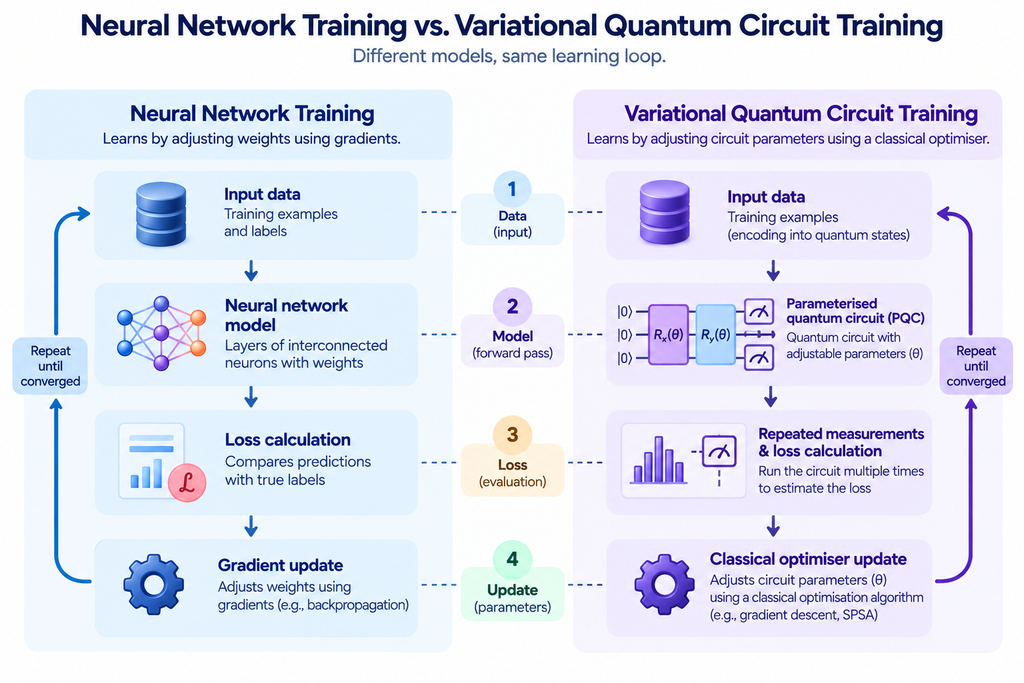
One difference matters. A quantum computer does not evaluate every possibility and report them all. Measurement returns a single outcome each run, so useful algorithms must arrange interference so the right answer becomes likely, which only works for problems with the right structure.
The tooling has converged too. Frameworks such as IBM’s Qiskit and Xanadu’s PennyLane let researchers plug quantum circuits into familiar machine learning workflows.
Where the convergence stalls in Quantum computing and ML
The same three obstacles appear in almost every critique of quantum machine learning. They are summarised briefly here from the convergence angle: each one is a place where the classical side keeps pushing back.
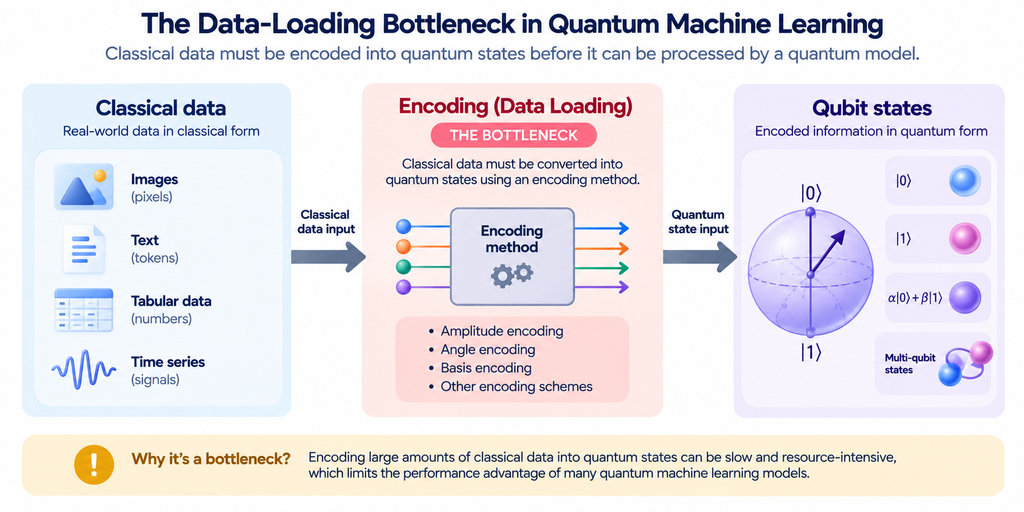
The Data-Loading Bottleneck in Quantum Machine Learning
Quantum machine learning requires classical data to be encoded into quantum states before processing. This encoding step can become a bottleneck, as loading large datasets into quantum systems may be time-consuming and resource-intensive, potentially limiting the performance advantage of quantum models.
Training large circuits in Quantum Machine Learning
Noise limits how long circuits can run. Separately, many variational circuits hit barren plateaus, where gradients flatten as the circuit grows and the optimiser has nothing to follow. This is also why machine learning for error correction matters: better error correction eventually allows deeper circuits.
Classical algorithms catching up in Quantum Machine Learning
In 2018, Ewin Tang published the quantum-inspired classical algorithm that closed the gap on a celebrated quantum recommendation speedup. Given comparable data access, classical methods matched it. This process, dequantisation, is classical ML’s most important contribution to the convergence: it keeps quantum claims honest.
What real progress would look like
No credible researcher puts a date on practical quantum machine learning, and this page will not either. What you can do is recognise genuine progress when it arrives.
The signals below separate a real step from a press cycle. A result that meets all five would be a genuine turning point for quantum computing helping machine learning.
- Peer review. The result appears in a journal or major conference, not only a press release.
- A strong classical baseline. The comparison uses the best known classical method, including data-driven ones.
- Classical data, loading included. The speedup survives once the cost of encoding the data is counted.
- No dequantisation. Classical researchers have tried and failed to match it.
- Logical qubits. It runs on error-corrected qubits, not only noisy physical ones.
Until then, expect most solid progress to keep flowing the other way, from machine learning into quantum hardware and quantum science.
Skills for working at the intersection
Working where the fields meet needs both sides, but not in equal measure at the start. Classical machine learning comes first: it is what makes quantum ML papers readable, and it is what gets people hired today regardless of quantum’s pace.
A sensible order is Python, then linear algebra and probability, then core machine learning, then deep learning. After that come quantum computing basics and, finally, a quantum ML framework. Deeper specialisation suits physics and maths postgraduates, PhD-track researchers, and engineers at the few companies with quantum teams. In India, the National Quantum Mission funds research in this area.
Turn Your Curiosity About Quantum AI Into Practical Expertise
Quantum computing is opening new possibilities across AI, machine learning, and advanced computing. Build the knowledge to explore this evolving field with the
Certification in Applied Quantum Computing and AI.
Take the next step toward understanding and working with emerging quantum technologies.
Explore the Programme and Start Your Quantum Learning Journey Today.
Frequently asked questions
1. What problems could quantum AI help solve?
Quantum AI could help researchers explore complex problems in areas such as molecular simulation, quantum-system analysis, optimization, and scientific discovery. Its usefulness will depend on whether quantum methods can deliver measurable benefits over classical approaches for specific tasks.
2. Does quantum AI require a quantum computer to work?
No. Quantum AI can also involve quantum-inspired algorithms that run on classical computers or AI models used to design, calibrate, and control quantum hardware. Only some approaches require quantum processors to perform computations.
3. What is the difference between quantum AI and quantum machine learning?
Quantum machine learning (QML) generally refers to using quantum computers within machine-learning workflows. Quantum AI is a broader term that can include QML, quantum-inspired classical algorithms, and the use of AI to develop or operate quantum systems.
4. How do qubits influence quantum machine learning?
Qubits are the basic units of quantum information. Their ability to exist in superpositions and become entangled allows quantum circuits to represent and process certain kinds of information differently from classical systems. Whether this provides a practical machine-learning advantage depends on the task and the algorithm.
5. What role does quantum entanglement play in quantum AI?
Quantum entanglement creates correlations between quantum systems that cannot be described by treating each system independently. In quantum machine learning, entanglement can help quantum circuits represent complex relationships in data, although more entanglement does not automatically mean better performance.
6. Can quantum AI improve drug discovery?
Quantum AI is being explored as a potential tool for molecular simulation, materials research, and related scientific problems. These capabilities could eventually support parts of drug discovery, but quantum AI has not yet been established as a routine replacement for existing pharmaceutical research methods.
7. What programming languages and frameworks are used in quantum AI?
Python is widely used in quantum computing and machine-learning research. Frameworks such as IBM Qiskit and Xanadu PennyLane allow developers to build quantum circuits and integrate them with classical machine-learning workflows.
8. Why is quantum AI difficult to scale?
Quantum AI faces challenges such as hardware noise, limited qubit quality, data-loading costs, and difficulties training large quantum circuits. These constraints can reduce or eliminate a potential speedup, even when an algorithm looks promising in theory.
9. How can researchers determine whether a quantum AI model is better than a classical model?
Researchers compare quantum models against strong classical baselines using the same task and appropriate evaluation metrics. A meaningful advantage should account for data-loading, training, and execution costs—not just the quantum circuit’s theoretical computational speed.
10. What career opportunities are emerging in quantum AI?
Quantum AI-related work spans quantum software development, machine learning, quantum algorithm research, quantum hardware control, and scientific computing. Relevant roles may be found in research institutions, quantum technology companies, and advanced computing teams. Many positions require a strong foundation in programming, linear algebra, probability, and machine learning, with deeper quantum knowledge depending on the role.