AI Personalization in Marketing: How It Works + Examples

Key Insights
- 71% of consumers expect personalized interactions: McKinsey research found that 76% get frustrated when brands fail to deliver them, making relevance a customer-experience priority.
- Personalization can deliver measurable returns: McKinsey estimates that effective personalization can lift revenue by 5–15% and improve marketing ROI by 10–30%. Results vary by business and execution.
- AI personalizes more than product recommendations: Marketers can tailor website content, product attributes, promotions and customer journeys using relevant behavioural and preference data.
- Targeted promotions can improve commercial outcomes: McKinsey reported initial tests at one retailer that increased annualized margins by approximately 3% after three months of more targeted promotions.
- Measure incremental impact before scaling: Comparing personalized experiences with a control group helps determine whether changes improve conversions, repeat purchases or margins.
- Customer data needs clear boundaries: Better personalization depends on relevant, reliable data, appropriate permissions and safeguards against intrusive targeting, inaccurate predictions and biased outcomes.
AI personalization helps marketers adapt content, product recommendations, offers and customer journeys to customer preferences and behaviour. Instead of showing every customer the same message, businesses can use relevant data to make digital experiences more useful.
From product recommendations on shopping platforms to tailored email campaigns, AI-driven personalization can help brands respond to customer needs at different stages of their journey. However, effective personalization requires more than collecting data. Marketers need a clear objective, reliable information and safeguards that protect customer trust.
This guide covers the types of AI personalization, how the process works, real-world examples, implementation steps and privacy considerations for businesses in India.
What are the Types of AI Personalization?
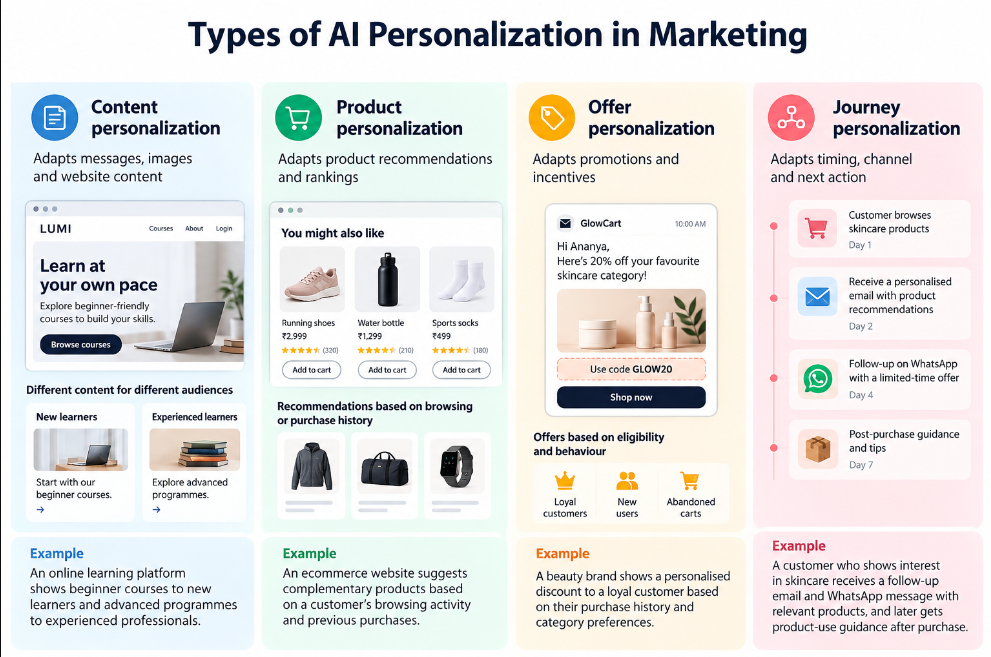
AI-powered personalization can influence different parts of the customer experience. The approach depends on what the business wants to adapt and which customer signals are relevant.
| Type | What it adapts | Example |
|---|---|---|
| Content personalization | Messages, images and website content | Displaying different homepage content based on customer interests |
| Product personalization | Product recommendations and rankings | Suggesting products based on browsing or purchase patterns |
| Offer personalization | Promotions and incentives | Showing an eligible customer a relevant offer |
| Journey personalization | Timing, channel and next action | Adjusting follow-up messages based on engagement |
Content personalization makes information more relevant to the audience. An online learning platform, for example, could highlight beginner courses for new learners and advanced programmes for experienced professionals.
Product personalization helps customers discover relevant items. An ecommerce website might recommend complementary products based on previous purchases or browsing activity.
Offer personalization adapts promotions to customer needs and eligibility. Businesses should ensure that offers remain transparent and do not unfairly disadvantage customers.
Journey personalization adapts interactions across channels. A customer who has already purchased a product might receive setup guidance instead of another message encouraging them to buy it.
These approaches can work together, but each should serve a specific customer need rather than simply increase the number of personalized messages.
How does AI Personalization Work?
AI-driven personalization turns relevant customer signals into decisions about what content, products or actions to present. The process generally follows four stages.
1. Collect Relevant Customer Data
Personalization begins with information that helps explain customer preferences and behaviour. Depending on the business and purpose, this could include:
- Purchase history and product preferences
- Website browsing and search activity
- Email clicks and campaign interactions
- Customer-stated interests and preferences
Data quality matters. Incomplete records, outdated preferences or inaccurate purchase histories can lead to irrelevant recommendations. Businesses should also establish an appropriate legal basis for using the data and respect applicable consent and preference requirements.
2. Build Segments and Dynamic Personas
AI systems can identify patterns across customer interactions and group people with similar behaviours or needs. These groups help marketers understand how different audiences engage with products and content.
For example, an online retailer might identify customers who frequently browse skincare products but have not purchased recently. A dynamic persona can be updated as new, relevant signals emerge rather than remaining fixed around an initial assumption.
Segmentation and personalization are related but different. Segmentation groups customers; personalization uses information about a group or individual to adapt an experience.
3. Generate Predictions and Recommendations
Recommendation models and predictive systems analyse patterns to estimate which products, messages or actions may be relevant.
An ecommerce platform might recommend a complementary product based on browsing behaviour and product relationships. A streaming service might use viewing activity to rank content that a viewer may want to watch next.
These systems make predictions, not guarantees. Recommendations can be inaccurate, so businesses should evaluate their relevance and avoid treating inferred preferences as confirmed facts.
4. Deliver and Refine the Experience
The selected content or recommendation is delivered through a website, app, email or another suitable channel. Marketers then examine how customers respond.
If a recommendation improves product discovery, the business can assess whether the approach is worth continuing. If customers ignore the message or find it irrelevant, the team can revise the rules, data inputs or model.
What are Some Examples of AI Personalization in Marketing?
AI personalization is used in entertainment and ecommerce to help customers discover relevant content and products. The following examples distinguish documented company practices from an illustrative Indian D2C scenario.
Netflix: Content Recommendations
Source: Netflix Technology Blog
- Customer signal: Viewing activity and interactions with content
- Personalized experience: Recommendations and content rankings tailored to viewing patterns
- Intended benefit: Help viewers discover content relevant to their interests
Recommendation systems can make a large content catalogue easier to navigate. Their value lies in helping viewers find something relevant, not simply presenting more titles. Recommendations can still miss the mark, so customer behaviour should not be treated as a perfect measure of preference.
Amazon: Product Recommendations
Source: How Amazon Uses Generative AI to Improve Product Recommendations and Descriptions
- Customer signal: Shopping activity, searches, browsing and purchase history
- Personalized experience: Product recommendations and descriptions adapted to customer interests
- Intended benefit: Help shoppers discover products that better match their needs
Amazon describes using AI and machine learning to personalize recommendations across its shopping experience. It also explains how generative AI can highlight product attributes that matter to individual shoppers. For instance, someone searching for gluten-free cereal may see that attribute made more prominent in relevant product information.
This illustrates how personalization can improve product discovery by making relevant details easier to find.
Indian D2C: Personalized Beauty Shopping
Consider an illustrative Indian direct-to-consumer beauty brand that sells skincare products online. This is a hypothetical scenario, not a claim about a particular company’s technology.
- Customer signal: A shopper’s stated skin concerns, product preferences and previous purchases
- Personalized experience: Relevant product categories, educational content and follow-up messages
- Intended benefit: Help the shopper navigate the catalogue and make an informed choice
For example, someone who selects fragrance-free products could be shown suitable options from the catalogue, provided the product information supports that recommendation. A follow-up email might explain how to use a product already purchased instead of repeatedly promoting the same item.
The brand should avoid unsupported medical claims or unexpected inferences about a customer’s health. Email and WhatsApp follow-ups must also respect applicable communication and data-protection requirements.
How can Marketers Implement AI Personalization?
Implementation should begin with a business problem, not simply a decision to use AI. A focused pilot helps teams evaluate whether personalization adds value before expanding it across channels.
1. Choose a Specific Business Goal
Define what you want to improve. Possible objectives include:
- Helping customers discover relevant products
- Increasing repeat purchases
- Improving engagement with useful content
- Reducing irrelevant marketing messages
Choose a measurable outcome and establish a baseline before making changes. A broad objective such as “improve customer experience” needs a more specific measure to guide implementation.
2. Identify the Necessary Data
List the information required for the chosen use case. A product recommendation pilot may need product details and relevant browsing or purchase signals, rather than an extensive profile of every customer.
Check whether the data is accurate, accessible and appropriate to use for the intended purpose. Avoid collecting additional information simply because it is available.
3. Select a Personalization Method
The right approach depends on the use case, available data and technical resources.
- Rules-based personalization: Uses predefined conditions, such as showing a relevant category when a customer selects a preference.
- Recommendation models: Rank products or content based on relevant patterns and relationships.
- Predictive personalization: Estimates likely interests or next actions using historical and current signals.
Not every business needs a complex AI model. Rules-based methods may be sufficient for straightforward use cases, while more advanced systems may help when the catalogue, customer base or decision-making requirements become more complex.
4. Test Against a Baseline
Compare the personalized experience with a suitable control group receiving the existing experience. Keep other conditions as comparable as possible.
Choose metrics that match the objective. Product discovery could be measured through relevant product-page engagement, while repeat-purchase initiatives might track subsequent purchases over a defined period.
A controlled comparison helps distinguish incremental impact from changes caused by seasonality, pricing or other campaign activity. Do not assume an improvement occurred because of personalization without examining the evidence.
5. Connect Personalization to Customer Journeys
Personalization can also inform the timing and content of customer communications.
For example, a customer who completes a purchase might receive relevant onboarding or product-use guidance. Someone who has expressed interest in a category could receive related content, subject to their preferences and the permissions required for that channel.
Keep messages consistent across touchpoints and suppress communications that are no longer relevant. The aim is to make the next interaction useful, not to contact customers at every possible opportunity.
What Privacy and Consent Risks Should Marketers Consider?
Personalization depends on customer information, making privacy and responsible data use central to implementation. In India, businesses should assess the Digital Personal Data Protection (DPDP) Act, 2023, the applicable rules and the commencement provisions relevant to their activities.
Obtain Appropriate Consent and Respect Preferences
Where consent is required, explain what information will be used and for what purpose. Provide appropriate ways to withdraw consent or opt out, and ensure that customer preferences are reflected in marketing systems.
Do not assume that sharing information for one purpose automatically permits its use for every personalization activity.
Minimise Data Collection
Collect only the information needed for the intended purpose. A product recommendation may require purchase or browsing signals, but not unrelated personal details.
Be particularly careful with sensitive inferences. A customer should not be surprised by a recommendation based on information they did not knowingly provide for that purpose.
Protect Customer Data
Use appropriate access controls, security measures, retention practices and vendor oversight. Limit access to people and systems that need the information, and review how third-party tools process customer data.
Personalization systems should also have a clear process for handling inaccurate records and responding to relevant customer requests.
Keep Personalization Transparent
An experience can feel invasive when it reveals assumptions customers did not expect a brand to make. Avoid discriminatory targeting, manipulative messaging and recommendations that exploit vulnerability.
Review outcomes across relevant customer groups to identify patterns that could lead to unfair treatment. Make it possible for customers to seek help when an automated recommendation is unsuitable.
For legal accuracy, consult the official Digital Personal Data Protection Act, 2023 and the Ministry of Electronics and Information Technology for the relevant rules and commencement notifications. Verify the current status of applicable provisions before publication rather than assuming every obligation is already in force.
Conclusion
Effective AI personalization starts with a clear customer need, relevant data and a measurable business goal. Marketers can begin with one use case, test whether it improves the experience and introduce appropriate privacy safeguards before expanding to more channels. The objective is not to collect as much customer information as possible. It is to use suitable information to make interactions more useful while giving customers good reasons to trust the brand.
To learn about AI-driven brand strategy, dynamic personas and customer lifecycle applications, explore the IIM Trichy AI-Powered Marketing & Growth Strategy course.
FAQs
1. What is the difference between AI personalization and customer segmentation?
Customer segmentation groups people according to shared characteristics or behaviours. AI personalization uses relevant information about a segment or individual to adapt content, recommendations, offers or interactions. Segmentation can inform personalization, but it does not automatically create an individualized experience.
2. Does AI personalization require real-time data?
No. Some applications use real-time signals, such as activity during a website visit, while others rely on data updated periodically. The appropriate frequency depends on the use case. A live product recommendation may benefit from current activity, whereas a monthly customer segment may not need continuous updates.
3. How can small businesses start with AI personalization?
Start with one practical use case, such as relevant product recommendations or audience-specific website content. Use data the business already collects appropriately, define a measurable goal and compare results with a baseline. Expand only when the approach demonstrates value and the business can manage the associated costs and privacy responsibilities.
4. How can marketers measure incremental lift from personalization?
Use a control group that receives the existing experience and compare its results with those of the personalized group. Select a metric that matches the objective, such as conversions, repeat purchases or relevant engagement. Keep test conditions comparable and account for other factors that may influence the outcome.
5. Can AI personalization reinforce customer bias?
Yes. Historical data may reflect existing inequalities or incomplete representations of customers. A model can reproduce these patterns through its recommendations or targeting decisions. Marketers should evaluate outcomes across relevant groups, check the quality of input data and review potentially harmful or unfair results.
6. What should businesses consider under India’s DPDP framework?
Businesses should assess which provisions apply to their activities and when those provisions take effect. Relevant considerations include lawful processing, appropriate consent where required, purpose limitation, security safeguards and applicable rights of individuals. Consult the official Act, rules and commencement notifications rather than assuming every requirement applies immediately or identically to every business.
7. What is the difference between AI-driven and AI-powered personalization?
The terms are often used interchangeably. Both describe personalization supported by AI technologies. “AI-driven” may emphasise that AI informs the decision, while “AI-powered” highlights the technology enabling the experience. Neither term, by itself, identifies a specific model or level of automation.
8. What data is commonly used for AI personalization?
Depending on the purpose, businesses may use purchase history, browsing activity, product preferences, campaign engagement and information customers provide directly. The appropriate data depends on the use case. Businesses should prioritise data quality, relevance and permission rather than collecting information without a clear need.
9. Can AI personalization work across email, websites and WhatsApp?
Yes, where the business has suitable systems, relevant data and permission to use each channel. A customer’s preferences can inform consistent recommendations across touchpoints. However, channel-specific consent, communication rules and opt-out preferences must be respected, and customers should not receive redundant or unwanted messages.
10. What are the main challenges of AI personalization?
Common challenges include incomplete data, inaccurate predictions, disconnected marketing systems, implementation costs, privacy risks and biased recommendations. Personalization can also fail when it does not address a genuine customer need. A focused pilot, clear success metrics, human oversight and regular evaluation help businesses identify problems before scaling.
Sources
- IBM: AI Personalization
- IBM: What Is a Recommendation Engine?
- Netflix Technology Blog
- Amazon: How Generative AI Improves Product Recommendations and Descriptions
- Ministry of Electronics and Information Technology: Digital Personal Data Protection Act, 2023
- Ministry of Electronics and Information Technology