Predictive Analytics in Marketing: Use Cases & Models

Key Insights
- Predictive marketing can influence purchasing decisions: Salesforce reports that predictive intelligence recommendations influenced 26.34% of total orders on average in its benchmark research. The reported share rose from 11.47% at the beginning of use to 34.71% after 36 months.
- Customer data quality matters: In Salesforce’s 2026 India research, 81% of surveyed marketers had adopted AI, but fragmented or poor-quality data remained a barrier to effective personalisation.
- Predictive models serve different goals: Use classification for churn or conversion, regression for customer value, and time-series forecasting for future demand.
- A churn prediction is not a retention strategy: Identifying customers likely to leave does not prove that a discount will keep them. Test interventions against a control group to measure incremental impact.
- Measure profit, not just accuracy: A model with strong predictive performance may still waste marketing spend. Evaluate campaign costs, customer value and the additional conversions or retained customers generated.
Predictive analytics in marketing helps businesses estimate future customer behaviour using historical data, statistical methods and machine learning. Marketers use it to identify customers at risk of leaving, prioritise leads, forecast demand and personalise campaigns. The goal is to make better decisions, not predict every outcome perfectly.
In this guide, you’ll learn how predictive analytics works in marketing, explore its key use cases and common models, and understand what data and tools you need to implement it. We’ll also cover how to build a predictive analytics workflow, evaluate model performance, and measure its impact on marketing ROI.
What does Predictive Analytics Tell Marketers?
Predictive analytics uses past and current data to estimate what may happen next. It differs from other types of marketing analytics:
- Descriptive analytics: What happened?
- Predictive analytics: What is likely to happen?
- Prescriptive analytics: What action should we take?
For example, descriptive analytics identifies how many customers stopped purchasing last quarter. Predictive analytics estimates which customers may stop purchasing next quarter. Prescriptive analytics helps determine which retention action to test.
Predictions indicate likelihood, not certainty. Their value depends on how well they support real marketing decisions.
What are the Main Use Cases of Predictive Analytics in Marketing?
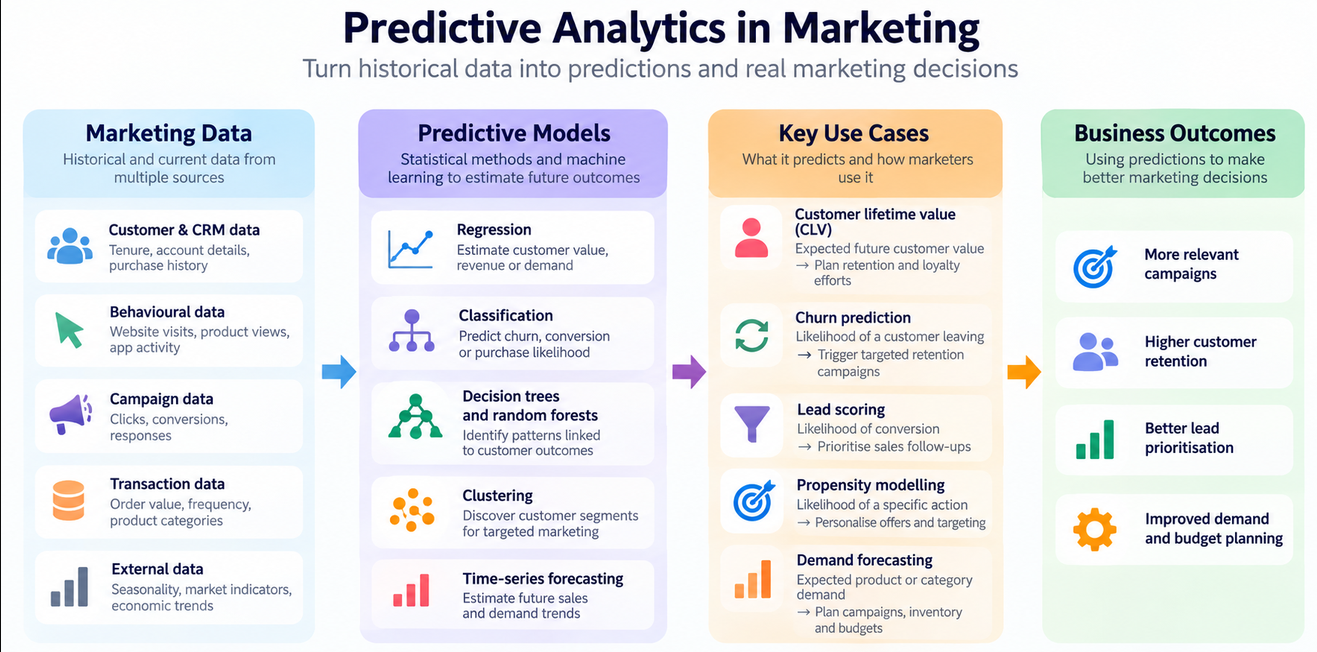
Predictive analytics can support several marketing functions, each addressing a different business need. The table below outlines where these applications fit into a marketing strategy.
| Use case | What it predicts | How marketers use it |
|---|---|---|
| Customer lifetime value (CLV) | Expected future customer value | Plan retention spending and loyalty programmes |
| Churn prediction | Likelihood of a customer leaving | Target retention campaigns |
| Lead scoring | Likelihood of conversion | Prioritise sales follow-ups |
| Propensity modelling | Likelihood of a specific action | Personalise offers and recommendations |
| Demand forecasting | Future product or category demand | Plan campaigns, budgets and inventory |
1. Customer Retention and Churn Prediction
Churn models identify customers who may stop buying or engaging with a business. Marketers can use purchase frequency, customer tenure and engagement history to identify potential risks and test relevant interventions.
Customer lifetime value prediction estimates how much value a customer may generate over a defined period. Together, these insights can help teams prioritise retention efforts.
2. Customer Acquisition and Lead Scoring
Predictive lead scoring estimates which prospects are most likely to become customers. It can use website activity, previous interactions and campaign engagement to help sales teams prioritise follow-ups.
Propensity models estimate the likelihood of a specific action, such as clicking an offer or making a purchase. Marketers can use these estimates to test more relevant messages and offers.
3. Demand and Campaign Planning
Demand forecasting estimates future sales using historical demand, seasonal patterns and other relevant information. Marketing teams can use forecasts to plan promotional calendars, allocate budgets and coordinate campaigns with inventory availability.
Which Predictive Models Are Used in Marketing?
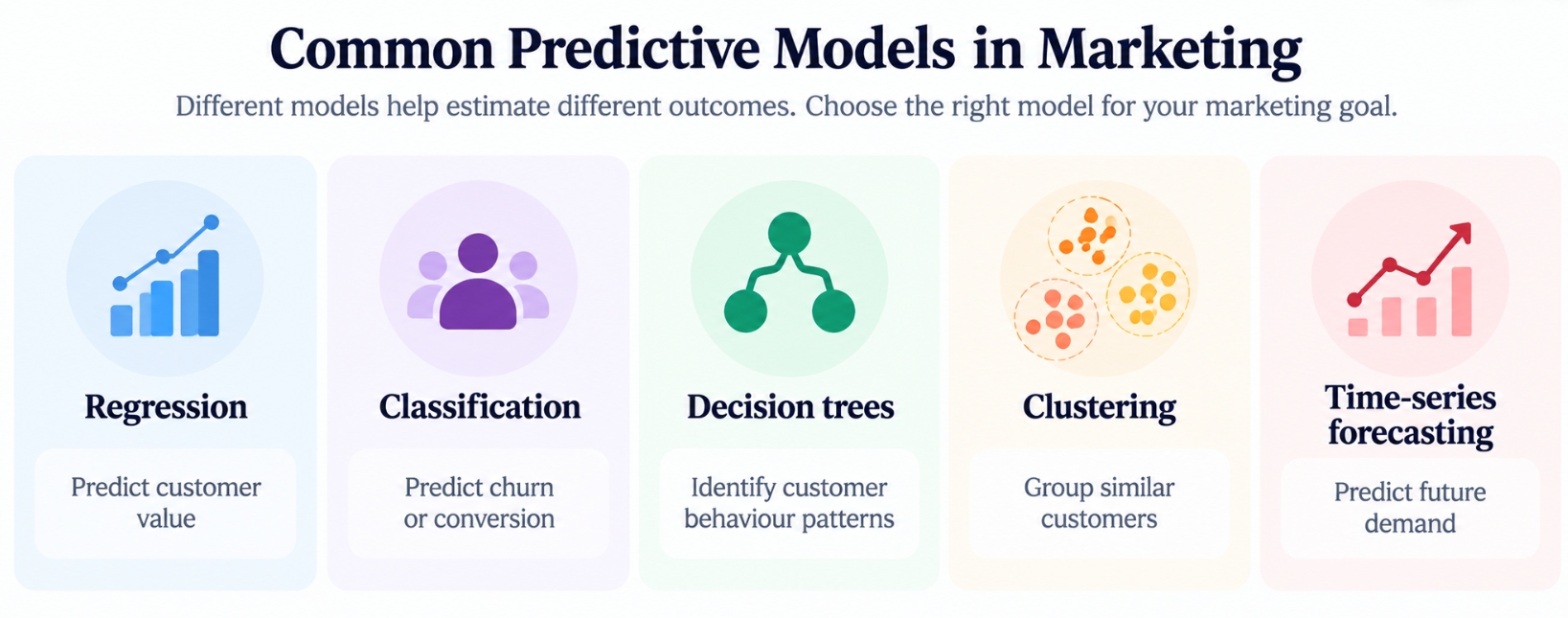
The right model depends on the outcome being predicted and the data available.
| Model | Marketing application |
|---|---|
| Regression | Estimate customer value, revenue or sales |
| Classification | Predict churn, conversion or purchase likelihood |
| Decision trees and random forests | Identify patterns linked to customer outcomes |
| Clustering | Discover customer segments for targeted marketing |
| Time-series forecasting | Estimate future sales and demand trends |
Important distinction: Clustering groups similar customers based on shared characteristics. It is an unsupervised learning method, rather than a predictive model for a labelled outcome like regression or classification.
Businesses do not always need complex models. Start with a suitable baseline and adopt more advanced methods only when they improve results enough to justify their cost and complexity.
What Data Is Needed for Predictive Marketing Analytics?
| Data source | Examples | Common application |
|---|---|---|
| CRM data | Customer tenure, account details | Churn and customer value |
| Behavioural data | Website visits, product views | Purchase propensity |
| Campaign data | Clicks, conversions, responses | Lead scoring and campaign analysis |
| Transaction data | Order value, purchase frequency | Customer value and demand |
| External data | Seasonality, market indicators | Demand forecasting |
Use data that is relevant, sufficiently complete and representative of the customers being analysed. Check permissions and privacy requirements before using personal information.
Poor-quality data, inconsistent records and unrepresentative customer histories can reduce model reliability.
How to Implement Predictive Analytics in Marketing
Follow these six steps to move from a business question to a measurable outcome.
- Define the objective. Choose a specific problem, such as identifying customers likely to churn within 60 days.
- Collect and prepare data. Combine relevant sources, resolve inconsistencies and handle missing values.
- Define the target. Specify exactly what the model should estimate, including the outcome and time period.
- Choose and train a model. Select a method suited to the target, available data and business constraints.
- Test performance. Evaluate predictions on data not used for training and compare them with a baseline.
- Activate and monitor. Connect predictions to marketing actions and track model performance and business outcomes over time.
Example: Predicting Customer Churn
An online retailer wants to improve repeat purchases.
- Data: Purchase frequency, time since the last order and customer engagement.
- Prediction: Estimate which customers are less likely to return.
- Action: Test relevant reminders or loyalty incentives with selected customers.
- Measurement: Compare repeat-purchase rates against a suitable control group and account for campaign costs.
This illustrative example shows why prediction alone is not enough. The retailer must establish whether the intervention actually improves results.
Which Tools Support Predictive Analytics in Marketing?
| Tool | Potential use |
|---|---|
| Salesforce | Customer data and campaign activation |
| Snowflake | Marketing data storage and analytics workflows |
| IBM | Predictive analytics and enterprise data workflows |
| Python with scikit-learn | Building and evaluating custom models |
| Business intelligence platforms | Visualising trends and monitoring results |
Choose tools based on your existing systems, technical skills, integration needs, privacy requirements and budget. Confirm which predictive features are included in the specific product and plan.
How do You Measure the ROI of Predictive Analytics?
Measure whether actions informed by predictions improve business outcomes. Depending on the use case, track:
- Incremental conversions and revenue
- Customer retention and repeat purchases
- Customer acquisition cost
- Campaign costs and operating expenses
- Revenue or margin generated relative to investment
Where possible, use controlled experiments to compare customers who receive an intervention with a suitable control group. This helps distinguish the effect of a marketing action from purchases or conversions that would have happened anyway.
Conclusion
Predictive analytics in marketing helps businesses make informed decisions about customers, campaigns and demand. Start with one measurable problem, use relevant data and choose a model that fits the task. Then test the resulting marketing action and measure its impact. Predictions become valuable when they improve decisions and deliver measurable results.
Ready to strengthen your AI-powered marketing skills? Explore the IIM Trichy Certificate Programme in AI-Powered Marketing & Growth Strategy to learn about predictive analytics, AI-driven marketing and autonomous campaign systems.
FAQs
1. What is the difference between predictive analytics and forecasting?
Forecasting estimates future values, often across time, such as next month’s sales. Predictive analytics covers a wider range of outcomes, including churn, conversion and purchase likelihood. Forecasting is one application of predictive analytics.
2. Can predictive analytics work with small amounts of marketing data?
Yes, depending on the problem. Simpler statistical methods may work with limited data, but complex models generally need enough relevant observations to learn reliable patterns. Test against a baseline before investing in a more complex approach.
3. What is the difference between propensity modelling and lead scoring?
Lead scoring prioritises prospects based on their likelihood of becoming customers. Propensity modelling estimates the likelihood of a particular action, such as purchasing a product, clicking an offer or renewing a subscription. Lead scoring can be treated as a specific application of predictive modelling.
4. How can marketers prevent data leakage in predictive models?
Ensure that training data contains only information that would have been available when the prediction was made. For example, a model predicting future purchases should not use purchase information recorded after the prediction date. Use appropriate time-based splits when evaluating models that predict future behaviour.
5. Which metrics should marketers use to evaluate a churn model?
Useful metrics include precision, recall and, where appropriate, precision-recall AUC. The choice depends on the cost of missing an at-risk customer versus contacting someone who would have stayed anyway. Business impact should also be measured after the model is used.
6. How is predictive analytics different from marketing attribution?
Predictive analytics estimates future outcomes, such as conversion likelihood or customer value. Marketing attribution assigns credit for observed conversions to marketing touchpoints under a chosen attribution method. Neither automatically proves that a marketing activity caused a conversion.
7. Can predictive analytics identify the best marketing channel for each customer?
It can estimate the likelihood of a customer responding through different channels when suitable data is available. However, predicting who is likely to respond is not the same as identifying which channel will cause the greatest improvement. Experiments can help measure incremental impact.
8. How does predictive analytics support marketing personalisation?
It can estimate customer interests, purchase propensity or likely next actions. Marketers can use these estimates to tailor recommendations, messages and offers. Personalisation should also respect customer preferences, data permissions and the risk of making inappropriate assumptions.
9. What are the main risks of predictive analytics in marketing?
Common risks include poor data quality, biased predictions, privacy violations, data leakage and declining model performance as behaviour changes. Businesses should establish data governance, evaluate model performance across customer groups and monitor outcomes after deployment.
10. Should businesses build predictive models in-house or use existing platforms?
It depends on the use case, technical expertise, budget and integration requirements. Existing platforms may be suitable for common marketing workflows, while custom models offer more control over features and evaluation. Compare total costs, data access, flexibility and ongoing maintenance before deciding.
11. How often should predictive marketing models be retrained?
There is no universal schedule. Monitor performance regularly and retrain when data patterns, customer behaviour or business conditions change enough to affect reliability. High-volume, rapidly changing use cases may require more frequent reviews than stable applications.
12. How can a business calculate the ROI of predictive marketing analytics?
Compare the incremental value generated by prediction-informed actions with implementation and operating costs. For example, measure additional retained customers or conversions against a control group, then account for campaign spending and the costs of building and maintaining the model.