Cold Chain Logistics and Specialized Freight: How They Work

Key Insights
Cold chain logistics and specialized freight both exist to move cargo that standard freight would damage. These are the points that matter most for logistics, operations and procurement teams.
- Cold chain is one part of specialized freight. Cold chain logistics is defined by temperature control alone. Specialized freight also covers hazardous, oversized, fragile and high-value cargo.
- Both follow the same six stages. Identify requirements, prepare cargo, select equipment, transport, monitor and deliver. The cargo’s characteristics drive every later decision.
- Conditions must hold from origin to final delivery. Storage, transfers and the last mile are just as important as the main transportation leg.
- Transfers and last-mile delivery are critical risk points. A shipment handled correctly for most of its journey can still be compromised at one handoff, cross-dock or final delivery.
- Temperature limits are product-specific. Refrigerated vaccines are stored at 2°C to 8°C under CDC guidance, while other products need frozen or room-temperature conditions.
- Equipment depends on cargo requirements. Reefer trucks and containers maintain the temperature of pre-cooled cargo. Heavy-haul vehicles, flatbeds, lifting equipment and securing systems handle size and weight.
- Monitoring supports early intervention. IoT sensors, data loggers and GPS detect excursions and delays. AI can flag risks earlier, but it does not prevent failures automatically.
- Regulations vary by product, transport mode and jurisdiction. The EU Good Distribution Practice guidelines cover medicines, while the US FDA’s Sanitary Transportation rule covers food moved by road or rail.
- Specialized logistics costs more, but failure can cost even more. Refrigerated vehicles, cold storage, energy, packaging and monitoring add expenses. Effective planning and handling help reduce spoilage, rejected products and returns.
Cold chain logistics is a temperature-controlled logistics system used to store, handle and transport temperature-sensitive products within a required temperature range. Specialized freight is the transportation of goods that need specific equipment, handling procedures, environmental conditions or transport controls beyond standard freight.
How the two relate:
- Cold chain is a form of specialized logistics used for pharmaceuticals, vaccines, fresh food and other temperature-sensitive goods.
- Specialized freight is broader and also covers hazardous, oversized, fragile and high-value cargo.
- Both require more planning, equipment, monitoring and handling than standard freight because a single lapse can damage the cargo.
This article explains how cold chain logistics and specialized freight work, covering their processes, equipment, monitoring technologies, challenges and real-world applications.
How Do Cold Chain Logistics and Specialized Freight Work?
Both follow the same six-stage sequence, with each stage designed to keep the cargo within its required conditions. The cargo’s needs are defined first, and each subsequent decision follows from them.

1. Identify the Freight and Its Requirements
The process starts by defining exactly what the shipment needs. These characteristics determine how the cargo must be packaged, transported, monitored and handled.
- Required temperature range
- Cargo size and weight
- Fragility or handling requirements
- Delivery time
- Regulatory or safety requirements
- Storage conditions before, during and after transit
2. Prepare and Package the Shipment
Packaging is matched to the risks identified in the first step. For cold chain shipments, the goal is to maintain temperature even when cargo is outside a refrigerated space.
- Cold chain shipments: Insulated packaging, refrigerants or cooling systems where required, temperature-controlled containers, and pre-conditioning of cargo and equipment to the target temperature before loading.
- Other specialized freight: Protective packaging, securing of oversized or fragile cargo, and hazard-specific handling.
3. Choose the Right Transportation and Equipment
The transportation method depends on the shipment’s requirements, transit time and route. A short regional delivery and an intercontinental move rarely use the same equipment.
- Refrigerated trucks and trailers for road transportation
- Reefer containers for sea and intermodal transportation
- Temperature-controlled air freight for urgent or high-value products
- Specialized heavy-haul vehicles for oversized or overweight loads
- Specialized containers or handling equipment for fragile, hazardous or irregular cargo
4. Monitor Conditions During Transit
Monitoring gives logistics teams visibility while the shipment is moving. In cold chain logistics, its main value is catching a temperature excursion, which is any period when the shipment moves outside its required temperature range, before it causes serious product damage.
- Temperature sensors and data loggers record conditions throughout the journey.
- GPS tracking shows location and delays.
- Humidity monitoring is added where the product requires it.
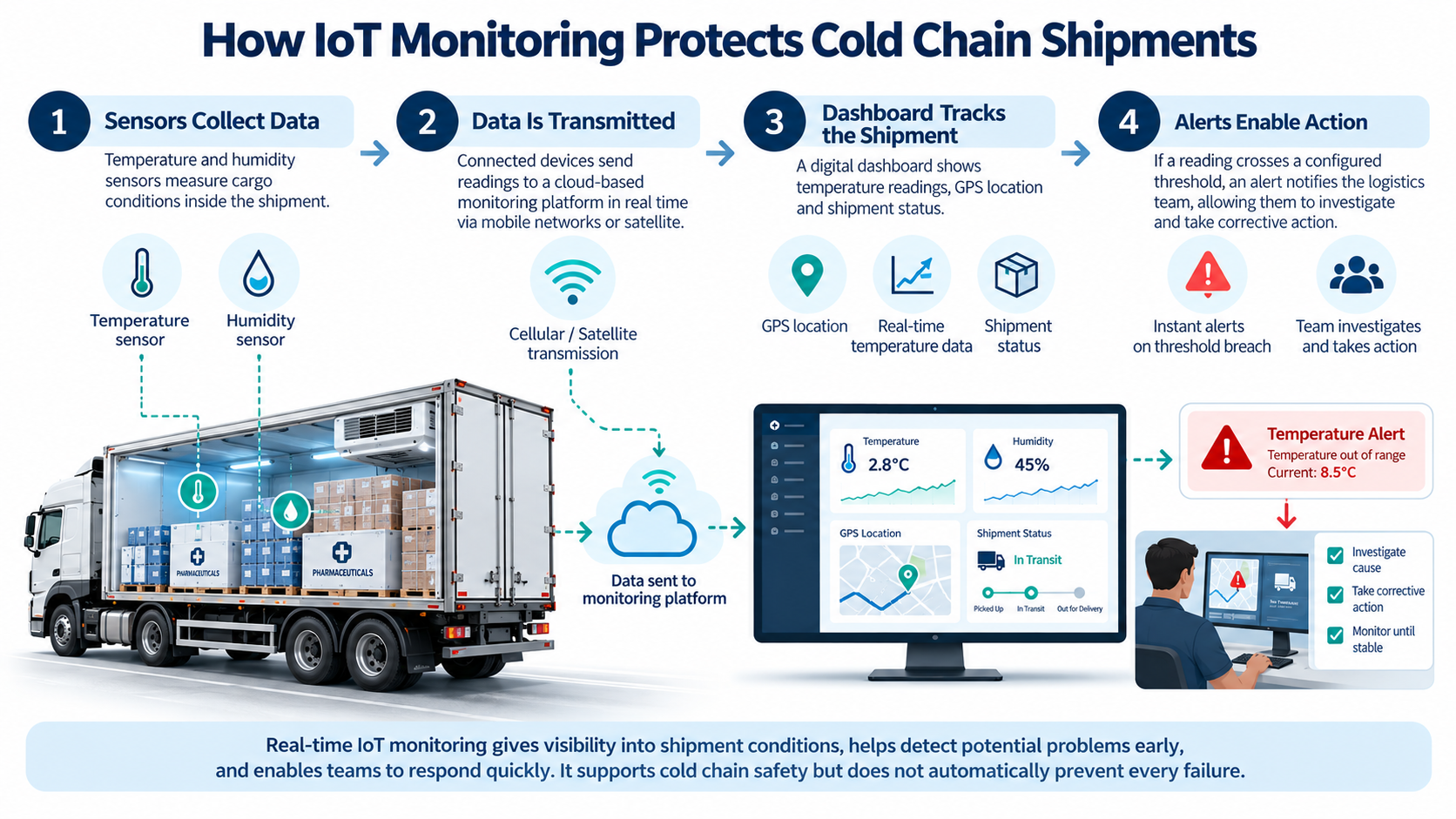
- Real-time alerts flag a breach so teams can act early.
5. Handle Transfers and Storage Carefully
Transfer points are where control is most easily lost because cargo leaves one controlled environment before entering the next. Each handoff needs a plan for maintaining the required conditions.
- Loading and unloading: Keep handling times short and ensure equipment is already at the required conditions.
- Warehousing: Use storage zones matched to the product.
- Cross-docking: Minimize waiting time on the dock.
- Transfers between transportation modes: Establish clear responsibility at each handoff.
6. Deliver and Verify the Shipment
Delivery is complete when the cargo’s condition is confirmed, not simply when the vehicle arrives. The final stage usually follows this sequence:
- The shipment reaches the destination and is unloaded under appropriate conditions.
- Temperature or handling records are reviewed where applicable.
- Product condition is checked where required.
- The cargo moves into suitable storage or to the final recipient.
Required conditions must hold from origin to final delivery, not just during the main transportation leg.
What Is the Difference Between Cold Chain Logistics and Specialized Freight?
Cold chain logistics is defined by one requirement: temperature. Specialized freight is the wider category of cargo that needs any control beyond standard freight. The distinction matters because it determines which equipment, providers and procedures a shipment needs.
| Factor | Cold Chain Logistics | Specialized Freight |
|---|---|---|
| Type of goods and scope | Temperature-sensitive goods | Goods requiring specialized transportation or handling |
| Temperature control | Always required | May require temperature, safety, security, size or handling controls |
| Typical applications | Pharmaceuticals, food and healthcare | Cold chain, hazardous, oversized, fragile and high-value freight |
| Equipment and infrastructure | Refrigerated or temperature-controlled infrastructure | Equipment based on specific freight requirements |
How Cold Chain Fits Into Specialized Freight
Cold chain is one type of specialized freight requirement, but not all specialized freight needs temperature control. Two shipments illustrate the difference:
- Pharmaceutical shipment: Specialized freight with a cold chain requirement.
- Oversized industrial machine: Specialized freight without a cold chain requirement.
What Equipment Is Used for Cold Chain and Specialized Freight?
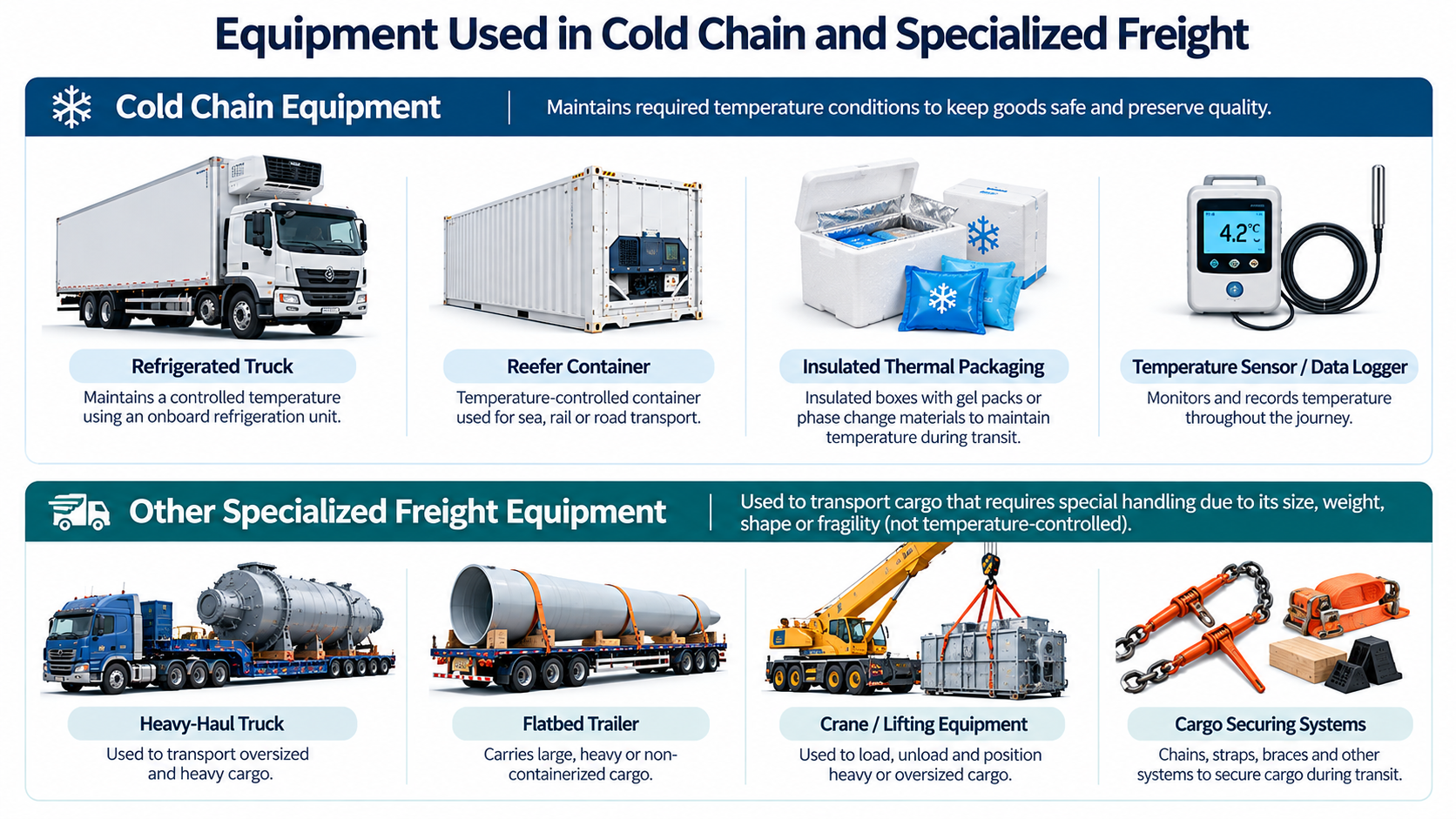
Equipment is selected according to what the cargo must be protected from: heat, cold, movement, weight or hazards. Each category below addresses a different requirement.
Refrigerated Trucks and Trailers
Refrigerated trucks and trailers maintain a set temperature during road transportation. They combine an insulated body with a refrigeration unit that removes heat entering through the walls and doors.
These units are generally built to maintain the temperature of pre-cooled cargo, not to cool warm products down.
Refrigerated Containers and Temperature-Controlled Packaging
Containers and packaging protect cargo on longer, multi-leg journeys and on stretches without a refrigerated vehicle. The right choice depends on shipment size and transit time.
- Reefer containers: Powered units that maintain temperature at sea, on rail and at terminals.
- Insulated containers: Slow heat transfer without active cooling.
- Thermal packaging: Insulated boxes or pallet covers for smaller consignments.
- Cooling systems: Passive options, such as gel packs, dry ice or phase-change materials, or active systems using powered refrigeration.
Specialized Vehicles and Handling Equipment
Specialized freight without a temperature requirement needs equipment built for size, weight or fragility. The aim is to carry, lift and restrain the load safely.
- Heavy-haul vehicles carry loads beyond standard weight or dimension limits.
- Flatbed trailers transport cargo that will not fit an enclosed trailer.
- Specialized lifting equipment, such as cranes, positions heavy items.
- Securing systems, such as chains, straps and bracing, prevent movement during transit.
Temperature and Condition Monitoring Devices
Monitoring devices provide evidence that required conditions were maintained. Without them, an excursion or impact can go unnoticed until the product fails inspection.
- Sensors measure temperature, humidity, shock or tilt.
- Data loggers store readings for review at delivery.
- GPS trackers report location.
- Connected monitoring systems combine these capabilities and transmit data in real time.
How Does Technology Support Cold Chain and Specialized Freight?
Technology turns condition control from a check at delivery into something teams can manage while the shipment is still moving. Four capabilities do most of the work.
IoT Sensors for Real-Time Monitoring
Connected sensors track temperature, humidity, location and other environmental conditions, such as light exposure or shock, throughout transit. Their value lies in a short response chain:
Sensor detects change → Data is transmitted → Alert is generated → Logistics team responds
AI and Predictive Analytics
AI analyses sensor, equipment and route data to flag risks earlier than manual review would. It supports decisions rather than preventing failures automatically, and results depend on data quality and how teams respond.
- Identifying unusual patterns in temperature or equipment behaviour
- Predicting refrigeration equipment failures
- Detecting potential temperature excursions
- Improving route planning
- Supporting proactive intervention
GPS and End-to-End Shipment Visibility
Location tracking shows where a shipment is and whether it will arrive within its allowed transit time. That matters because every delay lengthens the cargo’s exposure to risk.
- Monitoring shipment progress against plan
- Identifying delays as they develop
- Coordinating handoffs so receiving sites are ready
- Responding to route disruptions with alternative routing
Digital Traceability and Documentation
Digital systems maintain a continuous record for each shipment, replacing paper logs that can be lost or left incomplete. That record supports product acceptance decisions, audits and claims.
- Temperature history
- Shipment location
- Handling events
- Delivery information
What Are the Challenges of Cold Chain and Specialized Freight?
These shipments are harder to manage than standard freight because there is little room for error, and one lapse can make the cargo unusable. Four challenges arise frequently.
Maintaining Required Conditions Throughout Transit
Conditions can slip at any point in the journey, often through ordinary events rather than major failures. Common causes include:
- Equipment failure, such as a refrigeration unit breakdown
- Loading delays that leave cargo waiting on a dock
- Frequent or prolonged door openings
- Poor or unsuitable packaging
- Transportation disruptions, including traffic, weather and customs holds
Higher Infrastructure and Operating Costs
Specialized capability costs more to build and run than standard freight capacity. Energy is a continuing cost because refrigeration runs throughout transportation and storage.
- Refrigerated vehicles and cold storage
- Energy
- Specialized packaging
- Monitoring systems
- Specialized handling equipment
Regulatory and Compliance Requirements
Many of these shipments fall under rules covering storage, transportation, documentation, handling and safety. Which rules apply depends on the product, transport mode and jurisdiction.
For example, the EU’s Good Distribution Practice guidelines cover medicines, while the US FDA’s Sanitary Transportation rule covers food moved by road or rail. Hazardous cargo follows separate dangerous goods rules for each mode.
Risks During Transfers and Last-Mile Delivery
A shipment can be handled correctly for most of its journey and still be compromised by one poorly managed transfer or final-mile delivery.
Handoffs and cross-docking add risk because cargo changes hands and may wait in uncontrolled areas. Final delivery adds further risks through smaller vehicles, frequent door openings and recipients who may not be ready.
What are Some Examples of Cold Chain and Specialized Freight?
Requirements differ sharply by cargo type. These four categories show how the same process produces very different shipments.
Pharmaceutical and Healthcare Shipments
Pharmaceuticals, vaccines and other healthcare products often have narrow temperature limits set by the manufacturer. Refrigerated vaccines, for example, are stored at 2°C to 8°C under CDC guidance, while other products need frozen or room-temperature conditions.
These shipments may require controlled temperatures, specialized packaging, continuous monitoring and time-sensitive transportation.
Food and Perishable Goods
Dairy, meat, seafood, fresh produce and frozen food each need their own temperature range, so chilled and frozen goods cannot share the same conditions.
Cold chain slows spoilage and bacterial growth, helping preserve product quality and shelf life from producer to store.
Oversized and Heavy Industrial Cargo
Industrial machinery, construction equipment and large components need no temperature control, but they may exceed standard vehicle limits.
They require specialized vehicles, route planning around bridges and clearance restrictions, permits, and careful lifting and securing at both ends.
Hazardous and Sensitive Freight
Hazardous or sensitive materials, such as chemicals and lithium batteries, are controlled to protect people and property as well as the cargo.
They may require specialized packaging, classification and labelling, shipping documentation, trained handling, and transportation controls based on mode or route.
Why are Cold Chain Logistics and Specialized Freight Important?
For this cargo, the way it is moved is part of the product’s quality. The operational value shows up in four ways.
Protecting Product Quality and Integrity
Controlled conditions keep products fit for use on arrival. This matters most where damage is invisible, since a medicine exposed to the wrong temperature can lose effectiveness without looking different.
- Spoilage
- Product degradation
- Physical damage
- Loss of product integrity
Reducing Waste and Financial Losses
A failed shipment costs the product, the freight and often an urgent replacement. Better planning, monitoring and handling help reduce common causes of loss.
- Spoilage in transit or storage
- Damaged shipments
- Product rejection at receipt
- Returns
Improving Supply Chain Reliability
Specialized logistics capabilities make outcomes more predictable for shippers and receivers. Each capability removes a different source of uncertainty.
- Visibility: Teams know where the shipment is.
- Traceability: Records show how it was handled.
- Predictability: Arrival times and conditions are easier to plan around.
- Shipment control: Problems can be corrected in transit.
Supporting Time-Sensitive and Sensitive Industries
Several industries depend on these capabilities because their products cannot travel as standard freight.
- Healthcare and pharmaceuticals: Medicines, vaccines and clinical supplies
- Food and beverage: Chilled and frozen products
- Manufacturing: Machinery and large components
- Chemicals: Hazardous and reactive materials
Conclusion
Cold chain and specialized freight decisions should begin with the consequences of a shipment failing, not simply with the transport rate. A low-cost route may become expensive if it increases exposure to temperature excursions, damage, delays or compliance issues.
Teams should evaluate providers, equipment and routes against the cargo’s actual risk profile, then define who acts when conditions change. This approach makes specialized logistics a controlled operational process rather than a last-minute transportation arrangement.
Transform Logistics Operations with AI
Discover how AI can improve operational efficiency, optimize workflows, and support smarter logistics decisions with the Certificate Programme in AI-Powered Operations & Process Transformation by IIM Tiruchirappalli.
Explore the programme to take the next step towards smarter, AI-driven operations.
Frequently Asked Questions
What happens if a cold chain shipment goes outside its required temperature range?
The event is recorded as a temperature excursion, and the product is usually held until it is assessed. Whether it can still be used depends on the product, how far and how long it was out of range, and the manufacturer’s stability data.
How can companies prevent temperature excursions during transportation?
Pre-condition cargo and equipment, use packaging suited to the route and season, keep loading times short, and monitor in real time with clear escalation steps. No single measure removes the risk.
What type of packaging is best for temperature-sensitive freight?
It depends on the temperature range, shipment size and transit time. Passive packaging suits shorter or smaller shipments, while active, powered containers suit longer journeys or tighter tolerances.
How do companies maintain cold chain integrity during last-mile delivery?
They use refrigerated vans or insulated packaging, plan routes to limit door openings and time on the road, and confirm the recipient can move goods into suitable storage on arrival.
Which is better for cold chain shipments: air freight, road freight, or sea freight?
None is best in every case. Air is fastest and suits urgent, high-value products. Sea moves large volumes at lower cost over longer transit times. Road offers door-to-door flexibility and connects the other modes.
How do companies choose a cold chain logistics provider?
Check experience with the specific product, the equipment and storage network, monitoring and reporting capability, compliance with relevant regulations, and documented contingency procedures.
What documents are required for cold chain and specialized freight?
This varies by product, mode and jurisdiction. Common examples are a bill of lading or air waybill, temperature records, handling instructions, dangerous goods declarations, oversize permits, and customs or health certificates.
How can businesses reduce the cost of cold chain logistics?
Consolidate loads, match packaging to the actual route and duration, shorten transit times through route planning, reuse packaging where practical, and use monitoring data to reduce product losses.
How does cold chain logistics differ for pharmaceuticals and food products?
Both need temperature control, but pharmaceuticals typically have tighter tolerances, stricter documentation and product-specific stability limits. Food logistics focuses on safety, freshness and shelf life, with ranges that vary by category.
What should businesses do when a refrigerated vehicle or container fails during transit?
Follow the contingency plan: keep doors closed, alert the carrier and shipper, and arrange repair, a replacement unit or transfer to nearby cold storage. Keep recording temperatures so the product can be assessed afterwards.
How can companies track temperature-sensitive shipments in real time?
Use connected sensors or trackers that send temperature and location data over cellular or satellite networks to a monitoring platform, with alerts set at agreed thresholds.
What factors determine the cost of specialized freight?
The main factors are cargo size and weight, the equipment required, distance and route complexity, permits and escorts, handling and packaging needs, urgency, insurance and regulatory requirements.
Resources
- CDC Vaccine Storage and Handling Toolkit
- FDA Sanitary Transportation Rule
- EU Good Distribution Practice Guidelines for Medicinal Products