India’s National Quantum Mission: What the ₹6,003 Cr Bet Means for Quantum Computing Careers

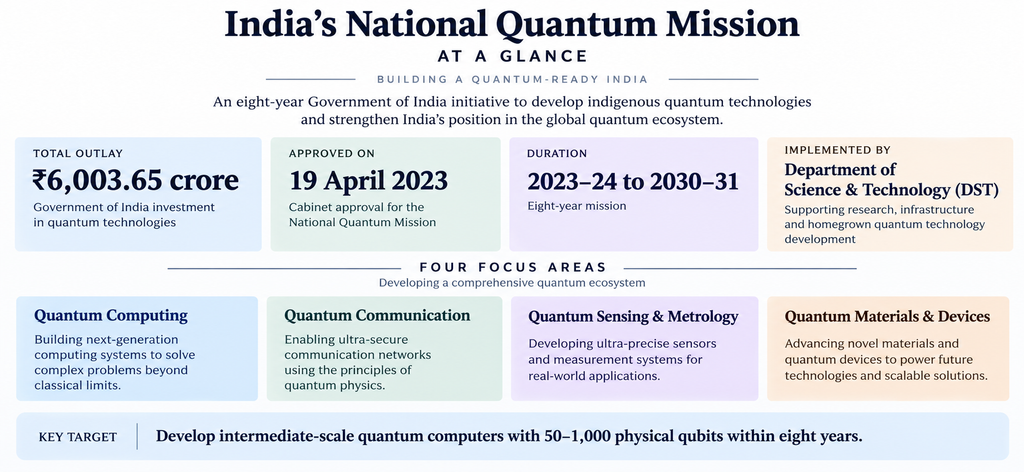
The National Quantum Mission (NQM) is an eight-year Government of India initiative to develop indigenous quantum technologies and strengthen India’s position in the global quantum ecosystem.
- Total outlay: ₹6,003.65 crore
- Approved on: 19 April 2023
- Duration: 2023-24 to 2030-31
- Four focus areas: Quantum computing, communication, sensing & metrology, and materials & devices
- Key target: Develop intermediate-scale quantum computers with 50–1,000 physical qubits within eight years.
The mission is led by the Department of Science & Technology (DST) and supports research, infrastructure, and homegrown quantum technology development through four thematic hubs.
Beyond scientific advancement, this investment is building the foundation for India’s quantum technology ecosystem, opening new pathways for skilled engineers, researchers, and quantum computing professionals.
What the ₹6,003 Cr bet means for Quantum Computing Careers in India
The ₹6,003.65 crore National Quantum Mission (NQM) is more than a research investment; it is laying the foundation for India’s quantum technology industry.
- The mission supports the development of quantum infrastructure, startups, research hubs, and technical talent.
- With 17 supported startups, four thematic hubs, and 43 participating institutions, India’s quantum ecosystem is expanding beyond academic research.
- Emerging opportunities span quantum hardware, communication, photonics, cryogenics, quantum software, and supporting engineering systems.
What this means for aspiring professionals
- More career entry points: Opportunities are not limited to quantum researchers. Computer science, electronics, electrical, and instrumentation graduates can contribute through relevant technical skills.
- Beyond quantum algorithms: The ecosystem also needs embedded systems engineers, control electronics specialists, HPC professionals, and cybersecurity talent.
- Industry-building opportunities: Mission-backed startups and research institutions are developing technologies that may support future quantum-focused roles.
- A growing skills ecosystem: Investments in quantum education, teaching labs, and research infrastructure can help students build specialised knowledge and practical experience.
- A long-term career horizon: As the mission progresses towards 2030–31, demand will depend on research outcomes, commercial adoption, and the growth of quantum companies.
For engineering students and early-career professionals, the mission creates pathways to explore quantum technology without necessarily pursuing a physics PhD. Quantum-specific hiring is still at an early stage, but building transferable skills today can open doors to both conventional engineering roles and emerging quantum careers.
Where quantum hiring is actually happening
Eight startups were selected in November 2024:
- QNu Labs (quantum-safe networking, Bengaluru)
- QpiAI India (superconducting computing, Bengaluru)
- Dimira Technologies (cryogenic cables, IIT Mumbai)
- Prenishq (diode lasers, IIT Delhi)
- QuPrayog (optical atomic clocks, Pune)
- Quanastra (cryogenics, Delhi)
- Pristine Diamonds (Ahmedabad)
- Quan2D Technologies (single-photon detectors, Bengaluru)
Nine more startups reportedly joined in April 2026, taking the total to 17.
Thematic hub companies
Research and engineering staff at the four Section 8 foundations hosted at IISc Bengaluru, IIT Madras, IIT Bombay, and IIT Delhi contribute to mission-related research and technology development.
IT services and product companies
Companies building quantum-readiness and post-quantum-cryptography practices may also offer relevant opportunities, particularly for software engineers, cybersecurity professionals, and systems specialists.
Two patterns stand out. Many of the listed startups focus on hardware, materials, or communications rather than software alone, a useful reminder that quantum careers extend beyond algorithm development.
Bengaluru is also a notable centre, with four of the original eight startups and the quantum computing hub located there. For specific openings, check each company’s own careers page rather than relying on outdated job lists, and note when you checked.
The roles that exist today
Quantum roles are easier to understand when grouped by the work involved rather than by job-board titles. The ecosystem requires specialised quantum knowledge as well as classical engineering capabilities.
| Job Family | What the Work Involves |
| Quantum hardware and cryogenics | Device testing, low-temperature systems, and hardware integration |
| Photonics and optics | Lasers, optical components, and single-photon systems |
| Quantum software and algorithms | Circuit development and simulation using Qiskit, PennyLane, or Cirq |
| Quantum-safe security | Post-quantum cryptography and quantum communication networks |
| Quantum research | Error correction and other specialised research areas |
| Supporting engineering | Control electronics, FPGA, embedded systems, HPC, and machine learning |
A quantum company also needs classical engineering. Depending on the opening, an embedded, control-systems, or HPC engineer may contribute without holding a physics PhD. Role requirements vary by employer and project.
What the mission’s own timeline creates next
Tying roles to milestones rather than guessing: the mission’s 2,000-km QKD target already demonstrated at 1,000 km by QNu Labs in April 2026 means network and cryptography demand arrives before large-scale computing demand does.
The 23 quantum teaching labs approved in March 2026, and the AICTE-backed undergraduate minor, mean teaching and lab-engineering roles are a real, overlooked path. The materials hub’s mandate means semiconductor and cryogenics manufacturing skills matter more than most readers expect.
What to study to Build a Career in Quantum Computing
You do not need to master every quantum technology domain at once. Start with the fundamentals, then build skills aligned with the type of role you want to explore.
- Foundations: linear algebra first quantum states are vectors, gates are matrices then probability, then enough quantum mechanics to be genuinely useful. Python remains the field’s working language.
- Government-backed routes: the AICTE–DST undergraduate minor (18 credits, third/fourth semester onward), the PSA’s model M.Tech curriculum (published August 2025), and the 23 approved teaching labs, with roughly 100 more under evaluation. Check whether your own college is on the approved list rather than assuming it isn’t.
- This month, free: Qiskit and IBM Quantum’s browser tools, PennyLane, open courseware. One concrete step: build and run a two-qubit entangled circuit in a browser simulator. The point is momentum, not a finished course.
The goal is not to complete every course before applying for opportunities. It is to build a foundation, practise consistently, and develop projects that demonstrate your understanding.
An honest read on the timeline
The mission runs to 2030–31, and its most ambitious qubit target 50 to 1,000 physical qubits sits at the far end of that. Quantum-specific job postings in India today number in the low hundreds nationally, concentrated in a handful of companies , this is genuinely an early-stage field.
But the skills that make someone employable in quantum by 2030 linear algebra, systems programming, control electronics, cryptography, applied ML already pay in ordinary engineering jobs in 2026. Nobody has to bet a career on the mission’s timeline to start building toward it.
What has actually been building so far (2023–2026)
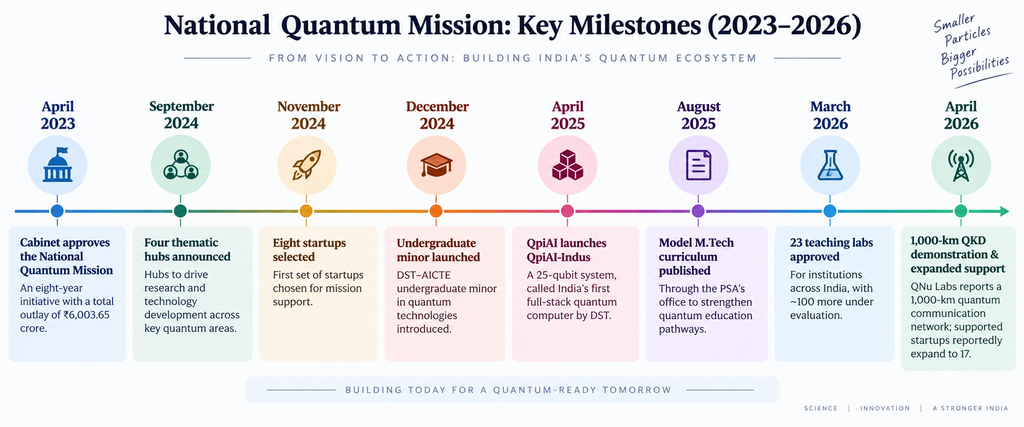
The National Quantum Mission has progressed from policy approval to tangible developments in quantum computing, communication, education, and startup support between 2023 and 2026. These milestones highlight how India is building its quantum technology ecosystem through research infrastructure, academic programmes, industry participation, and institutional support.
- Apr 2023 – Cabinet approves the mission
- Sep 2024 – Four thematic hubs announced
- Nov 2024 – Eight startups selected for mission support
- Dec 2024 – DST–AICTE undergraduate minor in quantum technologies launched
- Apr 2025 – QpiAI launches QpiAI-Indus, a 25-qubit system DST calls the country’s first full-stack quantum computer
- Aug 2025 – Model M.Tech curriculum published via the PSA’s office
- Mar 2026 – 23 institutions approved for quantum teaching labs; ~100 more under evaluation
- Apr 2026 – QNu Labs demonstrates a 1,000-km quantum communication network; supported startups expand to 17
The original eight startups (Nov 2024) were QNu Labs (quantum-safe networking, Bengaluru), QpiAI India (superconducting computing, Bengaluru), Dimira Technologies (cryogenic cables, IIT Mumbai), Prenishq (diode lasers, IIT Delhi), QuPrayog (optical atomic clocks, Pune), Quanastra (cryogenics, Delhi), Pristine Diamonds (Ahmedabad) and Quan2D Technologies (single-photon detectors, Bengaluru).
The UG minor requires a minimum of 18 credits from a pool of 30+, open to any engineering discipline from the third or fourth semester.
The April 2026 milestone was the biggest yet: QNu Labs’ 1,000-km QKD network, on its indigenous ARMOS platform, which DST called one of the longest such deployments globally — achieved under two years after the hubs went live. Nine more startups joined that month, taking supported ventures to 17: Sense-XT, ORVISSEMI, QuBeats, Quantum AI Global, bloq, GDQ Labs, Quantum Biosciences, Bumble Bee Instruments and SAS Qute Electronics.
India’s quantum decade is being built at four institutions, and IIT Delhi leads the mission’s Quantum Materials & Devices hub. If you want to build the applied skills the field is hiring for, look at the
Certification in Applied Quantum Computing and AI with IIT Delhi 6.5 months, live online with recorded sessions, and one of India’s first applied quantum programmes.
FREQUENTLY ASKED QUESTIONS
What is the budget of the National Quantum Mission?
₹6,003.65 crore, sanctioned for 2023–24 to 2030–31, often rounded to ₹6,003 crore in press coverage.
Which country is leading the global race in quantum computing?
The United States and China are among the major global leaders in quantum computing, supported by substantial investments, research institutions, and technology companies. Their progress spans quantum hardware, algorithms, and ecosystem development. Leadership varies by area, so there is no single country that ranks first across every quantum computing metric.
What are the four pillars of India’s National Quantum Mission?
India’s National Quantum Mission is built around four technology pillars: quantum computing, quantum communication, quantum sensing and metrology, and quantum materials and devices. Together, these areas support the development of quantum hardware, secure communication systems, precision measurement technologies, and advanced materials needed for India’s quantum ecosystem.
Which ministry runs the National Quantum Mission?
The Department of Science & Technology, governed through a Mission Governing Board, a Mission Coordination Cell and a Mission Technology Research Council.
What are the four thematic hubs under NQM?
Quantum Computing at IISc Bengaluru, Quantum Communication at IIT Madras with C-DOT, Quantum Sensing & Metrology at IIT Bombay, and Quantum Materials & Devices at IIT Delhi, each a separate Section 8 company.
How many qubits does the National Quantum Mission target?
20–50 physical qubits in three years, 50–100 in five, and 50–1,000 in eight physical, not logical, qubits.
Which startups are supported under the National Quantum Mission?
Eight from November 2024, including QNu Labs and QpiAI, expanding to 17 by April 2026 across computing, communication, sensing, cryogenics and photonics.
What jobs will the National Quantum Mission create?
Hardware and cryogenics engineering, photonics, quantum algorithm development, post-quantum cryptography, and classical roles inside quantum companies control electronics, embedded systems and HPC.
Can I study quantum technology in India as an undergraduate?
Yes , the DST-AICTE undergraduate minor requires a minimum of 18 credits from the third or fourth semester at approved institutions. Twenty-three quantum teaching laboratories were approved in March 2026.